
Most creator email sequences are not too short or too long. They are just badly matched to the job.
That is the real answer to How Long Should Creator Email Sequences Be in 2026? Not “7 emails.” Not “12 touchpoints.” Not some funnel bro’s sacred spreadsheet from 2019. The right length depends on what the sequence is trying to do, how warm the reader is, how expensive the offer is, and whether each email actually earns its place.
If your sequence needs 3 emails, great. If it needs 9, fine. If it needs 14 because you are selling something nuanced, trust-heavy, or high-ticket, also fine. The part people keep messing up is assuming length creates results. It does not. Relevance, pacing, clarity, trust, and timing create results. Length just makes those things more obvious.
This article will help you figure out how long your creator email sequences should be in 2026, when shorter wins, when longer wins, and how to stop writing bloated automations that feel like hostage notes from your CRM.
If you want the broader foundation first, start with creator email sequences and the more complete creator email sequences guide for creators who want better results.
For the full path around this topic, head to the parent guide.
How long should creator email sequences be in 2026? The practical answer
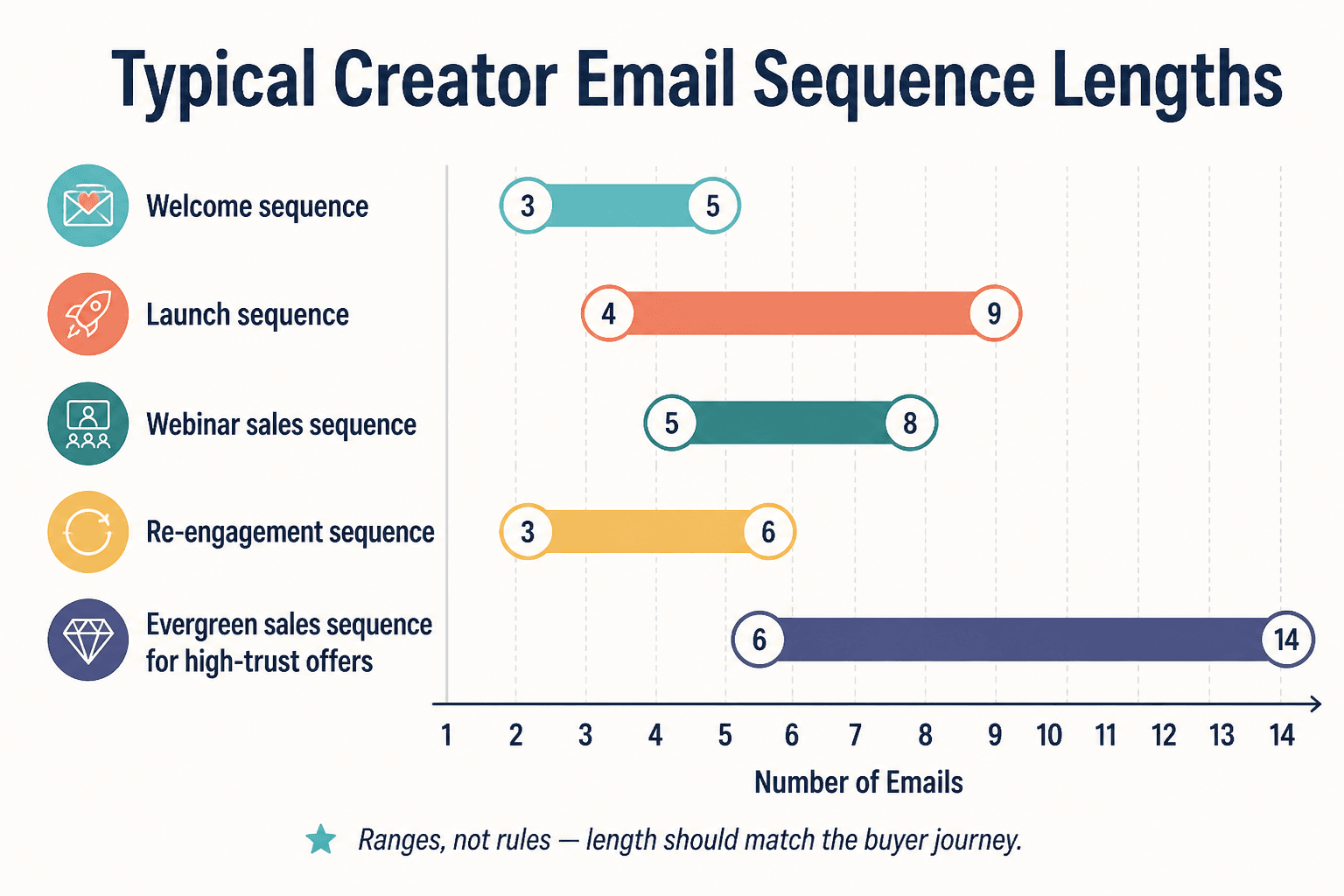
For most creators, a useful range looks like this:
| Sequence type | Typical length | What it is for |
|---|---|---|
| Welcome sequence | 3–7 emails | Introduce your brand, build trust, guide readers to your best stuff |
| Lead magnet follow-up | 3–6 emails | Deliver the resource, deepen the problem, create momentum toward an offer |
| Low-ticket offer sequence | 4–8 emails | Handle objections, show value, get the sale without overcooking it |
| Consulting or coaching nurture | 5–10 emails | Build authority, show process, prove fit, invite the next step |
| Launch sequence | 5–12 emails | Build urgency, answer questions, stack proof, close sales |
| Re-engagement sequence | 2–4 emails | Wake up inactive subscribers or clean the list |
| Evergreen sales sequence for high-trust offers | 6–14 emails | Educate, qualify, and convert readers over time |
Those are ranges, not laws. If your sequence falls outside them, that does not automatically mean it is wrong. But if you have 15 emails selling a $29 template, we should probably have a quiet word.
The cleaner rule is this: your sequence should be as long as the buyer journey requires and no longer.
That sounds obvious, but a lot of creators still build sequences backwards. They pick a number first, then try to stuff enough emails into it. That is how you end up with Email 6 saying the same thing as Email 3, just with more fake urgency and worse formatting.
What should decide sequence length
If you want a useful answer instead of a lazy one, look at these five factors.
1. The goal of the sequence
A welcome sequence has a different job from a launch sequence. A re-engagement sequence has a different job from a webinar sales sequence. Do not mash them together and then wonder why the whole thing feels confused.
Ask: what is this sequence meant to accomplish?
- Warm up new subscribers?
- Get readers to consume your best content?
- Sell a product?
- Book calls?
- Revive cold leads?
- Move people from one offer level to another?
The clearer the goal, the easier it is to spot how many emails are actually necessary.
2. How warm the reader already is
Cold subscribers need more context. Warm subscribers need less.
If someone opted in after bingeing your content for three months, they may be ready for a short, direct sequence. If they found you through one random lead magnet and barely know your name, they probably need more trust-building before you pitch anything serious.
This is one of the biggest mistakes creators make with email automation. They treat every subscriber like they arrived with the same level of intent. They did not.
3. The complexity of the offer
Simple offers usually need fewer emails. Complex offers usually need more.
- A $19 guide does not need a 10-email emotional odyssey.
- A course with multiple modules might need more explanation and proof.
- A coaching offer almost always needs more trust, fit, and objection handling.
- A consulting engagement may need authority, case examples, process clarity, and a softer CTA.
People are not buying based only on price, by the way. They are buying based on perceived risk. A $200 product can still need a thoughtful sequence if it solves a serious problem and the reader wants proof that you are not just good at writing emails about writing emails.
4. How much proof the reader needs
Some creators can sell faster because their positioning is already sharp, their content has built trust, and their offer is easy to understand. Others need more runway because the market is skeptical, the transformation is less obvious, or the creator has not yet established much authority.
If your sequence has to do heavy lifting around credibility, length might need to increase. That does not mean more fluff. It means more useful proof:
- Case studies
- Specific examples
- Screenshots or outcomes
- Breakdowns of process
- Objection-handling
- Clear explanation of who the offer is for and not for
5. Reader attention and list quality
2026 is not exactly suffering from an email shortage. People are subscribed to too much. Attention is thinner. Patience is lower. Generic sequences get ignored faster now because inbox tolerance has dropped.
That does not mean all sequences should be shorter. It means every email has to justify existing. If the message is useful, interesting, specific, and well-timed, readers will stay with you longer than you think. If it sounds like warmed-over automation paste, they will mentally unsubscribe before clicking anything.
When short creator email sequences win
Short sequences usually win when the reader already has momentum and the action is simple.
That might include:
- A welcome sequence for subscribers who came from a strong content funnel
- A lead magnet sequence tied to one very clear pain point
- A low-ticket product with obvious value
- A re-engagement campaign
- A short event reminder sequence
In those situations, 3 to 5 emails can do plenty. The job is not to philosophize at people. The job is to keep momentum moving.
A good short sequence often works because it respects the reader’s existing intent. It does not over-nurture someone who is already halfway sold. It gives them what they need, handles a couple of objections, and makes the next step easy.
For a deeper look at that, read when short creator email sequences beat long ones.
A simple 4-email short sequence example
- Email 1: Deliver the promised resource and frame the problem
- Email 2: Share one practical win or fast result
- Email 3: Show a proof example or explain a common mistake
- Email 4: Present the offer with a clear, low-friction CTA
That is enough for a lot of creators. Not everything needs to become a 9-part trust opera.
When longer creator email sequences make sense
Longer sequences make sense when the decision is slower, the offer is more expensive, or the reader needs more confidence before acting.
This tends to apply to:
- Coaching and consulting offers
- Done-for-you services
- Higher-ticket courses or memberships
- Offers that require belief change, not just product awareness
- Niche transformations that need more education
In those cases, 6 to 10 emails is often reasonable. Sometimes more during a launch window. But longer only works when the sequence has progression. If each email adds a new angle, answers a different objection, tells a sharper story, or helps the reader self-qualify, good. If it is just “still open” dressed in fresh subject lines, no.
A long sequence should feel like a guided decision, not repeated tapping on the glass.
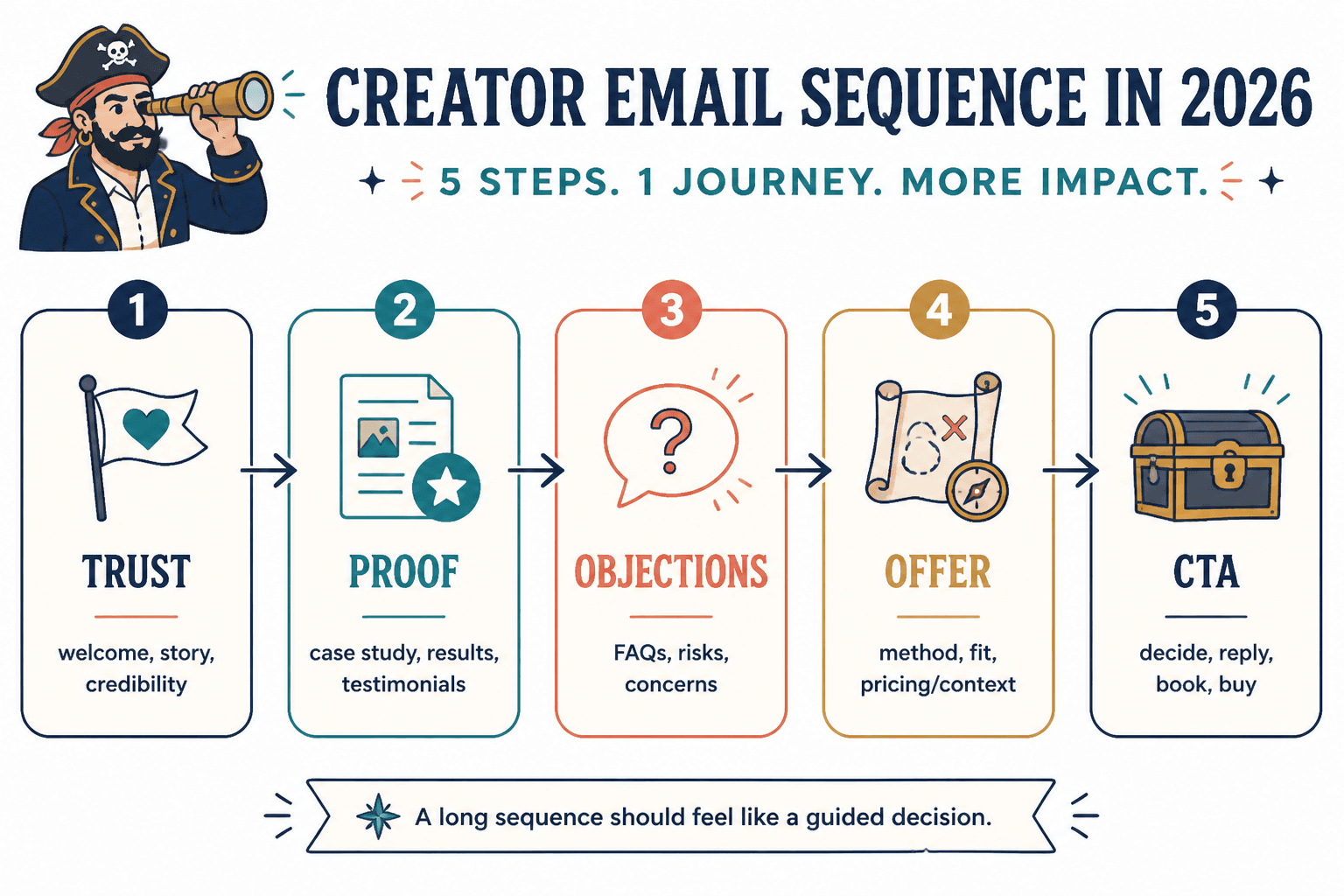
A useful 8-email longer sequence structure
- Email 1: Welcome and orientation
- Email 2: Problem clarity
- Email 3: Mistakes and false assumptions
- Email 4: Your framework or method
- Email 5: Proof or case study
- Email 6: Objection handling
- Email 7: Offer invitation
- Email 8: Deadline, decision, or soft close
Notice that this is not eight versions of “buy now.” It is a sequence with shape. That is the difference.
The better question: how many emails can you send before value runs out?
This is the part more creators need to hear.
The limit on sequence length is not some mystical inbox rule. The limit is your ability to keep producing useful, persuasive, non-repetitive emails.
Some creators should absolutely shorten their sequences because they are writing five decent emails and then three ghost emails full of generic advice, vague urgency, and invented “just checking in” energy. That stuff drags performance down because it teaches readers your emails are skippable.
Other creators are too timid. They stop at three emails when the reader still has obvious unanswered questions. Then they say email does not convert for them. No, your sequence just left the room early.
The right length is where the sequence still has momentum, value, and persuasive movement. Once those disappear, cut it.
What creator email sequences should include in 2026
Email expectations have shifted. Readers are quicker to ignore bland automation, but they still respond well to sequences that feel specific, relevant, and well-paced.
In 2026, stronger sequences usually include:
- Fast orientation: Why they are getting these emails and what they will get from them
- Useful specificity: Not broad motivation, but concrete problems, examples, and language your audience actually uses
- Real proof: Outcomes, examples, mini case studies, behind-the-scenes process
- Clear positioning: Who this is for, who it is not for, and what makes your approach different
- One job per email: Each message should move one thing forward
- Simple calls to action: Read, reply, click, book, buy, or learn more
What they should include less of: throat-clearing, generic inspiration, fake intimacy, and filler emails that exist because some template told you a sequence needs seven touches.
Common sequence length mistakes
Making the sequence too short to build trust
If you sell a higher-trust offer, three emails may not be enough. Especially if one is just the opt-in delivery email and another is an awkward sales pitch. That is not a nurture sequence. That is a shrug with a button.
Making the sequence too long because you are avoiding the pitch
Some creators hide inside “value” emails because selling feels uncomfortable. So the sequence drifts. Eight emails later, the reader still has no idea what the next step is. If that is you, the problem is not sequence length. It is that you are stalling.
Repeating the same argument
If Email 5 says what Email 2 already said, but in slightly shinier words, cut it or rewrite it. Repetition without progression gets ignored.
Ignoring the gap between newsletters and sequences
Your ongoing newsletter can carry trust too. Not every objection has to be solved inside one automation. Sometimes creators overbuild sequences because they forget subscribers will continue hearing from them after the sequence ends.
If you are building the bigger picture, browse email newsletter writing and creator email systems.
How to decide the right sequence length for your offer
Use this simple process.
- Define the goal. What exactly should the reader do by the end?
- Map the decision gaps. What does the reader need to believe, understand, or trust before taking that action?
- List the missing pieces. These might be proof, explanation, objection handling, urgency, or fit.
- Assign one main job per email. If two emails have the same job, one probably should not exist.
- Check for momentum. Does each message move naturally to the next?
- Trim the obvious filler. “Following up” is not a strategy.
- Watch behavior. Opens, clicks, replies, conversions, and drop-off matter more than your preferred number.
This is also where tools can help. Not by magically writing something brilliant, but by making it easier to map sequences, track behavior, and test changes. If you need that side of the stack, see best email automation tools and CRM tools for creator email sequences.
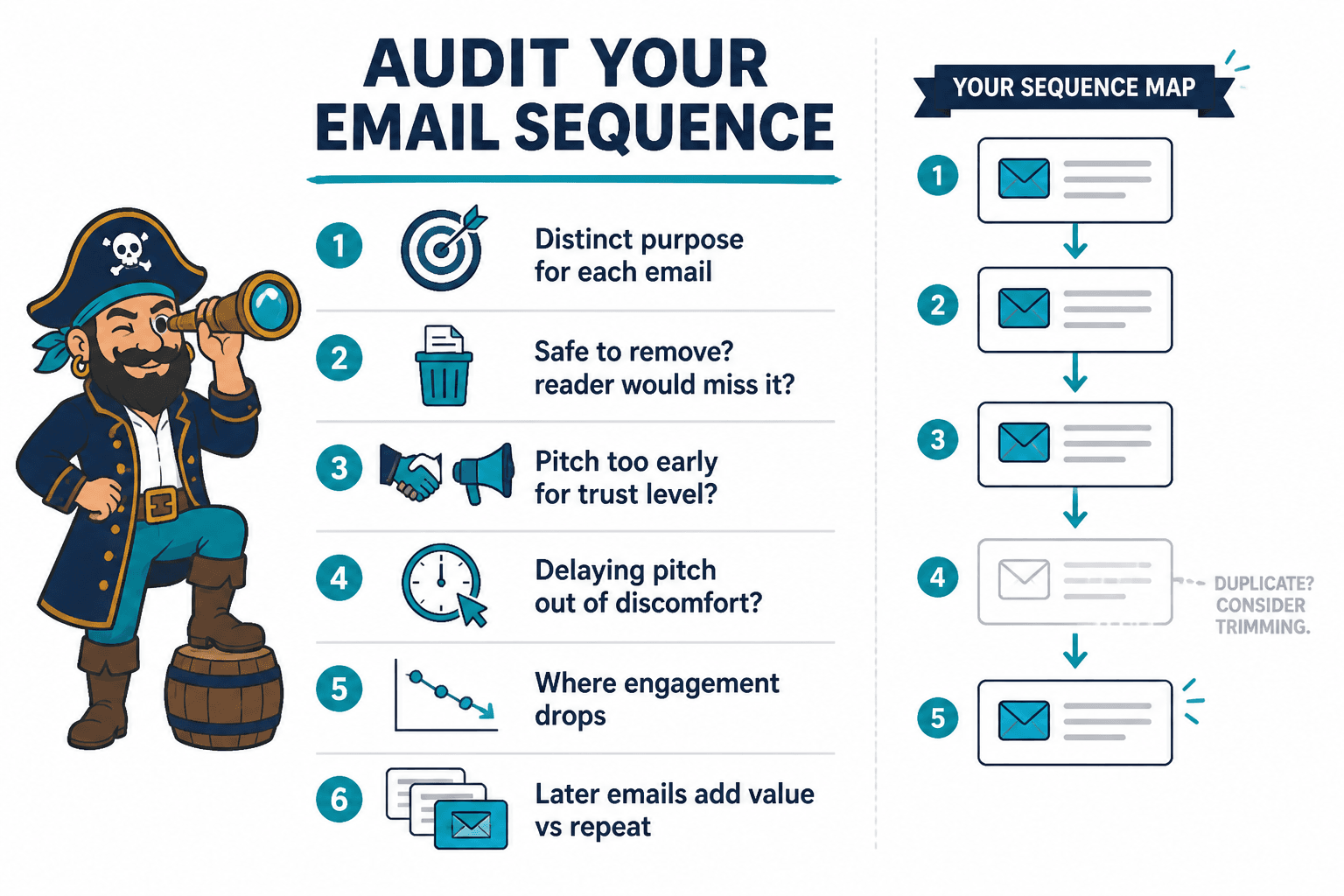
A quick way to audit your current sequence
If you already have a sequence live, ask these questions:
The bigger point is simple: clearer structure and clearer writing make the piece more useful. That is usually what makes the ending land better too.