
Most creator nurture emails do not fail because the writing is bad.
They fail because they sound like they were assembled from the same kit: vague welcome, soft life lesson, hollow value bomb, awkward pitch, goodbye forever. Technically fine. Emotionally forgettable. The kind of email sequence people skim, archive, and never think about again.
If you want to know how to improve creator nurture emails without sounding generic, the fix is not adding more “personality” in the abstract. It is building emails around specificity, tension, usefulness, and a voice that sounds like an actual person with an actual opinion. Not a nervous funnel template trying to be inoffensive to everybody.
Here’s how to make your nurture emails sharper, more trusted, and a lot less interchangeable, so new subscribers do not just receive your sequence. They remember it.
If you want the bigger picture, start with the parent guide.
Why creator nurture emails sound generic in the first place
Generic nurture emails usually have one of three problems:
- They are built from broad marketing formulas with no real point of view.
- They are trying so hard to sound polished that they erase the creator’s personality.
- They confuse “nurturing” with “saying nice, helpful-ish things until it is time to sell.”
That last one is especially common. A nurture sequence is not just a waiting room before the offer. It is where people decide what kind of mind you have, whether your advice feels lived-in, and whether your future emails deserve attention.
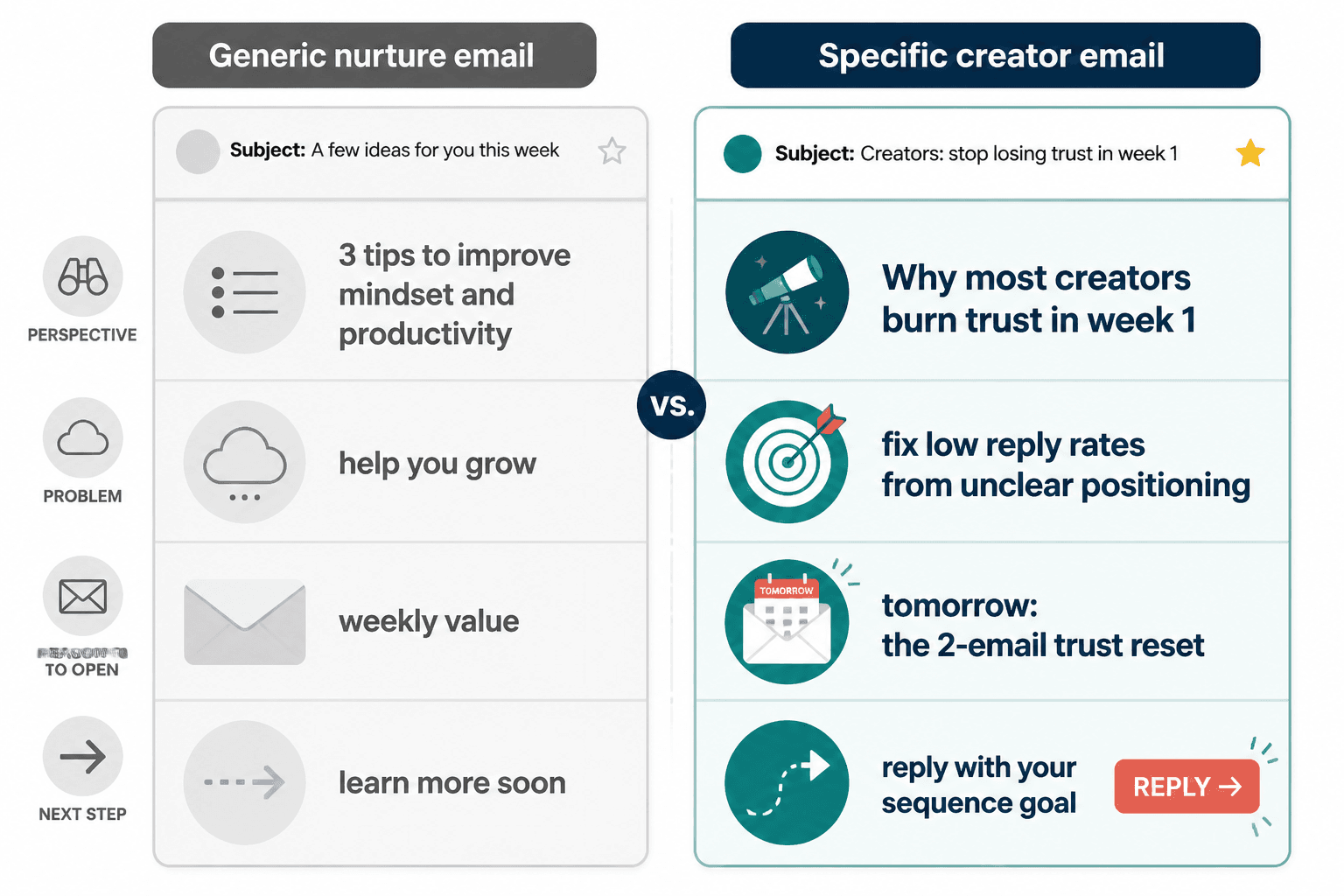
If every email sounds like “here are 3 tips to improve your mindset and productivity,” you are not nurturing trust. You are slowly becoming wallpaper.
A better sequence gives the reader something more solid:
- A clear perspective
- A clear problem you help solve
- A clear reason to keep opening
- A clear path toward the next step
That is the standard. Not “pleasant enough.”
Start with a sequence angle, not just a sequence goal
A lot of creators know the goal of their nurture emails. They want to welcome subscribers, build trust, and eventually lead toward a product, service, call, or newsletter habit.
Fine. But that is not enough to make the sequence interesting.
You also need an angle. An angle is the lens that makes the sequence feel like it came from you and not from a downloadable funnel pack.
For example, these are sequence goals:
- Warm up new subscribers
- Build trust
- Lead to a discovery call
These are sequence angles:
- Show why most creators are overcomplicating content systems
- Break down what makes audiences trust some experts and ignore others
- Expose the small mistakes ruining conversion before people ever sell
See the difference? The goal is operational. The angle gives the sequence shape.
When you have an angle, your nurture emails stop feeling like detached tips and start feeling like a guided argument. That is a much better reading experience. It is also much better sales groundwork.
A simple angle formula
Use this:
I help [specific person] get [specific result], and this sequence shows them why the usual advice fails and what works better instead.
Example:
I help service-based creators turn attention into leads, and this sequence shows why most content does not convert and how to fix the trust gaps behind that.
Now your emails have a spine. Useful thing to have.
Write each email around one sharp job
One reason nurture sequences go limp is that creators try to make every email do everything.
Teach. Connect. Share a story. Build authority. Mention the offer. Be warm. Be smart. Be different. Sound casual. Sound strategic.
That is how you end up with emails that feel busy but say very little.
Each nurture email should have one primary job. Not seven. One.
| Email type | Primary job | What it should not do |
|---|---|---|
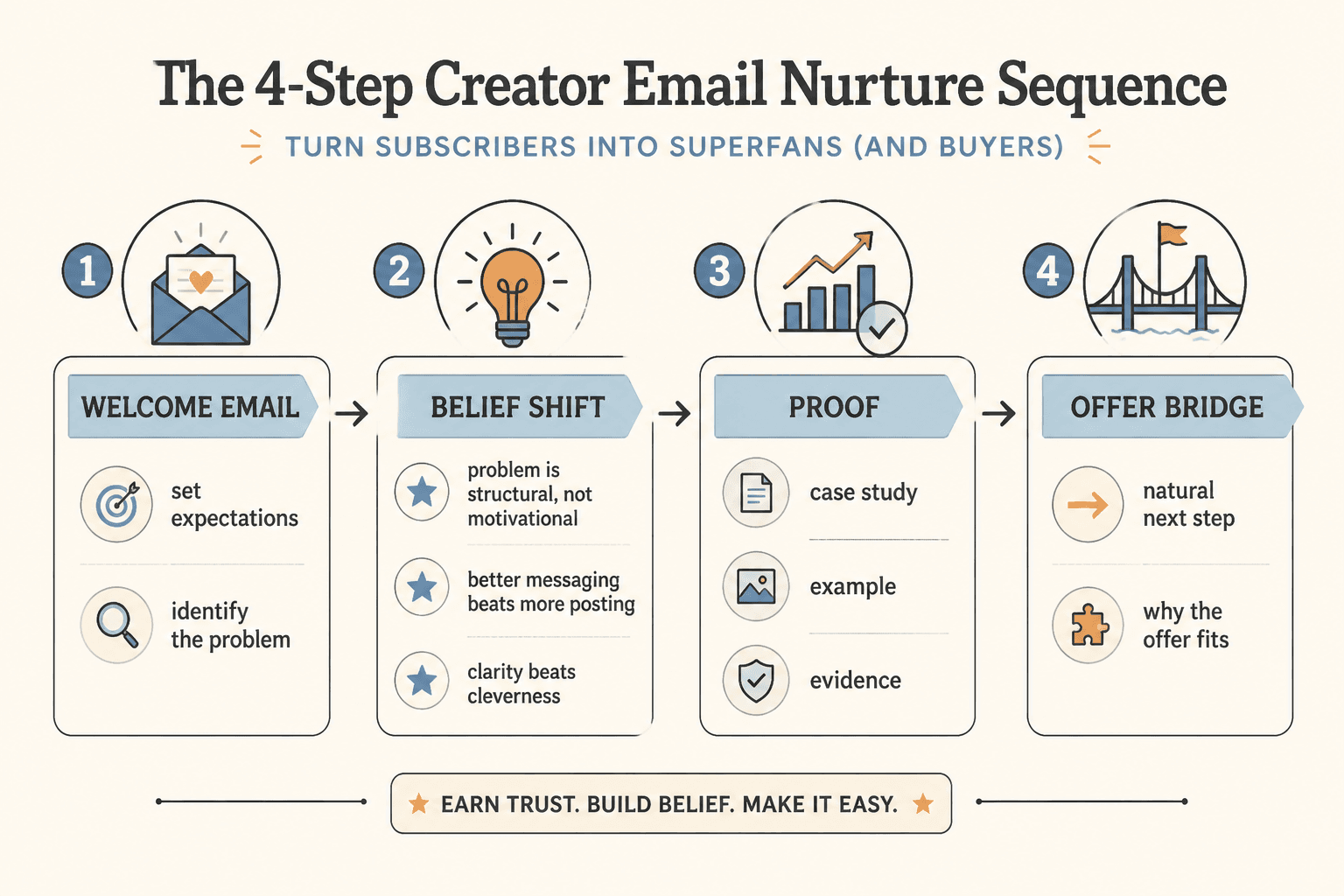
| Welcome email | Set expectations and establish voice | Tell your entire life story |
| Belief-shift email | Challenge a common bad assumption | Pile on random tips |
| Proof email | Show your method works in real life | Read like a brag parade |
| Value email | Teach one useful framework | Become a mini course with no point |
| Offer-bridge email | Connect the problem to your offer | Suddenly hard-sell out of nowhere |
If you do this well, subscribers can feel the logic of the sequence. Each email earns its place. Each one moves the relationship forward.
If you need help structuring the overall flow, this guide on creator email sequences is a useful next read.
Specificity is what makes nurture emails feel human
Generic writing lives on abstraction.
It says things like:
- build authentic connection
- show up consistently
- deliver value
- create transformation
- stay aligned with your audience
None of that means much on its own. It sounds professional in the same way a hotel lobby smells clean. Pleasant. Forgettable. Not exactly worth opening.
Specificity gives your emails texture. It proves you understand the reader’s actual situation, not just the category they sit in.
Weak line vs stronger line
Weak: Many creators struggle to turn their audience into paying clients.
Stronger: A lot of creators are posting useful content, getting polite likes, and still hearing crickets when they mention an offer.
Weak: It is important to build trust with your audience.
Stronger: If your emails sound polished but interchangeable, subscribers might respect you in theory and ignore you in practice.
The second version of each line creates a picture. That matters. People respond to what they can recognize.
Ways to add specificity fast
- Name the exact mistake, not just the category of mistake.
- Describe what the reader is probably seeing right now.
- Use concrete examples from content, client work, audience behavior, or buying friction.
- Replace broad outcomes with visible outcomes.
- Use language your audience would actually say out loud.
That last one is underrated. If your audience says, “I am getting subscribers but not clients,” do not rewrite that into “I seek improved conversion pathways across my business ecosystem.” Nobody talks like that unless they are trapped in a bad webinar.
Stop teaching random tips and start building belief
Many nurture sequences become generic because they are just little stacks of advice. Tip here. Tip there. Another tip wearing a cardigan.
Useful? Sometimes. Memorable? Rarely.
The stronger approach is to use your nurture emails to build key beliefs that make your future offer make sense.
If you sell strategy, your emails should not only give tips. They should also help readers believe things like:
- their problem is structural, not just motivational
- better messaging beats more posting
- clarity usually outperforms cleverness
- small trust gaps kill conversion
- DIY gets expensive when the wrong system keeps repeating
This is where nurture sequences get more persuasive without sounding salesy. You are not forcing a pitch into every email. You are shaping how the reader understands the problem.
And if you want your sales emails to feel less robotic later, read how to write creator email sequences without sounding salesy or robotic.
Use voice in the right places, not everywhere at once
When creators hear “sound less generic,” they often overcorrect. Suddenly every email is full of exaggerated slang, hyperactive jokes, or theatrical personality. That can be just as tiring as bland copy.
Voice works best when it sharpens the point, not when it performs for attention.
Good places to let your voice show:
- The opening line
- Your framing of the problem
- Your transitions
- Your opinion on what people keep doing wrong
- The CTA
You do not need every sentence to sparkle. You need enough texture that readers can tell a person wrote it.
Example: bland vs human
Bland: One of the biggest mistakes creators make is failing to communicate their value effectively.
Human: A lot of creators are not bad at what they do. They are just describing it in a way no busy buyer cares to decode.
Bland CTA: If you would like support with this, learn more about my offer here.
Human CTA: If your content is getting attention but not leading anywhere useful, this is exactly the kind of problem I help fix.
That is enough voice. No need to write like you are auditioning to be the internet’s coolest email person.
Open each email like you mean it
Weak openings are one of the fastest ways to make nurture emails feel generic.
If every email starts with “Hope you are doing well” or “Today I want to talk about,” you are wasting the most attention-rich part of the message.
A stronger opening does one of three things quickly:
- Calls out a recognizable problem
- Challenges a bad assumption
- Creates tension around a useful truth
Examples:
- Most nurture emails are too polite to be persuasive.
- A lot of creators do not need more leads yet. They need better trust signals.
- If your welcome sequence sounds like everybody else’s, your offer probably will too.
- The problem is not that your readers do not care. It is that your email made them work too hard to understand why they should.
These openings feel sharper because they contain an actual thought. Not a throat-clearing ritual.
If openings are where your sequence keeps going soft, read how to start creator email sequences without a weak opening.
Make your examples do real work
One of the easiest ways to improve creator nurture emails without sounding generic is to stop explaining ideas only in theory.
Examples create proof, clarity, and relief. They help readers think, “Oh, now I see what you mean.” Without that moment, even good advice can feel slippery.
Instead of this
Make sure your messaging is audience-focused and outcome-driven.
Try this
“I help coaches unlock their voice” sounds nice, but it makes the reader do all the interpretation. “I help coaches turn scattered ideas into clear content that brings in consult calls” is easier to believe, easier to remember, and much easier to buy.
That tiny example teaches more than five abstract lines about messaging. It also makes your email feel less templated because it is anchored in something concrete.
If you want to bulk up your sequence with stronger models, steal from your own world:
- common audience mistakes
- before-and-after copy examples
- client patterns
- sales page rewrites
- content positioning shifts
- mistakes you see in your inbox or feed constantly
Specific examples make you sound experienced. Vague advice just makes you sound tidy.
The bigger point is simple: clearer structure and clearer writing make the piece more useful. That is usually what makes the ending land better too.