
Most creator email sequences are not failing because the tech is broken.
They are failing because the emails feel like they were written by someone trying very hard to “nurture” a lead instead of help a real person make a decision.
You can usually spot the problem by email two. The tone gets stiffer. The value gets vaguer. The writer starts sounding like a course platform with abandonment issues. And then they wonder why open rates sag, clicks disappear, and nobody replies.
If you want to know how to write better creator email sequences, the fix is not more hype, more automation, or seven extra “just checking in” emails. It is better sequencing, clearer intent, stronger transitions, and emails that actually sound like they came from one brain instead of a funnel template with a head injury.
This article will help you write creator email sequences that feel sharper, earn more trust, and move readers toward the next step without sounding generic, needy, or weirdly over-rehearsed. We’ll cover structure, email roles, common mistakes, stronger examples, and how to make your sequence feel like a guided path instead of a pile of semi-related messages.
If you need broader sequence strategy after this, it’s worth pairing this with Creator Email Sequences Guide for Creators Who Want Better Results and the main creator email sequences hub.
If you want the bigger picture, start with the parent guide.
What better creator email sequences actually do
A good email sequence does not just “follow up.” It does a job.
Each email should reduce uncertainty, build context, create movement, or help the reader see why your offer, content, method, or point of view matters. That means every email needs a role. Not just a topic. A role.
That distinction matters more than people think. “Email about mindset” is a topic. “Email that removes doubt before the offer email lands” is a role. One is loose. The other has a reason to exist.
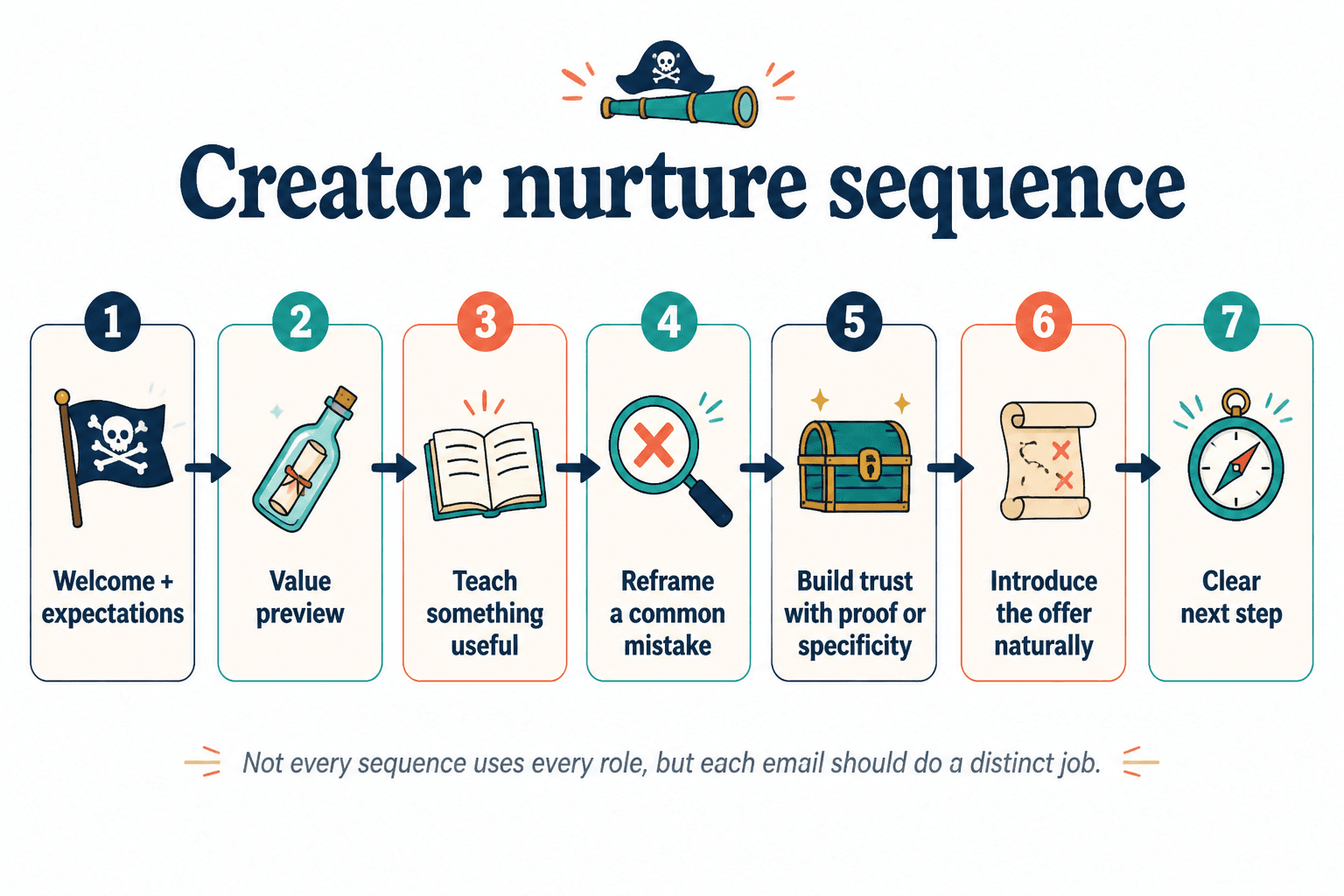
Better creator email sequences usually do some mix of these things:
- Welcome the reader and set expectations
- Show them what kind of value you give
- Teach something useful and relevant
- Reframe a common mistake or assumption
- Build trust through clarity, proof, or specificity
- Introduce your offer naturally
- Handle hesitation without sounding defensive
- Give a clear next step
That is it. Not magic. Not persuasion sorcery. Just sequence logic.
And yes, this applies whether your sequence is selling a coaching offer, warming up newsletter subscribers, onboarding clients, introducing a digital product, or turning old audience attention into actual business momentum.
Why so many creator email sequences feel flat
Most sequences go wrong in one of three ways.
1. Every email says the same thing in slightly different outfits
You have seen this one. Email one says the creator wants to help. Email two says they really want to help. Email three says they are passionate about helping. Somewhere around email four there is a soft pitch, but by then the reader has learned almost nothing except that the sender enjoys adjectives.
Repetition is useful when it deepens a point. It is annoying when it just circles it.
2. The sequence was built from email marketing clichés instead of actual buyer friction
People do not buy because you inserted a “quick win” on day two and a “social proof” email on day four. Those elements can help, sure. But they only work when they match what the reader actually needs to believe, understand, or feel before taking action.
If someone is hesitant because your offer feels vague, more testimonials may not fix it. If they are interested but busy, a longer origin story may not help. If they do not understand your method, urgency will just feel pushy.
3. The writing sounds polished in the worst way
There is a specific kind of creator email that sounds “professional” but has no pulse. It is smooth, correct, and absolutely forgettable. Every sentence is tidy. None of them land.
Better writing is usually more specific, more human, and a little less obsessed with sounding impressive. You are not writing a brochure. You are guiding attention and trust over time.
Start with sequence intent, not email count
One of the easiest ways to write a bad sequence is to begin with, “I need a 7-email nurture sequence.”
Need based on what, exactly?
Email count should come after intent. Before writing anything, answer these questions:
- Who is this sequence for?
- What just happened before they entered it?
- What do they want right now?
- What do they still not understand or trust?
- What next step do you want them to take?
- What might stop them from taking it?
That gives you the real shape of the sequence.
A new subscriber who downloaded a lead magnet needs a different sequence than someone who watched your workshop. A warm audience considering a consulting offer needs a different sequence than someone joining your newsletter for free tips. Obvious, yes. Still ignored constantly.
If you want more ideas on structuring and improving the flow itself, read How to Improve Creator Email Sequences Nurture Emails Without Sounding Generic.
A simple structure for writing better creator email sequences
You do not need a baroque 14-part system here. For most creators, this structure is enough.
Email 1: Welcome and orient
This email should do three things:
- Deliver what they came for, if they signed up for something specific
- Set expectations for what kinds of emails they will get
- Start the relationship with a useful point, not just logistics
Weak version:
Thanks for joining my list. I’m so excited to have you here. Over the next few days I’ll be sharing valuable tips to help you grow.
That says almost nothing.
Stronger version:
You’re in. Here’s the guide.
Also, one quick thing before you read it: most creators do not need more content ideas. They need better packaging and better sequence logic. So the emails I send will focus less on “post more” and more on what actually moves readers toward trust, replies, and sales.
Now we have positioning, expectation, and a point of view.
Email 2: Teach one useful thing
This email proves your usefulness. Not with a giant lesson. Just one clear thing that helps the reader think or act better.
Good teaching emails usually include:
- One problem
- One insight or reframe
- One example
- One next action
Keep it focused. Most people wreck useful emails by stuffing three frameworks, a personal story, and a call to buy something into the same message. Pick a lane.
Email 3: Diagnose the common mistake
This is where you show the reader why their current approach is underperforming. Not to shame them. To create clarity.
For example:
- Your newsletter is inconsistent because your content system is reactive
- Your sequence is weak because every email is trying to educate and convert at once
- Your emails are not getting clicks because the CTA feels disconnected from the message
- Your writing sounds bland because you are drafting from topic instead of tension
This kind of email works because it helps the reader explain their own frustration. And when people can name the problem more clearly, they are much more ready for a relevant solution.
Email 4: Show the better way
Now you give them the alternative. This can be a framework, process, checklist, or simple sequence map. The goal is not to hide all the good stuff until the offer arrives. The goal is to make your approach make sense.
If your offer is a service, this email can preview your method. If your offer is a product, it can show the logic behind the product. If your offer is your newsletter itself, it can deepen the reader’s trust in your thinking.
Email 5: Introduce the offer without acting weird about it
This is where many creators suddenly become allergic to direct language.
They spend four paragraphs dancing around the offer, then toss in a tiny link like they are hoping the reader might accidentally click it.
You are allowed to be clear.
A strong offer email usually includes:
- Who it is for
- What it helps them do
- Why it matters now
- What makes your approach different or credible
- What to do next
No drama needed. No “doors are closing” unless they actually are.
Email 6 and beyond: Handle hesitation, add proof, and close the gap
After the offer appears, your job is usually to reduce friction.
That can mean emails about:
- Common objections
- Case studies or examples
- Behind-the-scenes process
- Who the offer is not for
- What happens after buying or booking
- A final reminder with an actual reason to act
Notice what is missing here: random filler. If an email does not reduce confusion, increase trust, or create relevant movement, it probably does not belong in the sequence.
For more concrete structures and concepts, the broader email newsletter writing and creator email systems paths are useful companions.
Write each email around a single movement
Here is one of the cleanest ways to improve your sequence writing fast: stop trying to make each email do everything.
A stronger email usually creates one movement from point A to point B.
| Email movement | Example |
|---|---|
| Confused → clear | Explain why a common tactic is underperforming |
| Interested → convinced | Show proof or a stronger process |
| Skeptical → open | Address a likely objection directly |
| Passive → active | Give one simple next step with a reason |
| Unaware → problem-aware | Name the issue they have not diagnosed yet |
This keeps your emails from becoming mushy little content casseroles full of mixed intent.
How to make your emails sound more human and less funnel-shaped
If your sequence sounds stiff, the problem is usually not grammar. It is distance.
You are writing as if the reader is a lead in a pipeline instead of a person trying to solve something.
Some fixes:
- Use specific nouns instead of abstract promises
- Say what people are actually doing wrong
- Use examples that feel plausible, not polished into oblivion
- Cut overexplaining before the main point
- Write transitions that sound like a person continuing a thought
- Stop using “valuable insights,” “journey,” and “special opportunity” unless irony is intended
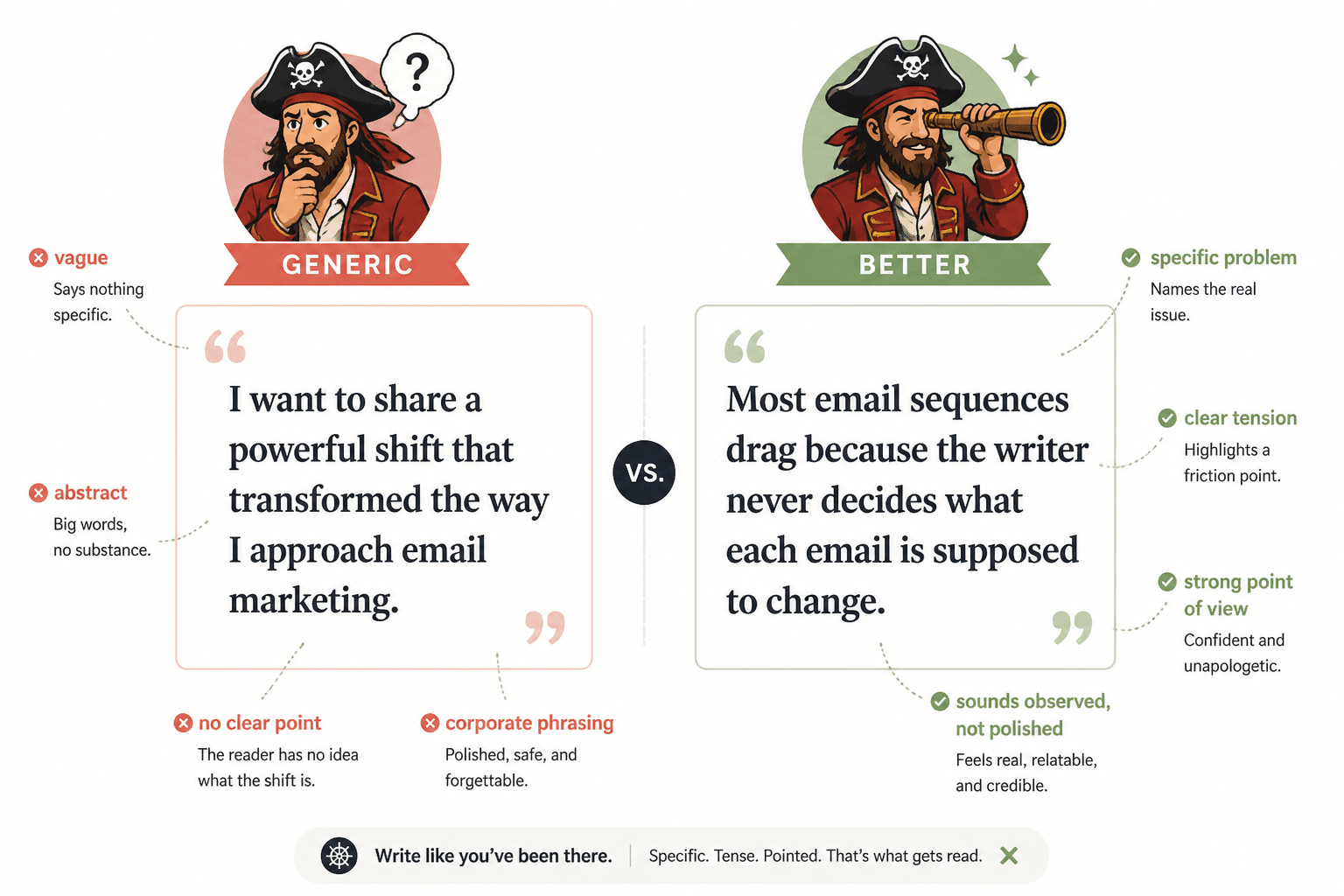
Compare these.
Generic: “I want to share a powerful shift that transformed the way I approach email marketing.”
Better: “Most email sequences drag because the writer never decides what each email is supposed to change.”
The second version has a point. It has tension. It sounds like someone who noticed a real problem.
That is what readers respond to.
Use transitions so the sequence actually feels like a sequence
A lot of creators write decent standalone emails and then wonder why the sequence feels disjointed.
Usually, they forgot the sequence part.
Each email should feel connected to what came before and what comes next. That does not mean every message needs “as I said in my last email.” It means the logic should carry forward.
Useful transition lines look like this:
- “Yesterday I talked about why most welcome emails waste the moment. Today, here’s how to make your second email actually earn attention.”
- “Now that the problem is clearer, the useful question is what to do instead.”
- “If that last email made you realize your sequence is too broad, this is the fix.”
- “Before I show you the offer, I want to deal with the part that trips most people up.”
Simple. Clear. Connected.
Transitions matter because they create momentum. And momentum is one of the main reasons people keep opening sequence emails instead of mentally filing them under “automated sender trying their best.”
How to write stronger CTAs in creator email sequences
A lot of sequence CTAs fail because they are detached from the email that came before them.
If you spend 400 words explaining why the reader’s current approach is wasting time, your CTA should not suddenly become “Check out my offer here :)” with no bridge.
The CTA should feel like the next logical move.
Here are better CTA types for creator sequences:
- Read this next: good when the sequence points to an article, guide, or deeper resource
- Reply and tell me: good when you want conversation, objections, or insight
- Book this: good when the reader already understands the problem and your offer solves it
- See how it works: good for process-heavy services or systems
- Get the full version: good for digital products or lead magnets connected to the email’s lesson
Examples:
Weak: “If you’re ready to transform your business, click here.”
Stronger: “If your current sequence is doing a lot of talking and not much moving, this is where I help creators tighten the structure and turn it into something that actually converts. You can see the details here.”
Weak: “Book a call to learn more.”
Stronger: “If you want help fixing the sequence you already have instead of starting from scratch again, book a call here.”
Specific CTAs convert better because they answer the silent question in the reader’s head: why this, why now?
A practical writing process for better creator email sequences
If writing sequences feels messy, use this process.
- Map the reader state. What do they know, want, fear, and misunderstand right now?
- Choose the sequence goal. Subscribe deeper, reply, book, buy, read, or trust you more.
- Assign each email a role. Welcome, teach, diagnose, reframe, offer, objection-handle, proof, reminder.
- Write the core movement for each email. One sentence only.
- Draft ugly first. Do not try to sound polished on the first pass.
- Cut throat-clearing. Most intros can lose their first two lines.
- Add one sharp example. This makes the email feel grounded.
- Tighten the CTA. Make it fit the email, not just the campaign goal.
- Check sequence flow. Make sure each email earns the next one.
This process also makes editing much easier. When an email feels weak, ask: is the role unclear, the movement muddy, or the CTA disconnected? Usually it is one of those three.
Before and after: a bland sequence email rewritten
Here is a typical bland creator sequence email:
Hi there,
I hope you’re doing well. I wanted to check in and share a reminder that consistency is important when it comes to building your brand. Many people struggle because they do not stay committed to the process. If you want support, I offer coaching to help you gain clarity and confidence in your content strategy. Click here to learn more.
This email is not evil. It is just vague, forgettable, and doing almost no persuasive work.
Here is a stronger rewrite:
Your content probably does not need more consistency advice.
It needs fewer decisions.
A lot of creators think they are inconsistent because they lack discipline. Usually, the real problem is that every week starts from scratch. New post ideas. New angles. New offers. New confusion.
That is exhausting, and it makes email sequences worse too, because the emails end up sounding disconnected from the rest of the brand.
One simple fix: build 3 to 5 repeatable message themes and write your emails from those. Suddenly your content gets faster, your positioning gets clearer, and your offers stop sounding random.
If you want help building that system, that is exactly what I do in my coaching. You can see the details here.
Notice what changed:
- The opening has a real point
- The problem is specific
- The insight is useful on its own
- The offer fits naturally
- The CTA makes sense because the email earned it
Good sequence ideas come from existing content, not constant reinvention
You do not need to invent every sequence email from thin air. In fact, that is usually a bad use of energy.
Your best sequence material often already exists in:
- Popular posts
- Strong newsletter issues
- Client call notes
- Sales objections
- FAQs
- Workshop lessons
- Comment threads and DMs
- Rants you cleaned up into useful arguments
That matters because the best sequence emails usually come from things you already know your audience cares about, not things you guessed they might care about while staring at a blank document and pretending to be inspired.
The bigger point is simple: clearer structure and clearer writing make the piece more useful. That is usually what makes the ending land better too.