
Most welcome emails are not boring because they are short. They are boring because they are terrified of being specific.
They say things like “thanks for subscribing,” “here’s what to expect,” and “we’re excited to have you here,” then proceed to sound like a compliance form wearing a smile. Technically fine. Emotionally beige. Easy to ignore.
If your welcome email is the first real impression after someone joins your list, that is a terrible time to become forgettable.
How to Rewrite Boring Welcome Emails comes down to a few simple shifts: say something real faster, make the value clearer, sound like an actual person, and give the reader an easy next step that does not feel like a tiny ambush. Done well, a welcome email can build trust, set expectations, and move someone deeper into your world without sounding needy, stiff, or weirdly overproduced.
This is not about making your welcome email longer. It is about making it sharper. You want less throat-clearing, more signal.
If you want the bigger picture, start with the parent guide.
Why most welcome emails fall flat
A lot of creators, coaches, consultants, and brands write welcome emails like they are trying not to offend a committee. So the result is safe, generic, and instantly skimmable in the bad way.
The usual problems look like this:
- The opening says nothing memorable
- The email talks about the brand more than the reader
- The promised value is vague
- The tone suddenly becomes corporate
- The CTA is either missing or weirdly aggressive
- Everything sounds like it was assembled from leftover email templates
And yes, a welcome email can be simple. It should be simple. But simple is not the same as bland. A plain white plate can still hold excellent food. A plain white plate holding dry toast is still dry toast.
If you want a stronger overall foundation for this kind of email, it helps to understand how email newsletter writing and creator email systems work together. A welcome email is not an isolated note. It is the front door.
What a good welcome email actually needs to do
Before you rewrite anything, get clear on the job.
A good welcome email usually needs to do four things:
- Confirm the reader made a smart choice
- Tell them what kind of value they are actually signing up for
- Introduce your voice, angle, or perspective
- Guide them to one useful next step
That is it. Not a life story. Not a giant origin tale. Not a five-link buffet that makes people do admin work. Just a clear, human first touch.
When people ask how to rewrite boring welcome emails, they often focus on line edits. Those matter. But the bigger fix is strategic: your email needs a point. Readers should finish it knowing who this is for, what makes your emails worth opening, and what to do next.
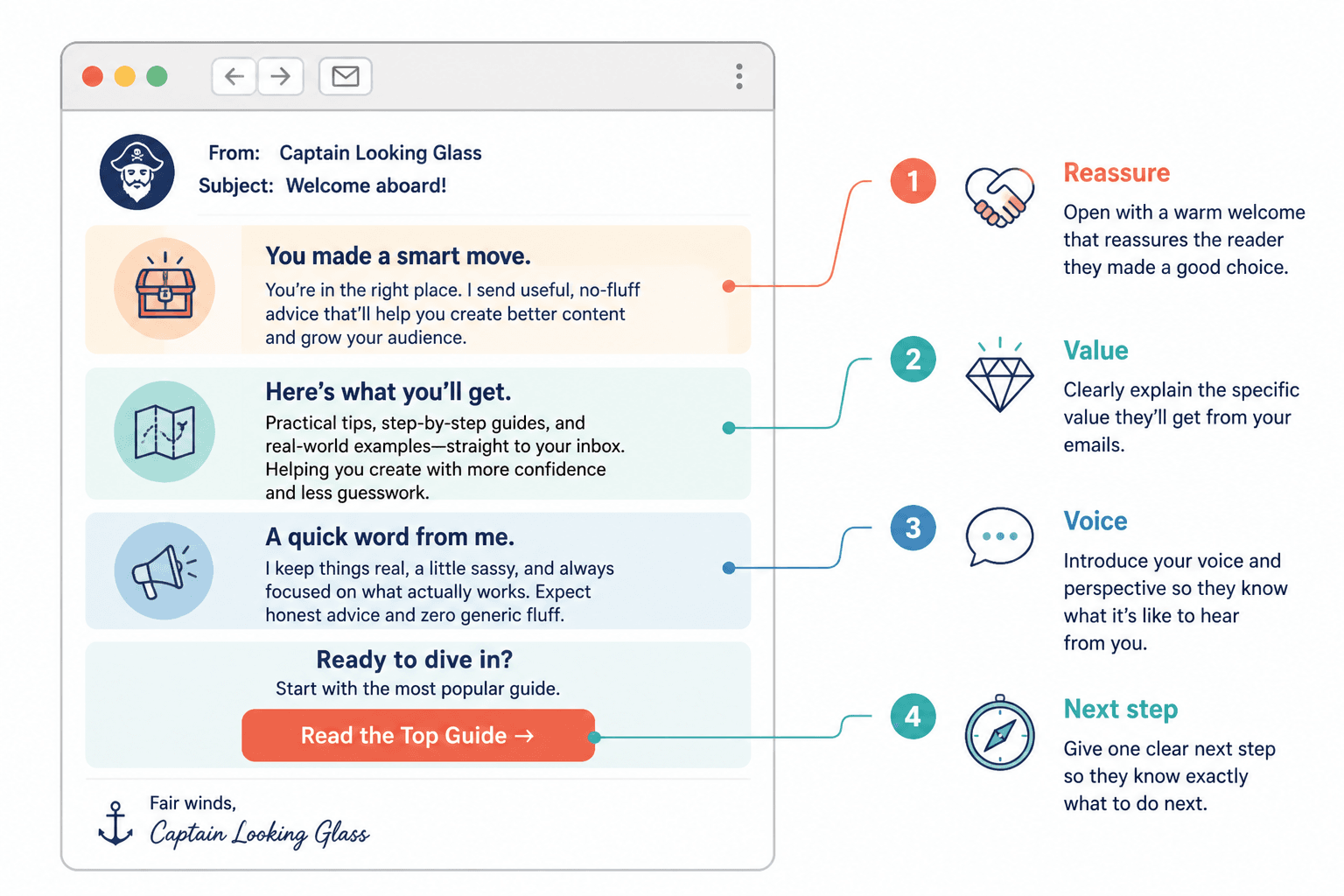
The rewrite process: from bland to worth reading
Here is the cleanest way to rewrite a boring welcome email without turning it into a dramatic manifesto.
1. Find the actual promise
Most weak welcome emails hide the value behind polite filler. Strip that out and ask: what is the real promise of this list?
Not “tips, insights, and updates.” That means nothing. What does the reader get that is useful, specific, or different?
For example:
- Weekly practical breakdowns on writing better emails that sound human
- Short content ideas for creators who want leads without posting five times a day
- Sharp strategy notes for consultants trying to turn expertise into trust
If you cannot state the promise clearly, the email is not the problem. The positioning is.
2. Cut the formal greeting-card language
Lines like these usually make emails weaker:
- “We’re thrilled to welcome you”
- “Thank you so much for being here”
- “I’m excited to share this journey with you”
- “You’re now part of our community”
None of those are evil. They are just overused, low-signal, and often disconnected from any real message.
Try replacing ceremonial fluff with something that sounds like a person who knows why the reader joined:
Good call joining. You’ll get practical emails about writing sharper content, building more trust, and making your marketing sound less like a dehydrated sales funnel.
That works better because it says what matters fast.
3. Make the opening earn attention
The first two lines carry too much weight for you to waste them on ceremonial niceness.
Weak opening:
Hi there, and welcome to our newsletter. We’re so happy you signed up.
Better opening:
You signed up because you want better emails, not more inbox wallpaper. That is exactly what you’ll get here.
See the difference? One acknowledges the signup. The other gives the signup meaning.
If you want more help with this specific piece, read How to Start Welcome Emails Without a Weak Opening. The first lines do a lot of heavy lifting.
4. Replace vague claims with concrete expectations
Readers do not trust “valuable content.” They trust specifics.
Instead of this:
You’ll receive helpful tips, exclusive updates, and resources to help you grow.
Try this:
Expect short emails on better hooks, cleaner offers, stronger welcome sequences, and content that gets attention without sounding like recycled business sludge.
Specificity does two things at once: it makes the email more interesting, and it quietly filters for the right people.
5. Add a reason to trust you without writing a memoir
A boring welcome email often swings between two extremes: no credibility at all, or a giant autobiography nobody asked for.
You usually just need a compact positioning line. One or two sentences is enough.
For example:
- I help creators and consultants write sharper emails, posts, and funnels that sound human and convert better.
- This newsletter is where I share the strategies, rewrites, and examples behind that work.
That gives context without forcing the reader through your entire backstory like they are trapped at a networking breakfast.
6. Give one next step, not six
Many welcome emails die in a pile of options. Follow on Instagram. Book a call. Download a thing. Read the blog. Join the group. Reply with your goals. Forward to a friend. Smile at the moon.
Pick one next step that matches the moment.
Good options include:
- Read one strong starter article
- Reply with a short answer to a useful question
- Grab the promised free resource
- Browse your best welcome-email-related content
For example:
If you want the quickest win, start here: welcome emails. It’ll help you tighten the basics before you overcomplicate the sequence.
If your CTA tends to get slippery or too soft, Welcome Emails Soft CTAs Mistakes That Hurt Performance is worth reading next.
Before-and-after rewrite examples
Here is where the difference gets obvious.
Example 1: The generic creator welcome email
Before
Hi and welcome.
Thank you for subscribing to my newsletter. I’m so excited to have you here. You can expect weekly insights, tips, and updates on content creation, branding, and marketing. My goal is to provide value and help you on your journey.
Be sure to follow me on social media and check out my website for more resources.
After
You signed up for useful content, so that is what you’ll get.
I send practical emails on writing sharper posts, clearer offers, and better welcome sequences for creators and service businesses who want more trust and fewer awkward sales tactics.
Most of it is short, specific, and built to help you fix something quickly.
If you want a strong place to start, read this next: Best Welcome Emails Ideas and Examples for Creators.
What improved:
- The opening has a point
- The promise is specific
- The audience is clearer
- The CTA is singular and useful
Example 2: The coach email that sounds too polished
Before
Welcome to our transformational community. We are honored to support you on your path toward greater clarity, alignment, and success. Over the coming weeks, you’ll receive inspirational content, mindset tools, and strategic guidance designed to elevate your journey.
After
Glad you’re here.
This email list is for people who want clearer messaging, stronger content, and a business that does not rely on sounding profound while saying almost nothing.
You’ll get practical notes on positioning, email strategy, and conversion without the usual fog machine language.
And if your welcome flow needs work, this will help next: How to Improve Welcome Emails Mini Onboarding Flows Without Sounding Generic.
This version sounds more grounded, more distinctive, and much easier to trust.
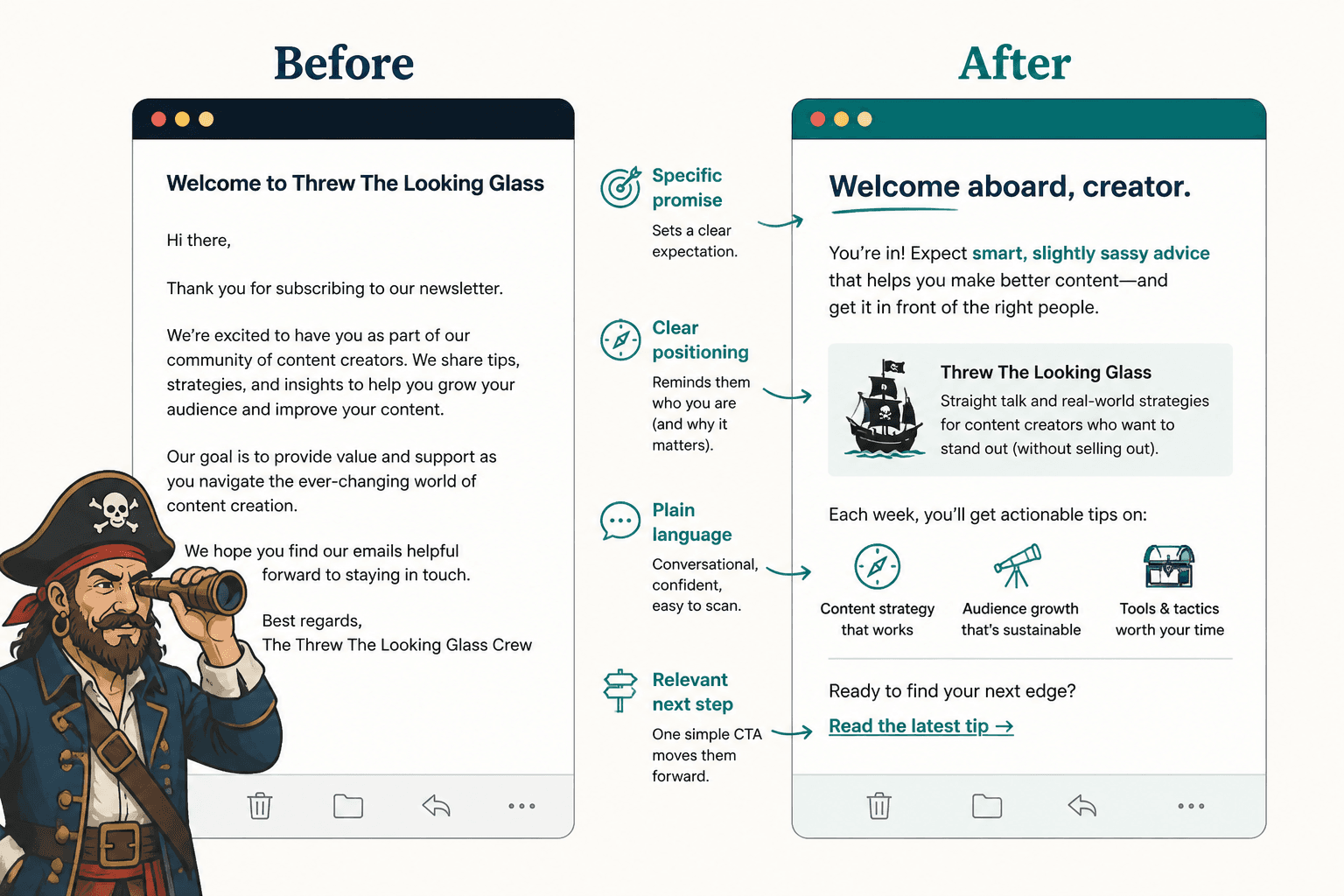
A simple structure you can use to rewrite your own
If you want a reusable format, use this:
- Opening: one line that acknowledges why they signed up
- Promise: what kind of useful emails they will get
- Positioning: who you help and how you think about the problem
- Next step: one soft, relevant CTA
Template:
You signed up for [specific outcome], so that is what I’ll send.
Expect [type of content] about [topics] with a focus on [angle or benefit].
I help [audience] do [result] without [common frustration or bad method].
If you want to start with something useful, go here: [one CTA].
Filled example:
You signed up for better welcome emails, so let’s skip the fluff.
Expect short, practical notes on onboarding, email structure, copy rewrites, and soft CTAs that do not sound like a hostage negotiation.
I help creators and service businesses write emails that feel human and still lead somewhere.
If you want a smart next read, start here: welcome emails.
What to remove from a boring welcome email immediately
If your draft feels dull, these are usually the first things to cut:
- Overly formal thank-you language
- Empty phrases like “provide value” or “support your journey”
- Long founder backstories
- Three or more CTAs
- Vague topic lists with no angle
- Fake enthusiasm that does not match your normal voice
- Corporate wording that somehow snuck in and started paying rent
One practical editing trick: read the email and highlight every sentence that could appear in almost anyone’s welcome email. Those are usually the sentences killing the draft.
The bigger point is simple: clearer structure and clearer writing make the piece more useful. That is usually what makes the ending land better too.