
Most Substack monetization advice has one of two problems.
It either tells you to “just start charging” as if trust appears by magic the second you add a paywall, or it slides into weird funnel goblin behavior where every post starts feeling like a setup for a pitch. Neither works for long. One leaves money on the table. The other makes readers feel handled.
If you want to know how to monetize Substack posts and series without wrecking trust, the basic rule is simple: the money has to feel like a fair extension of the value, not a bait-and-switch. Readers will pay for depth, access, curation, tools, continuity, and sharper help. They will not happily pay because you suddenly decided your vague thoughts are now premium.
This is about building a paid Substack that still feels generous, credible, and worth sticking with. We’ll cover what to monetize, what to leave free, how to structure paid series, where people usually get too salesy, and how to make offers that feel clean instead of clingy.
If you have not nailed the writing side yet, read how to write Substack posts and series without sounding salesy or robotic alongside this. Monetization gets much easier when the posts already sound like a person, not a content machine in a polo shirt.
If you want the bigger picture, start with the parent guide.
Trust breaks when the monetization logic feels off
People do not usually resent paying. They resent paying for the wrong thing.
If your free posts are thin and your paid posts are mysteriously where the actual thinking lives, readers notice. If every series starts strong and then gets shoved behind a paywall right when it becomes useful, readers notice that too. And if every post ends with a needy paragraph about “supporting the work,” people can smell the guilt angle from space.
Healthy monetization on Substack works when the reader can say:
- “I got value before I paid.”
- “I understand what I’m paying for.”
- “The paid part goes deeper, not just darker behind a curtain.”
- “This person respects my attention.”
- “I’m not being chased around with a tin cup.”
That is the standard. Not maximum extraction. Not squeezing every post for conversion. Just clear value, fair boundaries, and offers that make sense.
What actually monetizes well on Substack
The easiest way to wreck trust is to monetize the wrong layer of your work. The safest way is to monetize forms of value that feel naturally more premium.
In plain English: charge for depth, usefulness, access, and continuity. Keep enough free that readers can still learn, trust your thinking, and recommend you without feeling like unpaid affiliates for a locked vault.
Strong things to monetize
- Deep-dive breakdowns: full frameworks, detailed case studies, teardown posts, advanced walkthroughs.
- Ongoing series: multi-part educational or strategic series with clear progression.
- Templates and tools: swipe files, prompts, checklists, planning docs, audits.
- Analysis and curation: smart commentary, industry roundups, filtered insight, trend interpretation.
- Office-hours style access: subscriber Q&As, responses, feedback, private threads.
- Archives and libraries: a useful bank of evergreen resources people can return to.
Weak things to monetize
- Basic opinions with no proof or depth
- Posts that just repeat public advice more slowly
- Personal updates unless your audience explicitly values that access
- Half-finished ideas presented as premium insight
- Artificially cut-off posts with “subscribe to keep reading” stuck in the middle like a toll booth
People will pay for a sharper version of your thinking. They usually will not pay for your rough draft confidence.
For a broader strategy view, this parent resource is worth keeping nearby: Substack posts and series. It helps to see monetization as one part of the overall publishing system, not a random bolt-on.
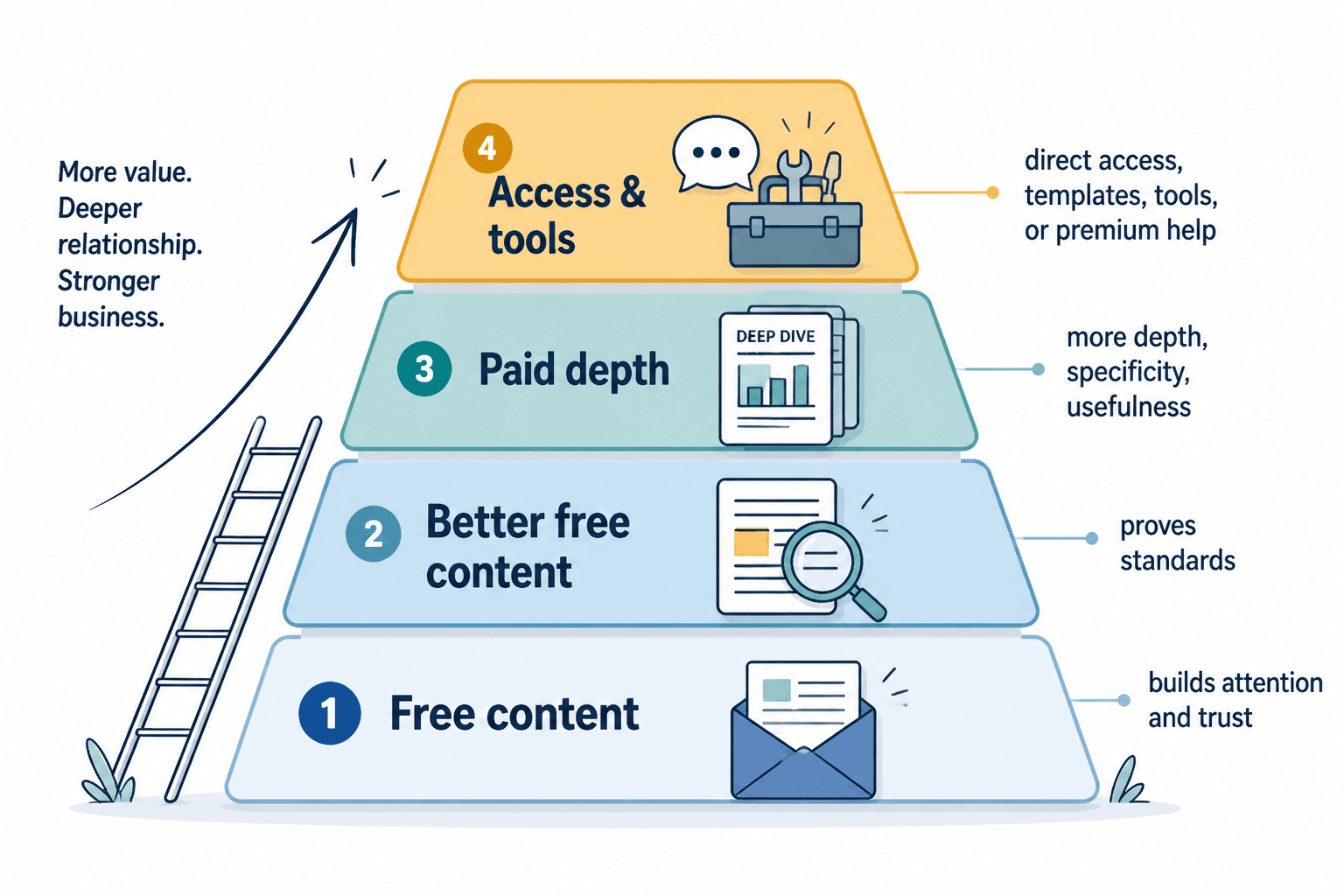
Use a free-to-paid ladder, not a trap door
A lot of creators treat paid Substack like a switch. One day it is free. The next day half the newsletter is locked and the tone gets a little desperate. That usually goes badly because the reader did not experience a progression. They experienced a mood swing.
A better model is a ladder.
- Free content builds attention and trust.
- Better free content proves your standards are high.
- Paid content offers more depth, more specificity, or more direct usefulness.
- Higher-ticket offers come later, if they fit.
That means your free posts should still be worth reading on their own. Not teaser scraps. Not padded intros for premium content. Actual value. The free layer is not there to be stingy. It is there to prove your paid layer is likely worth it.
This matters even more for newer writers with smaller lists. If trust is still forming, you cannot act like The New York Times with a velvet rope. You need your free posts doing real work: building confidence, showing your thinking, and giving readers enough wins that paying feels like the obvious next step.
How to structure paid Substack series so people want the next part
Series are one of the cleanest ways to monetize on Substack because they create continuity. Done well, they feel like a guided path. Done badly, they feel like a Netflix show that forgot to include an ending.
A paid series works best when each part has its own value, but the full run gives the reader a better result than any one post alone.
A simple paid series structure
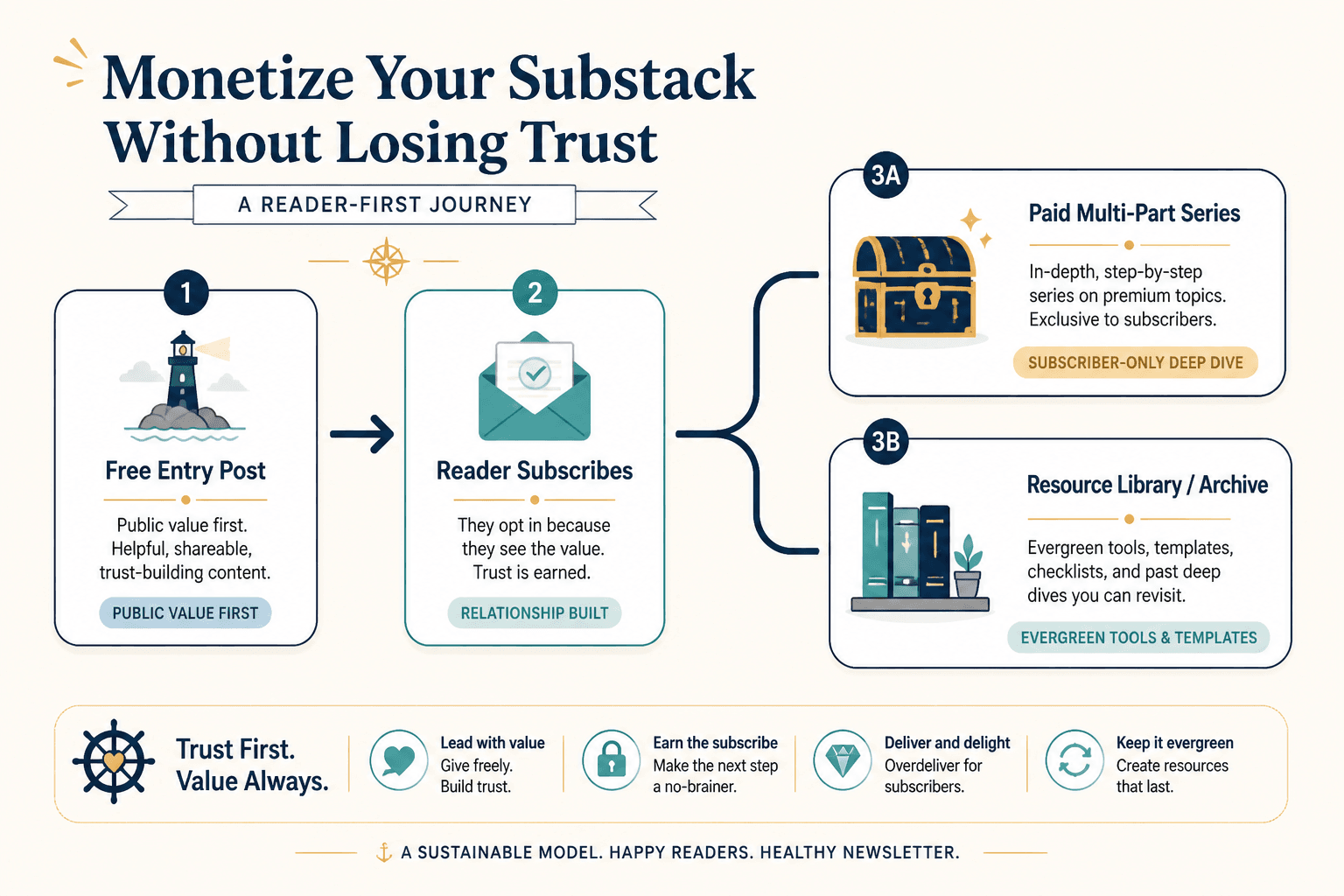
- Open the series with a strong free post. Explain the problem, stakes, and overall path.
- Use the next paid posts to go deeper. Break the topic into practical parts with examples.
- Give each installment a clear payoff. Do not save all usefulness for the finale.
- Build momentum between parts. End with what comes next and why it matters.
- Close with synthesis. Summarize the system, add a checklist, template, or implementation guide.
Here’s a simple example.
- Free part 1: Why most newsletter monetization feels gross and what to do instead
- Paid part 2: Choosing what to monetize: depth, access, templates, or curation
- Paid part 3: Designing a paid editorial calendar readers will stick with
- Paid part 4: Writing conversion points inside posts without sounding needy
- Paid part 5: Creating a paid archive, resource hub, or subscriber-only bonus system
- Paid part 6: Putting the whole thing into a simple content-to-revenue flow
The key is that the free part gives enough value to earn attention, while the paid sequence gives enough additional structure and usefulness to justify the subscription.
What kills a paid series
- Weak setup with no clear promise
- Posts that feel repetitive
- No progression from one installment to the next
- Too much filler because “it’s a series”
- Making the paid layer feel like homework instead of help
If you want more series-specific strategy, read Substack posts and series guide for creators who want better results. It pairs nicely with this because good monetization depends on a solid series structure in the first place.
Do not hide all the good stuff behind the paywall
This is where writers get twitchy. They think, “If I give too much away for free, nobody will pay.”
Usually the opposite problem is more common. They give too little away, so nobody has enough evidence to pay.
Your free posts should do at least one of these things well:
- Teach something useful
- Offer a sharp perspective
- Solve a small but real problem
- Show your credibility through examples or reasoning
- Make the reader think, “If this is free, the paid stuff is probably solid”
What should stay paid is the more involved layer: the system, the template, the detailed teardown, the step-by-step application, the archive, the office hours, the curated edge.
Think of free content as proof and paid content as leverage. Free says, “I know what I’m doing.” Paid says, “Here is the version that saves you time, gives you implementation help, or gets you deeper results.”
If your free content is useless, your paid content looks risky. If your free content is excellent, your paid content looks promising.
Write monetized posts like a host, not a hustler
Tone matters more than people admit. Readers can feel the difference between a writer inviting them into a better experience and a writer constantly nudging them toward checkout.
The easiest fix is to write like a host.
- Be clear about what is free and what is paid.
- Explain why the paid version exists.
- Describe the benefit without overselling it.
- Let the work make the case.
- Stop repeating the pitch three times in one post. They heard you.
That last one matters. A lot.
Writers often get nervous that readers will miss the offer, so they mention it in the intro, in the middle, in the conclusion, and in the postscript like they are trying to summon a conversion with ritual chanting. Calm down. One clean mention, maybe two if the post is long, is plenty.
Weak monetization language
- “If you want to support my work, consider becoming a paid subscriber.”
- “The rest is for premium members only.”
- “Upgrade now for exclusive content.”
Stronger monetization language
- “I kept this one free because the core idea matters. Paid subscribers get the full teardown with examples and the template I use.”
- “This series starts in public, then the paid posts go into the implementation side: structure, examples, and mistakes to avoid.”
- “If you want the detailed version, the subscriber edition includes the full framework and the checklist.”
See the difference? One sounds vaguely needy. The other tells the reader what they actually get.
Use clear monetization models readers can understand in seconds
You do not need a complicated membership maze. Most creators are better off with a simple, obvious value model.
| Model | What readers get | Why it works |
|---|---|---|
| Free + premium deep dives | Public essays, paid breakdowns and templates | Easy to understand and easy to maintain |
| Free + paid series | Free entry point, subscriber-only multi-part training or analysis | Creates momentum and retention |
| Free + paid archive | Public recent posts, premium access to library or resource hub | Good for evergreen utility |
| Free + subscriber Q&A | Public writing plus private answers, feedback, or office hours | Adds access without constant hard selling |
| Free + paid tools | Public insights plus templates, prompts, checklists, swipe files | High practical value for professional audiences |
Pick one model first. Do it well. Most trust problems start when people stack too many monetization layers too early and the newsletter starts looking like a menu designed during a sugar rush.
Make the offer fit the post
This is one of the most overlooked parts of Substack monetization.
The offer at the end of a post should match the kind of value the post just delivered. If the post is a sharp opinion piece, a paid CTA for a detailed breakdown can work. If the post is a practical tutorial, the natural paid extension might be a template, checklist, or case study. If the post is a series opener, the paid next step should continue that exact path.
What does not work is slapping the same generic subscribe line under every post regardless of what the reader just experienced. That is lazy. It also lowers conversion because the offer feels disconnected.
Examples of matched offers
- Post: Why most newsletter welcome emails underperform
Better paid offer: “Paid subscribers get the 5-email welcome sequence template and full breakdown.” - Post: A public essay on creator trust and audience fatigue
Better paid offer: “The subscriber edition includes the trust audit I use to spot where monetization starts to feel off.” - Post: Part one of a Substack series
Better paid offer: “The next installment goes into the exact structure, examples, and conversion points.”
The point is not to be clever. The point is to be coherent.
How to sell inside Substack posts without sounding salesy
You do not need to pretend money is embarrassing. You also do not need to turn every post into a mini launch.
Clean selling inside Substack usually comes down to four moves:
- Give value first. Make the post worth the open.
- Bridge naturally. Mention the next level of help in a way that fits the topic.
- State the benefit clearly. Tell readers what the paid version includes.
- Leave space. Do not perform desperation in the closing paragraph.
Here’s a basic formula:
“This post covers the core idea. If you want the applied version, the paid edition includes [specific asset, walkthrough, examples, or framework].”
That works because it is specific and calm. No chest-beating. No guilt. No “join hundreds of ambitious professionals.” Thank you, no.
If your bigger goal is turning Substack into revenue beyond subscriptions, read how to turn Substack posts and series into more leads or sales. Paid subscriptions are only one path. Depending on your business, a post can also lead to a service, consultation, product, or newsletter-driven funnel.
Do not confuse trust-preserving monetization with being timid
Some writers overcorrect. They get so worried about sounding pushy that they barely mention their paid offer at all. Then they conclude that “my audience just doesn’t buy.”
Maybe. But often the actual problem is that readers do not know what is available, why it matters, or who it is for.
You can protect trust and still be direct.
- Tell readers what the paid subscription includes.
- Repeat the structure occasionally in plain English.
- Mention who the paid tier is best for.
- Point to a useful paid archive or series.
- Explain the difference between free and paid without getting weird about it.
Clarity is not pushy. Vagueness is not noble. If the paid layer is genuinely useful, describe it like an adult.
A practical free vs paid content split
You do not need a sacred ratio, but you do need a pattern readers can understand. Here is a practical starting point for many Substack writers:
- Free: strong public essays, selected practical posts, previews of series, useful opinion pieces, occasional full-value flagship pieces
- Paid: implementation details, toolkits, in-depth case studies, recurring series installments, archives, Q&A, templates
A simple way to test your balance is to ask two questions.
- Would a free reader still think this newsletter is worth subscribing to?
- Would a paid reader clearly feel they are getting something extra and meaningful?
If the answer to either is no, adjust.
What to monetize besides subscriptions
Not every Substack should rely on paid subscriptions as the main revenue model. In some cases, Substack works better as trust-building infrastructure that leads to other offers.
That can actually preserve trust better, because the monetization path is tied to a clear business model instead of trying to force every reader into a monthly payment.
Substack posts and series can support:
- Consulting or coaching offers
- Workshops or cohorts
- Digital products
- Courses
- Speaking or training inquiries
- Low-ticket templates or playbooks
- Lead magnets that move readers into a broader funnel
If that route fits your business better, read best funnel ideas to pair with Substack posts and series. The right monetization model depends on what you actually sell, not what some creator thread said was “working right now.”
Common mistakes that make readers trust you less
Some trust damage is subtle. Some is gloriously obvious. Here are the usual offenders.
The bigger point is simple: clearer structure and clearer writing make the piece more useful. That is usually what makes the ending land better too.