
Most people trying to get leads or sales from Substack make the same mistake: they publish good thoughts, earn polite attention, and then do absolutely nothing useful with that attention.
They write a thoughtful post. Maybe even a strong series. Readers nod along, maybe subscribe, maybe share it, and then leave with no clear next step. No path. No offer. No reason to move closer.
That is the problem. Not that your writing is bad. Not that your audience is too small. Usually it is that your Substack content is acting like a nice little magazine when it should be doing a bit more business work.
If you want to know how to turn Substack posts and series into more leads or sales, the answer is not “sell harder.” It is to build cleaner bridges between your ideas, your audience’s needs, and the next action that makes sense. That could mean an email reply, a free resource, a consult, a paid offer, a product, or a low-friction way to keep the relationship moving.
This is where a lot of smart writers get weirdly passive. They publish value, hope readers connect the dots, and then wonder why nothing converts. Readers are busy. They do not sit there thinking, “How can I become a lead for this creator today?” You have to guide them without turning your newsletter into a greasy funnel in a trench coat.
If you want the bigger picture, start with the parent guide.
Why Substack is better for trust than instant conversion
Substack is not usually the place for hard-closing strangers cold. It is much better at building trust, depth, and repeat attention. Which is good news, because trust is the thing most people skip while trying to force conversions from content.
A strong Substack post lets you show how you think. A strong Substack series lets you show how consistently you think. That difference matters. One good post can earn interest. A good series can build authority, credibility, and buying intent over time.
So the goal is not to make every post “convert.” The goal is to make your posts and series pull readers toward the right next step.
- A post can spark awareness.
- A sequence can build trust.
- A soft CTA can identify interest.
- A linked resource or offer can capture intent.
- A follow-up system can turn attention into revenue.
That is a much saner model than trying to jam a sales pitch into every essay and hoping no one notices.
If you are still shaping the content side first, it helps to tighten the writing itself before expecting better conversion behavior. This guide on how to write better Substack posts and series is a useful companion if your ideas are solid but the packaging is loose.
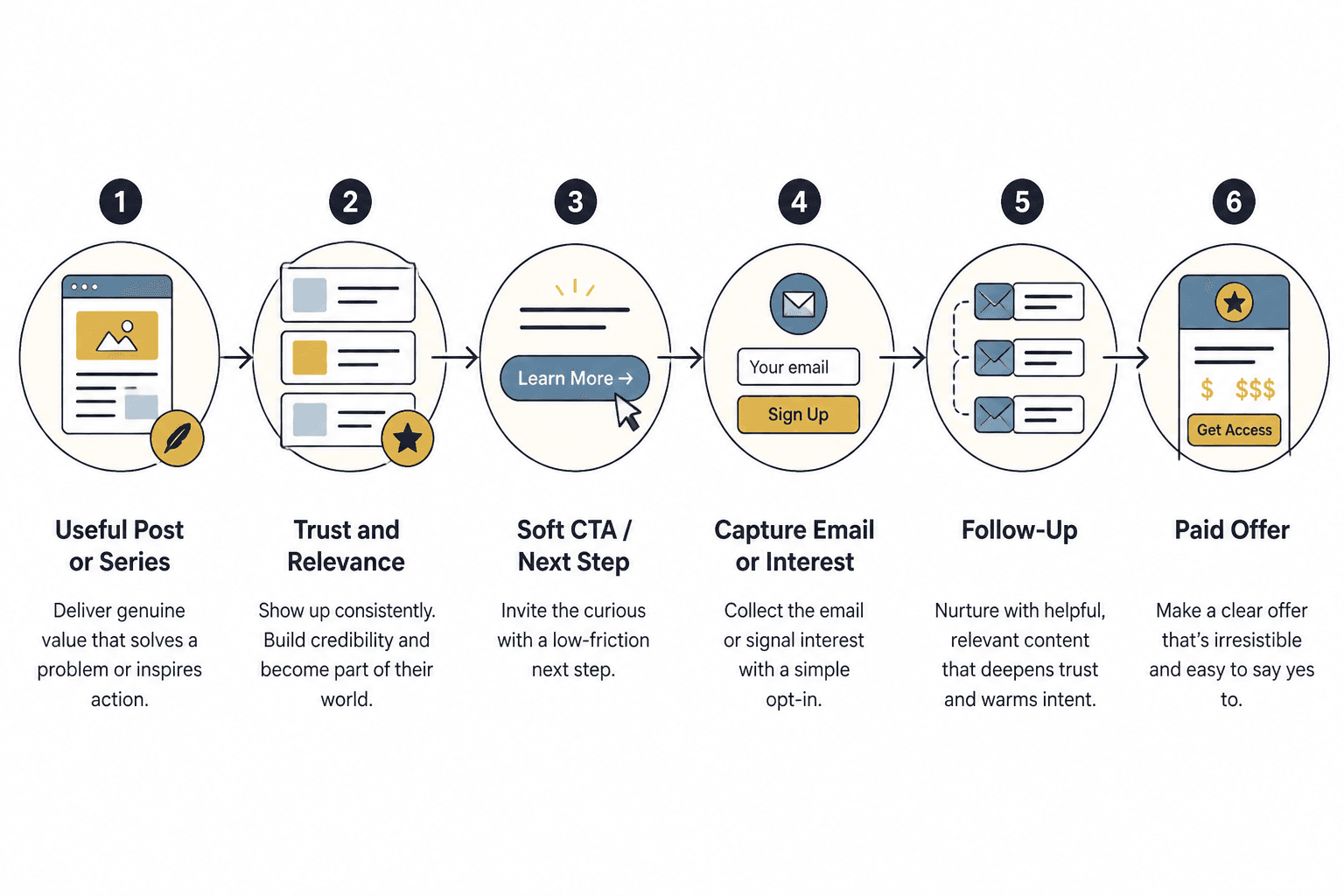
The basic conversion path for Substack content
Before you optimize anything, get clear on the path. Turning Substack posts and series into more leads or sales usually looks something like this:
- Publish a useful post or series tied to a specific problem.
- Build relevance and trust inside the content.
- Offer a next step that matches reader intent.
- Capture contact, interest, or direct response.
- Follow up with something more targeted.
- Present the paid offer when the context makes sense.
That next step matters more than people think. If your article is about fixing weak sales pages, the next step should not be a random “book a call” tossed at the bottom like an afterthought. It should feel connected. Maybe a sales page checklist. Maybe a teardown offer. Maybe a reply prompt inviting people to send their current page. Maybe a product that helps them implement the exact thing you just taught.
When content converts well, it usually feels less like persuasion and more like continuity.
Start with posts and series that connect to buying intent
Some Substack content is great for attention but weak for sales. Other content naturally attracts people closer to a buying decision. If your goal is leads or revenue, you need more of the second kind.
Topics that usually attract stronger lead intent
- Common mistakes your ideal client keeps making
- Behind-the-scenes process breakdowns
- Decision guides
- Frameworks people can apply to a business problem
- Case-study style posts
- Before-and-after rewrites
- Series that walk through a transformation step by step
- Comparisons between weak and strong approaches
These topics work because they attract readers who are not just vaguely interested. They are trying to solve something.
Topics that can get attention but often convert worse
- General mindset essays
- Broad industry commentary with no practical angle
- Personal updates with no business relevance
- High-level “lessons learned” posts
- Opinion pieces with no bridge to your offer
These are not useless. They can build personality and affinity. But if your whole Substack is made of ambient thoughts and tasteful observations, do not be shocked when it feels difficult to turn into leads.
A smart content mix helps. You want trust-building content, yes, but you also want problem-aware content that naturally creates demand for what you sell.
Do not just write posts. Build conversion-aware series.
Single posts can work. Series work better when you want sales with less awkwardness.
A series gives you room to build an argument, teach progressively, show proof, and earn the right to mention a relevant offer. It also gives readers repeated exposure to your thinking, which is often what they need before taking action.
This is one reason series are underrated. They create momentum. Instead of trying to make one heroic post do all the work, you spread the conversion job across several pieces.
A simple high-converting Substack series structure
- Part 1: Name the problem clearly.
Show the cost of doing it badly. - Part 2: Break down the common mistakes.
Help readers see themselves in the mess. - Part 3: Teach a better framework or process.
Give useful guidance, not vague fluff. - Part 4: Show examples, proof, or application.
Reduce doubt. - Part 5: Offer the next step.
Resource, product, service, consult, or reply invitation.
That is not manipulative. It is coherent. Readers are more likely to act when the path is obvious.
If you need fresh material for a series without inventing your personality from scratch every week, this piece on how to turn old content into better Substack posts and series can help you mine existing ideas that already connect to your offers.
Match the CTA to the stage of reader intent
This is where a lot of creators wreck trust. They write a solid educational post for fairly cold readers, then slap on a giant “work with me” pitch that belongs three steps later in the relationship.
Your CTA should match how ready the reader probably is.
| Reader state | Better CTA | Usually worse CTA |
|---|---|---|
| Just discovering you | Subscribe, reply, read related post | Book a high-ticket call now |
| Problem-aware | Download resource, join list, read part 2 | Generic sales pitch |
| Actively comparing solutions | Case study, audit, consultation, demo | “Hope this helped” and nothing else |
| Warm returning reader | Paid offer, service page, product link | Another vague “stay tuned” ending |
Most newsletter CTAs fail because they are either too aggressive or too timid. Too aggressive feels needy. Too timid wastes intent. You want the middle: relevant, useful, and proportionate.
Examples of stronger Substack CTAs
- “If this is the part your newsletter is struggling with, reply with ‘audit’ and I’ll send the breakdown.”
- “I put the full checklist into a short resource here if you want the practical version.”
- “This is exactly the kind of problem I fix in consulting. If you want help applying it to your setup, you can reach out.”
- “Part 2 covers the actual structure. Read that next before you rewrite anything.”
- “If you want the template I use for this, it’s inside the paid version.”
Notice what these do not sound like. They do not sound like webinar sludge. They are direct, contextual, and tied to the content the reader just consumed.
Use offers that fit the kind of trust Substack builds
Substack readers often respond well to offers that feel like a natural extension of your writing, not a left turn into bro-marketing theater.
That means the best lead and sales paths from Substack tend to be trust-friendly offers like:
- Consulting inquiries
- Advisory retainers
- Audits and reviews
- Paid subscriptions
- Templates, guides, and digital products
- Workshops
- Courses for a clearly named problem
- Application-based services
- Newsletter-linked lead magnets
If you are trying to monetize without making your readers feel like they just got cornered at a networking brunch, this guide on how to monetize Substack posts and series without wrecking trust is worth reading next.
The key question to ask
After reading this post or series, what is the most natural next action for someone who found it useful?
That should drive the offer.
Not “what do I want to sell today?”
That question matters, but it comes second. If the offer does not fit the content, conversion gets clunky fast.
Design posts with soft conversion points inside, not just at the end
Most people only think about CTAs at the bottom. That is lazy, and often ineffective.
Longer Substack posts especially benefit from small conversion points throughout the piece. Not constant pitching. Just strategic moments where the reader can take the next step without needing to finish 1,800 words first.
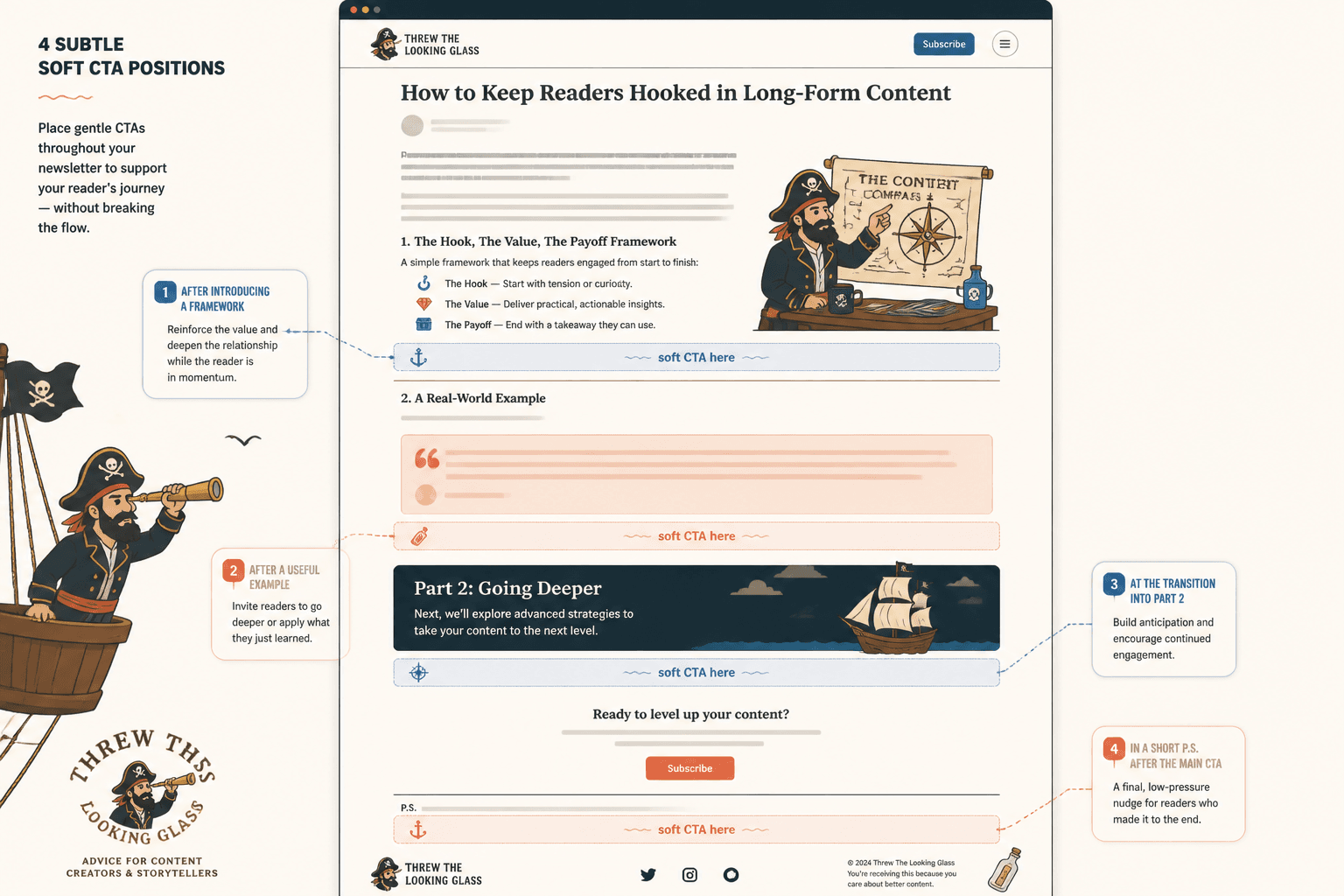
Places to add soft conversion moments
- After naming the problem
- After introducing a framework
- After showing a useful example
- At the transition into part 2 of a series
- In a short P.S. after the main CTA
For example:
If this is the exact bottleneck in your newsletter, I made a short worksheet to help you fix it. You can grab it here.
I’ll show the full rewrite process in the next issue, but if you already know you want help applying it to your own funnel, reply and I’ll send details.
These feel smoother than the classic creator move of teaching for twenty minutes and then suddenly shouting about your offer at the bottom like you just remembered rent exists.
Turn your best posts into lead filters, not just audience bait
A good lead magnet does not just get more people. It helps attract the right people.
Your best-performing Substack posts can do the same thing if you treat them like lead filters. That means writing in a way that qualifies readers, not just flatters them.
What qualifying content looks like
- It names a specific problem.
- It speaks to a specific kind of reader.
- It explains the cost of not fixing the problem.
- It shows your approach or philosophy.
- It makes the next step relevant for the right people.
For example, compare these two endings.
Weak: “If you need help with content, get in touch.”
Better: “If you are a consultant or founder with solid expertise but your newsletter still reads like polished oatmeal, this is exactly the kind of positioning and content system work I help clients fix.”
The second one qualifies. It helps the right person think, “Ah. That is me.” It also helps the wrong person self-select out, which is good. More leads is nice. Better leads is nicer.
Use series to sell the outcome, not just the information
One of the easiest ways to make a Substack series drive sales is to structure it around a transformation instead of a topic.
Topic-based series are fine. Transformation-based series convert better.
So instead of:
- “Five essays about newsletter writing”
Build something more like:
- “How to turn a quiet newsletter into a lead source in five parts”
- “How to fix a vague consultant newsletter so readers actually inquire”
- “How to build a Substack welcome path that earns trust and books calls”
See the difference? The second group has movement. Stakes. Reader benefit. A destination.
That destination gives you a much cleaner bridge to a relevant offer because your offer becomes the logical continuation of the transformation.
Make the next step stupidly clear
If readers have to guess what to do next, many of them will do nothing.
Clarity beats cleverness here. You do not need an artistic CTA. You need an obvious one.
Weak CTA language
- “Thoughts welcome.”
- “Reach out if this resonates.”
- “Check my stuff.”
Stronger CTA language
- “Reply with ‘template’ and I’ll send the version I use.”
- “If you want the full framework, read part 2 here.”
- “If this is the bottleneck in your business, you can apply to work with me here.”
- “The paid version includes the swipe file and examples.”
Specific actions get more action. A shocking development, I know.
Build a simple funnel around the post instead of expecting the post to do everything
You do not need a giant funnel. You do need a funnel.
Substack content converts better when it feeds into a simple system around it. This can stay lean.
Useful funnel paths for Substack
- Post → related post → lead magnet
- Post → reply prompt → conversation → soft pitch
- Series → paid subscription
- Post → case study → consultation page
- Post → resource download → email follow-up → offer
- Series → workshop invite
- Post → application form
The important thing is that your Substack content is part of a sequence, not a standalone island.
If you want ideas for the actual structure around your newsletter content, read best funnel ideas to pair with Substack posts and series.
It also helps to think of your broader content ecosystem. If your newsletter sits inside a larger strategy, these hub pages may be useful: email newsletter writing, newsletter writing, and Substack posts and series.
Use proof inside your posts so the offer feels earned
A lot of Substack content teaches well but sells weakly because it never gives readers a reason to trust the teacher beyond “this sounds smart.”
You do not need to turn every issue into a chest-thumping authority parade. But you do need some proof. Especially if you want people to buy, inquire, or move from reader to lead.
Useful forms of proof inside a Substack post
- A short case example
- A before-and-after rewrite
- A quick result from applying the method
- A client pattern you have observed repeatedly
- A specific mistake you have fixed and how
- A concrete process you use in your work
This can be subtle. One clean paragraph can do a lot:
One reason I’m opinionated about this is that I keep seeing the same issue in consultant newsletters: the writing is smart, but the offer path is foggy. Once that gets tightened, inquiries usually become much more consistent.
That kind of proof supports the offer without making the whole article feel like a brochure.
Repurpose high-intent posts into sales assets
If one of your Substack posts gets strong engagement from the right readers, do not just admire it and move on. Turn it into assets that support leads and sales elsewhere.
What to repurpose from a strong Substack post
The bigger point is simple: clearer structure and clearer writing make the piece more useful. That is usually what makes the ending land better too.
Stronger Substack posts usually come from a clearer point, tighter structure, and a more deliberate series flow. Better pacing often matters more than more volume.