
For the main guide behind this topic, visit the parent guide.
Examples
The bigger point is simple: clearer structure and clearer writing make the piece more useful. That is usually what makes the ending land better too.
Better rewrites and refreshes make the article clearer, more current, and easier to act on. A sharper update usually beats a bigger but messier rewrite.
Most people do not ruin trust when they monetize blog rewrites and refreshes because they sell. They ruin it because they suddenly start acting like every updated article is a trap door into a funnel.
That is the real problem. A refreshed blog post can absolutely bring in leads, subscribers, inquiries, and sales. But the second the article feels less useful than the CTA bolted onto it, readers notice. Fast. And they do not usually reward that with loyalty. They reward it with a tab close.
If you want to know how to monetize blog rewrites and refreshes without wrecking trust, the answer is not “never sell.” It is to make the updated content more useful than before, create a next step that actually fits the reader’s intent, and stop treating every piece like it needs to squeeze money out of someone by paragraph four.
Done well, a rewrite or refresh can pull in better search traffic, build more authority, and convert more readers than the original ever did. Done badly, it turns into a polished little betrayal wearing SEO shoes.
This piece will show you how to make blog refreshes commercially useful without making them feel like thinly disguised sales pages. We will cover what to monetize, where to place offers, which funnel types make sense, and what people keep getting wrong when they try to “optimize” trust right out of the room.
Why monetizing rewrites feels risky in the first place
A rewrite or refresh already changes the relationship a little.
The reader came for information. You updated the article to improve it, rank it, sharpen it, or align it with your current business. Fair enough. But if the update suddenly adds aggressive CTAs, awkward lead magnets, pushy product mentions, and pop-up energy in paragraph form, the reader can feel the shift instantly.
Trust gets damaged when monetization feels mismatched, premature, or manipulative. Not when it simply exists.
That matters because blog rewrites often sit in a delicate middle ground. They are not cold ads. They are not usually pure sales pages either. They are trust-building assets. So if you monetize them, the money has to come from relevance and usefulness, not pressure.
The good news is that this is fixable. In fact, refreshed articles are often better places to monetize than brand-new ones, because you already have signals. You can see what the article ranks for, what readers care about, where they drop off, and what intent is sitting behind the traffic.
That gives you something rare on the internet: evidence. Try not to waste it by slapping “book a call” onto everything with a pulse.
Start with the reader intent, not the revenue fantasy
If you want to monetize a blog refresh well, start by asking one question:
What is this reader actually trying to do when they land here?
Not what do you want them to do. What do they want help with?
This sounds obvious, but this is where a lot of people lose the plot. They refresh an article about fixing weak introductions, then try to funnel that traffic into a premium mastermind. Or they update a practical SEO piece and stuff it with broad positioning language that belongs on a homepage, not in the middle of a problem-solving article.
Intent should shape monetization. If the article attracts readers looking for hands-on fixes, give them a next step that helps them keep solving that problem. If it attracts readers closer to purchase, then a service, audit, consultation, or product may fit naturally.
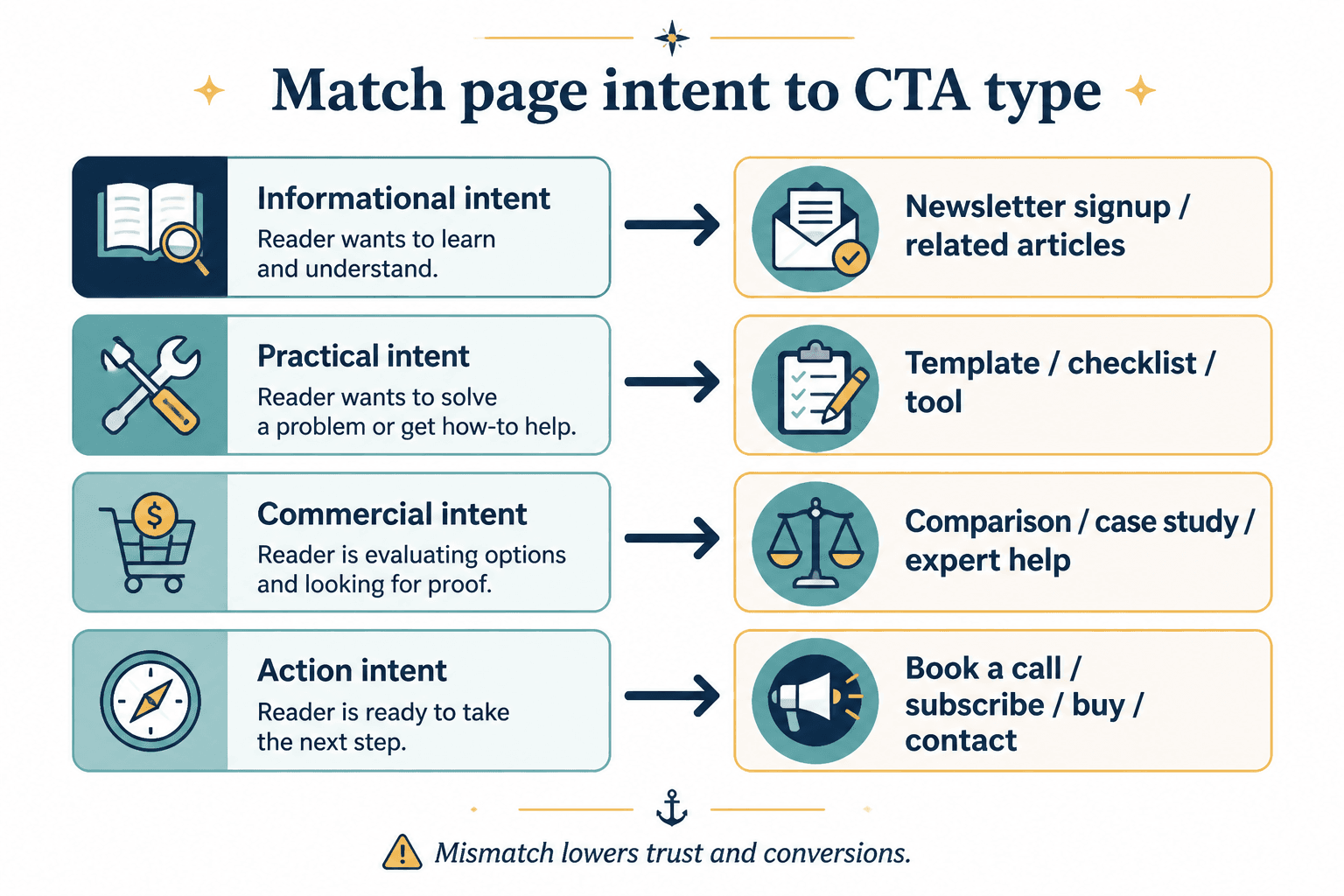
A simple intent check for refreshed articles
- Informational intent: The reader wants to understand something or improve a skill.
- Practical intent: The reader wants a template, checklist, tool, or process.
- Commercial intent: The reader is comparing solutions or looking for expert help.
- Action intent: The reader is ready to subscribe, book, buy, or contact.
The monetization should match that stage. If the article mostly attracts informational readers, a newsletter signup, downloadable resource, or related article path will usually work better than a hard pitch. If it attracts commercial readers, you can be more direct.
This is also why some blog refreshes convert beautifully and others do not. It is not always the CTA copy. Sometimes the offer is just wildly out of sync with the page.
What you can monetize in a blog rewrite without making it gross
You do not have to monetize every updated article the same way. In fact, you probably should not. Different rewrites support different business goals.
Here are the cleanest options.
1. Email subscribers
This is often the safest and strongest move, especially for top- and mid-funnel traffic. A well-matched newsletter CTA or free resource lets the reader continue the relationship without feeling cornered.
Good fit when:
- The article solves one piece of a bigger problem
- The reader likely needs ongoing guidance
- Your trust is stronger than your immediate conversion odds
2. Lead magnets tied to the article
This works best when the lead magnet is a natural extension of the article, not a random freebie tossed in because someone on YouTube said “capture emails.”
Examples:
- An article on rewriting blog intros leads to an intro checklist
- An article on content refreshes offers a refresh audit worksheet
- An article on monetization offers funnel examples or CTA templates
Relevance does most of the conversion work here.
3. Services
If the refreshed post attracts readers who clearly need expert help, you can point to a service. Just do it after earning the right.
This works especially well for consultants, strategists, SEO writers, editors, agencies, and content people with a productized service tied to the topic.
A strong service CTA usually follows useful proof. Not vague chest-thumping. Proof.
4. Paid products or templates
If you sell frameworks, swipe files, packs, mini-products, or courses, refreshed articles can feed them well. But the product has to feel like a real shortcut, not a paywall disguised as “premium insight.”
The article should still stand on its own. If the post feels intentionally incomplete so the product can rescue it, trust takes a hit.
5. Soft consultation paths
Sometimes the best monetization is not a giant CTA button. It is a soft bridge.
Something like:
If your content is getting traffic but not turning into leads, this is the kind of thing I help clients fix. You can read more about that here.
That works because it feels proportionate. Calm. Useful. Like you are an adult, not a funnel intern with a quota.
How to monetize blog rewrites and refreshes without wrecking trust: the practical framework
Here is the simple version. Every monetized refresh should do four things well:
- Improve the article itself
- Match the offer to the reader’s likely intent
- Place the offer where it makes sense
- Keep the content useful even if nobody clicks the CTA
That is the whole job. The rest is execution.
Step 1: Refresh for value first
Before you touch the monetization, fix the article.
If the original piece is outdated, thin, repetitive, vague, or badly structured, monetizing it harder will just make a mediocre asset more annoying. Refresh the examples. Tighten the opening. Improve clarity. Add real specifics. Answer the actual search intent more completely. If you need help with the writing side of that, see how to write blog rewrites and refreshes without sounding salesy or robotic and how to start blog rewrites and refreshes without a weak opening.
A better article earns more trust. More trust makes monetization less fragile.
Step 2: Choose one primary conversion goal
Do not make one article try to do all of this at once:
- Get newsletter subscribers
- Sell a template pack
- Book calls
- Push a workshop
- Warm up a service inquiry
- Send people to three other pages
That usually creates noisy pages and weak results.
Pick one primary goal and maybe one soft secondary path. That keeps the article coherent and gives the CTA a fair shot.
Step 3: Put the CTA where the reader has earned it
A lot of trust problems are timing problems.
If you ask too early, it feels needy. If you only ask once at the very bottom of a long article, many readers never see it. The answer is usually a few calm, relevant opportunities instead of one giant shout.
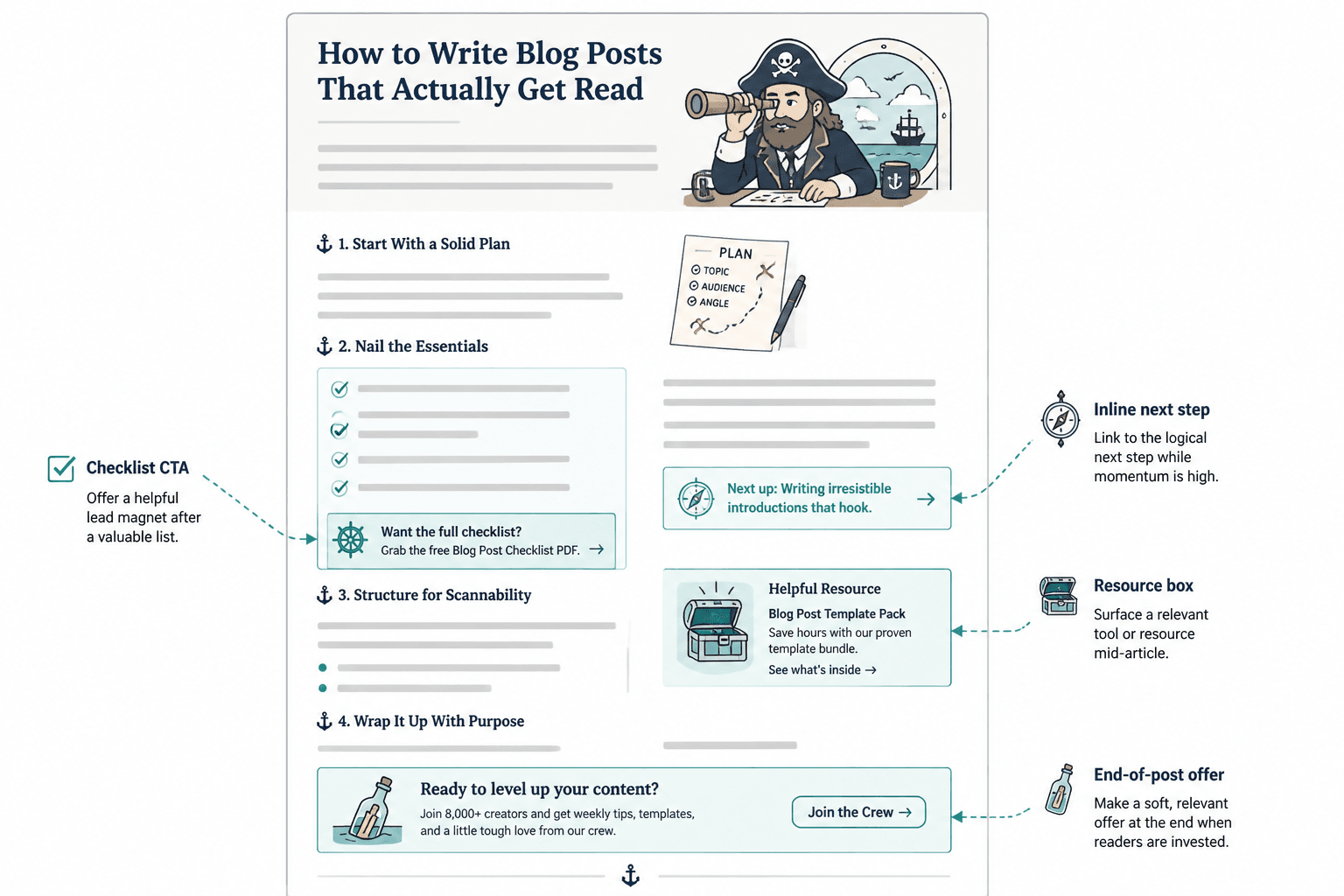
Good CTA placements in a refreshed article:
- Near the intro, if it helps frame the article and is low-pressure
- Mid-article, when a reader has just hit a friction point or useful insight
- At the end, once the article has delivered
Bad CTA placement is not just “too high” or “too low.” It is misplaced emotionally. A CTA should feel like the next sensible step, not a hand grabbing the reader’s ankle.
Step 4: Make the offer feel like continuation, not interruption
The cleanest monetization flows out of the article’s logic.
If your article explains how to refresh old posts for more traffic, then the next step might be:
- A refresh checklist
- A content audit service
- A funnel guide for updated content
- A lead generation system tied to refreshed articles
That feels coherent. The reader does not need to make a weird mental leap.
This is where internal linking helps too. If the article is part of a broader cluster, guide the reader naturally. For example, you can send them to how to turn blog rewrites and refreshes into more leads or sales or best funnel ideas to pair with blog rewrites and refreshes if they are ready for the next stage.
What trust-safe monetization actually looks like on the page
Let’s make this less abstract.
Weak version
“Need help growing your content? Book a strategy call now. Spots are limited.”
This is weak because it is broad, generic, and not tied to the article. It could sit under literally anything. Which is usually a sign it should not be there.
Better version
“If you have older blog posts bringing in traffic but not leads, the fix is usually not ‘publish more.’ It is structure, intent, and CTA fit. If you want help finding those gaps, I offer content refresh audits here.”
Now the offer matches the topic, the reader problem, and the article’s logic.
Weak lead magnet CTA
“Download my free business growth guide.”
No. Too broad. Too foggy. Too interchangeable.
Better lead magnet CTA
“Want to turn updated articles into actual next steps? Grab the blog refresh CTA checklist I use to match offers to search intent.”
That works because it feels like a useful extension, not a random bribe.
The monetization mistakes that quietly damage trust
Most trust damage is not dramatic. It is cumulative. It comes from patterns that make readers feel managed instead of helped.
1. Updating the CTA but not the content
If the article still feels old, thin, or undercooked, but the sales layer is shiny and current, the imbalance is obvious. Readers can feel when the business model got refreshed more carefully than the actual advice.
2. Treating every article like bottom-of-funnel traffic
Some articles attract buyers. Some attract learners. Some attract curious people who may become buyers later. If you pitch all of them the same way, conversion usually drops and trust goes with it.
3. Forcing urgency where none exists
“Act now.” “Limited spots.” “Do not miss out.”
Sometimes urgency is real. Fine. But if every refreshed article sounds like it wandered in from a launch sequence, people start tuning out. Calm specificity beats fake urgency most of the time.
4. Hiding the pitch inside “helpful” content
This is the manipulative cousin of trust-based marketing. The article pretends to educate, but every section is really just steering toward the product reveal. Readers are not stupid. If the article exists only to corner them, they can tell.
5. Monetizing pages with no proof
If you want a refreshed article to sell a service or product, the page should give the reader some reason to believe you know what you are doing. That might be examples, strategic reasoning, before-and-after logic, process clarity, or sharp diagnosis.
“Trust me, I help people with this” is not proof. It is a sentence.
Best monetization paths for different types of refreshed blog posts
| Type of refreshed article | Best primary monetization | Trust-safe secondary path |
|---|---|---|
| Educational how-to post | Newsletter or lead magnet | Related service page |
| Problem-solving tactical post | Checklist, template, or audit | Consultation CTA |
| Comparison or strategy post | Service inquiry or product | Newsletter |
| Authority-building evergreen guide | Email opt-in | Internal links to service-related content |
| Case-study style refresh | Consultation or audit | Related article path |
You do not need a giant monetization system to make this work. You need a sensible match between content type, reader intent, and next step.
How to build a simple funnel from a refreshed article
People hear “funnel” and immediately picture a seven-email labyrinth with timers and a fake smile. It does not need to be that complicated.
For most creators, consultants, and service-led businesses, a simple trust-first funnel is enough.
Simple funnel option 1: Article to lead magnet to nurture
- Refreshed article solves a specific problem
- CTA offers a useful related resource
- Email sequence expands on that problem
- Service or product is introduced later, when relevant
Simple funnel option 2: Article to service page
- Refreshed article attracts commercially relevant traffic
- In-article CTA points to audit, consultation, or service
- Service page continues the same problem/solution logic
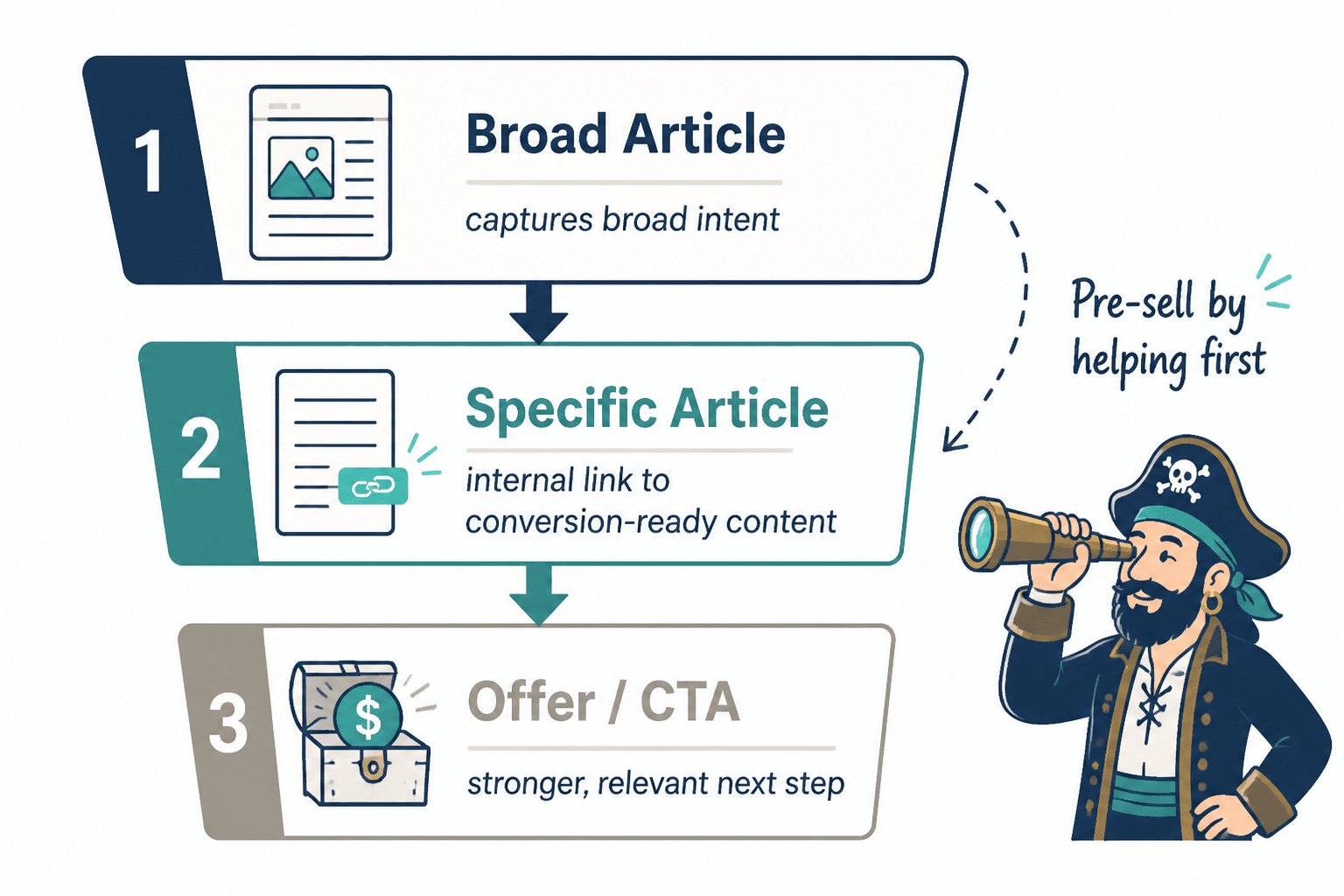
Simple funnel option 3: Article to related article to offer
- First refreshed article captures broad intent
- Internal link sends readers to a more specific, conversion-ready article
- That second article carries the stronger CTA
This third option is underrated. Not every article needs to convert directly. Some should pre-sell by helping the reader get more informed and more ready. If you are building a cluster around this topic, your broader blog rewrites and refreshes content can do a lot of that lifting.
And if you are planning the bigger content system, it also helps to map the article into the wider blog SEO writing and blog article systems structure, instead of treating each refresh like a lone sales opportunity floating in space.
How to write monetized CTAs that do not sound thirsty
A decent rule: the CTA should sound like a competent recommendation, not a panic response.
Good monetized CTAs usually include some mix of these:
- The specific problem
- Who the next step is for
- What the reader gets
- Why it is relevant now
- A calm invitation
Examples
The bigger point is simple: clearer structure and clearer writing make the piece more useful. That is usually what makes the ending land better too.
Better rewrites and refreshes make the article clearer, more current, and easier to act on. A sharper update usually beats a bigger but messier rewrite.