
Most blog rewrites do not fail because the writer lacks skill. They fail because the opening still sounds like the old draft wearing a cleaner shirt.
You update the stats. Tighten a few sentences. Swap in a better keyword. Maybe even improve the subheads. But then the intro still opens with three limp lines explaining the obvious, and the whole piece drifts into the same beige fog it had before.
If you want to know how to start blog rewrites and refreshes without a weak opening, the fix is not “write a catchier intro” and hope for the best. You need a better starting point. One that finds the real angle of the piece, cuts the stale throat-clearing, and gives the reader a reason to keep going before they bounce back to search results with the emotional energy of someone abandoning a sad buffet.
This article will help you do exactly that. We will cover how to diagnose a weak opening, how to rebuild one around actual reader intent, and how to write refreshed intros that feel sharper, clearer, and much more worth reading. If you are updating older blog posts for SEO, authority, leads, or just basic dignity, this is where the rewrite should start.
If you want the broader system behind refreshes, it also helps to review the main blog rewrites and refreshes hub and the wider blog SEO writing section. But for now, let’s deal with the part most drafts quietly fumble: the beginning.
To see how this fits into the wider strategy, open the parent guide.
Why blog refresh openings go weak so fast
A weak opening usually comes from one of two problems.
- You are still writing from the old article structure instead of the current reader need.
- You are trying to “ease in” instead of getting to the point.
That second one gets people all the time. They think a refreshed article needs a polite runway. A little context. A broad setup. Some introductory wallpaper about why the topic matters.
It does not.
When someone lands on a rewrite or refresh, they are usually trying to solve something specific. They searched for a fix, clicked because your title suggested a useful answer, and now they are scanning the top of the page to decide if this article is current, relevant, and likely to help. Your opening is not there to gently clear its throat. It is there to confirm they are in the right place.
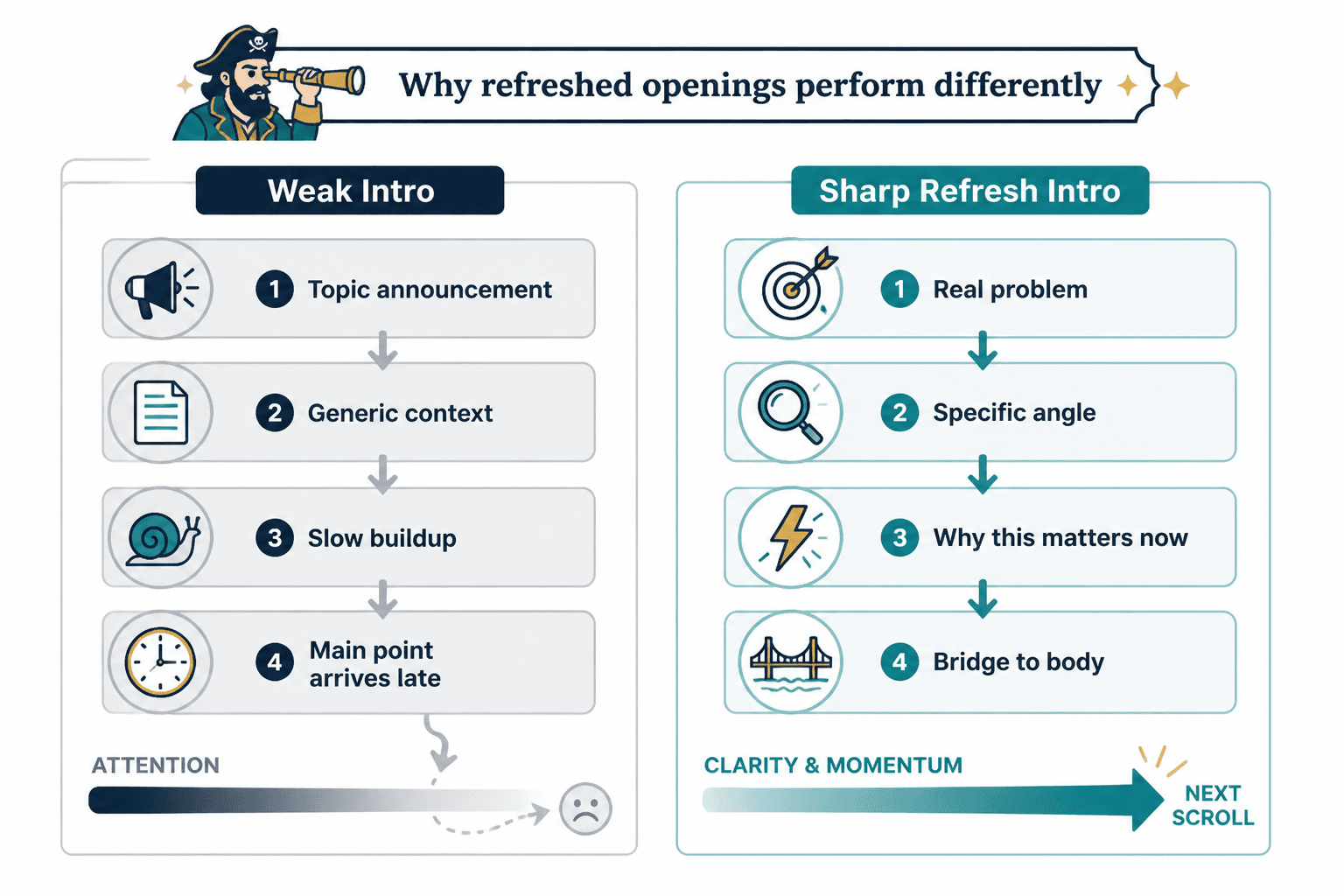
A good refreshed opening does three things quickly: names the real problem, sharpens the angle, and earns the next scroll.
If it spends too long announcing the topic instead of framing the tension, it feels old. Even if the rest of the article is updated.
That is why so many refreshes still underperform. The body got better. The beginning did not.
What a strong opening actually needs to do
Before you rewrite anything, get clear on the job of the intro. It is not just there to sound nice. It has work to do.
- Match the search intent or reader expectation behind the title
- Show you understand the specific problem
- Signal that this article is current and useful
- Set up the angle or payoff of the piece
- Move the reader cleanly into the body
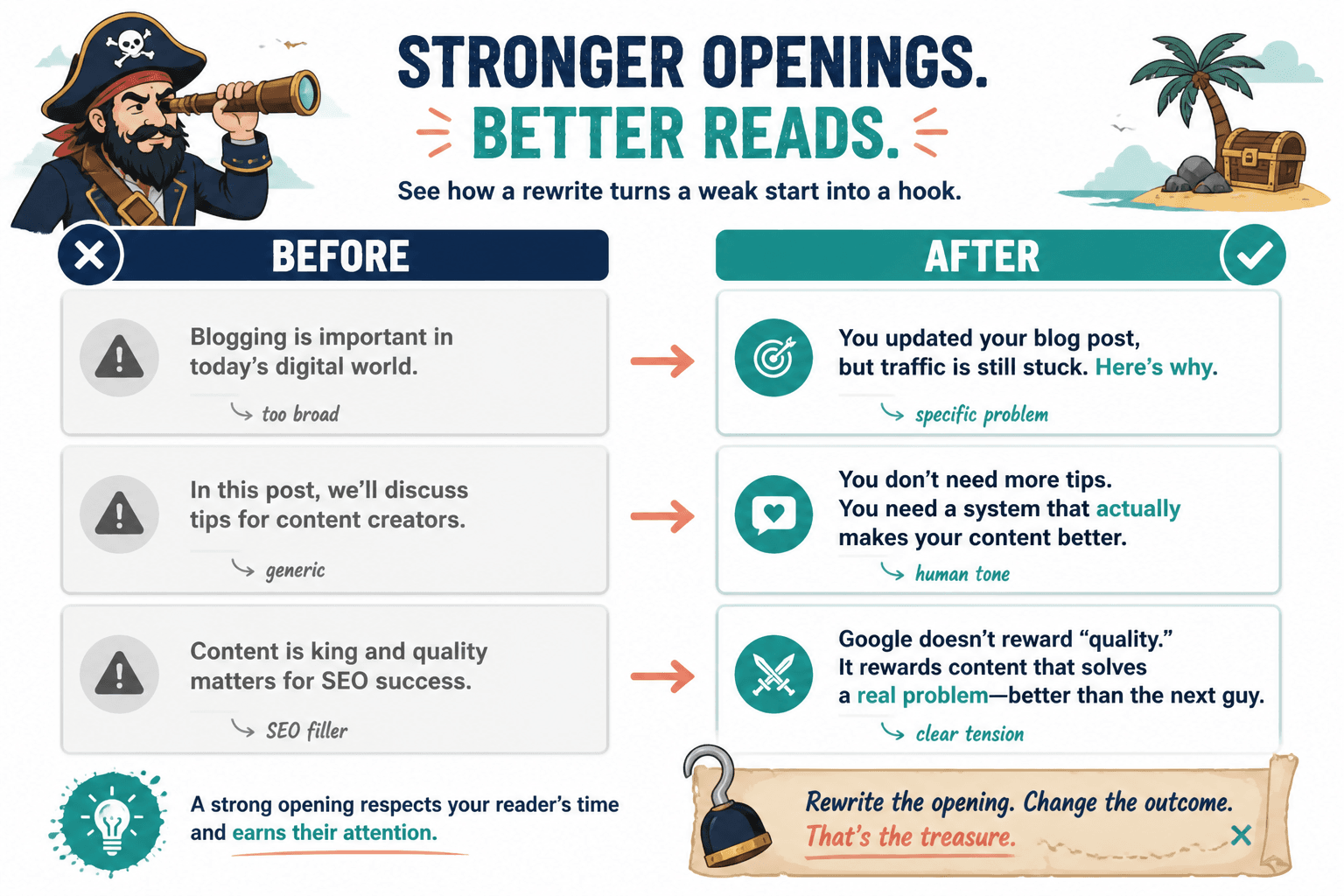
That means the best openings are usually more specific than writers expect. They do not begin with broad educational fluff like “Content refreshes are important for maintaining relevance.” That is technically true and spiritually dead.
A stronger opening sounds more like this: “Most blog refreshes improve the article but leave the intro untouched, which is why the piece still feels old within ten seconds.”
See the difference? One describes the topic. The other creates tension inside the topic. That tension is what pulls people in.
How to start blog rewrites and refreshes without a weak opening: the simple process
If you want a repeatable method, use this five-step process before you rewrite the intro itself.
1. Figure out what the article is really about now
The old version may have been aimed at a broader or weaker question. Your refresh needs to reflect what the article should do today, not what it was trying to do eighteen months ago when everyone was publishing vaguely helpful 1,200-word posts and calling it strategy.
Ask:
- What problem is the reader most likely trying to solve now?
- What angle makes this article different from the ten similar results nearby?
- What would make someone trust this piece within the first few lines?
- What outcome should they get by the end?
If you cannot answer those cleanly, do not touch the intro yet. You do not have an intro problem. You have an article-positioning problem.
2. Find the actual friction point
Weak openings usually stay general. Strong ones start where the reader is getting stuck.
For example, if your article is about blog rewrites and refreshes, the friction point is not “people need updated content.” The friction point might be:
- They keep refreshing posts but rankings do not improve
- The updated draft still feels stale
- The intro loses readers before the useful part begins
- The rewrite sounds robotic and over-optimized
- They are improving information but not improving reader experience
That friction gives you your opening. No friction, no edge. No edge, no momentum.
3. Cut the “topic announcement” lines
This is the easiest cleanup step and one of the most useful.
Look at the first 3–5 lines of the current article and delete anything that does one of these things:
- Defines the topic in obvious terms
- States that the topic matters
- Uses generic search-optimized filler
- Explains what the article will cover before giving a reason to care
- Sounds like it is introducing a webinar from 2019
You can always add a little context back in later. Most intros do not need more context. They need less furniture.
4. Lead with the tension, not the textbook
Your first paragraph should make the reader feel seen, slightly called out, or usefully challenged. Ideally all three.
Good opening moves include:
- Calling out the common mistake
- Naming the hidden reason the article is underperforming
- Challenging a lazy assumption
- Showing the gap between what people update and what readers actually notice
You are not trying to be dramatic. You are trying to be accurate in an interesting way.
5. Make the promise early and naturally
Once the problem is clear, tell the reader what this refreshed article will help them do. Do it plainly. Do not hide the payoff under cleverness.
Something like:
Here’s how to rebuild the opening of a rewritten blog post so it sounds current, earns attention faster, and leads cleanly into the rest of the piece.
Simple works. Readers are not here to admire your intro. They are here to decide if they should keep reading.
The easiest way to write a better refreshed opening
If you want a practical template, use this four-part structure:
- Problem: name what is going wrong
- Tension: explain why the obvious fix is not enough
- Promise: say what this article will help them do
- Bridge: move into the body with a clean next step
That is enough structure to keep the intro sharp without making it sound formulaic.
Template
[Common problem].
[Why most people still get it wrong or why the usual fix is weak].
[What this article will help them do instead].
[Clean transition into the first section].
Filled example for this topic
Most blog refreshes improve the information but keep the same tired intro, which means the piece still feels old before the reader even reaches the useful part.
That is the problem with weak openings: they make a refreshed article look barely refreshed at all. Better stats and cleaner formatting cannot save an intro that spends four lines politely announcing the topic.
Here’s how to rewrite blog openings so they feel sharper, more current, and more worth reading without turning them into clickbait sludge.
Start by figuring out what the article actually needs to say now.
Before-and-after opening rewrites
Sometimes the fastest way to improve your own intros is to see what changed in a real rewrite pattern. So here are a few.
Example 1: broad and obvious to specific and useful
Before: Blog content refreshes are important for keeping your website up to date and relevant in search engines. By updating old posts regularly, businesses can improve performance and provide value to readers.
After: A lot of blog refreshes look productive on the backend and invisible on the page. You update keywords, stats, and headers, but the intro still sounds stale, so readers leave before the rewrite gets a chance to work.
Why it works better: the second version names the failure point and gives the reader a recognizable problem instead of generic importance language.
Example 2: too soft to properly sharp
Before: If you are thinking about rewriting your old blog posts, it can be helpful to know where to begin. There are many elements to consider when refreshing content for modern audiences.
After: The worst place to start a blog refresh is with random edits. If the opening stays vague, the whole article still feels weak no matter how many sections you polish underneath it.
Why it works better: it creates direction immediately. It also has a point of view, which helps. Not every article needs to be spicy, but bland is rarely persuasive.
Example 3: too much setup to cleaner promise
Before: With content marketing continuing to evolve, many brands are realizing the need to revisit previous blog posts and ensure they align with current best practices, audience expectations, and SEO strategies.
After: Updating an old blog post is easy. Making it feel current in the first ten seconds is harder. If the opening still sounds padded, cautious, or generic, the refresh is not finished.
Why it works better: it sounds human, current, and grounded in an actual reading experience instead of floating in abstract marketing weather.
If you want more rewrite examples like this, see how to rewrite boring blog rewrites and refreshes and how to write better blog rewrites and refreshes.
How to diagnose your current intro in under five minutes
If you are refreshing an existing post, do not start by rewriting sentence one in isolation. Diagnose the opening first.
Use this quick check.
| Question | If the answer is no |
|---|---|
| Does the first paragraph name a specific problem? | The intro is probably too broad. |
| Would a real reader feel understood within 2–3 lines? | The opening likely lacks tension. |
| Does it sound current rather than recycled? | You may be using stale SEO filler. |
| Is there a clear angle, claim, or opinion? | The intro may be too neutral to matter. |
| Does it lead naturally into the rest of the piece? | You may have an intro that sits on top of the article instead of opening it. |
If your intro fails three or more of those checks, do not patch it. Replace it.
Common opening mistakes in blog rewrites and refreshes
These are the patterns that quietly wreck a refreshed article before it gets moving.
Starting with obvious definitions
If someone searched for your topic, they usually do not need a school-project definition in line one. They need relevance, not a glossary entry.
Keeping the original intro because it is “fine”
Fine is often the problem. A refreshed article should not begin with the most forgettable part of the old draft just because rewriting intros feels annoying.
Trying to sound authoritative by sounding formal
Authority does not come from sounding laminated. It comes from saying something clear and useful with confidence.
Overexplaining the topic before stating the point
Context has its place. But if readers have to wade through six sentences before they know what the article is really about, the opening is dragging.
Writing an intro that could fit any article on the topic
This one is everywhere. If you could paste your opening onto a dozen competing articles and nobody would notice, it is too generic.
A cleaner rewrite workflow for intros
Here is a workflow you can actually use when refreshing old posts at scale.
- Step 1: Read the title and current intro only
- Step 2: Ask what a reader expects from that title right now
- Step 3: Highlight the first line where the article becomes genuinely useful
- Step 4: Move that insight or tension closer to the top
- Step 5: Rewrite the intro around the problem, not the topic
- Step 6: Add a short natural promise of what the article will help them do
- Step 7: Read the first four paragraphs out loud and remove any sentence that sounds padded
That “first useful line” trick is especially helpful. In a lot of weak drafts, the real opening is buried in paragraph four. The first three paragraphs are just standing around holding clipboards.
How SEO fits in without ruining the intro
Yes, your refreshed article should use the target phrase naturally. No, that does not mean jamming it into a dead-sounding first sentence and calling it optimization.
For a topic like How to Start Blog Rewrites and Refreshes Without a Weak Opening, the keyphrase can appear naturally in the opening or early body, but the sentence still has to sound like a person wrote it.
Good example:
If you are trying to figure out how to start blog rewrites and refreshes without a weak opening, stop tweaking sentences at random and fix the article’s first impression first.
Bad example:
How to start blog rewrites and refreshes without a weak opening is an important topic for marketers who want to start blog rewrites and refreshes without a weak opening effectively.
That second one deserves consequences.
The point is simple: SEO needs to support clarity, not replace it. Search-friendly does not have to mean reader-hostile.
If you are building a wider content system, the material in blog article systems for rewrites and refreshes can help you connect intros, structure, and refresh strategy more cleanly across your library.
When a longer opening is actually okay
Not every intro needs to be brutally short. Some topics need a little runway, especially if the article is strategic, nuanced, or correcting a bad assumption the reader may not realize they have.
But longer is only fine when every paragraph is still doing useful work. That might mean:
- Adding a second paragraph to sharpen the tension
- Clarifying what most people get wrong
- Giving a stronger promise of what the article will help fix
- Bridging into the body so the structure feels intentional
What it does not mean is stacking five interchangeable setup paragraphs because you are afraid to say the point plainly.
Sometimes a topic needs a paragraph or two of setup so the reader understands the stakes. Fine. Earn those paragraphs. Make them pull weight.
Quick opening formulas you can use in refreshes
If you are rewriting several intros in one sitting, these formulas can help you move faster without sounding templated.
The “you fixed the wrong part” opener
You updated [surface-level thing], but the article still loses readers because [deeper issue].
Example: You updated the stats and keywords, but the article still feels stale because the opening says nothing useful until paragraph three.
The “common mistake” opener
Most people think [common assumption]. The real problem is [actual issue].
Example: Most people think a blog refresh starts with new information. The real problem is usually the old framing at the top.
The “false confidence” opener
[Activity] sounds productive. It is not helping much if [failure point].
The bigger point is simple: clearer structure and clearer writing make the piece more useful. That is usually what makes the ending land better too.