
Most people do not wreck trust with monetization because they sell too much. They wreck it because they make the whole reading experience feel rigged.
A useful article becomes a maze of suspicious links. An update turns into a stealth ad. A helpful recommendation suddenly reads like it was written by a pop-up form with a pulse. Readers can feel that shift immediately, and once they do, your internal linking and updating strategy stops looking smart and starts looking opportunistic.
If you want to know how to monetize internal linking and updating without wrecking trust, the answer is not “never promote anything.” That is lazy advice. The real answer is to make monetization a byproduct of relevance, not the obvious motive behind every paragraph.
Done well, internal links help readers find the next useful thing. Updates keep old content accurate, stronger, and more commercially useful over time. That can absolutely lead to more leads, more sales, and better conversion paths. But it only works when the article still feels like it is helping first and selling second.
This is where a lot of site owners get clumsy. They hear “optimize older posts” and turn every update into a funnel with a fake mustache on. Not subtle. Not effective. Definitely not trustworthy.
To see how this fits into the wider strategy, open the parent guide.
What readers actually trust when they click internal links
Readers do not trust internal links because the links are internal. They trust them when the links feel earned.
That means a few things are happening at once:
- The linked page clearly helps with the next question the reader is likely to have.
- The anchor text is honest about what is on the other side.
- The article still stands on its own and is not withholding basic clarity just to force clicks.
- The links do not interrupt every other sentence like a desperate tour guide.
- The monetization path matches the reader’s intent instead of ambushing it.
Trust is not built by pretending you are not trying to monetize. People are not that naive. Trust is built by making the monetization feel fair.
A good internal link says, “Here is the next helpful step.” A bad one says, “Please enter the revenue tunnel.”
The basic rule: improve the content before you monetize the path
If you are updating older articles, start by making them more useful. Not more monetized. More useful.
That means tightening weak intros, removing outdated advice, clarifying confusing sections, adding examples, and fixing dead or sloppy internal links. Once the content is genuinely better, then you can shape the flow toward a lead magnet, service page, product, newsletter, or deeper article.
This order matters. A lot.
When people update content with monetization as the first goal, the whole thing gets weird fast. They add random CTAs to posts that do not support them. They shoehorn service mentions into educational sections. They over-link every semi-related article because someone said “increase page depth.” Very clever in a spreadsheet. Very annoying in real life.
If you need a cleaner editorial starting point, read how to start internal linking and updating without a weak opening. Weak openings make monetized pathways even more obvious, because readers have not been given a reason to care yet.
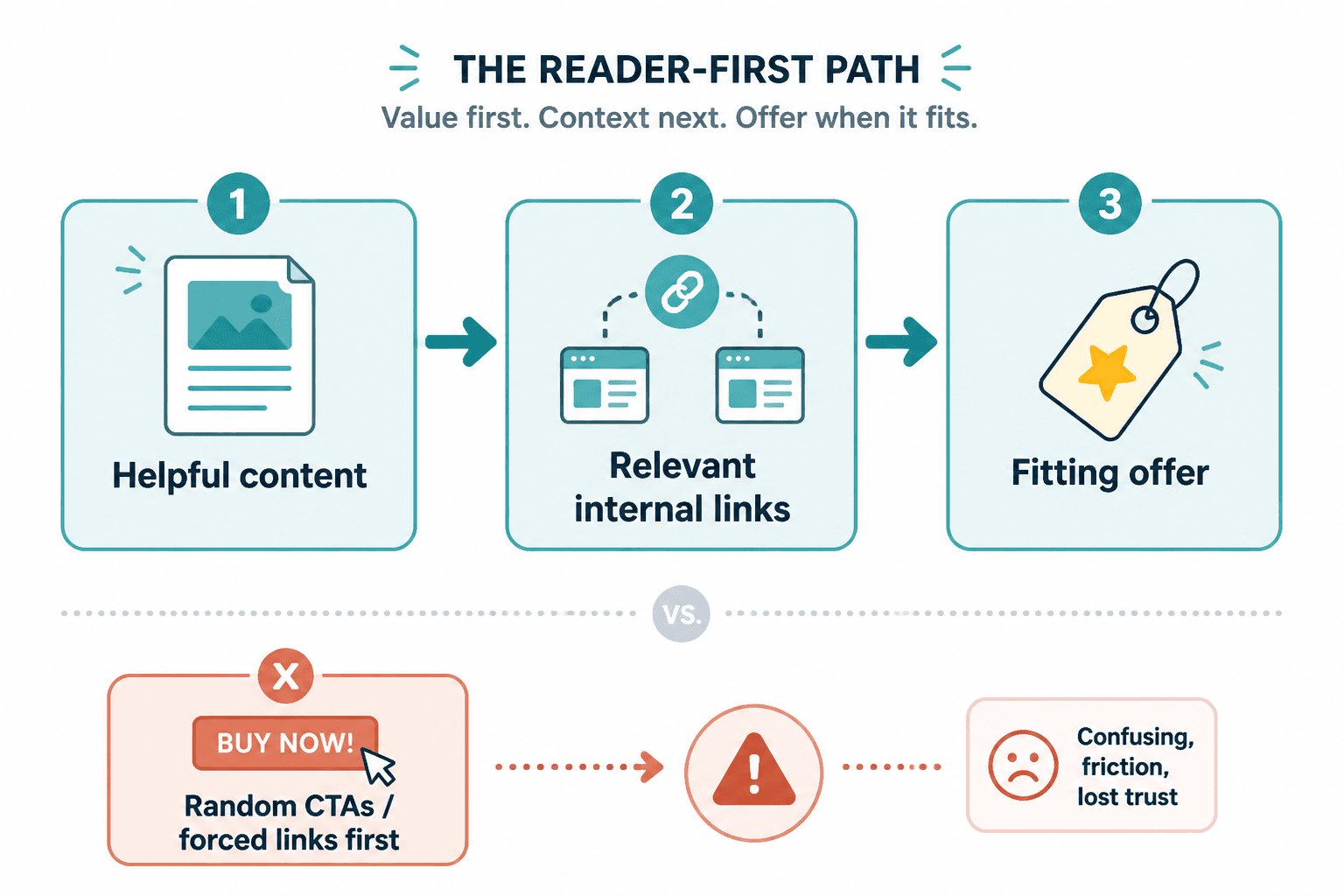
How to monetize internal linking and updating without making articles feel salesy
The trick is not to hide monetization. It is to make the path logical.
Here are the monetization methods that tend to work without setting off the reader’s internal nonsense alarm.
1. Link to deeper help, not straight to a pitch every time
Not every article needs to jump directly from education to “book a call.” In many cases, the better move is to link from one article to a more specific article, and then from there to an offer that fits the topic.
Example:
- Top-of-funnel article: explains the problem
- Mid-funnel article: shows the system or framework
- Offer page or lead magnet: helps apply it
That progression feels natural because it respects reader readiness. If someone is still learning the basics, a hard sell can feel premature. If they are already looking for implementation help, a direct CTA makes more sense.
This is one reason content systems built around topic clusters work so well. You are not forcing monetization into a single article. You are creating a sequence that lets trust build at a normal human pace. If you want a broader framework for that, the resources in internal linking and updating and blog article systems are useful places to continue.
2. Update old posts based on reader intent, not just traffic potential
A high-traffic post is not always the best monetization opportunity. Sometimes it attracts broad curiosity traffic with weak buyer intent. Sometimes a lower-traffic post pulls in exactly the kind of reader who is closer to taking action.
When updating content, ask:
- What is this reader actually trying to solve?
- What would be the most useful next step after this article?
- Is that next step educational, strategic, or transactional?
- Would a CTA here feel helpful or impatient?
This keeps your updates aligned with intent instead of just revenue wishful thinking.
For example, a post about “what internal links do” may deserve links to foundational guides. A post about “best funnel ideas to pair with internal linking and updating” can support a stronger conversion path because the reader is already thinking about outcomes and implementation. Conveniently, that article exists here: best funnel ideas to pair with internal linking and updating.
3. Use internal links to reduce friction, not inflate pageviews
Internal linking should help the reader get somewhere useful faster. If your linking strategy mostly exists to boost pageviews, people can tell. The article starts feeling stretched thin, like it is trying to force extra clicks instead of delivering the answer cleanly.
A simple test: if the linked section could be explained in one sentence without losing clarity, do that first. Then add the link for people who want more depth.
That makes your article self-respecting. It also makes the click more likely, because the reader does not feel manipulated.
4. Make your CTAs match the temperature of the article
Cold readers do not need “Apply now.” They need a smart next step.
If the article is educational and relatively early-stage, softer CTAs often work better:
- Read the next guide
- Grab the checklist
- See the examples
- Learn the system
- Join the newsletter for more practical breakdowns
If the article is more bottom-of-funnel, stronger CTAs can make sense:
- See how we help with this
- Book a consultation
- Request the service
- Review the offer details
The mistake is using the same conversion intensity everywhere. That is how blogs end up sounding like they were written by one nervous salesperson standing behind every paragraph.
Where monetization usually goes wrong
Most trust damage comes from a handful of repeat mistakes. None of them are especially mysterious.
| Bad move | What readers feel | Better move |
|---|---|---|
| Stuffing links into every paragraph | This article is trying too hard | Link only where the next step is genuinely useful |
| Updating only CTA sections | You did not improve the article, you just inserted a sales trap | Improve clarity, examples, accuracy, and structure first |
| Using vague anchor text like “click here” | I do not know what I am getting | Use clear anchor text that names the topic or payoff |
| Sending all posts to the same money page | This is a funnel, not a helpful site | Match links and offers to the article’s actual topic |
| Adding hard sells to informational posts | Too soon | Use softer next-step CTAs where intent is early-stage |
If your site has that “every road leads to the same checkout page” feeling, readers notice. It kills trust because it makes your content seem less editorial and more engineered. There is nothing wrong with engineering. But if people can see the gears grinding, you have probably overdone it.
A practical framework for trust-first monetization
If you want a cleaner process, use this four-part framework whenever you update an article or add internal links.
1. Diagnose the article’s real job
Every article should have a primary role:
- Attract search traffic
- Build trust
- Demonstrate expertise
- Move readers to a next step
- Support a commercial decision
One article can do more than one thing, sure. But it should still have a dominant job. If you treat every post like a sales page, the writing gets twitchy.
2. Improve the article so it deserves attention
Before adding monetization, tighten the article itself:
- Rewrite the introduction if it drags
- Cut repetition
- Add examples or mini case scenarios
- Clarify vague advice
- Fix outdated wording or references
- Break up heavy sections for readability
If the article is weak, monetizing it harder is like putting better signage on a boring store.
3. Add links that answer the next obvious question
This is where internal linking earns its keep. Instead of asking, “What page do I want to push?” ask, “What would the reader naturally need next?”
That one shift fixes a lot.
If someone is reading about monetizing internal linking, possible next questions might be:
- How do I write these updates without sounding fake?
- How do I turn this into actual leads or sales?
- What kind of funnel should this connect to?
- How do I improve the opening so people keep reading long enough to click?
Which means these internal links make sense here:
- how to write internal linking and updating without sounding salesy or robotic
- how to turn internal linking and updating into more leads or sales
- best funnel ideas to pair with internal linking and updating
- how to start internal linking and updating without a weak opening
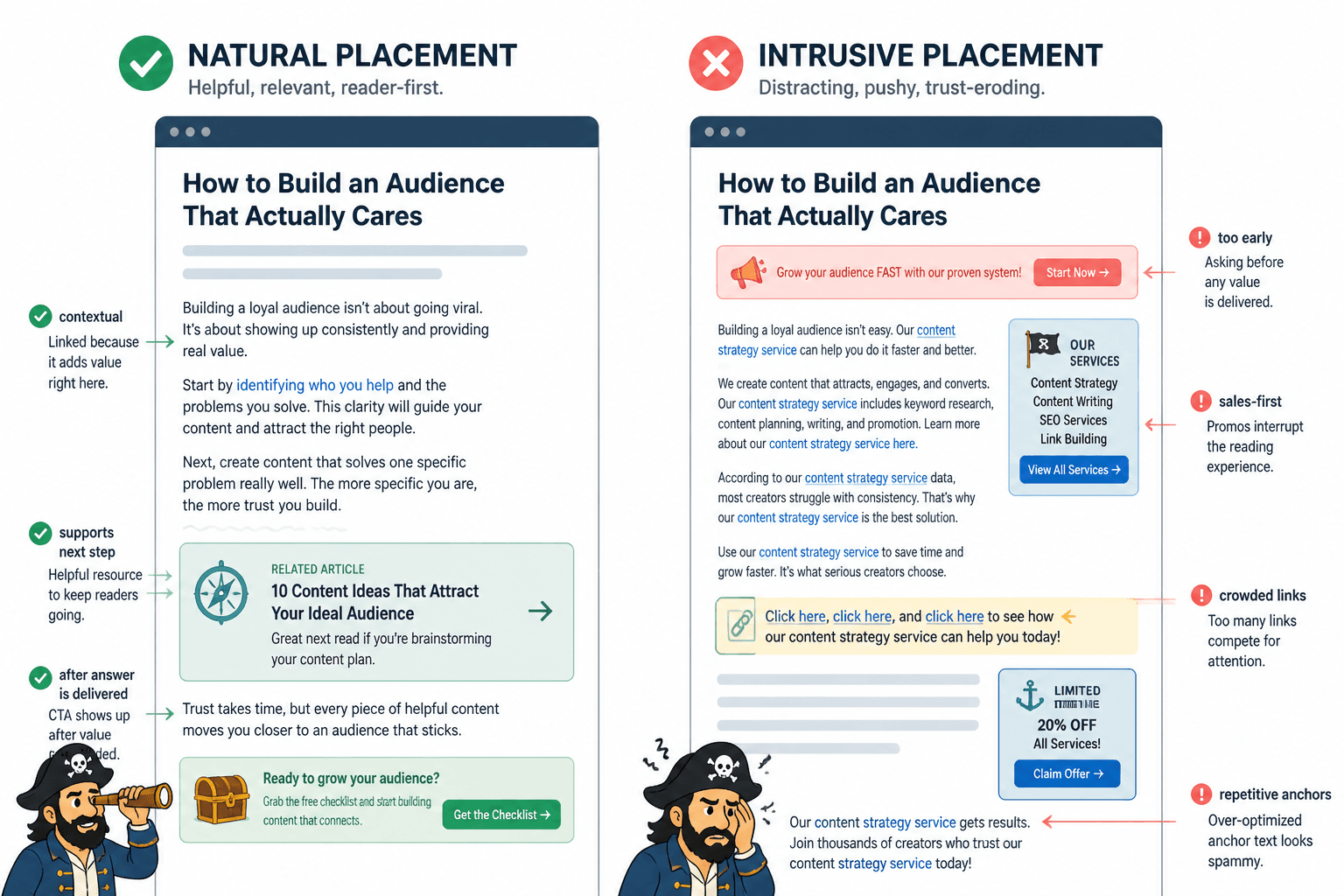
4. Place monetization where it feels like a service, not a trap
Your monetization points should feel like useful exits.
That might mean:
- A contextual CTA after a strong teaching section
- A relevant lead magnet after a pain-point-heavy article
- A service mention after demonstrating expertise with examples
- A product link in a comparison table or implementation section
The best monetization often feels almost quiet. Not hidden. Just proportionate.
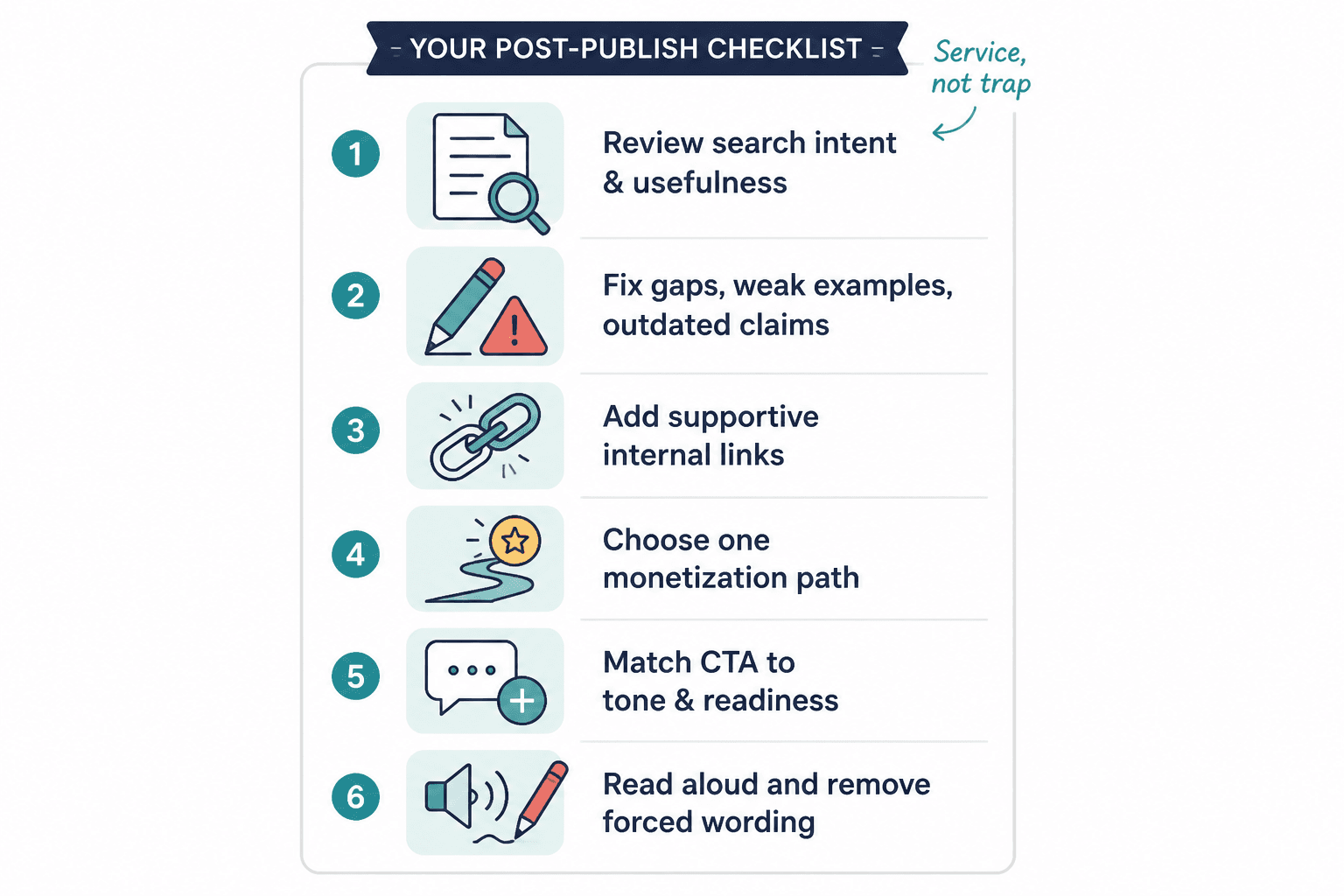
How to update old content for revenue without making it feel like a bait-and-switch
Updating older content is one of the easiest ways to improve revenue from existing traffic. It is also one of the easiest ways to accidentally make your site feel slimy if you do it badly.
Here is the safer approach:
- Review the article’s search intent and current usefulness.
- Identify missing sections, weak examples, or outdated claims.
- Add or improve internal links that support the reader’s next step.
- Choose one relevant monetization path, not five.
- Make the CTA match the article’s tone and reader readiness.
- Read the article out loud and remove anything that sounds forced.
That last step matters more than people think. Forced monetization has a weird texture. You can usually hear it before you can explain it.
For example, compare these two CTA styles:
Clunky
If you want to maximize your internal linking strategy for explosive business growth, contact us today to unlock your content potential.
Better
If you are updating old content and want those articles to pull more leads without feeling over-optimized, the next step is building a cleaner funnel around them. This guide on turning internal linking and updating into more leads or sales will help.
One sounds like a brochure wrote it. The other sounds like a useful editorial recommendation. Same commercial intent. Very different reader experience.
What to monetize through internal linking and what not to
Not every destination deserves equal promotion.
Good pages to monetize through internal links:
- Lead magnets tightly related to the article topic
- Service pages that solve the exact problem discussed
- Case studies that build confidence before a decision
- Newsletter signup pages with a clear benefit
- Product pages that naturally fit implementation-stage readers
- Deeper educational pages that move readers toward a later conversion
Pages to be careful with:
- Generic homepage links when a better resource exists
- Broad sales pages unrelated to the article’s specific topic
- Thin landing pages with little context
- Offers that require much more trust than the article has built
- Anything that feels disconnected from the reader’s current problem
This is where a lot of internal linking strategies get lazy. Instead of building a real content journey, they just point everything at whatever page the business wants to rank or sell from this month. That might make a dashboard look busy. It does not make the reader feel understood.
The best monetization paths usually look boring on purpose
There is a strange comfort in dramatic marketing tactics because they look active. Pop-ups. Hard pivots. “One weird secret” intros. Overwritten CTA boxes. But trust-first monetization often looks a lot more boring from the outside.
It usually looks like this:
- A genuinely strong article
- A few relevant internal links
- A smart update that improves clarity
- A CTA that matches intent
- A next step that actually helps
That is not flashy. It is just effective. And unlike hype-heavy tactics, it compounds. Readers trust the site more. They click more willingly. They come back. They share. They convert without feeling hustled.
If you want to build a broader system around that, the material under blog SEO writing is a useful place to continue, especially if you are trying to connect article structure, internal links, search intent, and monetization without turning your site into a used-car lot with subheadings.
A simple editorial test before you publish an update
Before publishing a monetized update, ask these five questions:
- Did this article become more useful, or just more commercial?
- Would the internal links still make sense if there were no sales goal attached?
- Is the CTA appropriate for the reader’s stage of awareness?
- Does the article still answer the main question clearly on its own?
- Would a skeptical reader think this feels fair?
If you hesitate on two or more, the piece probably needs another pass.
That does not mean stripping out every offer and pretending money is vulgar. It means editing with enough honesty to notice when the article stopped serving the reader and started performing for conversion metrics.
FAQ
How many internal links should a monetized article have?
Enough to help, not enough to feel crowded. In most cases, relevance matters more than quantity.
Should every updated article include a CTA?
No. Some should simply move readers deeper into the site. A forced CTA can hurt more than it helps.
Is it okay to link to service pages from blog posts?
Yes, if the service clearly fits the topic and the reader’s likely next step. Random service links feel pushy fast.
What is the safest monetization path for informational content?
Usually article to related article, then to lead magnet, newsletter, or offer. That gives trust a chance to do its job.
How often should I update older content for monetization?
Whenever the article has clear business relevance, outdated sections, or missed internal linking opportunities. Not every post needs constant tinkering.
Monetize the path, not the reader’s patience
If you want to monetize internal linking and updating without wrecking trust, stop trying to squeeze revenue out of every sentence. Build better articles. Add smarter links. Create next steps that fit what the reader actually needs.
That is the whole game.
Internal linking improves when each update makes the next useful step clearer. Cleaner structure usually does more work than a bigger pile of links ever will.