
AI jargon has a special talent for making simple things sound like tax law.
People say ChatGPT, GPT, and LLM like they all mean the same thing. They do not. Close cousins, yes. Identical twins, no.
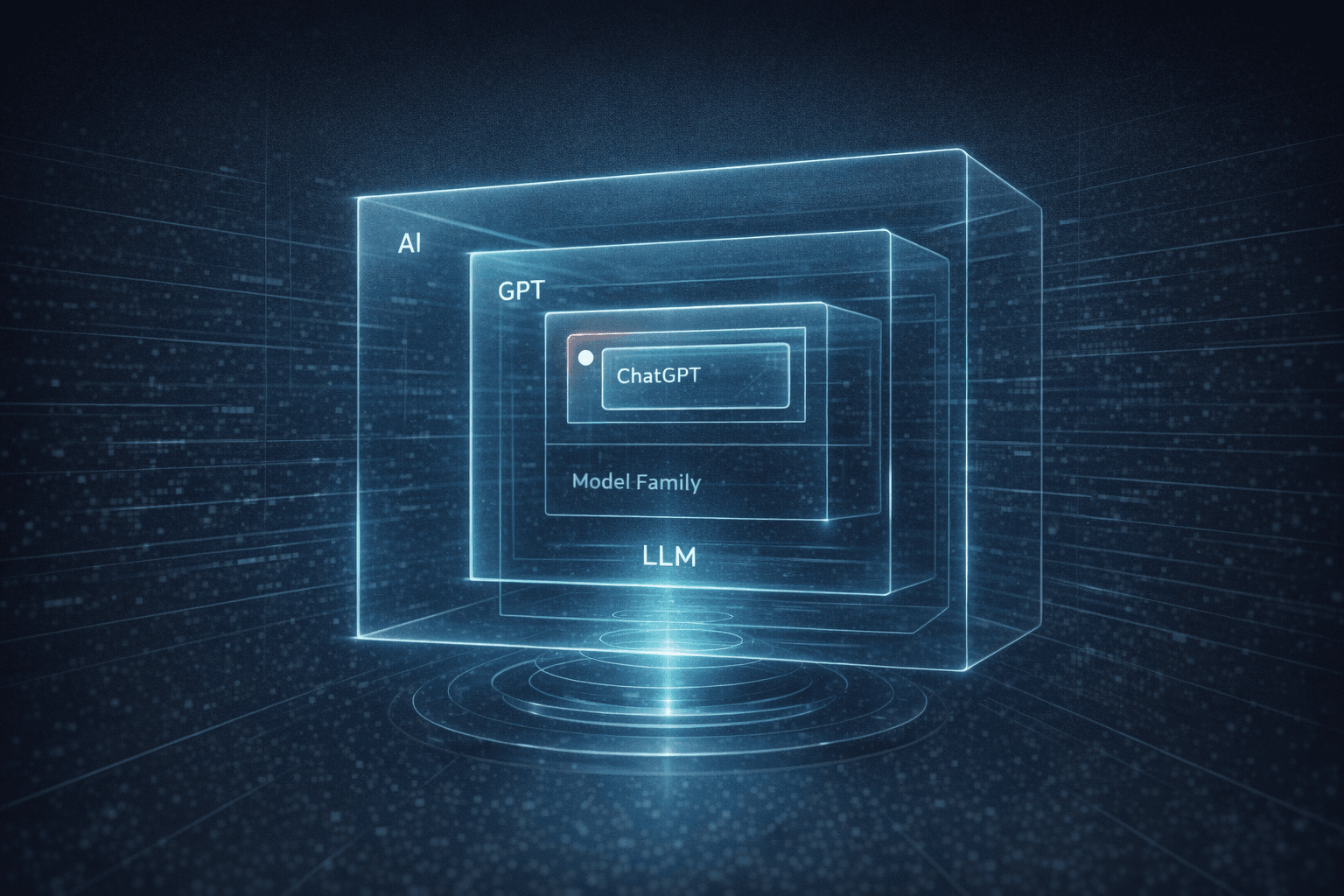
Here is the clean version: LLM is the big category, GPT is one kind of model in that category, and ChatGPT is the product people use to chat with AI. Once you see that, the whole foggy mess gets much less foggy.
LLM is the category. GPT is one model family in that category. ChatGPT is the product you open and use.
The Fast Answer
| Term | What It Means | Think Of It Like |
|---|---|---|
| LLM | A broad type of AI model that works with language | The whole category |
| GPT | A specific family of LLMs | One brand or model family |
| ChatGPT | A chatbot product built for people to use in conversation | The app or service |
If that already cleared it up, wonderful. You may now leave the acronym swamp. But if you want the full version, keep going.
What Is an LLM?
LLM stands for large language model.
That is the broad term. It means a language-focused AI model trained on a huge amount of text so it can understand patterns in language and generate new text in response.
An LLM can do things like answer questions, summarize documents, write drafts, translate text, explain code, and help with brainstorming. In plain English, it is a machine built to work with words.
The key word here is category. An LLM is not one single product. It is a class of models. Just like “car” is a category, not a specific vehicle.
So Claude is an LLM. Gemini is an LLM. Llama is an LLM. GPT models are also LLMs. They all live in the same neighborhood, even if they dress differently.
What Is GPT?
GPT stands for Generative Pre-trained Transformer.
That sounds like it was named by three engineers locked in a room with too much coffee, but the parts are actually useful.
- Generative: it generates text
- Pre-trained: it learned from huge amounts of data before you ever touched it
- Transformer: it uses a transformer architecture, which is the technical design behind how it handles language
GPT is not the same as all LLMs. It is one family of LLMs. That is the part people often miss.
So saying “GPT” when you mean “any AI chatbot” is a bit like saying “Google” when you mean “the internet.” People will know what you mean sometimes, but it is still wrong in a small, annoying way.
A better way to think about it is this: all GPTs are LLMs, but not all LLMs are GPTs.
What Is ChatGPT?
ChatGPT is the product.
It is the chatbot interface people use. You open it, type a prompt, upload a file, speak to it, ask questions, and get responses back in a conversation format.
This is where the confusion starts. Because people interact with ChatGPT directly, they often use the product name as if it were the underlying model. But that is like saying “Netflix” when you really mean “video streaming technology.” One is the service you use. The other is the thing underneath.
So if someone says, “I used ChatGPT,” they are talking about the chatbot product. If they say, “This runs on GPT,” they are talking about the model family underneath. And if they say, “We are comparing different LLMs,” they are talking about the wider category of language models.
Why People Mix These Up
There are three big reasons.
- The product became famous first. Many people met AI through ChatGPT, so the product name became shorthand for everything.
- GPT became a brand word. It is now used loosely in casual speech, even when people mean “AI model” in general.
- LLM sounds technical. So people skip it, even when it is the most accurate term.
That is how you end up with sentences like, “We need a ChatGPT for our website, maybe built on ChatGPT, using an LLM.” Which is not a sentence. It is a cry for help.
The Simple Analogy That Actually Works
Here is the cleanest analogy.
- LLM = smartphone
- GPT = iPhone
- ChatGPT = the app in your hand that lets you use it
Or if you prefer coffee:
- LLM = coffee as a category
- GPT = one coffee brand
- ChatGPT = the café where you order it
You do not need to marry the analogy. You just need one that makes the layers obvious.
How To Use the Terms Correctly
If you want to sound clear instead of vaguely techy, use the right word for the right layer.
- Use LLM when talking about the broad type of model
- Use GPT when talking about that specific model family
- Use ChatGPT when talking about the chatbot product people use
Here are a few examples:
- Correct: “ChatGPT is a chatbot product.”
- Correct: “GPT is one family of LLMs.”
- Correct: “Claude and Gemini are also LLMs, but they are not GPT.”
- Less correct: “Everything is ChatGPT now.”
That last one is common, but it blurs the whole picture.
A Few Examples That Make It Click
Let’s say a company says, “We built an AI writing tool.”
You can now ask three better questions:
- Is it using an LLM at all?
- If yes, is it using GPT or another model family?
- Is the thing I am using a chatbot product like ChatGPT, or some other interface built on top of a model?
Those questions matter. A lot of tools sound magical in the sales copy, but underneath they may just be a thin wrapper around an existing model.
That is not always bad. Some wrappers are genuinely useful. But it helps to know whether you are paying for new capability or just shinier buttons.
The One Sentence Rule
If you forget everything else, remember this:
ChatGPT is a product. GPT is a model family. LLM is the broader category.
That one sentence will rescue you from about 80% of the confusion online, in meetings, and in those suspiciously confident LinkedIn posts.
Final Take
Most of the confusion comes from people using the name they know best for the whole stack underneath. Fair enough. ChatGPT got famous. GPT became shorthand. LLM stayed in the nerd drawer.
But the clean version is better. It helps you read articles more clearly, compare tools more accurately, and sound like someone who actually knows what the words mean rather than someone throwing alphabet soup at the wall.
Use the right label, and half the mystery disappears. Then you can spend less time decoding buzzwords and more time making the machine do something useful. Which, for once, is the part that matters.