
Muddled bio copy does more than sound vague. It quietly leaks revenue by making the right visitor work too hard to figure out who you help, why you matter, and what they should do next. A website bio is not there to audition for “credible enough.” It is there to move a qualified reader one step closer to trust, action, or both.
The fix is not more polish. It is better structure. A useful bio or profile section does three jobs in order: it clarifies relevance, it gives a believable reason to trust you, and it points to a next step that fits the reader’s intent. That is the whole machine. Everything else is decoration, and decoration is rarely the thing that gets the lead.
What website bio and profile copy is supposed to do
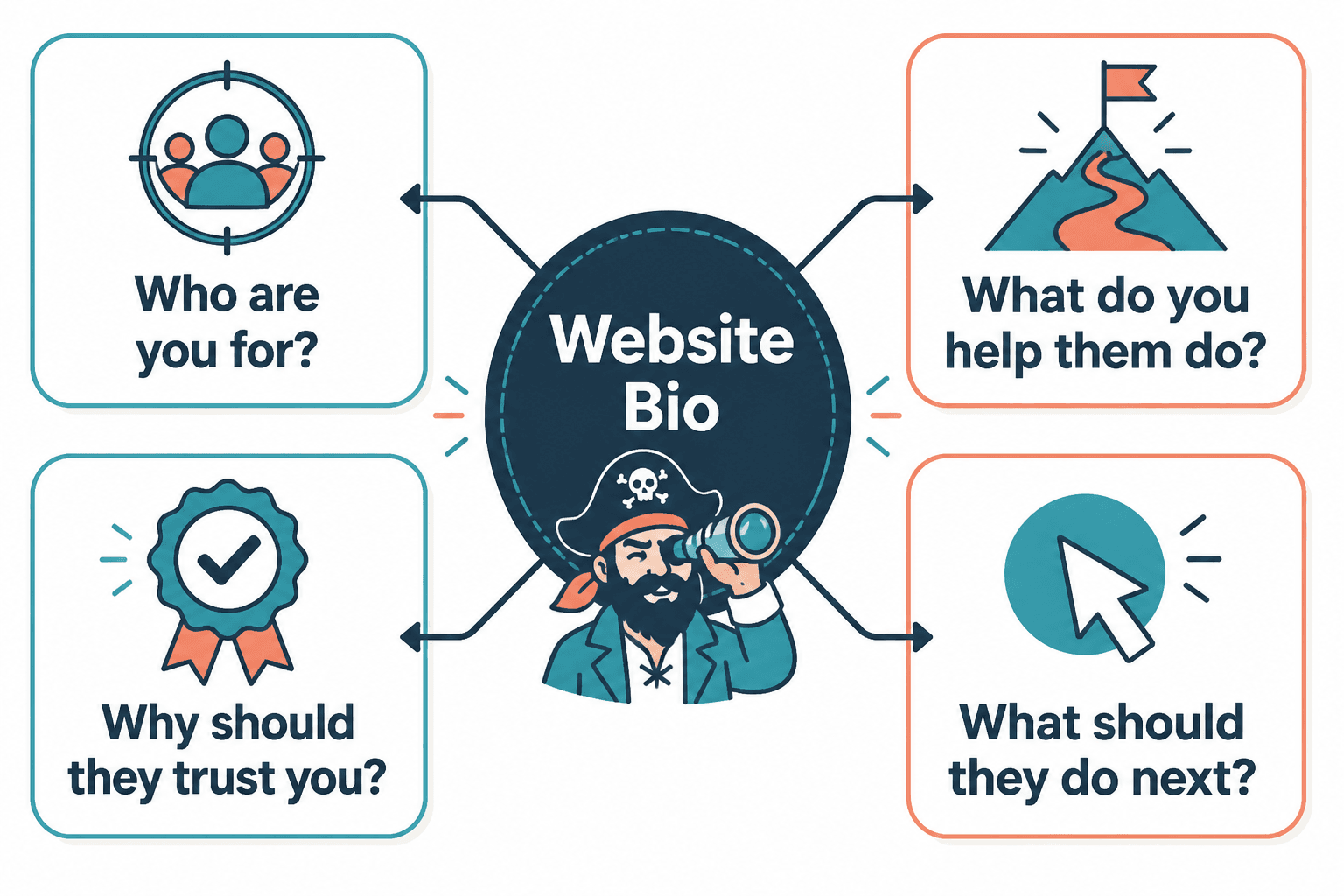
A bio is not a miniature autobiography with better fonts. On a website, it is conversion copy with a narrower job description. It should help the right visitor answer four questions fast:
- Who is this for?
- What do they help with?
- Why should I believe them?
- What should I do next?
If the bio answers those questions cleanly, it can support sales without sounding salesy. If it does not, the reader starts filling in blanks on their own, which is how good offers end up looking oddly optional.
This is why the surrounding page matters too. A strong bio works best when it connects to the rest of your site’s core copy, not when it floats around like a self-contained personality sketch. If you want the bigger structural view, the website bio and profile copy guide is the right place to start.
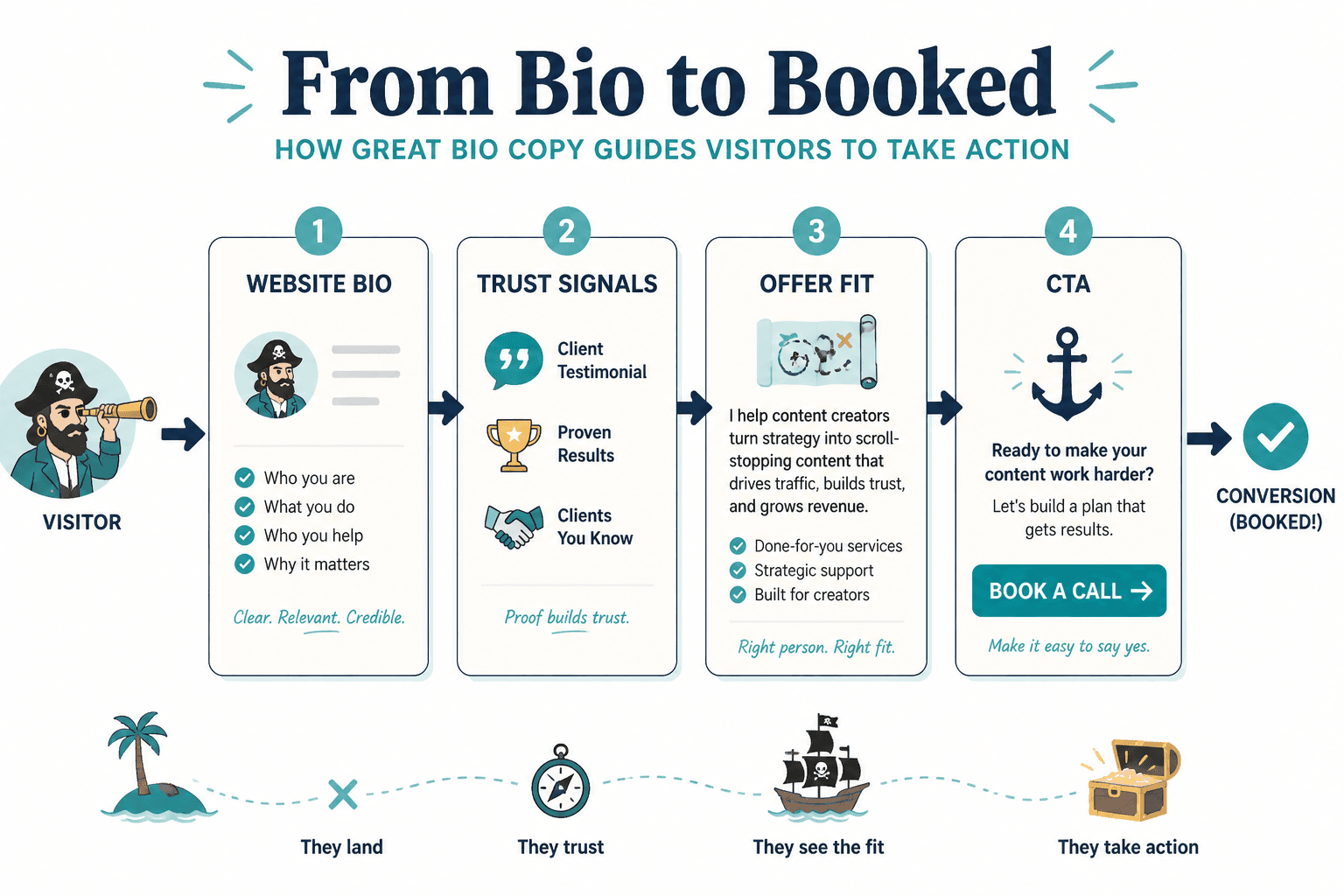
The simple conversion chain: clarity, proof, next step
Good bio copy usually follows a very boring but very effective sequence:
- Clarity – tell the reader what you do and who it is for.
- Proof – give a reason that claim is worth believing.
- Next step – point to an action that matches how ready the reader is.
That sequence is not flashy, but it works because it reduces friction. The page stops asking the visitor to decode your identity before they can evaluate your offer. Instead, it does the decoding for them.
What a credibility line is actually doing
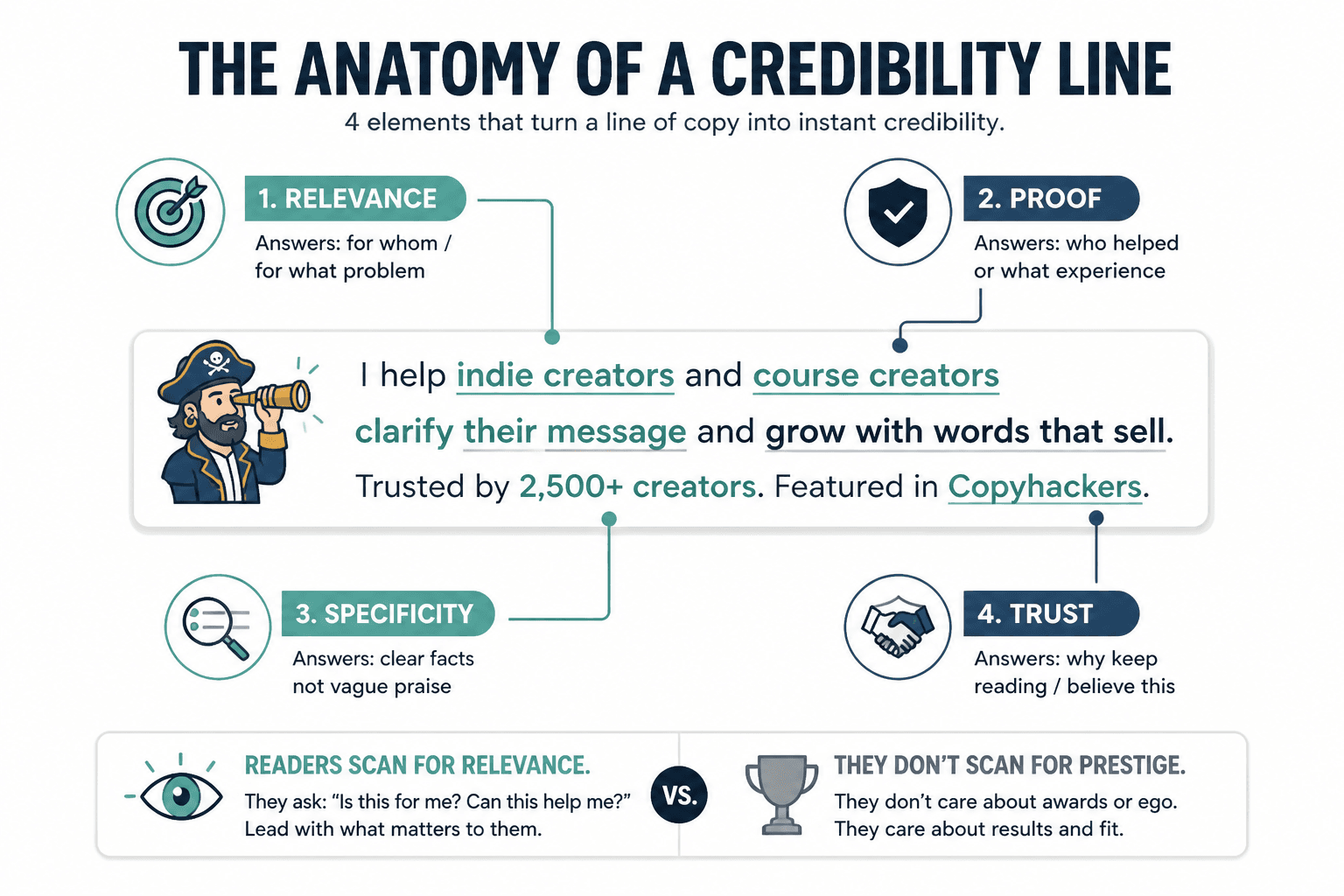
A credibility line is the bridge between “sounds nice” and “might be worth my time.” It is not there to brag. It is there to make the reader feel the copy is grounded in reality.
Strong credibility lines tend to rely on one or more of these:
- Audience proof: who you have helped or who you regularly work with.
- Outcome proof: what kind of result your work tends to support.
- Volume or scope proof: how much experience, reach, or usage you have.
- Credential proof: training, certification, or background, used carefully.
The trick is restraint. A credibility line should make the copy feel specific, not inflated. The moment it starts sounding like it wants applause, it stops helping conversion and starts helping nobody.
For a closer look at making those lines sharper, see the related piece on better credibility lines for personal brands.
Five credibility angles that work better than vague self-praise
1. Client or audience proof
Name the kind of person or business you help. That alone can reduce uncertainty.
Example: Helping service-based founders turn scattered bios into clear lead-supporting copy.
2. Outcome proof
Show the result your work supports, without promising magic tricks in a blazer.
Example: Creating website bios that make the next step easier to see.
3. Volume or scope proof
Numbers can help if they are real and relevant.
Example: Supporting dozens of website pages across service, creator, and consultant brands.
4. Credential proof
Use this when it strengthens trust, not when it is just sitting there wearing a name tag.
Example: Background in conversion-focused writing and web messaging.
5. Positioning proof
Say what makes your approach distinct.
Example: Focusing on bio copy that supports both trust and action instead of only sounding polished.
Choose a funnel path that matches reader intent
Bio copy should not force every visitor into the same next step. Someone who is just getting to know you may need a softer path. Someone already convinced may be ready for a direct offer. Good conversion copy respects that difference.
Useful next-step options include:
- Lead magnet for a cold or curious reader
- Proof page or case study for someone who needs evidence
- Newsletter for ongoing authority and warm leads
- Consultation or service page for a reader already close to buying
- Low-ticket offer when the audience needs a smaller step first
The best choice is the one that matches the reader’s level of readiness. Otherwise the page starts doing interpretive dance around the CTA.
If you want more structure on the path itself, the companion piece on best AI tools for bio and profile copy can help you move from draft to usable page faster, and the funnel-focused guide on best funnel ideas to pair with website bio and profile copy covers the next-step decision in more detail.
What to include if you want your bio to support leads and sales
1. A clear statement of who you help and what you help them do
Start with the audience, the problem, or the outcome. Do not make the reader reverse-engineer your job description.
Good direction: I help [specific audience] [do specific thing] so they can [result].
2. A credibility line that proves you are not making it up
This can be a background detail, a relevant result, a recognizable type of client, or a simple positioning statement.
Good direction: Trusted by [type of clients], with a background in [relevant area].
3. A point of view
Point of view adds shape. It tells readers how you work and why your approach is worth paying attention to.
Good direction: I focus on copy that makes the next step obvious instead of trying to sound impressive.
4. A next step that fits the reader
Do not shove every visitor toward the same conversion path. Match the CTA to intent.
Good direction: Read the guide, explore examples, book a call, or join the list depending on how ready the visitor is.
What strong bio copy looks like in practice
Here is a simple before-and-after pattern.
Weak: Writer, editor, and strategist helping brands tell better stories.
Stronger: Writer and strategist helping service businesses turn website bios into clearer positioning, stronger trust, and better next-step action.
The second version is not “more creative.” It is more useful. It tells the visitor what kind of work gets done and what the page is supposed to help with.
Another example:
Weak: Passionate about helping people grow online.
Stronger: Supporting creators and service providers who want bio copy that can pull its weight on a sales page, profile, or homepage section.
The difference is specificity. The first line could belong to anyone with a laptop and a gentle sense of ambition. The second line earns its place.
Common mistakes that weaken conversion
- Writing for approval instead of action – sounding nice but saying little.
- Stacking credentials without relevance – résumé energy is not a strategy.
- Being vague about who the page is for – broad language usually blurs trust.
- Using a CTA that does not match intent – too pushy, too soft, or just random.
- Trying to sound unique before being clear – clarity usually beats cleverness.
There is a reason a lot of bio copy reads like it was assembled by committee. The writer tries to sound professional, approachable, strategic, and inspirational all at once. The result is usually a paragraph with commitment issues.
A quick checklist before you publish
- Can a new visitor tell who this is for in one read?
- Does the copy give a believable reason to trust the claim?
- Is the main benefit or outcome specific?
- Does the CTA match the reader’s likely readiness?
- Could one sentence be cut without losing meaning?
- Does the section support the page instead of trying to be the whole page?
If the answer to any of those is no, the page probably needs tightening more than it needs flair.
Related examples and next steps
If you want to see how these ideas show up in real page structures, the bio and profile copy examples page is the most direct follow-up. If you are still deciding which tools to use for drafting or refinement, the tool guide is a practical next stop.
And if you are working from the bigger site structure outward, the parent guide on website core copy for bio and profile sections keeps the whole system in view.
Bottom line
Website bio and profile copy supports leads and sales when it does three things well: it clarifies relevance, builds trust with useful proof, and offers a next step that fits the reader. That is not glamorous. It is effective. And in conversion terms, effective copy is usually the one that quietly does its job instead of trying to win a costume contest.