
Most homepage copy gets written in a weird vacuum.
You open a blank doc, try to sound polished, vaguely strategic, and trustworthy, then end up with something like “Helping ambitious brands grow with clarity and confidence.” Which is impressive in the same way beige carpet is impressive. It exists. That is about it.
If you already have old content, you probably do not need to start from scratch. You need to mine what you have already said well, then turn it into homepage copy that is sharper, clearer, and more convincing.
That is really the trick behind How to Turn Old Content Into Better Homepage Copy: stop treating your archive like leftovers. Old posts, emails, sales notes, client calls, FAQs, DMs, articles, and offer pages are usually packed with the exact language your homepage needs. The problem is that most people either copy it too literally or ignore the useful parts and rewrite everything into sterile brand soup.
Here’s how to pull the gold out of your old content, shape it properly, and build a homepage that actually sounds like you know what you are doing.
For the broader learning path, visit our parent guide.
Why old content is usually better than your fresh homepage draft
Your best homepage language often already exists in the content you wrote when you were trying less hard to sound “official.”
That is because old content tends to be closer to real thinking. In a post, email, or client reply, you are usually explaining a problem, answering an objection, or making a useful point. On a homepage, people suddenly get formal and abstract. They stop saying what they mean. They start “positioning.” Dangerous hobby.
Old content can give you:
- clear phrases people actually responded to
- specific problem language
- strong opinions that separate you from lookalikes
- proof points buried in stories or examples
- natural CTAs that do not sound like funnel taxidermy
If you want a stronger foundation for your homepage, your archive is often more useful than another blank page and a fake-serious face.
If you need a broader foundation first, it helps to review the bigger picture of website conversion copy, the structure of website core copy, and the specific role of homepage copy before you start reshaping what you already have.
What your homepage actually needs to do
Before you start pulling lines from old content, get clear on the job of the homepage.
A homepage is not there to say every smart thing you have ever thought. It is there to help the right visitor quickly understand:
- who you help
- what you help them do
- why your approach is worth paying attention to
- what they should do next
That means when you reuse old content, you are not building an archive museum. You are extracting parts that support clarity, trust, and conversion.
Good homepage copy tends to need six things:
- A clear hero message
- A specific problem or need
- Your approach or differentiator
- Proof or credibility
- Some sense of what working with you looks like
- A next step that makes sense
If a piece of old content does not help one of those jobs, it might still be useful elsewhere on your site, but it probably does not belong on the homepage.
And if your current homepage feels muddy, read how to write better homepage copy alongside this. It pairs nicely with the repurposing process here.
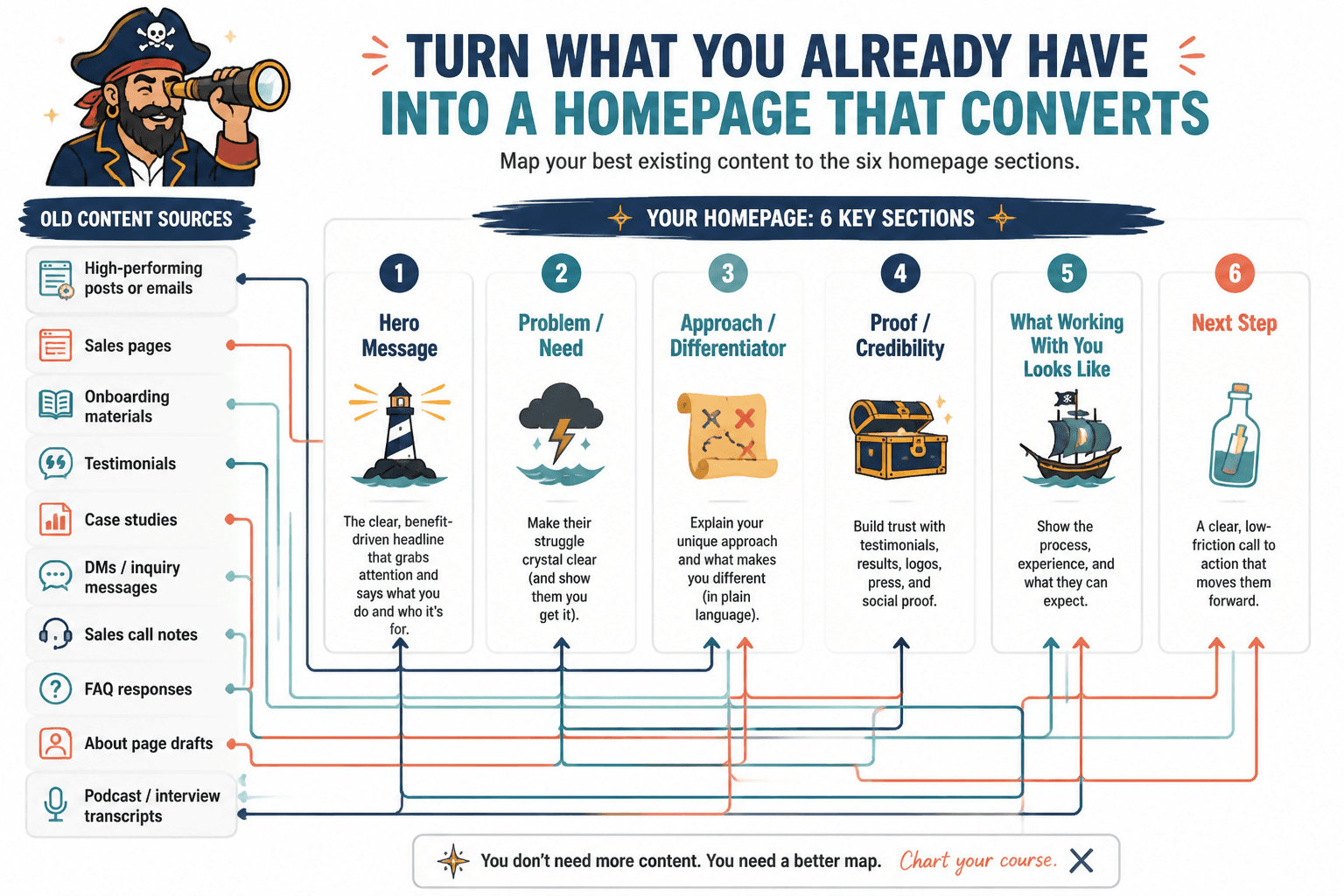
What kind of old content is worth mining
Not all old content is equally useful. Some of it is bloated, outdated, or written during a phase where you sounded like you had been trapped in a webinar funnel. Be selective.
The best sources are the ones closest to real audience friction, real decisions, and real language.
Best sources to pull from
- high-performing posts or emails
- sales pages and offer pages
- client onboarding materials
- testimonials and case studies
- DMs or inquiry messages
- sales call notes
- FAQ responses
- about page drafts
- podcast or interview transcripts
- articles where you explained your process clearly
Less useful sources
- generic social posts with no response
- old copy built around outdated offers
- fluffy mission statements
- anything written to impress peers instead of help buyers
- AI drafts you never meaningfully edited
You are looking for language with life in it. Phrases that explain. Lines that clarify. Sentences that make the right person feel seen and the wrong person realize, politely, that this is not for them.
How to turn old content into better homepage copy
Here is the actual process. It is simple, but not lazy-simple. You still need judgment.
1. Gather your raw material in one place
Pull together the old content most likely to contain strong homepage language. Paste it into one working document or swipe file.
You do not need everything. You need enough to spot patterns.
A good starter pack might include:
- 5 to 10 posts that got strong replies or shares
- 3 to 5 emails that earned clicks or responses
- your current sales page
- 3 to 10 testimonials
- client questions you hear repeatedly
- any article where you explained your process in detail
2. Highlight what repeats
Now look for recurring language and ideas.
Pay attention to:
- problems people keep mentioning
- phrases you keep using naturally
- promises or outcomes that show up more than once
- objections you address repeatedly
- descriptions of your process
- proof points that make people trust you faster
If something keeps showing up, it probably belongs somewhere on the homepage. Repetition is often signal, not redundancy.
3. Sort the good bits by homepage section
Once you have highlighted useful lines, sort them into rough homepage buckets.
| Homepage section | What to pull from old content |
|---|---|
| Hero | clearest audience + problem + outcome language |
| Problem section | pain points, frustrations, common mistakes |
| Approach | your process, philosophy, what you do differently |
| Proof | results, testimonials, case study snippets, credibility cues |
| Offer path | how people can work with you or what happens next |
| CTA | best natural invitation language from emails, posts, or sales copy |
This is where old content becomes much more useful. Instead of staring at a giant mess of words, you start seeing building blocks.
4. Rewrite for homepage context
This part matters. Do not just paste old content onto the homepage and hope formatting saves you.
A homepage needs tighter phrasing, faster clarity, and more obvious structure than a post or article. You are adapting, not copying.
When rewriting, do this:
- cut scene-setting and throat-clearing
- replace insider language with plain English
- tighten long explanations into strong lines
- keep the specificity that made the old content good
- remove anything that only makes sense with previous context
A post can ramble a little if the idea is interesting. A homepage cannot. It has to earn attention quickly.
5. Build around the strongest claim, not the broadest one
This is one of the main ways people ruin perfectly good source material.
They find a strong, specific line in old content, then “broaden it” for the homepage until it means almost nothing. Suddenly “I help consultants turn messy expertise into clear sales pages” becomes “Strategic messaging for modern brands.” Congratulations, I guess. You are now indistinguishable from fourteen tabs and a Canva template.
Your homepage usually gets better when the language gets more specific, not more corporate.
6. Check that every section leads somewhere
A homepage is not just informational. It should create momentum.
As you shape the copy, ask:
- Does the hero make the right person keep reading?
- Does the problem section make them feel understood?
- Does the approach section make your method feel credible?
- Does the proof section reduce skepticism?
- Does the CTA feel like the natural next move?
If the sections do not connect, the homepage will feel like a pile of decent sentences rather than a persuasive page.
What to look for in old content, specifically
If you are not sure what counts as reusable, here is a cleaner lens. Look for material that gives you one of these four things: audience language, problem language, trust language, and action language.
Audience language
How do you describe the people you help when you are being clear instead of fancy?
Examples:
- “coaches with solid offers but muddy messaging”
- “consultants who know their work but struggle to explain it clearly”
- “creators whose websites sound more polished than persuasive”
Problem language
What are they dealing with before they hire you, buy, or subscribe?
- “People visit the site but do not take the next step.”
- “The offer is good, but the homepage is vague.”
- “The copy sounds professional, but not convincing.”
Trust language
What old content proves you know what you are doing?
- client results
- sharp process explanations
- strong testimonials
- specific opinions that show expertise
- examples of what you fix and how
Action language
How do you naturally invite the next step without sounding needy or over-rehearsed?
- “See how I help fix weak homepage messaging.”
- “If your site is getting attention but not action, start here.”
- “Read the guide, then decide if you want help rewriting yours.”
These are the kinds of phrases that make a homepage feel grounded instead of assembled from random “brand voice” fragments.
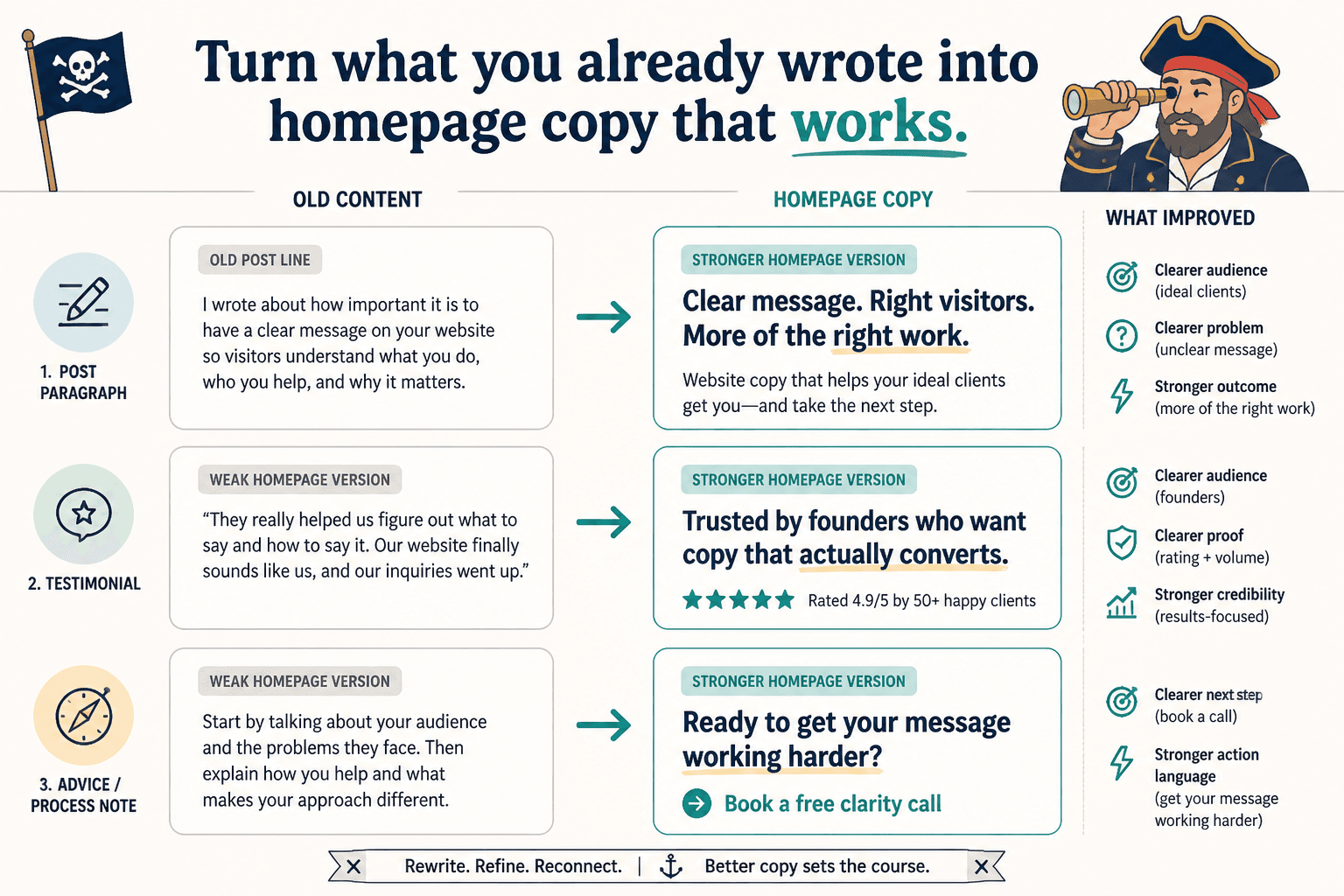
Before-and-after examples
Here is what this looks like in practice.
Example 1: Turning a social post into a hero section
Old post line:
“A lot of service businesses do not have a traffic problem. They have a clarity problem. People land on the site and still do not understand what is being offered, who it is for, or why it is different.”
Weak homepage version:
“Clarity-focused messaging solutions for service-based businesses.”
Stronger homepage version:
“Homepage copy for service businesses that get traffic but not enough action.
I help you clarify what you offer, who it is for, and why people should care.”
The stronger version keeps the actual tension. It says something. It sounds like a person with a point.
Example 2: Turning a client FAQ into a problem section
Old FAQ answer:
“Most clients come to me because their site sounds fine on the surface, but it is too vague. It does not create confidence, and visitors do not know where to go next.”
Homepage section rewrite:
“If your homepage sounds polished but vague, that is usually the problem.
Visitors should not have to guess what you do, who it helps, or what to click next.”
Example 3: Turning testimonial language into proof
Old testimonial:
“You took what I had been trying to say for months and turned it into copy that finally sounded clear and useful. People started mentioning the homepage on calls.”
Homepage proof block:
“Clients usually come in with decent ideas and unclear language. The fix is not more hype. It is sharper messaging people actually remember. In some cases, that is the difference between a homepage people skim and one prospects mention on calls.”
Notice what happened there. We did not just dump the testimonial in raw. We used it to support a stronger proof statement.
What to cut when reusing old content
Some things should stay in the archive.
The bigger point is simple: clearer structure and clearer writing make the piece more useful. That is usually what makes the ending land better too.
Homepage copy works best when the core promise is clearer and the next step is easier to understand. Simpler, sharper messaging usually does more work.