
Most blog title examples are useless for one simple reason: they show the shape of a headline without showing the thinking behind it.
So people copy the surface. They grab a formula, swap in a few words, and end up with titles like “10 Amazing Tips for Better Marketing” or “The Ultimate Guide to Personal Branding.” Technically, those are titles. Functionally, they are wallpaper.
If you want to write better blog title examples without sounding generic, you need more than a list of headline templates. You need to understand what makes a title feel specific, credible, and worth clicking in the first place.
That is what this article will help you do. We’ll break down why generic title examples fail, what stronger title examples actually include, and how to write blog headlines that sound like they came from a sharp human with a point, not a content machine fed stale oatmeal.
If you want a broader foundation first, this guide on how to write better blog titles and headlines pairs well with what we’re covering here.
Want the broader roadmap? Start with the parent guide.
Why most blog title examples sound generic
Generic blog titles usually are not failing because they are too short or too simple.
They fail because they avoid making a real promise.
A generic title tends to do at least one of these things:
- Uses broad words instead of specific outcomes
- Targets everybody, which means it really targets nobody
- Sounds like 500 other articles already in search results
- Makes a huge promise with no angle, proof, or distinction
- Uses filler words like “best,” “ultimate,” “amazing,” or “essential” to fake value
Here is the problem in plain English: a title example is only helpful if it teaches someone how to make stronger choices. A bland example teaches bland habits.
A good title does not just label the topic. It frames the value.
That is the shift. You are not naming a blog post. You are packaging an idea.
For more title strategy examples, the main blog titles and headlines hub is worth bookmarking.
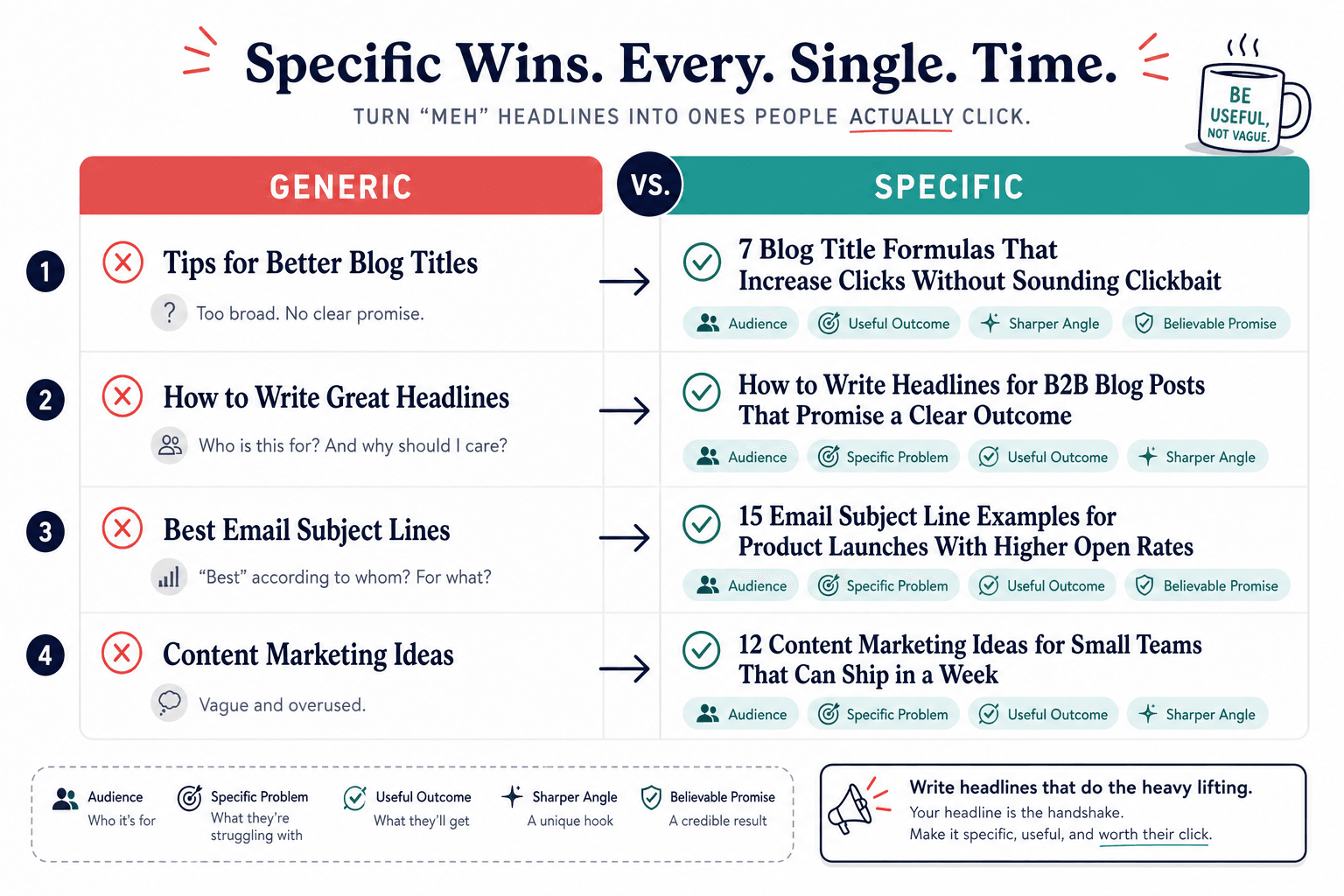
What better blog title examples actually do
If you want to improve blog titles and headlines title examples without sounding generic, the examples need to demonstrate real ingredients.
Strong title examples usually include a few of these:
- A clear audience
- A specific problem
- A useful outcome
- A sharper angle
- A believable promise
- A bit of tension, contrast, or curiosity
Notice what is missing: empty hype.
You do not need to make the title louder. You need to make it more precise.
Weak vs strong title examples
| Weak title example | Why it falls flat | Stronger version |
|---|---|---|
| Tips for Writing Better Headlines | Too broad, no audience, no angle | 7 Ways to Write Better Headlines That Do Not Sound Like Generic Content Soup |
| The Ultimate Guide to Blog Titles | Bloated promise, no distinction | A Practical Guide to Writing Blog Titles People Actually Want to Click |
| How to Create Great Headlines | Vague outcome, sounds interchangeable | How to Create Blog Headlines That Are Clear, Specific, and Not Embarrassingly Generic |
| Best Blog Title Ideas | Feels listy and thin | Best Blog Title Ideas for Creators Who Want Clicks Without Clickbait |
The stronger versions are not trying harder to sound impressive. They are trying harder to sound useful.
Start with the actual point of the article
This is where a lot of title examples go wrong. People title the topic, not the point.
There is a difference.
- Topic: blog headlines
- Point: how to make blog headlines less generic and more clickable
When you title the topic, you get broad sludge.
When you title the point, you get a reason to care.
A quick way to find the real point
Before writing title examples, answer these four questions:
- Who is this for?
- What are they trying to do?
- What keeps going wrong?
- What specific improvement does this article help them make?
That gets you closer to titles with actual value built in.
For example:
- Weak: Blog Headline Examples
- Better: Blog Headline Examples That Show You How to Be Specific Without Sounding Forced
The second one is doing more work. It names the benefit and the tension.
Use examples that teach a pattern, not just a format
A decent title example does not just say, “Here is a headline.” It quietly teaches the reader what made that headline better.
That means your examples should reveal a repeatable pattern.
Pattern 1: Add specificity
- Generic: How to Write Better Blog Titles
- Better: How to Write Better Blog Titles That Earn Clicks Without Sounding Like SEO Filler
Why it works: the second title adds a meaningful constraint. It tells the reader what kind of “better” you mean.
Pattern 2: Add audience fit
- Generic: Best Headline Examples
- Better: Best Headline Examples for Creators, Coaches, and Consultants Who Need More Clicks
Why it works: audience language helps the right reader self-identify fast.
Pattern 3: Add tension or contrast
- Generic: Title Ideas for Blogs
- Better: Blog Title Ideas That Sound Clear and Smart, Not Generic and Overcooked
Why it works: contrast sharpens the promise. It gives the reader a before-and-after in one line.
Pattern 4: Add a practical outcome
- Generic: Headline Writing Tips
- Better: Headline Writing Tips to Help More of the Right Readers Click and Keep Reading
Why it works: outcomes beat adjectives. “Useful” is nice. “Gets the right readers to click” is better.
A simple process for writing better blog title examples
If your current title examples feel flat, this process will fix most of that.
1. Write the boring version first
Yes, actually do this.
Get the obvious title out of your system. Something like:
- How to Write Better Blog Titles
- Blog Headline Tips
- Examples of Good Blog Titles
Now you have a baseline. It is bland, but at least it is honest.
2. Ask what makes this article different from the other 50
This is where your angle comes from.
Maybe your piece focuses on:
- avoiding generic phrasing
- writing for creators instead of corporations
- improving clickability without becoming clickbait
- using examples that are adaptable and not robotic
That difference belongs in the title or subtitle idea pool.
3. Add one strong modifier, not five weak ones
Good modifiers sharpen meaning.
Weak modifiers just take up oxygen.
- Weak: best, amazing, ultimate, essential, powerful
- Strong: practical, specific, clear, non-generic, click-worthy, creator-focused
One sharp word beats three inflated ones.
4. Build in a reason to care now
Titles perform better when they imply a consequence, frustration, or payoff.
- Flat: Blog Title Examples
- Sharper: Blog Title Examples That Make Your Posts Sound More Specific and Less Forgettable
That second one hints at the current pain and the desired improvement.
5. Cut anything that sounds auto-generated
If the headline includes words you would never say out loud to a client, cut them.
That includes titles that sound like:
- they were assembled from a content brief spreadsheet
- they are trying way too hard to sound “valuable”
- they could be used on literally any blog in any niche
A title should sound like a person with taste wrote it.
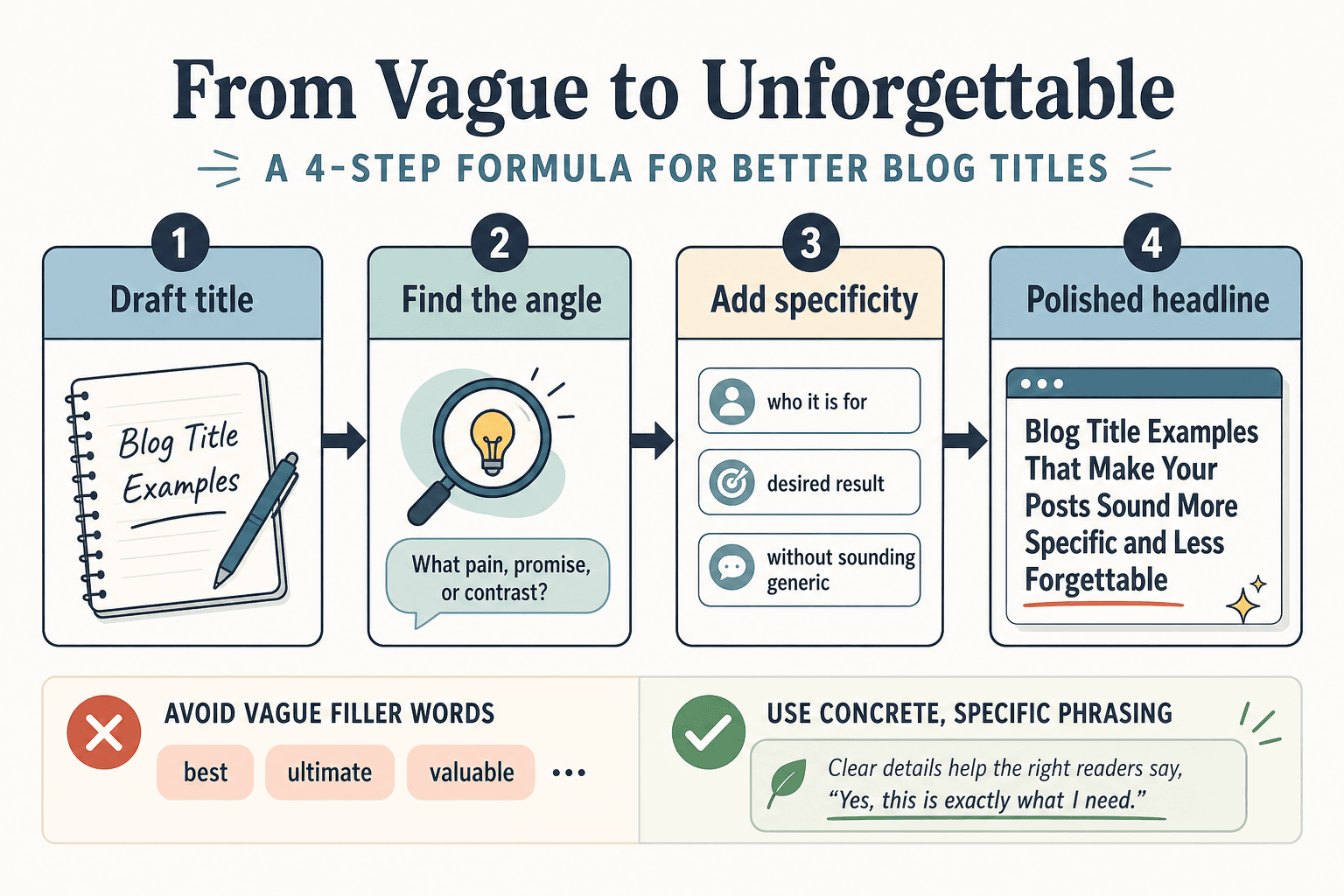
Before-and-after rewrites for generic blog title examples
Sometimes the fastest way to improve your own titles is to see weak ones rewritten with purpose.
Example 1
- Before: Headline Examples for Blogs
- After: Blog Headline Examples That Show What Makes People Click
Why it is better: it moves from label to benefit.
Example 2
- Before: Best Blog Title Formulas
- After: Blog Title Formulas Creators Can Adapt Fast Without Sounding Like Everybody Else
Why it is better: more specific audience, more believable promise, less fluff.
Example 3
- Before: Improve Your Blog Headlines Today
- After: How to Improve Blog Headlines When Your Current Titles Sound Too Generic
Why it is better: it names the exact problem instead of waving vaguely at “improvement.”
Example 4
- Before: Creative Blog Titles You Need to Try
- After: Creative Blog Titles That Still Sound Clear, Useful, and Worth Clicking
Why it is better: “creative” alone can mean weird for the sake of weird. The rewrite reins that in.
Title example formulas that do not feel painfully generic
Formulas are useful. Worshipping them is not.
The point of a formula is to give you structure, not to replace judgment. Here are a few formats that work well when you fill them with actual meaning.
Formula 1: How to [get result] without [common frustration]
- How to Write Better Blog Titles Without Sounding Like SEO Wallpaper
- How to Create Stronger Headlines Without Using Clickbait Tricks
Formula 2: [Number] ways to [result] for [audience]
- 9 Ways to Write Sharper Blog Titles for Creators and Personal Brands
- 7 Headline Fixes for Coaches Whose Blog Posts Are Not Getting Clicked
Formula 3: [Topic] examples that [specific benefit]
- Blog title examples that attract better-fit readers
- Headline examples that make the article promise clearer
That is the real point of formulas. They are there to help you package a clearer idea, not to mass-produce bland headlines with interchangeable nouns.