
A blog title is not just the name tag on the front of the article. That is the comfortable lie. In practice, the title does several jobs at once: it tells readers what the post is about, signals whether it is worth their time, and gives search engines and social feeds something concrete to work with. A weak title makes a decent post look forgettable. A strong one gives the same post a fighting chance.
That is why “good enough” titles so often underperform. They are broad, polite, and easy to ignore. The fix is not to make every headline louder. It is to make it clearer, more specific, and more useful to the person who is deciding whether to click.
Why blog titles matter more than they look like they should
A title is the first filter. It does not need to explain everything, but it does need to earn the next sentence. That matters because the title shapes three things at once:
- Click-through: people cannot read the article if they never open it.
- Expectation: the title sets the promise the body has to fulfill.
- Distribution: search, social, email, and internal links all depend on the title doing real work.
Search engines still rely heavily on title text as a relevance signal, and Google has long documented that title links help users understand what a page is about. See Google’s title link guidance. For writing that is meant to be discoverable, that is not a small detail. It is the foundation.
If you want a broader system view, the parent guide here is useful: blog titles and headlines in the blog article system.
What a strong blog title actually does
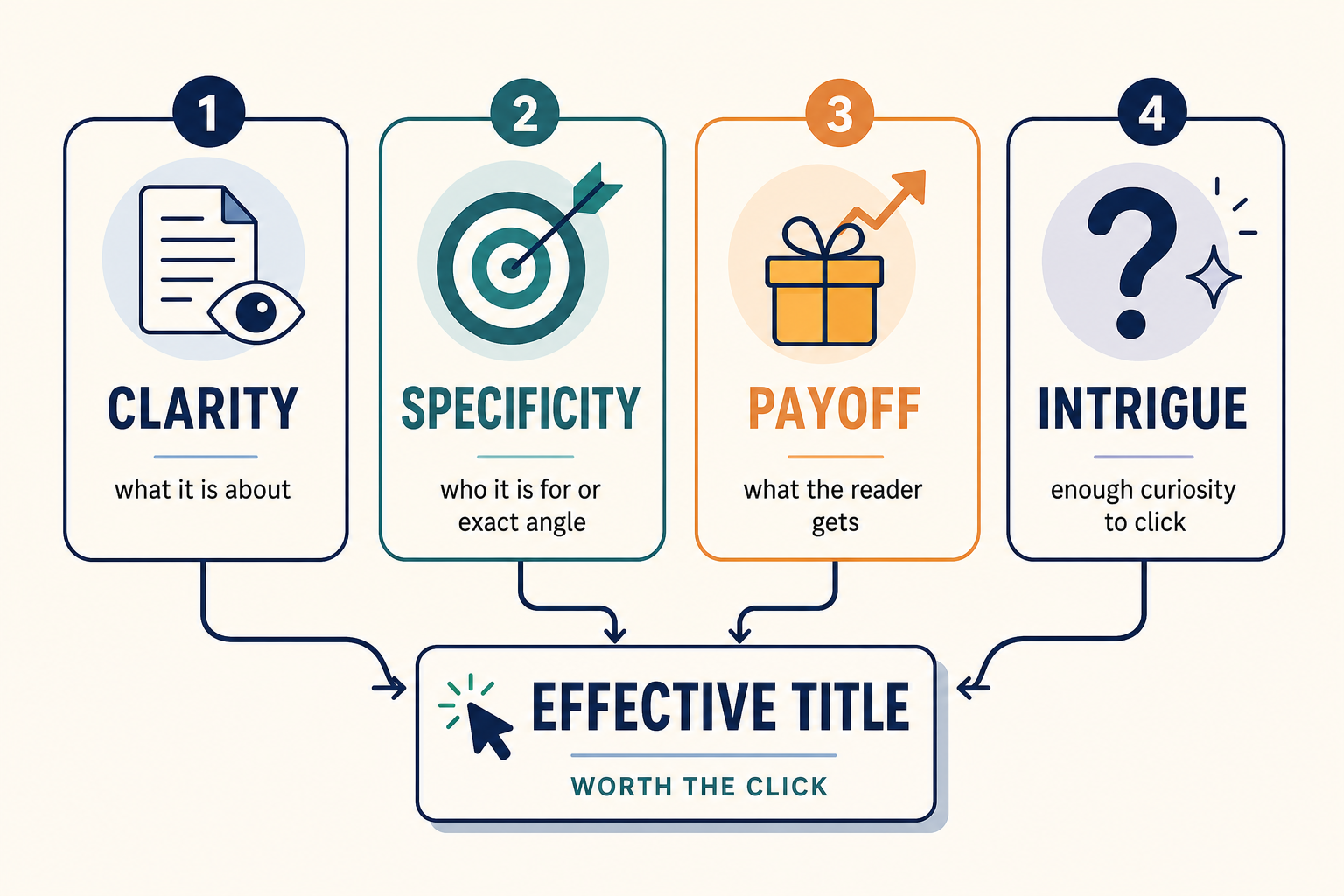
A strong title usually does four things well:
- Names the topic clearly. The reader should know the subject fast.
- Shows the angle. It should hint at what makes this version worth reading.
- Signals the audience or context. A headline for beginners should not read like one for specialists.
- Promises a payoff. The reader should see a reason to care.
That can mean different things depending on the article. Sometimes the payoff is a solution. Sometimes it is a shortcut. Sometimes it is a clearer way to think about a problem. Sometimes it is simply “you will stop wasting time doing it the hard way.” All respectable outcomes. Very little fluff required.
The most common reasons blog titles fall flat
Weak titles usually fail for familiar reasons. Not mysterious reasons. Familiar ones. Which is good news, because familiar problems are easier to fix.
1. They are too broad
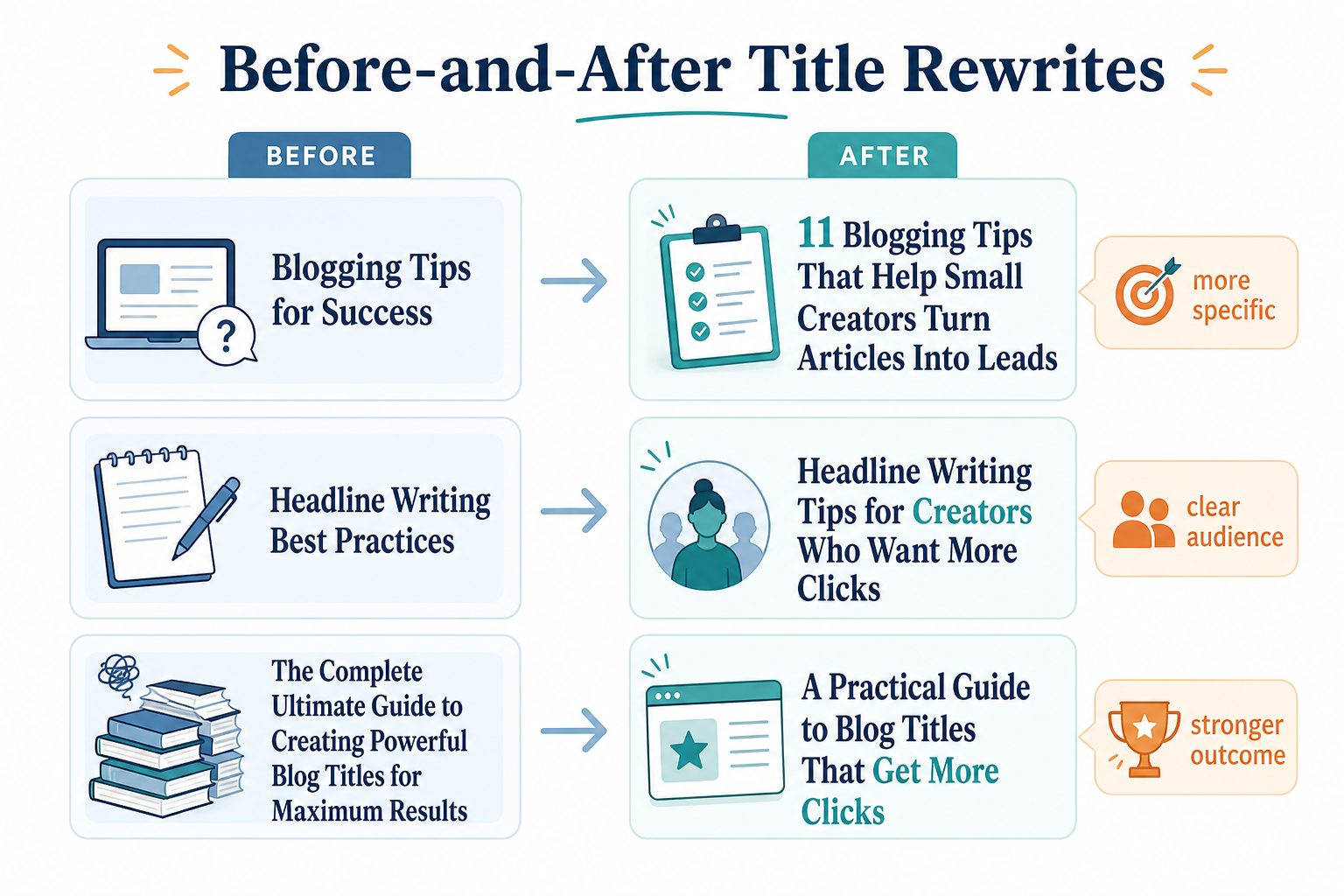
Broad titles sound safe, but safe is often the same thing as invisible. “Content Strategy Tips” tells you almost nothing about what the article will help you do.
2. They sound like everybody else
If the title could belong to ten other posts on the same topic, it is not doing much positioning work. The reader sees a category, not a reason to click.
3. They lead with cleverness instead of clarity
Clever can be fun. Clever can also be a gatekeeper wearing a friendly sweater. If the topic is hidden behind a joke or a vague metaphor, many readers will simply move on.
4. They promise nothing useful
A title can be grammatically fine and still fail because it offers no clear benefit. The reader wants to know what changes after reading.
5. They use empty hype words
Words like “ultimate,” “game-changing,” and “revolutionary” have been run through the content machine enough times to lose most of their electrical charge. They can sometimes work, but only when the underlying promise is specific enough to survive them.
6. They sound robotic
Titles written from templates often have the emotional texture of a receipt. Technically informative, spiritually absent.
7. They are too long for no good reason
Long titles are not automatically bad. Pointless long titles are. If the extra words do not improve clarity, specificity, or usefulness, they are just doing cardio.
How to write better blog titles step by step
There is a simple way to improve a headline without turning it into committee paste.
1. Start with the real point of the article
Do not begin with the topic label. Begin with the thing the article actually helps the reader do, understand, or avoid.
For example:
- “Email marketing” is a topic.
- “Write emails people actually open” is a point.
2. Choose the angle
One topic can support several useful headlines. You can frame the same post as a fix, a warning, a comparison, a shortcut, or a mistake to avoid.
That is where many weak titles become stronger. Not by inventing new information. By choosing a sharper angle.
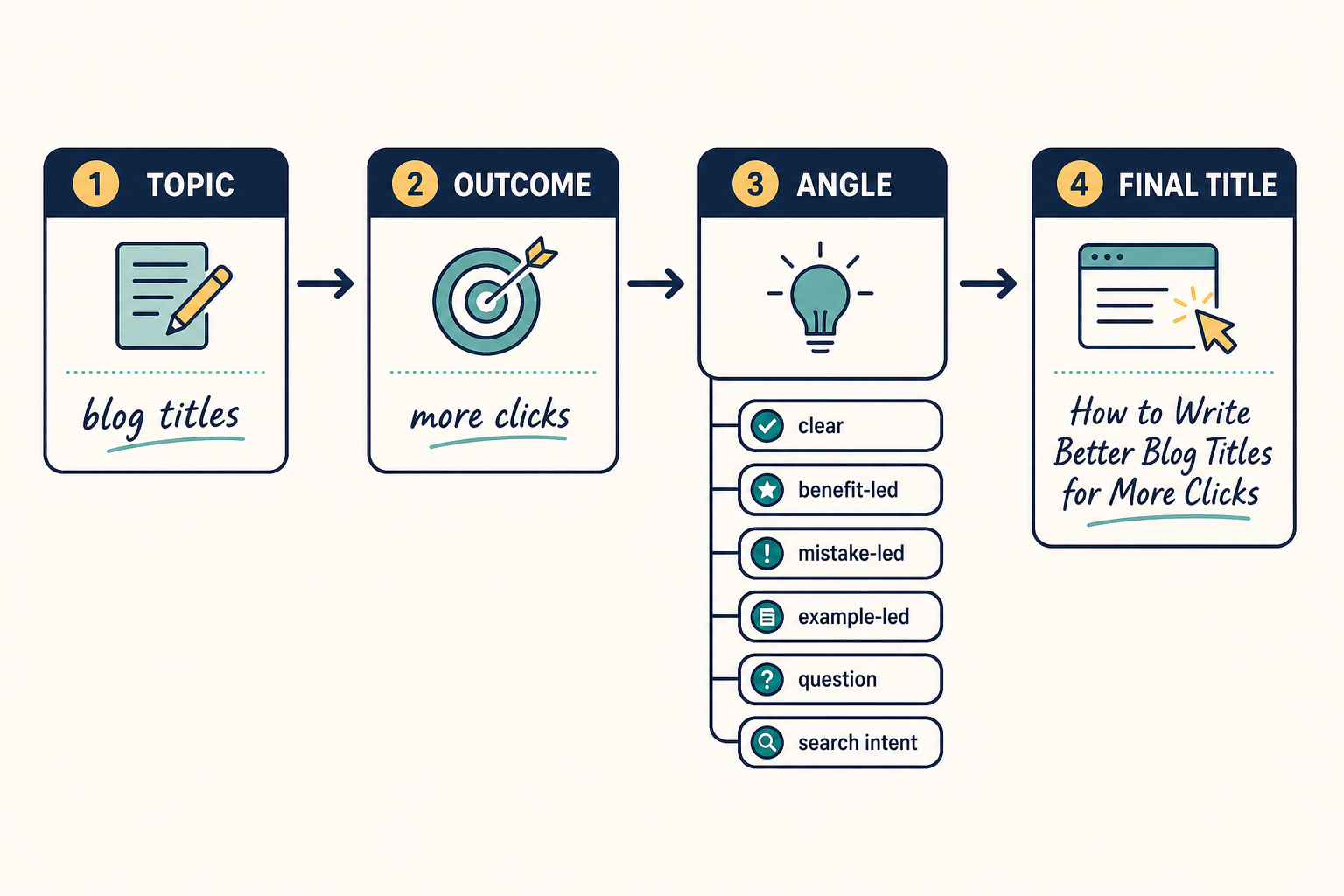
3. Add the reader or context when it helps
Some titles need audience context. Others do not. Use it when it makes the headline more relevant, not when it just adds extra words.
Useful context can look like:
- for beginners
- for small creators
- for SEO
- without sounding salesy
- for posts that need more clicks
4. Cut filler words aggressively
Words like “simple,” “powerful,” “ultimate,” “essential,” and “effective” are not bad by default. They are bad when they substitute for actual meaning.
Run the title through a plain-language test: if removing a word does not hurt clarity or intent, remove it.
5. Read it out loud
This matters more than headline nerds like to admit. If the title sounds stiff when spoken, it will probably feel stiff on the page too. Human speech is a good editor. Annoyingly good.
How long should blog titles and headlines be?
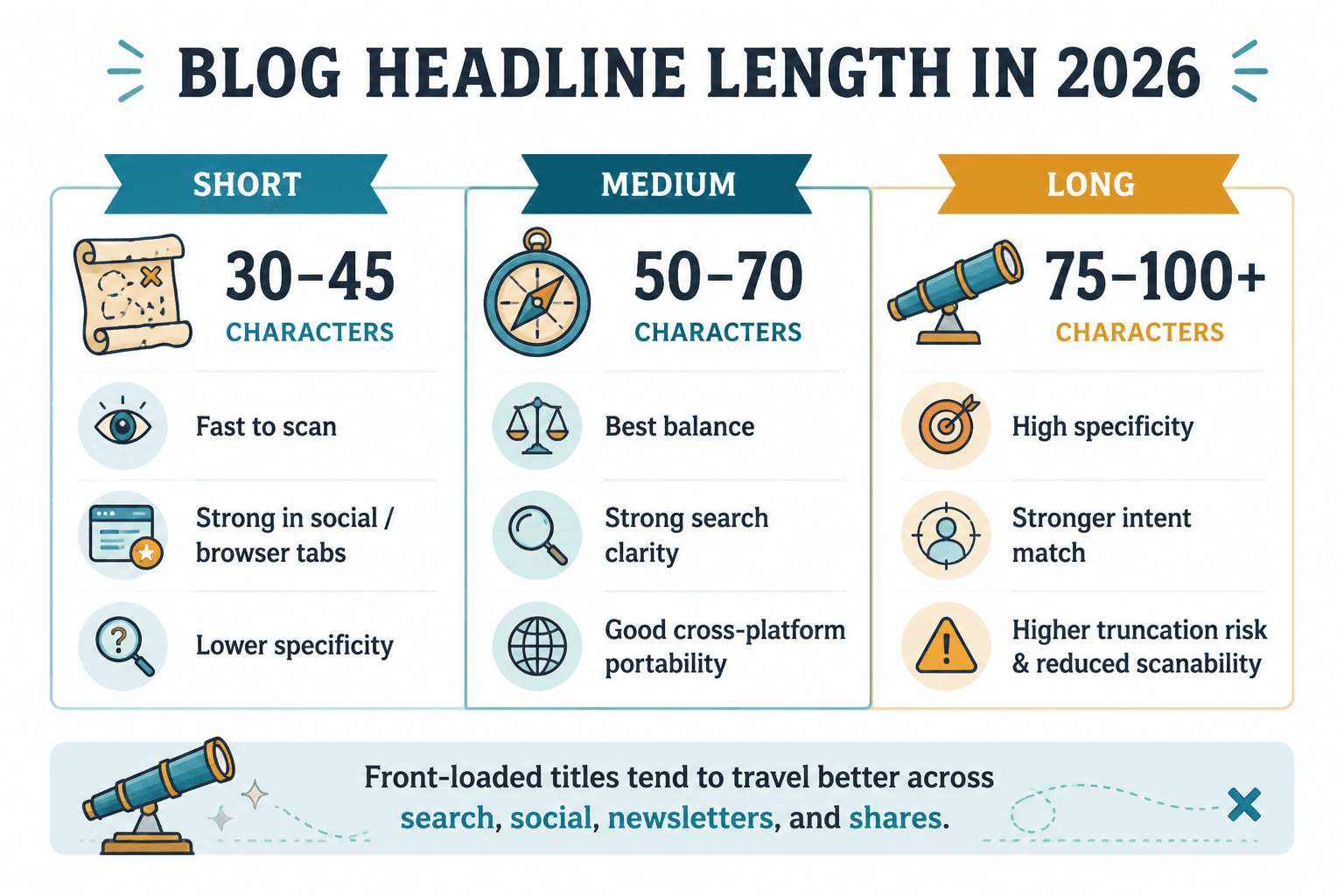
There is no magical number that makes a title good. Not 55 characters. Not 8 words. Not “whatever fits neatly on mobile unless the moon is in Virgo.”
Length should follow function. The right title length depends on:
- Search result display: titles need to be readable in results and snippets.
- Reader clarity: if the point takes extra words to make sense, use them.
- Search intent: some topics need a more explicit promise.
- Distribution: titles for social feeds and email previews often need to work fast.
Short headlines can outperform longer ones when the idea is already strong, the audience already understands the context, or scannability matters more than explanation. Longer headlines can win when the topic is unfamiliar, the payoff needs framing, or the nuance is part of the value.
For a deeper length-specific breakdown, see how long blog titles and headlines should be in 2026. For the opposite problem, this guide also helps: how to start blog titles and headlines without a weak opening.
Better headline formulas that still sound human
You do not need a formula for every title. But formulas are useful when the draft is getting wobbly and you need a structure that does not sound like it was assembled by a chatbot with a marketing minor.
Problem + solution
Example: How to Write Better Blog Titles Without Sounding Salesy
Mistake + fix
Example: Why Your Blog Titles Are Too Broad, and How to Tighten Them
How to + outcome
Example: How to Write Blog Headlines That Get More Clicks
Without + objection
Example: How to Write Better Titles Without Keyword Stuffing
Comparison or contrast
Example: Short vs. Long Blog Titles: When Each One Works Better
Audience + outcome
Example: Blog Titles and Headlines for Small Creators Who Need More Clicks
These are not sacred templates. They are starting points. The point is to give the title enough structure to be useful without sanding off every trace of personality.
How to turn one topic into several stronger title options
Good headline writing usually starts with generating more options than you think you need. The first version is often just the draft that walked in wearing decent shoes.
Try this process:
- Write the plain topic in one sentence.
- List the main outcome the reader wants.
- List the main obstacle, mistake, or pain point.
- Write three angles: solution, warning, and contrast.
- Create 5 to 10 title options from those angles.
- Trim any version that is vague, overlong, or obviously trying too hard.
For inspiration and phrasing patterns, the sibling guide on blog title and headline ideas and examples for creators can help you build a better options list. If you are comparing tools instead of writing by hand, see best AI tools for blog titles and headlines. For title choices tied to business outcomes, this companion piece is also useful: turn blog titles and headlines into more leads or sales.
A quick checklist before you publish
- Does the title say what the post is actually about?
- Does it offer a real reason to click?
- Is the angle specific enough to matter?
- Could a different post plausibly use the same title?
- Does it sound human when read aloud?
- Are any words padding instead of adding meaning?
- Would the title still work in search, social, and email?
If the answer to more than one of those is “sort of,” the title is probably not ready.
Final thought
Better blog titles are not about being louder, trendier, or more “optimized” in the abstract. They are about making the promise of the post sharper. That is the work. Clarity first. Specificity second. Intrigue only when it earns its place.
Once a title does that, the rest of the article has a better job to do. Which is a pleasant arrangement. The page stops introducing itself like a nervous intern and starts acting like it knows what it is for.