
Most website bios are trying very hard to sound credible and accidentally become invisible.
You have probably seen the type. “Passionate founder.” “Multi-disciplinary creative.” “Helping brands tell their story.” Technically words. Practically wallpaper.
If your bio and profile copy for websites is vague, over-polished, or trying to impress everyone at once, it does not build trust. It creates friction. People land on your site, skim a few lines, and leave with the same level of understanding they had before. Which is not ideal if you would like them to book, buy, subscribe, or remember you.
This guide will help you write website bio copy that is clearer, sharper, and more useful to the people you actually want to attract. Not more “professional sounding.” Better performing. There is a difference, and your conversion rate usually knows it before you do.
If you want the bigger picture on this topic, start with the main bio and profile copy for websites hub. If you need a broader website copy foundation, the website conversion copy section can help connect the dots.
For the broader learning path, visit our parent guide.
What good website bio copy is actually supposed to do
A bio is not there to give your life story a nice cardigan and sit it on the page.
Good bio and profile copy for websites has a job. Usually a few jobs, actually:
- Tell the right person they are in the right place
- Explain what you do in plain English
- Show why you are worth paying attention to
- Create a bit of trust without turning into a résumé dump
- Move the reader toward a next step
That means your website bio should not just answer “who am I?” It should answer the questions readers actually care about:
- Are you for someone like me?
- What do you help with?
- Do you seem credible?
- Do I like your style enough to keep reading?
- What should I do next?
Miss those, and the bio becomes decorative copy. Nice to have. Easy to ignore.
The biggest mistakes creators make with bio and profile copy for websites
Before fixing anything, it helps to know what keeps making bios feel bland, confusing, or weirdly stiff.
1. Writing for yourself instead of the reader
Many bios are basically a polished self-description. That feels natural because, well, it is your bio. But the reader is not there to admire your identity collage. They are trying to work out if you can help them.
Your personality matters. Your career path can matter. Your values can matter. But only if those details support the reader’s decision. If they do not, they are just autobiographical clutter.
2. Using vague role labels
“Creator.” “Strategist.” “Consultant.” “Writer.” Fine. But those labels are too broad on their own. They tell people almost nothing about what you actually do, for whom, or with what result.
A useful role line usually adds one or more of these:
- Specific audience
- Specific outcome
- Specific format or expertise area
- Specific category or niche
“Writer” is thin. “Email writer for B2B SaaS founders who need launches people actually open” is much better. Not because it is fancy. Because it says something.
3. Trying to sound impressive instead of useful
This is where bios get stuffed with grand words and empty calories. “Visionary.” “Dynamic.” “Thought leader.” “Award-winning” with no context. “Passionate” as if anyone was worried you hated your own work.
Useful beats impressive almost every time. Specific beats grand. Proof beats adjectives.
If your bio sounds like it was approved by three committee members and a corporate ghost, it probably needs less polish and more signal.
4. Listing too many identities at once
Creators especially do this because their work is often broad. You might be a writer, coach, speaker, consultant, podcaster, educator, and founder. True. Also too much for a first impression.
People need a clean handle first. You can expand later. Lead with the most commercially relevant version of what you do.
5. Forgetting the CTA
A lot of website bios just… end. Which is a bold choice for copy that lives on a page meant to move people somewhere.
If someone finishes your bio and likes what they see, what should they do next? Read your work? Book a call? Explore services? Join the newsletter? A bio without a next step is leaving momentum on the table.
For more on the mechanics, see how to write better bio and profile copy for websites.
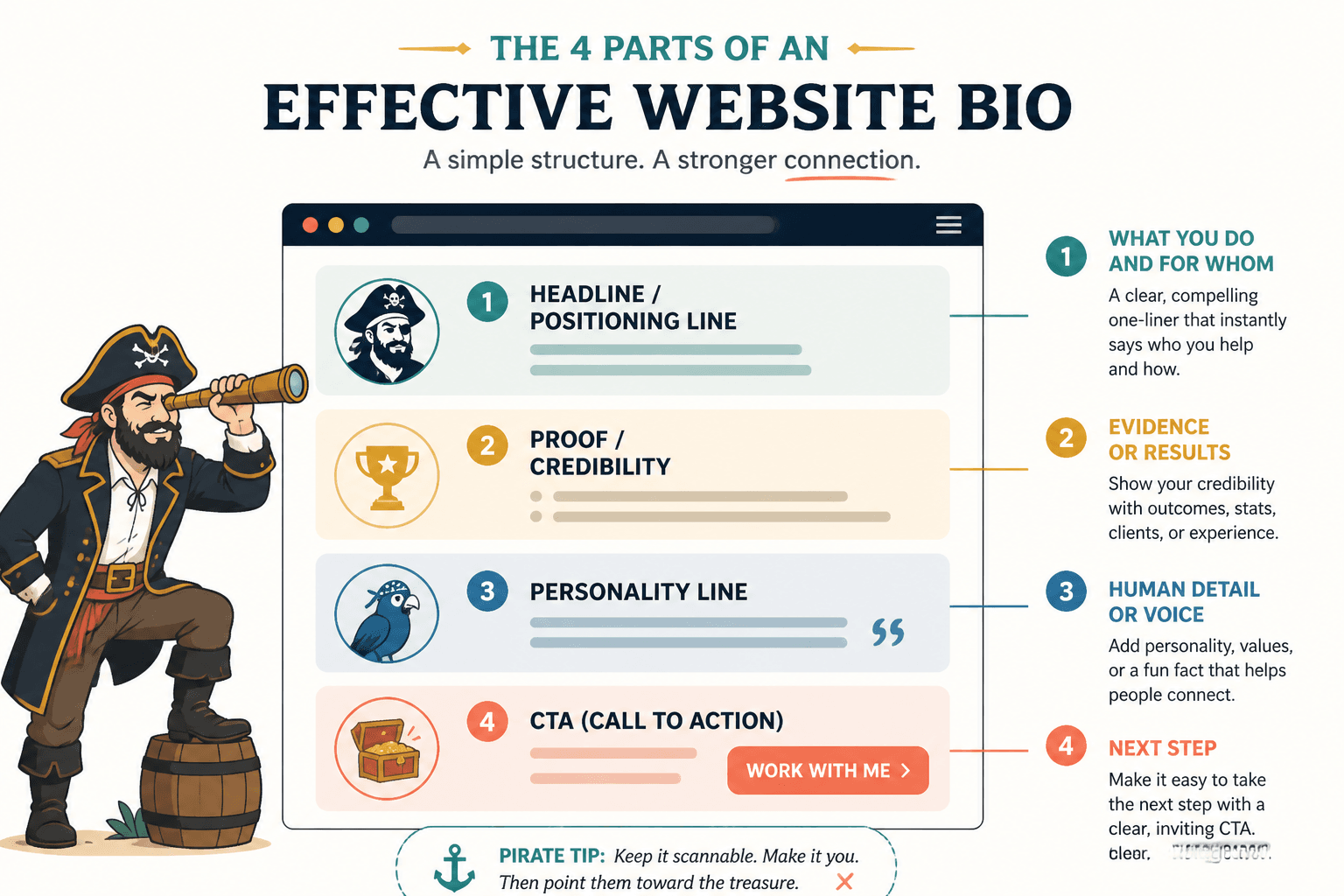
A simple structure that makes website bios work better
You do not need a magical formula, but you do need structure. A strong website bio usually includes five parts.
| Section | What it does | What it might sound like |
|---|---|---|
| Positioning line | Explains who you help and how | I help independent consultants turn messy expertise into clear, sellable content. |
| Specific context | Adds detail about your work | That includes homepage copy, offer messaging, and authority-building articles. |
| Proof | Shows credibility | My work has helped clients improve conversion, clarify positioning, and shorten the sales cycle. |
| Personality line | Makes you sound human | Sharp strategy, clean writing, and no interest in jargon for its own sake. |
| CTA | Gives the next step | Start with the services page or read a few articles first. |
That structure works because it balances clarity with credibility. It says what you do, adds enough substance to be believable, and leaves the reader with direction.
The short version
If you need a compact version for a sidebar, footer, author box, or homepage snippet, use this:
- Who you help
- What you help them do
- Why people should trust you
- What to do next
That alone puts you ahead of a surprising number of websites.
How to write a stronger positioning line
Your positioning line is doing the heavy lifting. It often appears at the top of the bio, and if it is weak, the rest of the section has to work much harder.
A good positioning line quickly answers three things:
- Who you are for
- What you help with
- What kind of result or change you create
Weak vs stronger examples
Weak: I help brands grow online.
Stronger: I help service-based founders turn unclear messaging into website copy that attracts better-fit leads.
Weak: Multi-passionate creative supporting conscious businesses.
Stronger: Brand writer for wellness and education businesses that need clearer offers, cleaner messaging, and less vague fluff.
Weak: Coach, speaker, and entrepreneur passionate about transformation.
Stronger: Business coach for solo consultants who are good at the work but tired of relying on referrals and hope as a marketing strategy.
The stronger versions are not better because they are longer. They are better because they reduce ambiguity.
A positioning template you can actually use
Try this:
I help [specific audience] do [specific thing] so they can [specific result].
Then make it less robotic. For example:
- I help coaches turn decent ideas into sharper website copy and more persuasive offers.
- I write conversion-focused website copy for creators who are done sounding generic.
- I help consultants clarify what they do, who they help, and why anyone should care within the first ten seconds of a homepage.
Notice the pattern. Clear audience. Clear work. Clear payoff. No fog machine.
What proof to include without turning your bio into a trophy shelf
People want proof, but not usually an avalanche of credentials with no narrative. The goal is confidence, not overload.
Good proof in website bio copy can include:
- Years of experience, if meaningful
- Notable client types or industries
- Known publications or platforms
- Relevant results or outcomes
- Useful credentials or certifications
- A short credibility marker such as “former in-house strategist” or “ex-agency copy lead”
The key is relevance. If the proof does not help the reader trust your ability to do the thing they care about, it probably belongs elsewhere.
Examples of proof that works
- Over the past five years, I have helped independent experts refine website messaging that converts more of the right traffic.
- My writing has appeared in major industry publications, but more importantly, it helps businesses explain what they do without sounding like everyone else.
- I have worked with consultants, coaches, and small agencies that needed clearer offers and more persuasive service pages.
- Former content strategist turned conversion copywriter for founder-led businesses.
That last one is short, but it carries signal. It gives context. It hints at range. It does not need a brass band.
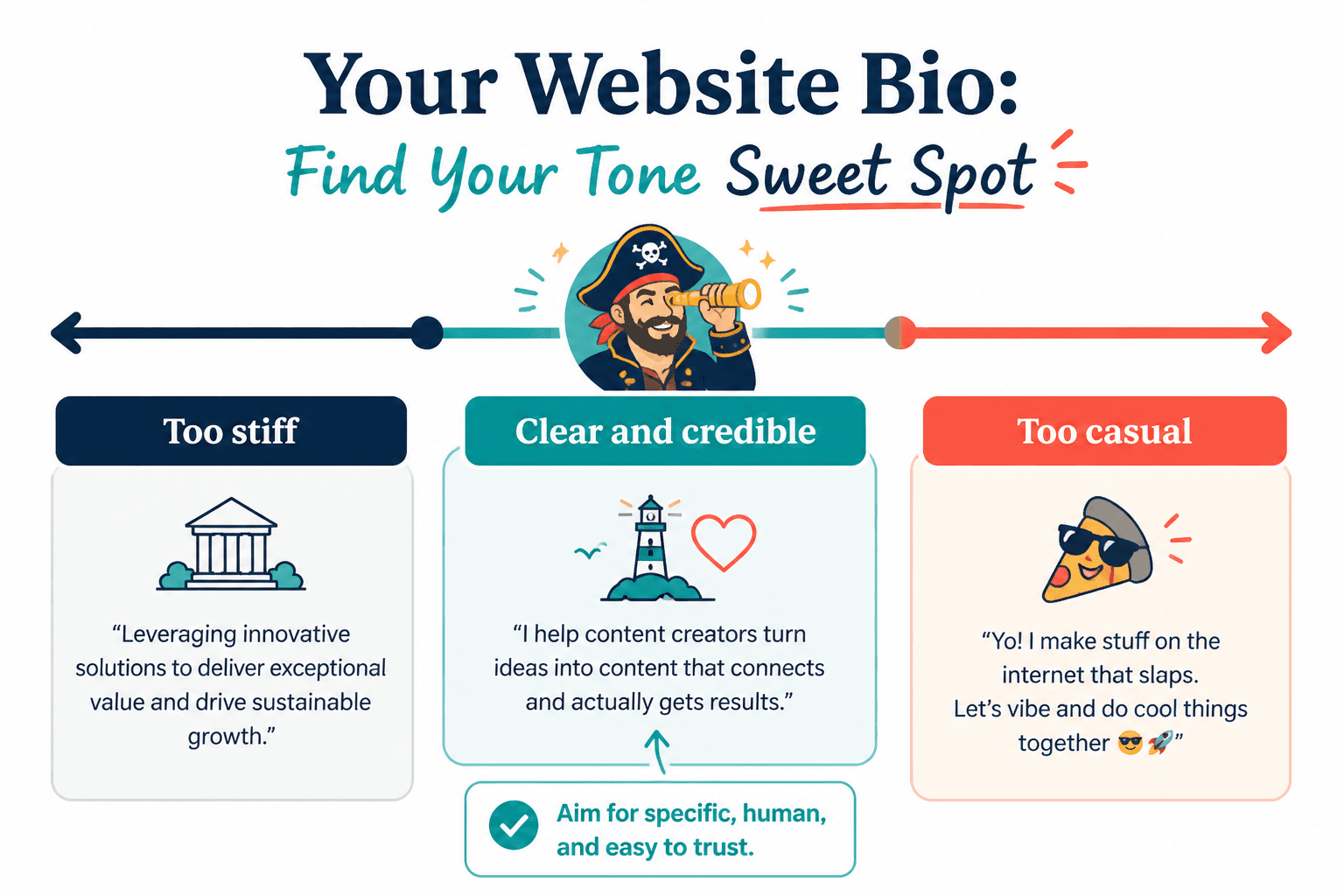
How much personality your bio should have
Enough to sound like a human. Not so much that clarity dies in the process.
Some creators swing too far into polished corporate language. Others overcorrect and write bios that feel like a late-night voice note to the internet. Neither is ideal if the page is meant to convert.
Personality in a website bio should support trust. It can show style, point of view, standards, even a little edge. But it still needs to stay useful.
Good ways to add personality
- Name how you work: clear, strategic, practical, fast-moving, research-heavy
- Express a real standard: no jargon, no generic messaging, no bloated funnels
- Use one clean opinion that fits your brand
- Add one human detail if it supports memorability
Examples:
- I like clean messaging, strong hooks, and offers that do not require a decoder ring.
- My style is strategic, direct, and allergic to filler.
- I help experts sound smarter online without making them sound less like themselves.
That is enough. You do not need to perform a full personality transplant in three sentences.
If you want examples across different styles, check these bio and profile copy ideas and examples for creators.
Where different website bio types should be shorter or deeper
Not every bio on your site should do the same job. A homepage intro is not an About page bio. An author box is not a speaker profile. Treating them all the same creates repetitive, underperforming copy.
Homepage bio
Keep it tight. Prioritize positioning, a little proof, and a CTA.
This is where people decide if they should keep exploring. They do not need your complete backstory yet.
About page bio
Go deeper here. Add context, story, philosophy, and more credibility. But still shape it around relevance. Your About page should not read like a timeline assembled by a nostalgic intern.
Author bio
Keep it short and tied to your expertise. Give readers a reason to trust the article and a reason to click further.
Service page profile
Focus on why you are qualified to deliver that service. Match the proof to the offer. If the service is messaging strategy, your pottery hobby can sit this one out.
Sidebar, footer, or team snippet
Use a compressed version: role, audience, proof, CTA. Short bios are a skill of their own, and they are worth getting right because they show up everywhere.
For quick versions you can adapt, see short bio examples creators can adapt fast and simple author bio templates for busy creators.
A practical rewrite process for boring bios
If your current bio feels muddy, here is a simple way to fix it without staring at the blinking cursor like it owes you money.
Step 1: Highlight the useful parts
Take your current bio and mark anything that clearly answers one of these:
- Who you help
- What you do
- What results you help create
- Why people should trust you
- What readers should do next
If huge sections do not answer any of those, they are probably filler.
Step 2: Cut the vague adjectives
Remove or replace words like:
- Passionate
- Dynamic
- Innovative
- Purpose-driven
- Authentic
- Experienced, unless you say in what
If a word sounds flattering but gives no information, it is usually not helping.
Step 3: Clarify the audience
“Businesses” is often too broad. “Founders” can still be too broad. Narrow it enough that the right people feel seen.
Examples:
- Independent consultants
- Service-based founders
- Coaches selling high-trust offers
- Small creative teams
- B2B experts building a personal brand
Step 4: Add one or two proof points
Not ten. One or two. Enough to reduce doubt.
Step 5: End with direction
Make the next step obvious. A good CTA in a bio can be very simple:
- Read the case studies
- Explore services
- Start with the About page
- Join the newsletter
- Book a consultation
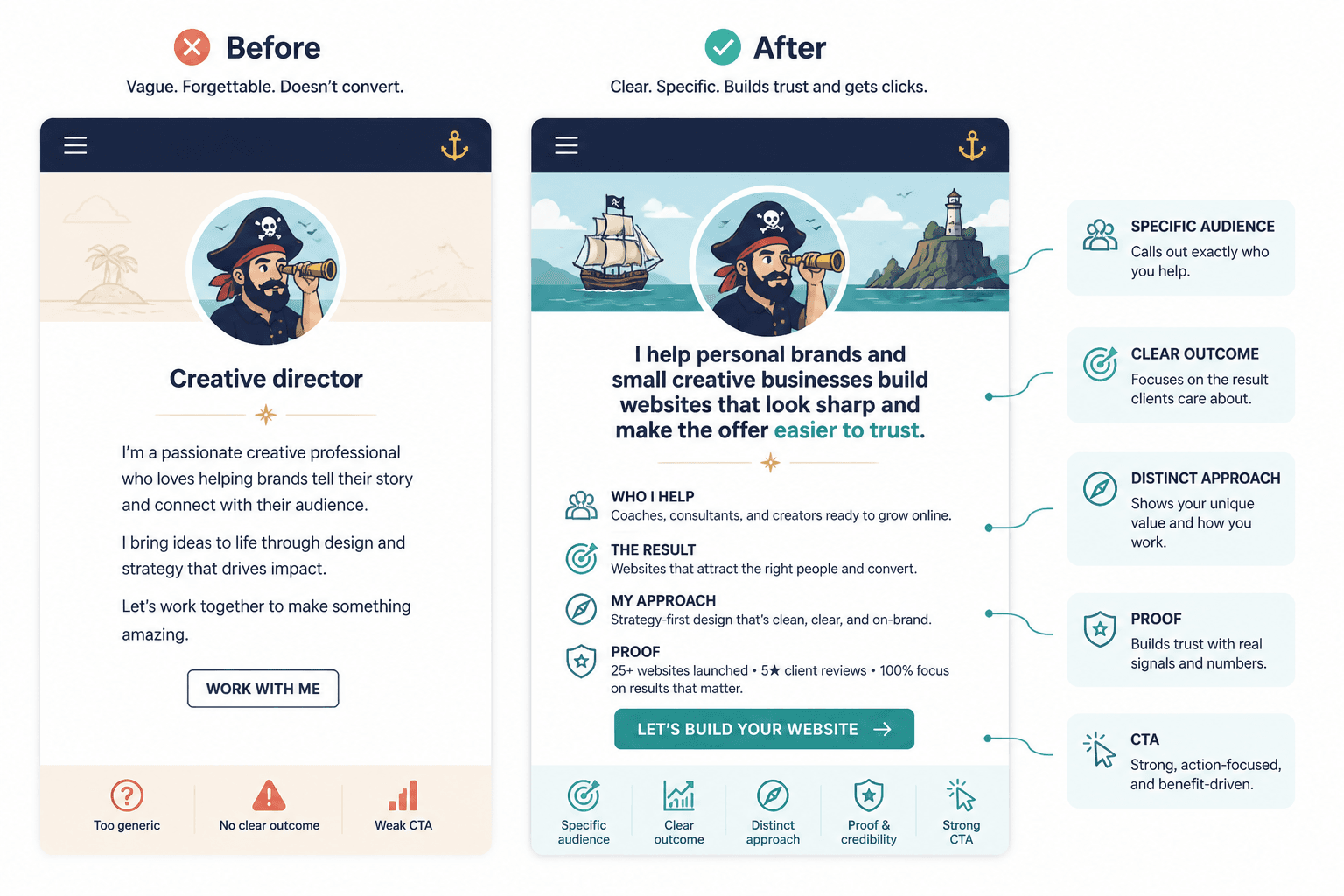
Before and after example
Before: Jane is a passionate entrepreneur, speaker, and creative strategist dedicated to helping businesses find their voice and thrive in the digital world. With years of experience across multiple industries, she brings authenticity, innovation, and heart to every project.
After: Jane helps service-based founders clarify their message and turn vague websites into sharper sales assets. She combines brand strategy and conversion copy to make offers easier to understand and easier to buy. After working across coaching, consulting, and education brands, she has developed a style that is clear, practical, and refreshingly free of marketing fog. Start with her services page or browse recent articles.
The second one is not brilliant because it is flashy. It is better because a real person could act on it.
Bio templates for different kinds of creators
Here are a few adaptable website bio templates that do not sound like they were assembled from leftover conference slides.
For a writer or copywriter
I help [audience] turn [messy problem] into [clear result] through [service or format]. My work focuses on [specialty], with an emphasis on [style or strength]. [Proof point]. [CTA].
Example: I help founder-led businesses turn unclear messaging into website copy that earns more trust and better leads. My work focuses on conversion copy, positioning, and content that actually sounds like a human wrote it. I have written for consultants, educators, and service brands that needed sharper offers and less fluff. Explore my services or read a few articles first.
For a coach
I work with [audience] who want to [goal] without [pain point]. My approach combines [method or perspective] with [practical outcome]. [Credibility]. [CTA].
Example: I work with independent consultants who want a steadier lead flow without turning their brand into a motivational costume. My approach combines business strategy, messaging clarity, and practical marketing systems that fit real life. I have helped clients refine offers, simplify funnels, and sell with more confidence. Book a consultation or start with the About page.
For a designer or creative director
I help [audience] build [asset or result] that feels [quality] and works [commercial outcome]. My work is shaped by [philosophy or specialty]. [Proof]. [CTA].
Example: I help personal brands and small creative businesses build websites that look sharp and make the offer easier to trust. My work sits at the intersection of clean design, brand clarity, and conversion-minded structure. I have led projects for coaches, consultants, and online educators who needed a site that felt more like a business and less like a placeholder. View recent work.
Templates are useful as scaffolding. Just do not stop at the template. Add your specifics or the copy will still feel generic, only more efficiently generic.
How to match your bio to the rest of your site
A good bio on a bad-fit page still struggles.
Your bio and profile copy for websites should match the rest of the site in tone, positioning, and promise. If your homepage says you help consultants simplify marketing, but your bio says you are a holistic creative visionary empowering impact-driven brands, readers are left reconciling two different people.
That mismatch quietly damages trust. Not because people consciously think, “Ah yes, a narrative inconsistency.” They just feel a wobble. The site stops feeling clean and coherent.
Check your bio against these elements:
- Homepage headline
- About page intro
- Service page positioning
- Author bio under articles
- Profile CTA in the header or footer
The wording does not need to be identical, but the message should rhyme.
Quick checklist for better website bio copy
- Does it clearly say who you help?
- Does it explain what you actually do?
- Does it include a useful result or outcome?
- Does it offer proof without overloading the reader?
- Does it sound like a smart human, not a press release?
- Does it avoid vague adjectives and role soup?
- Does it fit the page it is on?
- Does it tell the reader what to do next?
If you can answer yes to most of those, you are in decent shape. If not, good news: the fix is usually clarity, not genius.
FAQ
The bigger point is simple: clearer structure and clearer writing make the piece more useful. That is usually what makes the ending land better too.