
The bad assumption is that an About page only needs a nicer bio. That is a convenient lie because it turns a strategic page into a writing exercise and lets the real problems hide in plain sight. A strong About page is not there to admire itself in the mirror. It exists to help the right visitor understand who you are, what you do, why you do it, and whether they should keep going.
That means the job is less “write something meaningful” and more “build a page that earns trust without wasting time.” A good About page does not ramble, posture, or drift into brand poetry. It answers the reader’s quiet questions in a clean order and then gets out of the way.
What your About page is actually supposed to do
An About page has a practical job. It needs to help visitors move from curiosity to confidence. For some businesses, that means clarifying expertise. For others, it means making the brand feel human enough to trust. For many, it does a bit of both.
At minimum, the page should do four things:
- Show who the site is for
- Explain what the business helps with
- Build trust with relevant proof or context
- Make the next step obvious
That is not decorative copy. That is conversion support.
If you want the broader site structure this page belongs to, see the About page copy parent guide.
Why most About pages underperform
Most About pages go wrong in predictable ways. They either talk too much about the brand and not enough about the reader, or they try so hard to sound polished that they lose their actual meaning. Sometimes both happen in the same paragraph, which is ambitious in a disappointing sort of way.
Common failure points include:
- Self-focus without relevance: the copy is all origin story and no audience overlap.
- Vague claims: “passionate,” “dedicated,” “innovative,” and other words that could live anywhere.
- No structure: the page reads like a stream of consciousness with a URL.
- Thin proof: it makes claims but never grounds them.
- Weak CTA: the page ends like it forgot why the visitor came.
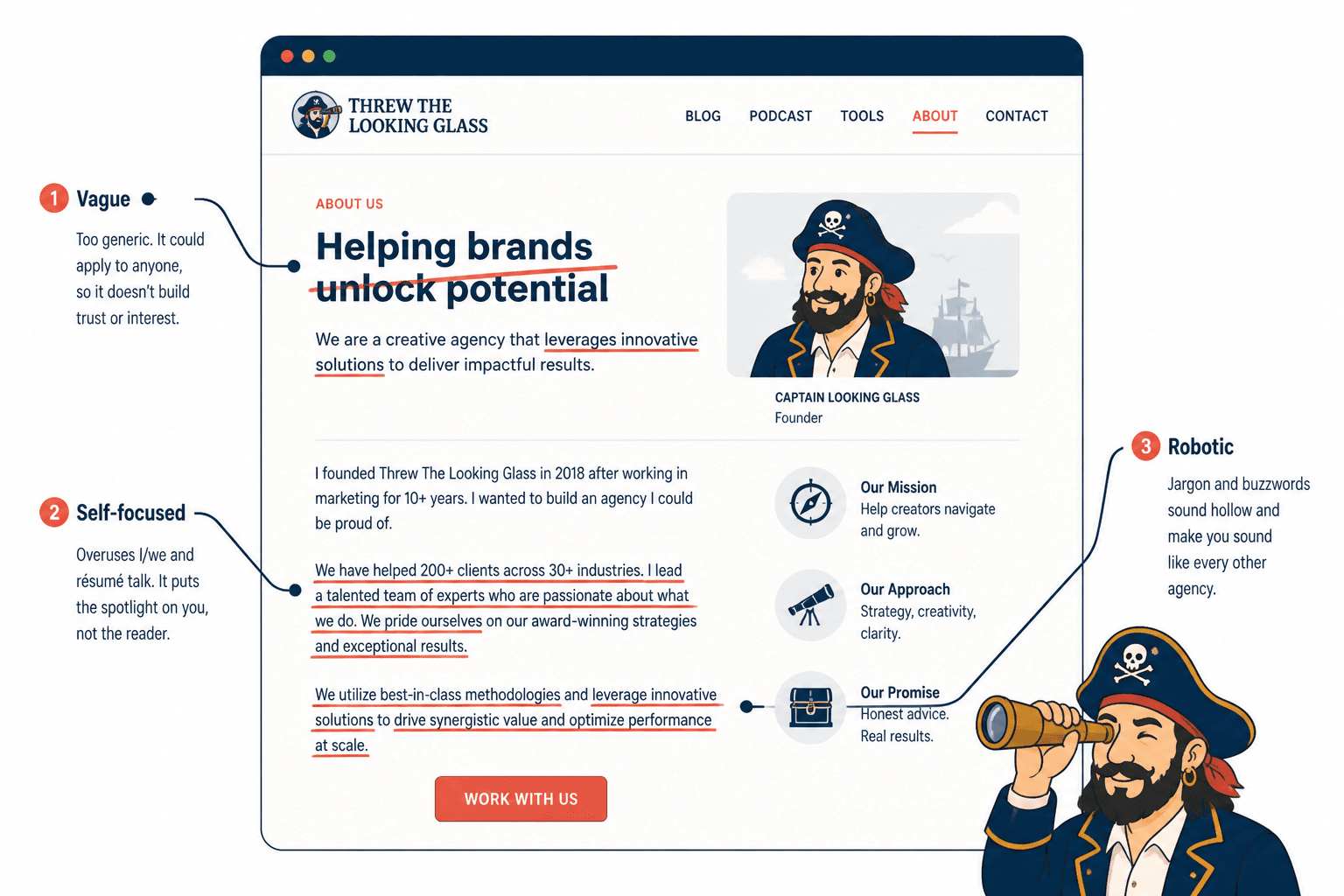
If your About page currently feels like a pleasant fog, the issue is usually not tone. It is ordering, specificity, and relevance.
The simplest structure that works
You do not need a clever format. You need a clear one.
- Opening: say who you help and why the page matters.
- Relevance: show you understand the reader’s situation or problem.
- Story: explain why your perspective or approach exists.
- Proof: add credibility, outcomes, or experience that matters.
- Mission or positioning: state what you are trying to do in plain language.
- CTA: tell the reader what to do next.
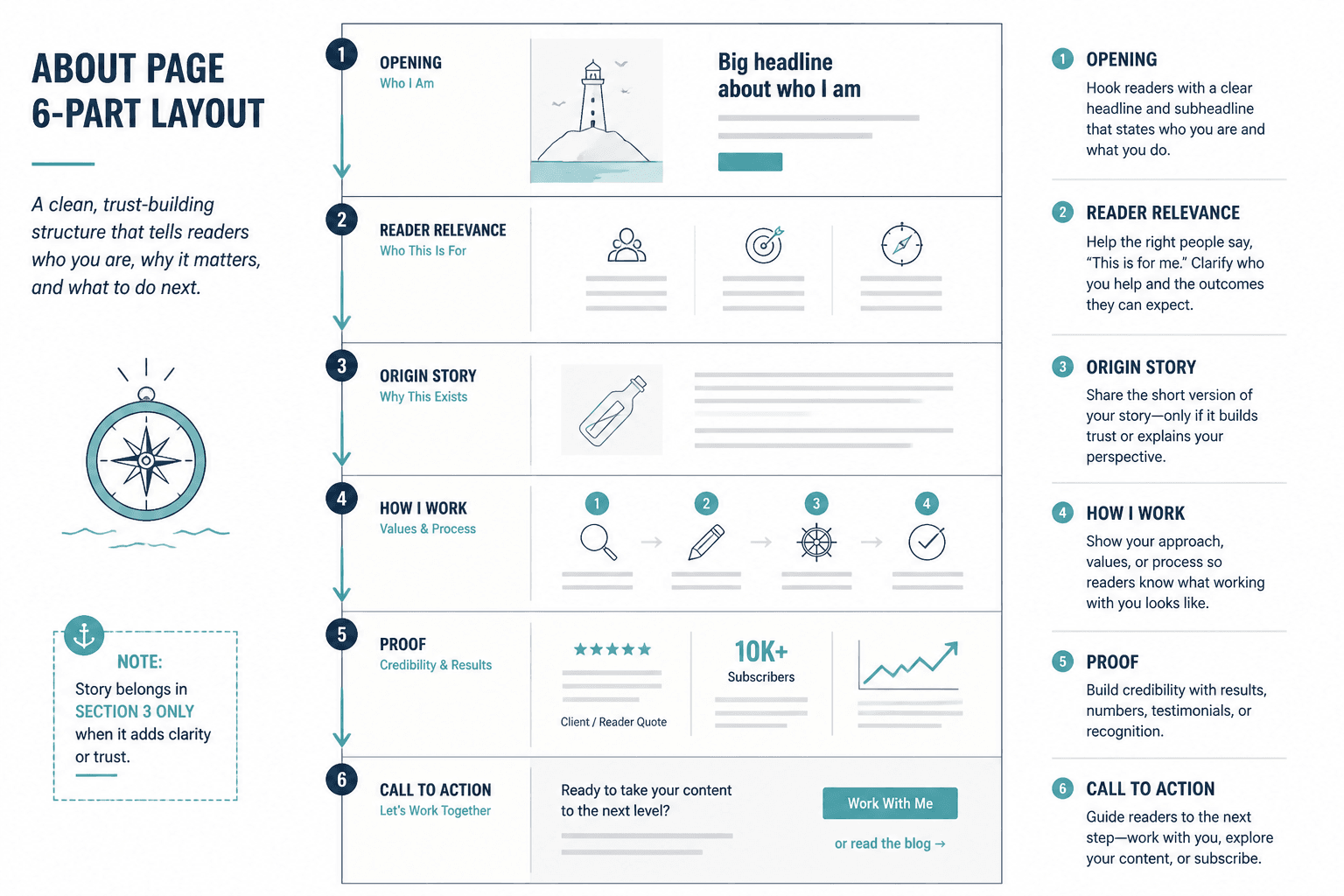
That structure is flexible enough for a creator, service provider, or small brand. The sections can be short or long, but they should keep the same basic logic: relevance first, personality second, proof third, next step last.
A practical section-by-section framework
1. Opening
The opening should establish who the page is for and what the reader is looking at. Not a greeting. Not a warm-up. Not a small theatrical performance called “my journey.”
Good openings do one or more of these:
- name the audience
- name the problem or goal
- state the offer or role
- set up the page’s point
2. Reader relevance
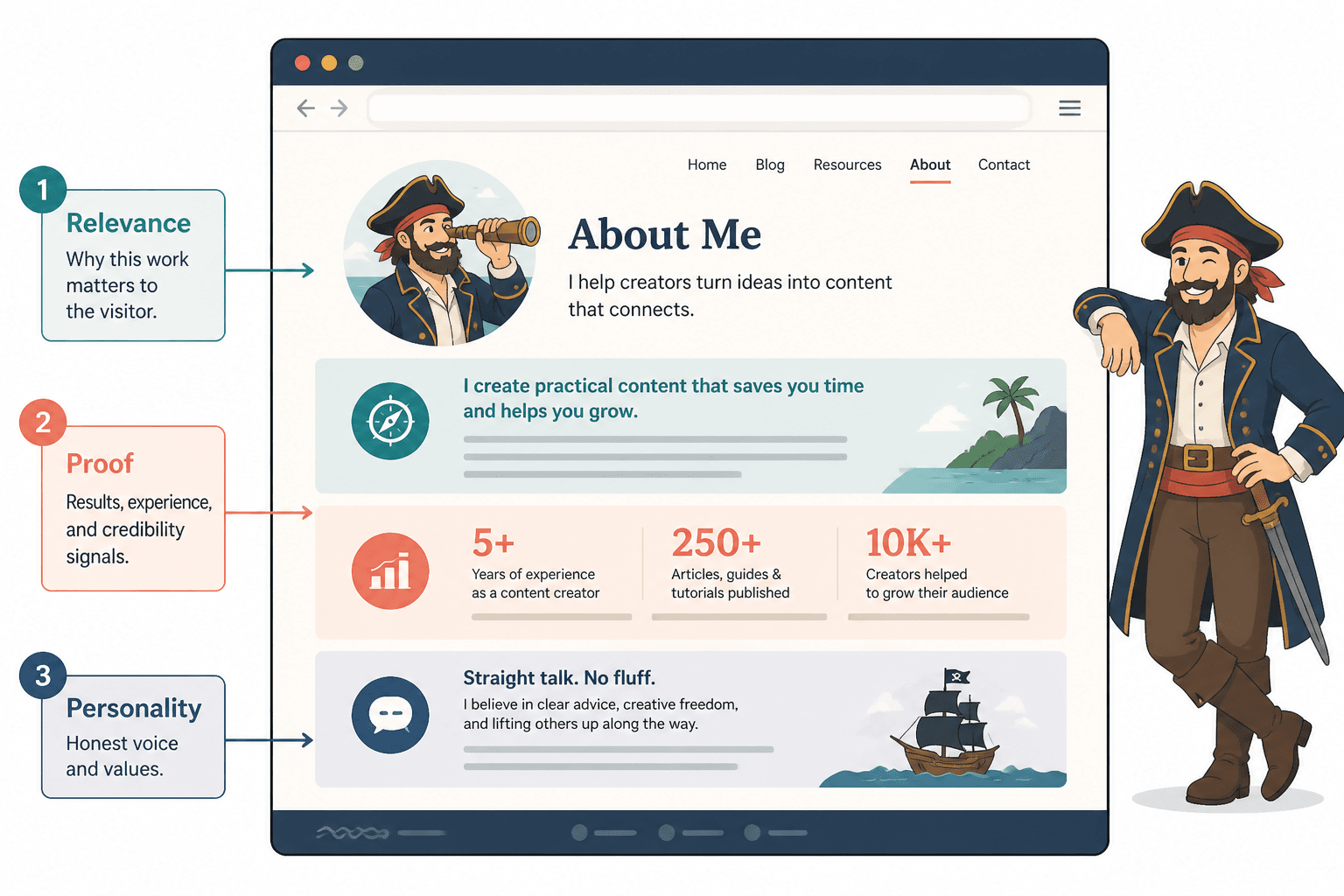
Show that you understand the reader’s situation. A short paragraph can do a lot of work here if it is specific. The goal is not to flatter the audience. It is to make them feel accurately seen.
3. Story
Your story belongs here only if it helps explain why your approach exists. Use it to build context, not to dump a timeline. A useful story says, in effect, “Here is what changed, why that matters, and how it shaped the work.”
4. Proof
Proof can be experience, results, credentials, process, reputation, or a concrete track record. The right proof depends on the business model and the level of trust the visitor needs before taking the next step.
5. Mission or positioning
This is the place for a clear point of view. If the business has a mission line, it should sharpen the page, not inflate it. One sentence can do the job if it is specific.
6. CTA
Do not end with a shrug. The reader should know whether to book, browse, contact, read more, or keep exploring the site.
For a tighter layout and lighter presentation, the sibling guide on how long About page copy should be is the better fit for length decisions. If you are still shaping the opening, the companion guide on how to start About page copy without a weak opening covers that section in more detail.
How to write an opening that does not waste everyone’s time
Weak openings usually start with a greeting, a vague identity statement, or a sentence that sounds like it is trying to wear a blazer. The problem is not that the sentence is rude. It is that it gives the reader nothing to hold onto.
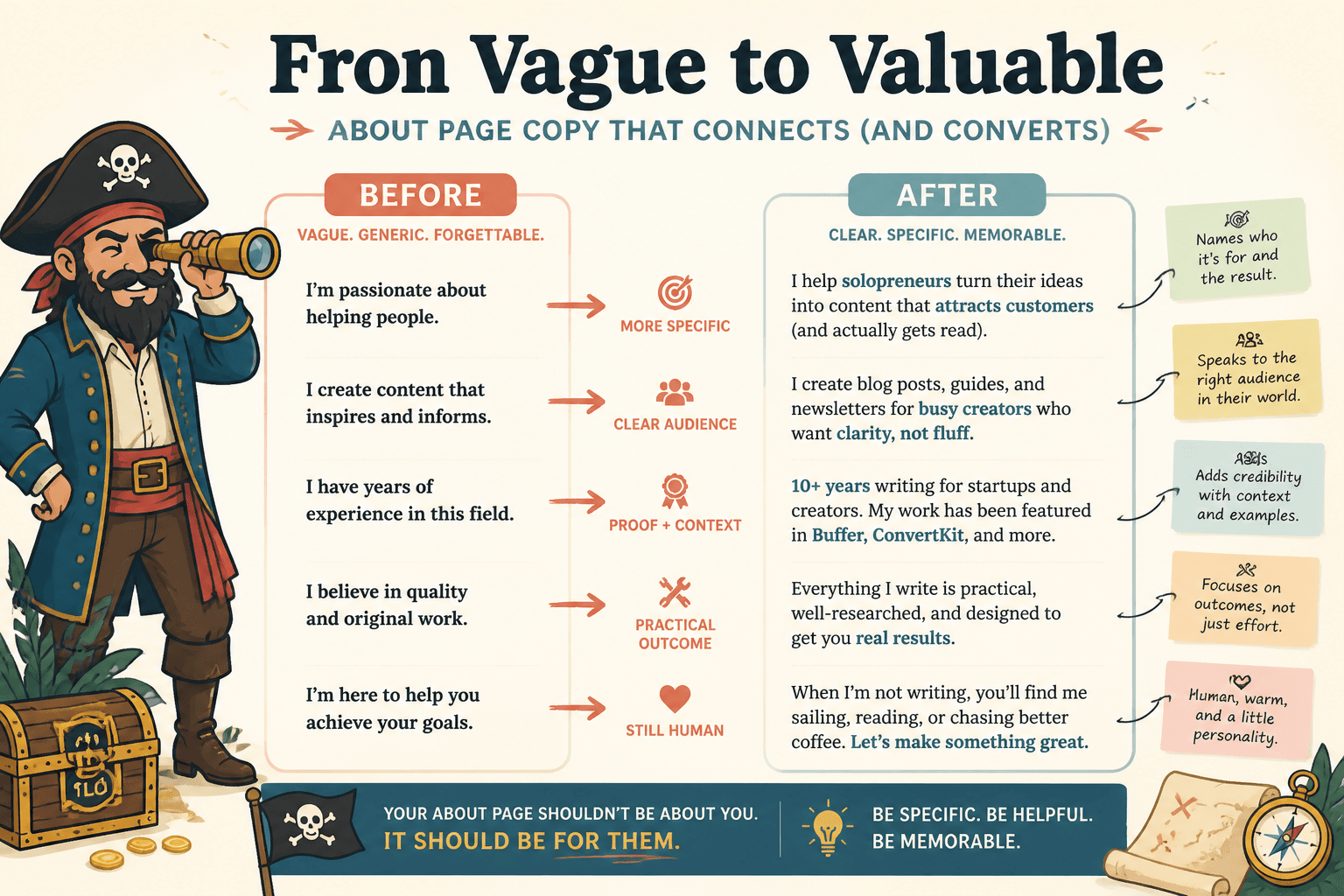
Weak opening
“Hi, I’m Jordan, and I’m passionate about helping people grow.”
That could belong to almost anyone, which is exactly the problem. It introduces a person without introducing a reason to care.
Stronger opening
“I help independent brands turn messy messaging into copy people can actually use.”
Now the reader knows what sort of work happens here and why the page exists.
A simple opening formula
Use this as a starting point:
- Who you help
- What you help them do
- Why your perspective matters
A basic version might look like this:
I help [audience] do [specific result] by [your method, angle, or expertise].
That formula is not a cage. It is a clean place to begin before you add voice, proof, or personality.
How to write the story without sounding generic
About page stories often fail because they start too far back, stay too broad, or conclude with a lesson so soft it could be sold as a pillow. The useful version of the story is compact and relevant.
Try this shape instead:
- Before: what was not working?
- Shift: what changed your approach?
- Now: how does that shape the work you do?
That keeps the story moving toward the reader instead of circling the autobiography drain.
Specificity matters more than dramatic flair. A sentence about noticing a repeated client problem is usually more useful than a paragraph about “a lifelong passion for helping people unlock their potential.” One sounds like work. The other sounds like a candle label.
Mission statement mistakes that hurt performance
A mission line should help the reader understand your point of view. It should not sound like it escaped from a corporate retreat.
Common mistakes include:
- Being too general: the line could belong to ten different businesses.
- Being too abstract: words like “empower,” “transform,” and “elevate” do all the hiding.
- Being too self-important: the copy tries to sound bigger than it is.
- Being too crowded: one sentence is doing the work of four.
A stronger mission line is usually narrower, clearer, and more grounded in what the business actually helps people do.
If you are refining the mission sentence specifically, the companion article on About page mission statement mistakes is the better next stop.
How long About page copy should be
Length should follow the job of the page, not a trend chart. Some About pages should be short and clean. Others need enough room to earn trust. The mistake is assuming that long automatically means thoughtful or that short automatically means sharp.
Use length based on:
- how complex the offer is
- how much trust the visitor needs
- how personal the brand is
- how much proof is available
- how much of the page is already doing other work
For a clearer breakdown of scope and structure, the length-focused sibling guide on how long About page copy should be covers this in more detail.
How to make the copy sound human, not salesy or robotic
The easiest way to sound robotic is to write in abstractions. The easiest way to sound salesy is to overcompensate for those abstractions with enthusiasm. Neither mode is impressive for long.
To keep the copy human:
- use concrete nouns and verbs
- cut filler praise that does not help the reader
- keep the focus on the visitor more often than not
- let the voice be plain before it is clever
- use personality as seasoning, not as the meal
If a sentence sounds like it was written to impress a committee, rewrite it for a specific person instead. That usually fixes the tone faster than any branding exercise.
A simple editing pass before you publish
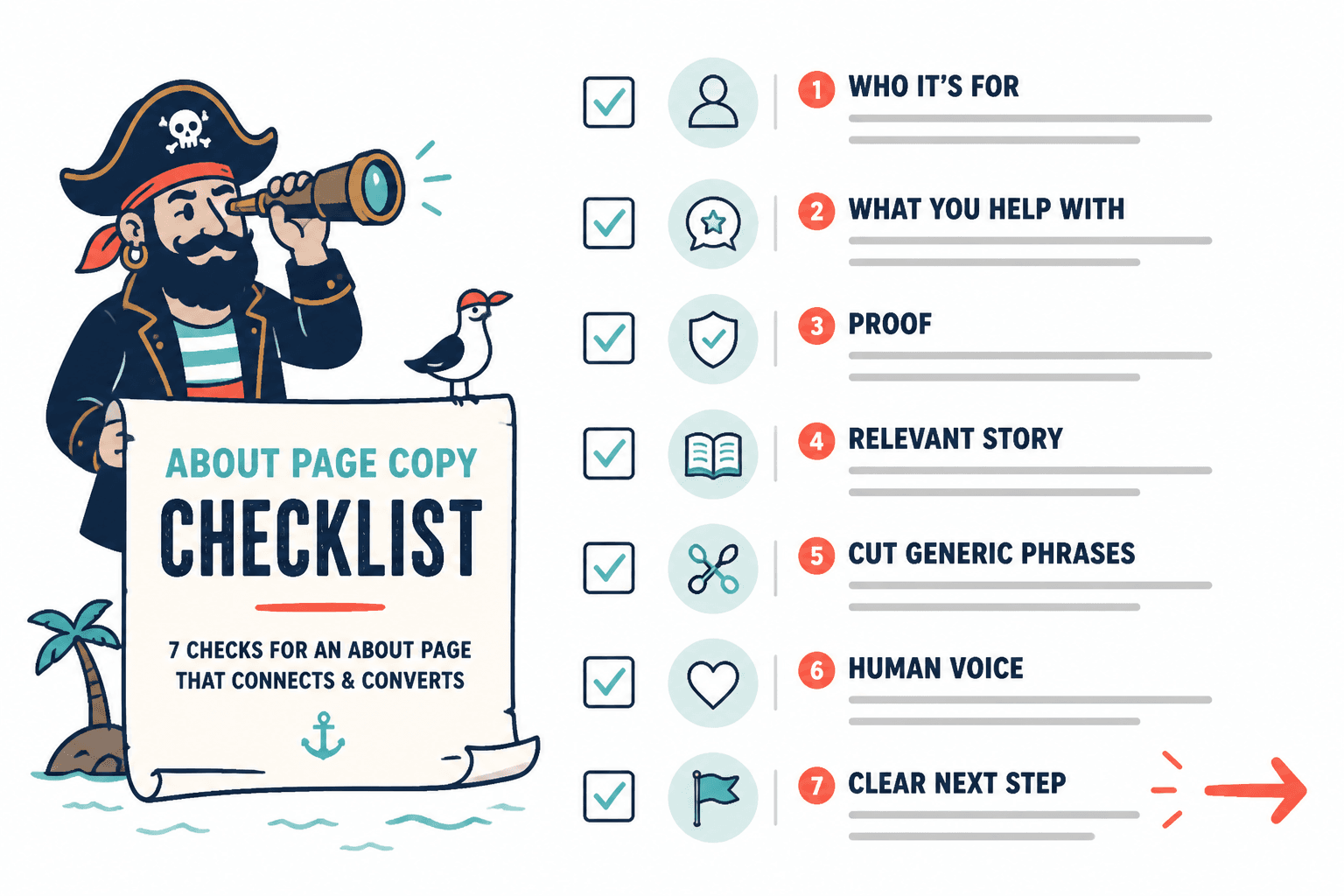
Before you treat the page as done, run this checklist:
- Can a new visitor tell who this page is for in the first few lines?
- Does the page explain what the business actually helps with?
- Is there at least one specific proof point?
- Does the story support the work instead of wandering away from it?
- Is the mission line specific enough to be useful?
- Does the CTA tell the reader what to do next?
- Have you removed vague filler, generic praise, and filler that thinks it is personality?
If the answer to any of those is no, the page is not finished yet. It is just politely formatted.
Final take
Better About page copy is not about sounding more impressive. It is about making the reader’s next question easier to answer. That means clearer openings, tighter stories, better proof, and a page structure that actually serves a purpose.
Start with relevance. Add useful context. Prove what matters. Then give the reader a next step that feels obvious rather than decorative.
That is the whole trick. No spiritual awakening required.