
Most creator funnels do not break because the tech is bad.
They break because the trust gets weird.
Someone follows you for useful ideas, honest perspective, or sharp content. Then the funnel starts acting like a dehydrated salesperson who read half a copywriting thread and got overconfident. Suddenly every email sounds urgent, every free resource is bait, and every call to action feels like a trap door.
If you want to know How to Monetize Creator Funnels Without Wrecking Trust, the answer is not “sell less.” It is sell with more alignment. Better sequencing. More honesty. Less funnel cosplay.
This article will help you build creator funnels that actually make money without making people regret giving you their email, attention, or time. We’ll cover what trust-killing funnels do wrong, how to structure offers more cleanly, where to place monetization without acting thirsty, and how to make the whole thing feel like a useful journey instead of a conversion ambush.
If your current funnel gets clicks but not much goodwill, or attention but not many buyers, that is usually not a traffic problem. It is often a trust design problem.
For the full path around this topic, head to the parent guide.
Why creator funnels lose trust so fast
Trust is fragile in creator businesses because the brand is usually you. Not a faceless company. Not a giant storefront. You. Your name, your posts, your ideas, your inbox, your offers.
That means every step in the funnel carries emotional weight. A pushy pitch does not just hurt one campaign. It changes how people read your future content. A low-effort lead magnet does not just underperform. It makes people question your standards. A manipulative sales sequence does not just annoy subscribers. It teaches them that your generosity had an invoice hidden inside it.
The usual trust-killers look like this:
- The free content is thoughtful, but the paid offer feels generic
- The opt-in promises one thing, then the emails pivot hard into something else
- The nurture sequence sounds like a discount furniture ad with emotional issues
- The creator starts pitching before proving anything
- The offer is real, but the pressure around it feels fake
- The funnel is clearly copied from someone selling to a completely different audience
None of this is subtle. Readers can feel it.
Creators sometimes think trust breaks when you ask for money. It does not. Trust usually breaks when the money ask feels disconnected from the value people came for.
The basic rule: monetization should feel like a continuation, not a betrayal
A good creator funnel feels like this:
- You helped me think better
- You helped me solve something small
- You showed me you understand the problem
- You made the next step obvious
- You gave me a paid option that fits what I already wanted
A bad creator funnel feels like this:
- You grabbed my attention with one topic
- You gave me a freebie I barely used
- You sent five emails pretending to “check in”
- You manufactured urgency out of thin air
- You pitched an offer that seems only loosely related to why I showed up
That gap matters more than people think.
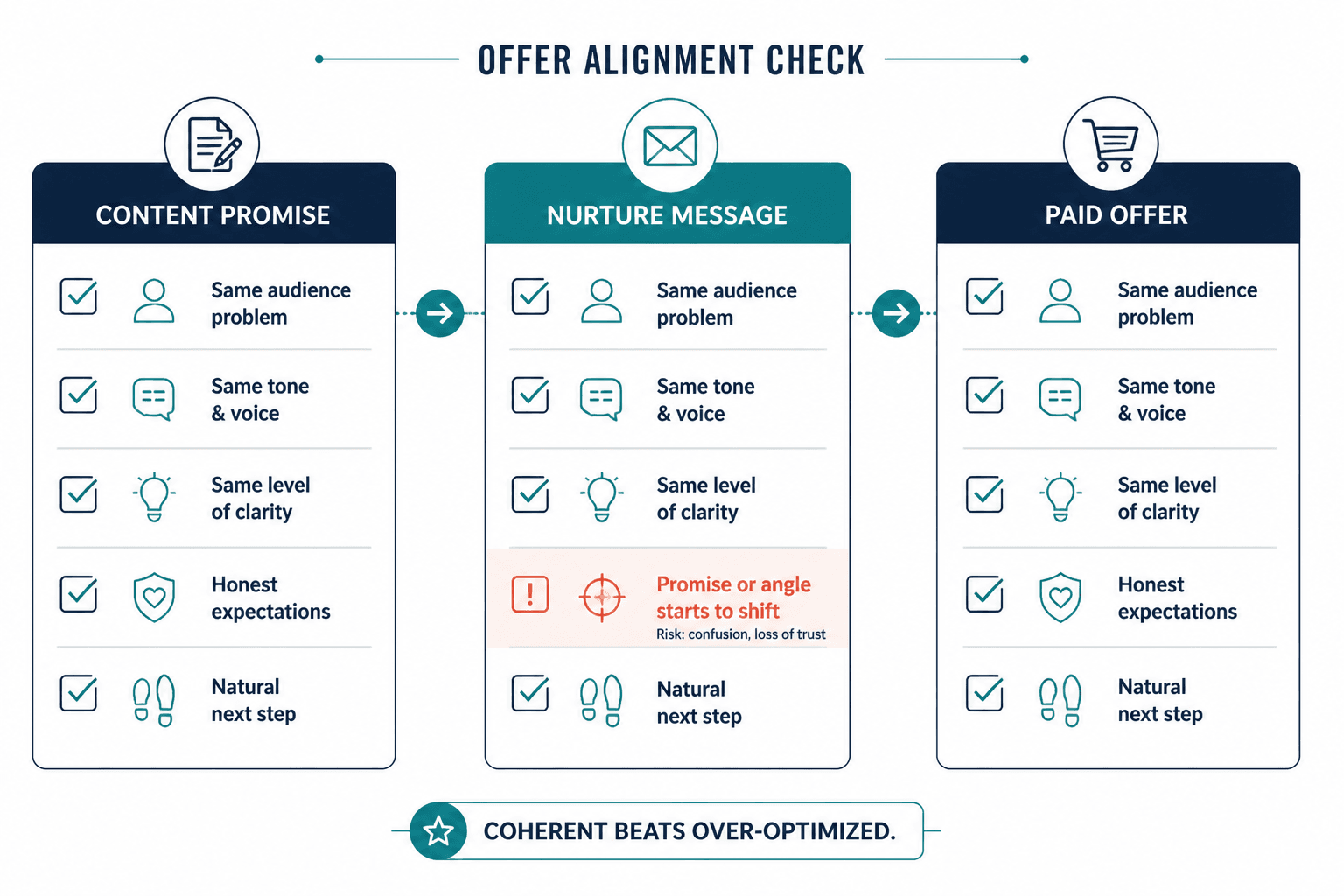
If you want monetization without trust damage, your funnel needs continuity across four things:
- Audience: the right people are entering
- Problem: the same core pain or goal keeps showing up
- Promise: each step logically builds on the last
- Tone: your content voice and sales voice do not sound like two strangers in a trench coat
That last one gets overlooked a lot. If your posts sound human and your funnel sounds auto-generated by a startup intern with a webinar addiction, people notice.
For a broader look at creator funnel structure, you can explore the main creator funnels guide and the related audience-to-offer journeys and trust sequence examples.
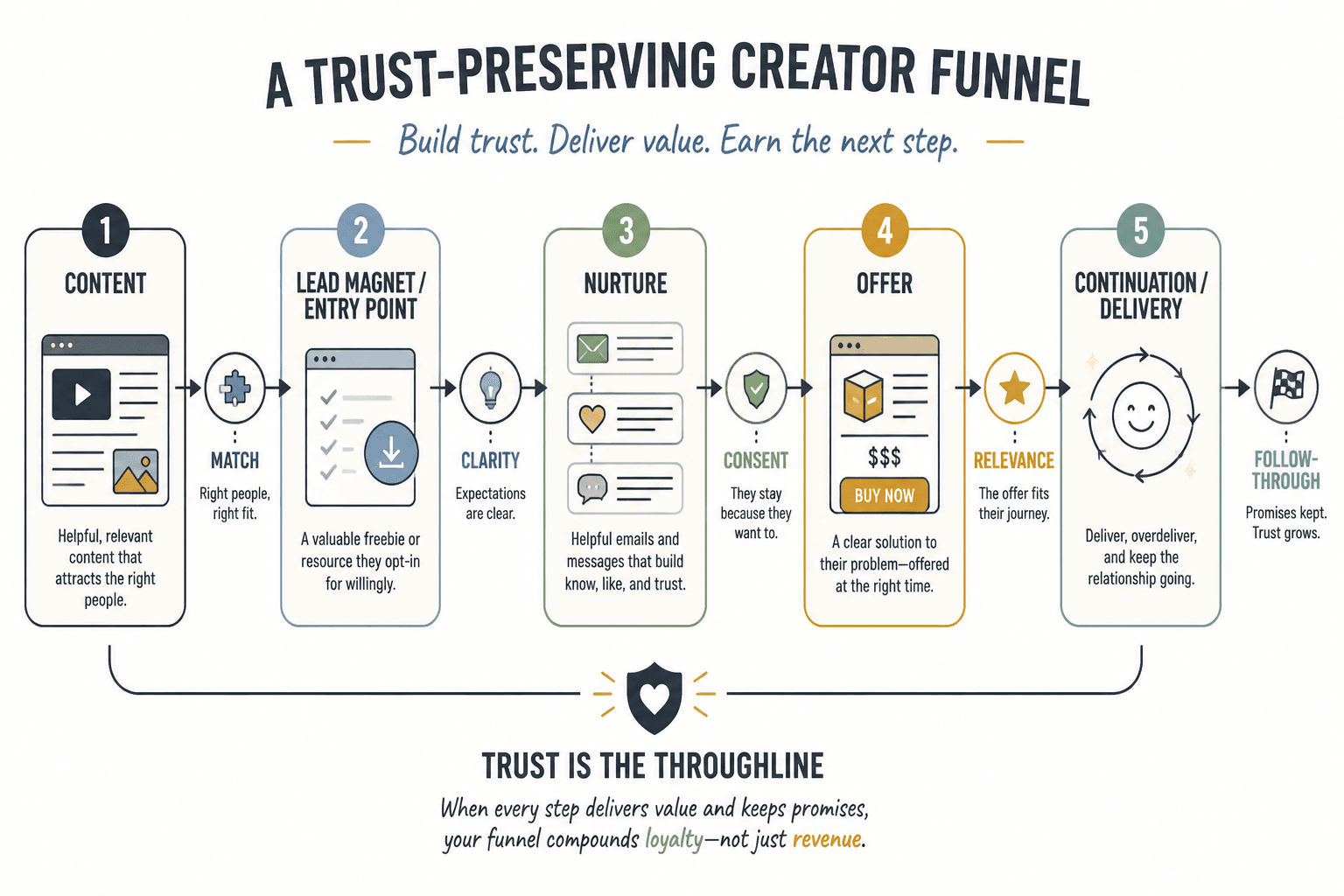
Start with a funnel that earns the right to sell
You do not need a huge funnel. You need a believable one.
For most creators, a trust-preserving funnel has five simple parts:
- Attention: a post, article, thread, video, or profile that attracts the right people
- Entry point: a newsletter, free resource, waitlist, quiz, mini training, template, or consultation invitation
- Nurture: useful follow-up that deepens trust and clarifies the problem
- Offer: a paid next step that fits what they already care about
- Continuation: delivery, follow-up, and future offers that make the first purchase feel smart
Simple. Not simplistic.
The key is that each step should make the next step feel earned. Not forced. If someone joins your list from a post about improving LinkedIn authority, and two emails later you are pitching a vague “creator growth accelerator,” do not act surprised when they vanish into the fog.
The cleaner version sounds more like this: “You came for stronger authority content. Here’s a practical resource. Here’s how to use it. Here’s where people get stuck. If you want help applying it to your business, here’s the paid option.”
That is not just more ethical. It converts better because it makes sense.
Use this trust-first funnel test
Ask these five questions about your current funnel:
- Would a reasonable person feel misled by the jump from free content to paid offer?
- Does the lead magnet solve a real problem or just collect emails?
- Do the nurture emails teach, clarify, or prove something useful before pitching?
- Is the offer specific enough that people know what they are buying?
- Would the tone still feel normal if your best client read it out loud?
If two or three of those answers are shaky, your monetization issue probably is not pricing. It is trust friction.
Choose monetization points that match trust level
One of the fastest ways to wreck trust is asking for too much too soon.
Not every reader is ready for your premium offer just because they liked one post. Attention is not intent. A click is not commitment. A freebie download is not a marriage proposal.
Different trust levels call for different asks.
| Trust level | What the audience likely wants | Best monetization move |
|---|---|---|
| Low | Clarity, relevance, low-risk next step | Newsletter, low-ticket product, diagnostic, workshop, waitlist |
| Medium | Proof, process, stronger guidance | Mini course, template pack, group offer, strategy session |
| High | Customization, speed, depth, direct help | Coaching, consulting, done-with-you, done-for-you, premium program |
The mistake is trying to send cold or lightly warmed people straight into a high-ticket pitch with no bridge. Sometimes that works if your positioning is extremely strong and the pain is urgent. Most of the time, it just feels aggressive.
A better approach is to match your ask to how much trust has actually been built.
Examples:
- A useful post can lead to a newsletter or free template
- A strong article can lead to a workshop or strategy call
- A case study email can lead to a consultation or service page
- A practical thread can lead to a low-ticket product or deeper guide
If you want a more detailed breakdown of moving from content into revenue, see how to turn creator funnels into more leads or sales.
Make your free value good enough to create belief, not just curiosity
A lot of creators misunderstand what free content is supposed to do in a funnel.
Its job is not just to attract eyeballs. Its job is to create belief.
Belief that you understand the problem. Belief that your approach is smart. Belief that your paid offer might be worth paying for. Belief that you are not another person stapling random advice together and calling it a framework.
This does not mean giving away your whole business for free. It means giving people enough real usefulness that your expertise becomes credible in practice, not just in branding.
What free content should do before the pitch
- Help the reader name the real problem
- Show why common fixes fail
- Offer one or two useful steps they can apply now
- Demonstrate your thinking style or method
- Make the paid next step feel deeper, not random
Free content that only teases usually creates shallow curiosity. Free content that genuinely helps creates trust and buying intent.
That is the difference between “I guess I’ll stay on this list for now” and “When I’m ready, this is probably who I’d buy from.”
Build nurture sequences that sound like you, not a funnel template from 2019
Your nurture sequence is where trust either compounds or quietly dies.
And no, “Hey friend, just bubbling this up in your inbox” is not a personality. It is a warning sign.
Good nurture does three things well:
- It helps: the emails are useful on their own
- It sharpens: the problem and desired outcome become clearer
- It transitions: the offer shows up as a logical next step, not a hard swerve
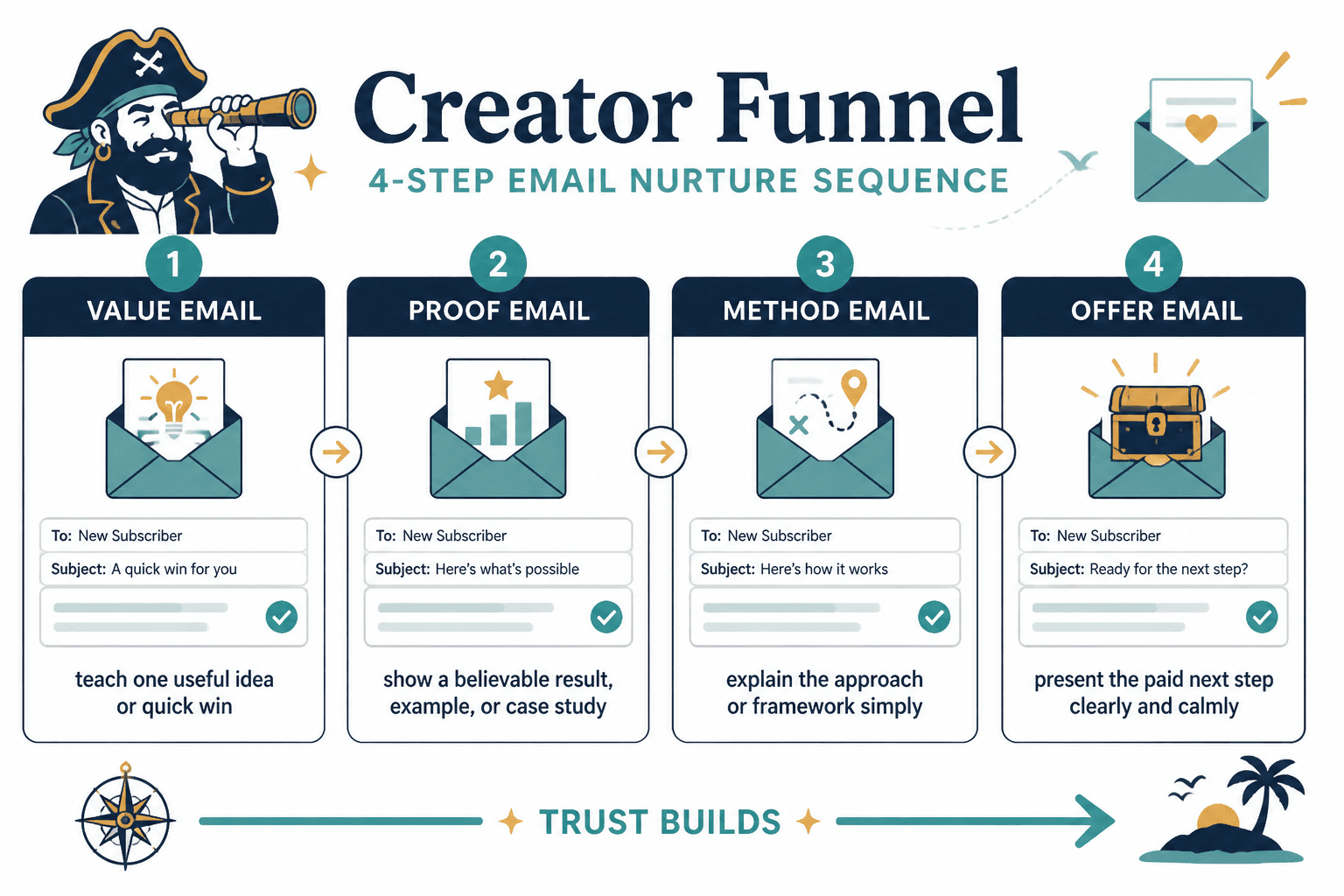
A simple 5-email trust-preserving sequence
- Delivery email: give them the thing, set expectations, point them to one useful next action
- Problem clarification email: explain a mistake or blind spot that keeps people stuck
- Proof email: share a short case study, client result, or before/after example
- Method email: explain your approach or framework in simple terms
- Offer email: present the paid next step clearly, calmly, and specifically
This works because it earns momentum. By the time the offer appears, the reader understands the problem better, trusts your point of view more, and can see why paying may help.
If you need help tightening the voice of that sequence, read how to write creator funnels without sounding salesy or robotic.
And if your funnel starts weakly from the very first touchpoint, fix that too with how to start creator funnels without a weak opening.
Sell with specificity, not pressure
When creators get nervous about selling, they often compensate in the worst possible way. They become louder, vaguer, and more urgent at the same time.
That is a horrible combination.
If you want to monetize without wrecking trust, make the offer more specific instead of more dramatic.
Weak pitch
If you’re ready to step into your next level and finally create aligned growth in your business, I have a few spots open for my transformational container.
This says almost nothing. It sounds expensive, foggy, and slightly dangerous.
Stronger pitch
If you want help turning your content into a cleaner funnel that leads to more consultations, I offer a 4-week strategy package. We’ll tighten your entry points, write your nurture sequence, and connect your content to one clear offer.
That one works better because the reader can answer the basic buying questions fast:
- Is this for me?
- What problem does it solve?
- How does it help?
- What am I actually getting?
Specificity builds trust because it lowers interpretation risk. People stop wondering what you mean and start deciding whether they want it.
Use proof without turning your funnel into a brag parade
Trust grows when people can see signs that your offer works. But there is a fine line between credible proof and relentless self-congratulation.
Use proof to reduce uncertainty, not to inflate your image.
Good kinds of proof
- Short case studies with a clear problem and outcome
- Specific client wins with relevant context
- Before/after rewrites or funnel improvements
- Concrete numbers when they are honest and useful
- Testimonials that mention process, clarity, or experience, not just praise
Less useful kinds of proof
- Meaningless screenshots with no context
- Huge revenue claims detached from your reader’s reality
- Testimonials that say “amazing energy” and nothing else
- Fake scarcity plus fake social proof stacked together like bad theater
A calm, relevant case study often sells better than a dramatic “I made 47 gazillion dollars in 3 days” flex. Shocking, I know.
The reason is simple: believable proof supports trust. Inflated proof invites suspicion.
Do not monetize every touchpoint
One of the most common trust mistakes in creator funnels is making every interaction transactional.
Every email points to a sale. Every post tees up an offer. Every DM is one “helpful question” away from a pitch. It creates a strange emotional tax around your brand. People start feeling like attention to your content comes with a hidden fee.
You need spaces in your funnel where no sale is happening yet. Places where the audience can learn, observe, reply, and build confidence without feeling cornered.
That could include:
- Newsletter emails that are purely useful
- Articles that teach without forcing a CTA every third paragraph
- Posts that open conversation instead of pushing traffic
- Free resources that actually solve a small problem well
This is not anti-sales. It is what makes future sales easier.
Trust needs breathing room.
Price and position your offers so they feel proportionate
A trust problem is sometimes a positioning problem wearing a sales hat.
If your funnel warms people with lightweight content and then jumps to a massive high-ticket offer, the issue may not be your copy. The issue may be that the leap feels too large for the relationship.
You can fix that in a few ways:
- Create a lower-friction offer between free and premium
- Improve the proof and problem awareness before the pitch
- Narrow the premium offer so it solves one urgent problem more clearly
- Extend the nurture period for complex or expensive offers
Monetization works better when the ask feels proportionate to the trust level, the pain level, and the audience’s stage of awareness.
That does not mean underpricing your work. It means not pretending a casual subscriber is instantly ready for your deepest, priciest engagement just because your checkout page exists.
Keep the tone consistent from content to sales
This is where a lot of creator funnels quietly sabotage themselves.
Your content voice creates trust partly because it feels recognizably human. So if your sales pages, opt-ins, or email pitches suddenly sound puffed up, theatrical, or suspiciously “optimized,” people feel the tonal whiplash.
Consistency matters.
If your posts are plainspoken and smart, your offer copy should be too. If your content is direct and strategic, your funnel should not suddenly start talking about abundance portals, effortless quantum expansion, or “the secret no one tells you.”
Readers do not need your funnel to be perfectly polished. They need it to feel coherent. Familiar. Honest.
A quick tone check
Read your last three content pieces and your main sales email back to back. Ask:
- Do these sound like the same person?
- Would my audience feel a weird shift here?
- Am I clearer in content than I am in the pitch?
- Did I trade honesty for conversion clichés?
If yes, smooth it out. Better a slightly less “optimized” funnel than one that feels like a bait-and-switch in a blazer.
A practical creator funnel structure that monetizes cleanly
If you want a cleaner model, here is one that works well for many creators, coaches, consultants, and solo service brands.
Example funnel
- Content: publish useful posts around one clear problem you help solve
- Profile CTA: invite readers to a relevant free resource or newsletter
- Lead magnet: solve a small but meaningful piece of the bigger problem
- Nurture sequence: teach, clarify, prove, and transition
- Core offer: present one paid next step with clear scope and outcome
- Follow-up: continue sending useful content, case studies, and occasional offers
That is enough. You do not need fourteen automations and a funnel map that looks like a conspiracy board.
If you do want to explore the wider category structure, there is also the broader monetization funnels path here: monetization and funnel systems resources.
Common mistakes that make monetization feel gross
- Using free content as pure bait: nothing useful, just dangling the “real value” behind a form
- Pitching constantly: your audience should not feel hunted
- Writing vague offers: if people cannot tell what you sell, trust drops fast
- Skipping proof: claims without evidence make readers defensive
- Forcing urgency: fake deadlines and pressure tactics age badly
- Mismatching audience and offer: content for beginners, sales page for advanced buyers, chaos for everyone
- Copying someone else’s funnel style: especially if their audience, price point, and business model are different from yours
Most of these errors come from impatience. The creator wants the sale before the audience has enough clarity or confidence to make one.
That impatience leaks into the funnel. People feel it.
FAQ
Should creators avoid selling in nurture emails?
Not at all. They should avoid selling badly. Useful emails plus a clear, relevant offer usually build more trust than endless “value” with no next step.
How often should a creator pitch?
Often enough that people know what you sell, not so often that every touchpoint feels transactional. The right rhythm depends on your audience, offer, and how much value surrounds the pitch.
Can low-ticket offers help preserve trust?
Yes, if they are genuinely useful and logically connected to the bigger offer. No, if they are just flimsy tripwires clogging the path.
What if my audience likes my content but does not buy?
Usually one of four things is off: the offer, the transition, the proof, or the audience fit. It is not always a content problem.
Is it possible to monetize a small audience without seeming pushy?
Absolutely. Small audiences often respond well to specific offers, honest language, and direct relevance. You do not need hype. You need fit.
Monetize the relationship you actually built
The cleanest answer to How to Monetize Creator Funnels Without Wrecking Trust is this: stop trying to monetize an imaginary relationship.
Creator funnels get better when the path feels simpler and the writing makes each next step obvious. A cleaner message usually fixes more than extra funnel complexity ever will.