
Most lead magnets do not fail at the opt-in.
They fail one click later.
Someone downloads your checklist, guide, prompt pack, or template. Then you hit them with a follow-up CTA that is either weirdly aggressive, painfully vague, or so limp it may as well say, “Anyway, good luck out there.” That is where momentum dies.
If you want better lead magnet follow-up CTAs for personal brands, the job is not to sound more polished. It is to make the next step feel obvious, useful, low-friction, and worth taking. That means your CTA has to match the promise of the lead magnet, the temperature of the relationship, and the kind of buyer journey you are actually running.
This is where a lot of creators, coaches, consultants, and solo founders get sloppy. They build a decent freebie, then bolt on a generic “book a call” or “join my program” CTA like nobody will notice the emotional whiplash. People notice.
Here is how to write follow-up CTAs that do not wreck trust, waste attention, or ask for too much too soon.
To see how this fits into the wider strategy, open the parent guide.
What a lead magnet follow-up CTA is actually supposed to do
A follow-up CTA is not just “the thing at the end.” It is the bridge between free value and deeper action.
That action might be reading another article, replying to an email, joining your newsletter, watching a short training, booking a consult, or checking out an offer. The point is not to push the hardest possible ask. The point is to move the right people into the right next step without making everyone else feel cornered.
Good follow-up CTAs do three things:
- They extend the value of the lead magnet
- They qualify interest without forcing commitment
- They create momentum toward trust, conversation, or conversion
Bad ones do this instead:
- Jump straight from freebie to sale
- Use vague language with no clear benefit
- Ask for too much from a cold lead
- Ignore what the person just downloaded
- Sound like every funnel template from the past ten years
Your CTA should feel like the natural next move. Not a trapdoor.
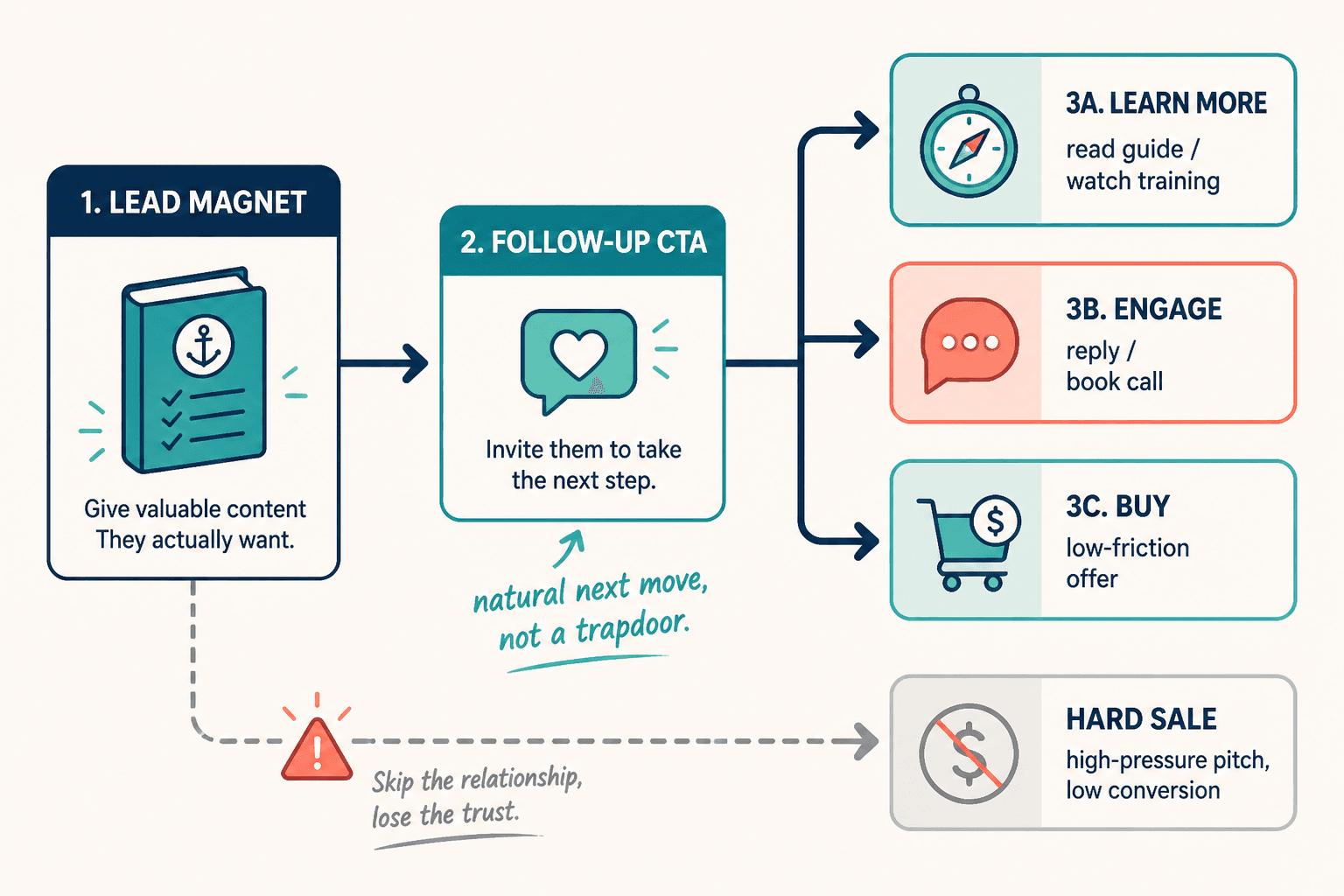
Why most personal brand CTAs after lead magnets underperform
The usual problem is not that the CTA exists. It is that it ignores context.
A person downloaded your lead magnet because they wanted a specific result, or at least a useful shortcut toward one. They did not wake up desperate to “explore working together” unless they were already very warm. So when your follow-up CTA skips over the actual problem and starts waving a sales page in their face, it feels disconnected.
Personal brands especially need to get this right because the whole model runs on trust. People are not just buying information. They are buying judgment, clarity, process, taste, and confidence that you understand their situation. A clumsy CTA makes you sound like someone who learned funnels from a dusty PDF and never met a real human.
Common reasons follow-up CTAs flop:
- The ask is too big: A cold subscriber downloads a one-page guide and gets pushed toward a high-ticket call.
- The CTA is too vague: “Learn more” and “take the next step” are not persuasive because they say almost nothing.
- The transition is too abrupt: There is no explanation of why this next step matters.
- The CTA is too self-centered: It focuses on your offer before their progress.
- The lead magnet and CTA do not match: The freebie promises one thing, the CTA points somewhere unrelated.
Most of this is fixable with better sequencing and sharper wording.
Start with the right CTA type, not just better wording
Before you write the line, decide what kind of CTA actually makes sense for this lead magnet and this audience stage.
Not every freebie should lead to the same place. A template pack for busy consultants needs a different next step than a strategic guide for founders actively shopping for help. If you force the same CTA onto everything, your funnel starts acting like a vending machine with emotional issues.
The 5 most useful follow-up CTA types for personal brands
| CTA type | Best for | Example next step |
| Read more | Building trust and depth | Link to a related article or guide |
| Reply or engage | Starting conversations | Ask them to reply with their biggest blocker |
| Use a tool or template | Creating momentum and quick wins | Point to a worksheet, checklist, or example bank |
| Join a nurture path | Warming leads over time | Invite them to your newsletter or email series |
| Book or buy | High-intent leads | Consult call, audit, strategy session, or offer page |
The important bit is this: your CTA should fit the buyer temperature.
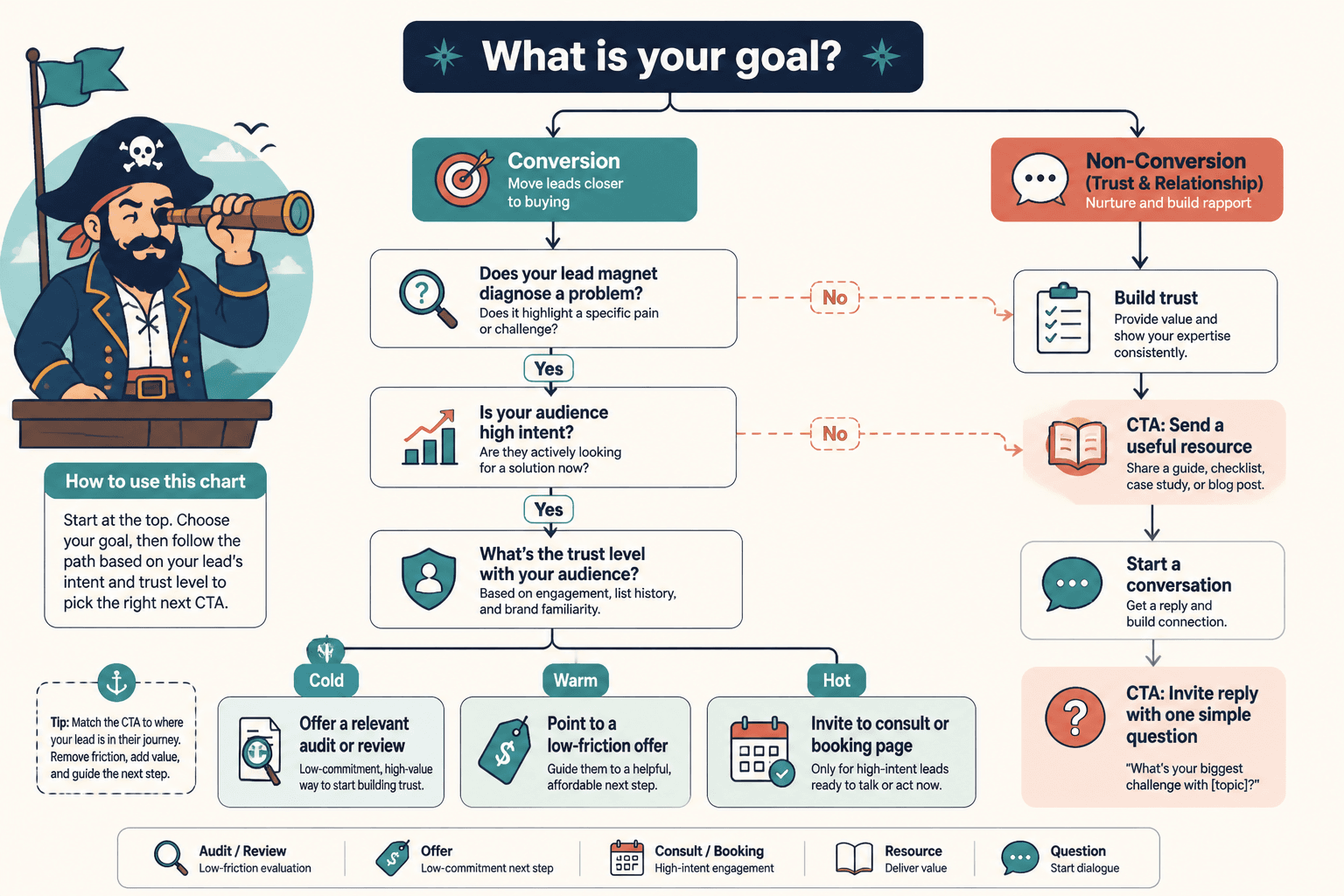
- Cold leads usually need a lighter ask
- Warm leads can handle a clearer commercial next step
- Hot leads need less persuasion and more friction removal
If your lead magnet is top-of-funnel, your CTA probably should not act bottom-of-funnel. Obvious point, yet people keep doing the opposite.
How to match the CTA to the lead magnet
The best follow-up CTAs feel like part two of the same promise.
If your lead magnet helps someone diagnose a problem, the CTA should help them interpret the diagnosis or act on it. If the lead magnet gives tactical steps, the CTA should help them implement those steps faster or better. If the lead magnet is educational, the CTA should deepen understanding or show the applied version.
Here is a simple way to think about it:
- Lead magnet gives clarity → CTA offers a deeper breakdown
- Lead magnet gives tactics → CTA offers implementation help
- Lead magnet gives examples → CTA offers customization or review
- Lead magnet gives a quick win → CTA points to the next milestone
- Lead magnet attracts buyers → CTA can invite a conversation or offer
That matching matters more than clever phrasing. A smart-sounding CTA attached to the wrong next step still feels wrong.
Examples of stronger lead magnet to CTA matches
- Lead magnet: LinkedIn hook swipe file
Weak CTA: Book a brand strategy call
Better CTA: Read the guide on improving signup hooks or reply with your current opener for a quick steer - Lead magnet: Personal brand bio template
Weak CTA: Buy my group coaching program
Better CTA: Use the template, then check out a deeper article on writing better lead magnets or profile copy if you want the message to connect end to end - Lead magnet: Funnel checklist for consultants
Weak CTA: Follow me on social media
Better CTA: See the broader lead magnet hub or book an audit if you already know your funnel is leaking leads
See the pattern? The CTA keeps the same conversation going.
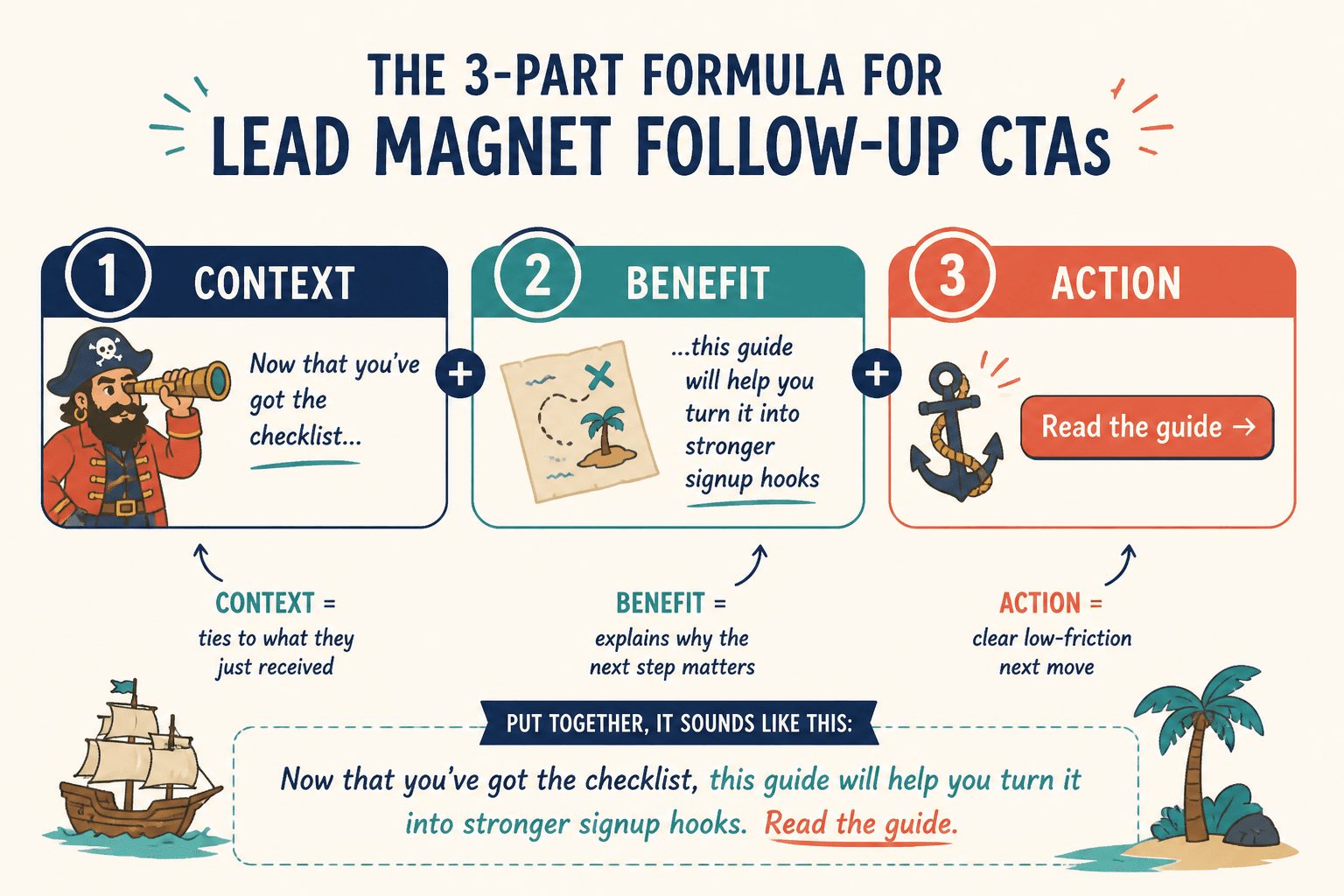
A simple framework for writing better lead magnet follow-up CTAs for personal brands
You do not need a mystical copywriting formula. You need a clean structure.
Use this:
- Context: Remind them what they just got or what it helps with
- Benefit: Explain why the next step is worth taking
- Action: Tell them exactly what to do
That can be as short as one sentence or expanded into a short paragraph, depending on where the CTA appears.
Template
Now that you’ve got [lead magnet result], the next useful step is [next action] so you can [specific benefit].
Examples
- Now that you’ve got the checklist, read this guide on writing better lead magnets if you want the actual asset to pull its weight too.
- If the swipe file helped you spot weak hooks, start here next. It’ll help you make the opt-in line less generic and a lot more convincing.
- Want more than ideas? Reply with “audit” and I’ll send details on a hands-on review if you want help fixing the whole funnel, not just the freebie.
Notice what these do not do. They do not scream. They do not beg. They do not sound like they were assembled by a funnel bot wearing a blazer.
They simply make the next move feel logical.
Where to place the follow-up CTA so people actually notice it
You are not limited to one CTA stuffed at the end of a PDF.
For personal brands, follow-up CTAs usually work best when they appear across the whole handoff experience, not just in one lonely spot. That means looking at the thank-you page, delivery email, welcome sequence, lead magnet itself, and any follow-up content it points toward.
High-leverage places to use them
- Thank-you page: Great for immediate next steps while attention is still high
- Delivery email: Strong place for a clean CTA with a little context
- Inside the lead magnet: Useful near the end, or after a particularly valuable section
- Welcome email sequence: Ideal for softer asks and relationship-building CTAs
- PS section: Often underrated, especially for lighter actions like replies or article clicks
If you use multiple CTA placements, do not repeat the exact same wording everywhere. That looks lazy and tends to flatten response. Keep the destination consistent if needed, but change the angle based on where the reader is.
For example:
- Thank-you page CTA: “Start here next if you want to tighten the signup hook too.”
- Delivery email CTA: “After you read the guide, this article will help you improve the opt-in line that gets people to download it in the first place.”
- In-guide CTA: “If your lead magnet is solid but signups are weak, the problem may be the promise, not the asset.”
How to write CTAs that sound human, not needy
The fastest way to make a CTA worse is to oversell it.
Personal brands usually perform better with language that is direct, calm, and useful. You do not need to inflate the next step like it is the opportunity of a lifetime. You just need to tell people why it matters.
What to avoid
- “Don’t miss out”
- “Act now”
- “Ready to transform your business?”
- “Book a call to unlock your potential”
- “Click here to learn more”
These either sound generic, pushy, or empty. Sometimes all three. A CTA should reduce friction, not add suspicion.
What works better
- “If you want the full process, read this next”
- “Use this after the checklist if you want stronger results”
- “Reply if you want a second pair of eyes on it”
- “This is the next article I’d read if your opt-ins are lagging”
- “If you are already considering help, here’s the cleanest next step”
That style works because it respects the reader. It says, here is the next useful move if it fits. Not, please sprint into my funnel and pretend this feels natural.
Before-and-after rewrites of weak follow-up CTAs
Sometimes the easiest way to improve your CTA is to look at what is broken on the page.
1. The vague CTA
Before: Learn more about how I can help.
After: If you want help turning this lead magnet into something people actually sign up for, read this next.
Why it works: It says what “help” means and ties directly to the problem.
2. The too-big ask
Before: Book a strategy call now.
After: If the guide made you realize your funnel needs more than patchwork fixes, you can reply to this email and ask about a strategy audit.
Why it works: It qualifies the reader and softens the jump to a paid or direct-contact action.
3. The disconnected CTA
Before: Follow me on LinkedIn for more content.
After: Want better examples before you build your next freebie? Start with these lead magnet ideas and examples.
Why it works: It keeps helping instead of asking for a vanity follow.
4. The generic nurture CTA
Before: Check out my other resources.
After: If this helped, the full lead magnet resource hub is the best next stop.
Why it works: It gives a specific destination and a reason to click.
Best CTA paths based on your goal
Not every personal brand uses lead magnets for the same reason. Your follow-up CTA should support the real business goal, not just generate activity that looks nice in a dashboard.
If your goal is trust
- Send them to a strong article
- Offer a useful example bank
- Invite them into your newsletter
Good fit links here include a broader guide to lead magnets or a deeper writing article.
If your goal is conversation
- Ask for a reply with a specific blocker
- Invite a short DM keyword response
- Offer a lightweight review or opinion
This works especially well for consultants, coaches, and service providers who sell through trust and diagnosis, not impulse purchases.
If your goal is conversion
- Offer a relevant audit or consult
- Point to a low-friction offer
- Invite them to a booking page only if the lead magnet attracts high-intent people
The key phrase there is relevant audit. A CTA converts better when the paid next step clearly continues the free value. If your lead magnet helps diagnose messaging problems, the CTA can offer messaging review. If it gives funnel advice, the CTA can offer funnel teardown. This is not groundbreaking. It is just alignment, which is apparently rare enough to feel impressive.
A quick checklist for stronger follow-up CTAs
Before you publish, run the CTA through this filter:
- Does it match what the lead magnet just promised?
- Is the next step useful for the reader, not just convenient for you?
- Is the ask appropriate for a cold, warm, or hot lead?
- Does the CTA explain why this next step matters?
- Is the wording specific?
- Does it sound like a real person wrote it?
- Would the reader feel helped even if they do not buy anything yet?
If you answered no to several of those, the CTA probably needs work.
Useful internal next steps to link from your lead magnet follow-up
Lead magnets work best when they solve one real problem cleanly and make the next step feel natural. The clearer the bridge from free value to real offer, the stronger the whole system gets.
Lead magnets work best when they solve one real problem cleanly and make the next step feel natural. The clearer the bridge from free value to real offer, the stronger the whole system gets.