
Most creators treat tool reviews like isolated content. They publish one, add an affiliate link, hope for clicks, and then act surprised when it produces a little traffic, a few random commissions, and not much else.
That is not a funnel. That is a content scratch-off ticket.
If you want tool reviews to do real work in your business, they need a job beyond “rank somewhere” or “maybe earn a commission.” Used properly, tool reviews can attract high-intent readers, build trust fast, segment your audience by problem, and move the right people toward a list, a service, a product, or a cleaner affiliate offer.
That is the real answer to How to Use Tool Reviews in a Creator Funnel: stop treating reviews like standalone posts and start using them as decision-stage assets inside a bigger path.
Here’s how to build that path without turning your content into a flimsy coupon site wearing a personal brand trench coat.
For the broader learning path, visit our parent guide.
What tool reviews are actually good for in a funnel
Tool reviews work best when the reader already knows they have a problem and suspects software, templates, or systems might help fix it.
That matters because tool-review traffic is usually closer to a decision than broad educational traffic. Someone searching for a review is not casually browsing motivational fluff. They are comparing risk, price, fit, ease, and payoff. They want help making a choice.
Which means a strong tool review can do four useful things at once:
- Bring in readers with commercial intent
- Show your judgment, not just your opinions
- Pre-frame who the tool is for and who it is not for
- Move the right reader into a next step that fits your business model
If you are a creator, coach, consultant, or solo founder, that next step might be an affiliate click. It might also be a newsletter signup, a lead magnet, a service inquiry, a strategy call, or a related educational article that warms the reader up properly.
That is why tool reviews belong inside a broader monetization funnel, not floating around as lonely money pages.
The simplest funnel structure for tool reviews
You do not need a 14-step automation with tags, branching logic, and a dashboard that looks like a pilot simulator. For most creators, a simple funnel is enough.
The basic structure looks like this:
- Problem-aware content brings in the right audience
- Tool review content helps them evaluate options
- A clear next step moves them deeper into your ecosystem
- Follow-up content or offers convert trust into revenue
In plain English:
- A creator reads your article about fixing a workflow issue
- They click into your review of a tool that helps solve it
- The review helps them decide if the tool fits
- From there, they join your list, buy through your affiliate link, download a comparison guide, or book help implementing the system
That is a funnel. Simple, useful, and not embarrassing.
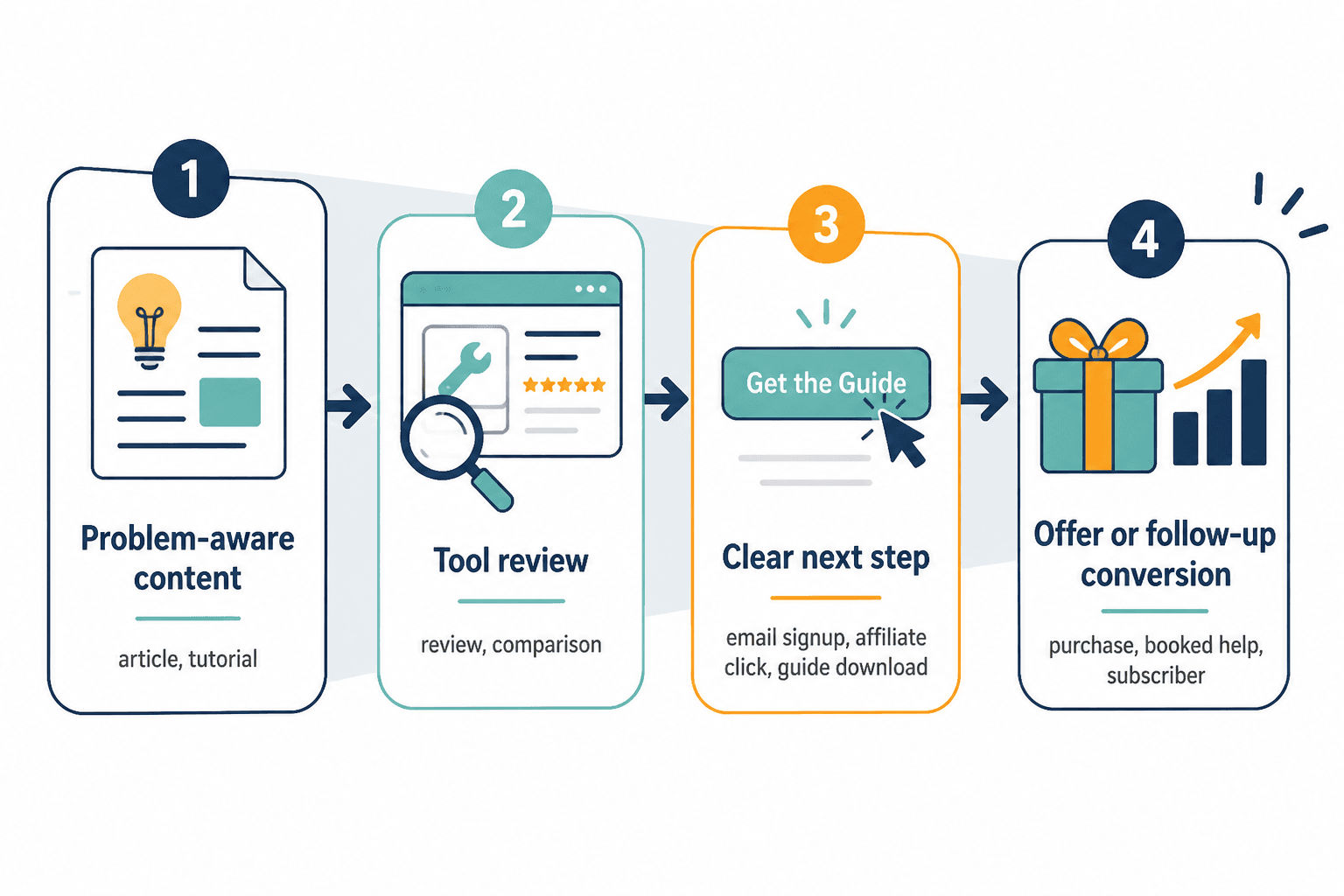
The four stages of a creator funnel using tool reviews
| Stage | Reader intent | Content type | Your goal |
|---|---|---|---|
| Awareness | I have a problem | Educational posts, articles, tutorials | Attract relevant readers |
| Consideration | I may need a tool | Comparisons, buyer guides, workflow breakdowns | Help them evaluate |
| Decision | Should I use this one? | Tool reviews, use-case reviews, pros/cons articles | Build trust and drive action |
| Conversion | What now? | Affiliate click, email opt-in, service CTA, implementation offer | Monetize or deepen relationship |
Reviews live mostly in consideration and decision. That is the key. Do not force them to do the whole job alone.
How to Use Tool Reviews in a Creator Funnel without making them thin and useless
A review only helps your funnel if the review itself is good. A lot of “review” content is just a dressed-up feature list with a referral link at the bottom. Readers can smell that from orbit.
If your review is thin, your funnel breaks in the middle. You get attention without trust, clicks without conviction, and maybe the occasional affiliate payout from someone who was probably going to buy anyway.
Good review content does not just describe the tool. It reduces buying friction.
That means your review should answer questions like:
- Who is this tool actually for?
- What problem does it solve well?
- What does it do badly, awkwardly, or expensively?
- What kind of user will get value fast?
- What kind of user should skip it?
- How does it compare with the obvious alternatives?
- What happens after someone signs up?
If you want a stronger foundation for this, read tool reviews guide for creators who care about quality and how to monetize tool reviews without thin reviews. Those pieces help tighten the content itself, which makes the funnel far more effective.
Pick the right role for the review inside your funnel
Not every tool review should try to do the same thing. Some reviews are better for attracting search traffic. Some are better for converting warm readers. Some are better for moving someone from “interested” to “fine, I’ll try it.”
Give each review a role. Otherwise, you end up writing mushy content with no clear job.
1. Entry-point review
This review is built to capture search traffic from people actively looking into a specific tool.
Best for:
- SEO traffic
- Affiliate discovery
- Introducing your brand to new readers
Useful CTA options:
- Read the comparison article
- Get the setup checklist
- Try the tool
- Join your newsletter for workflow tips
2. Comparison review
This helps readers decide between two or more options. It usually converts better than broad educational content because the reader is further along.
Best for:
- Mid-funnel readers
- Affiliate decisions
- Segmenting audience intent
Useful CTA options:
- See the full review of your recommended option
- Download a buyer’s guide
- Book help choosing the right setup
3. Use-case review
This is where reviews get more strategic. Instead of “Tool X review,” you frame the article around a specific audience or problem.
Examples:
- Best email tools for solo coaches who hate tech debt
- My review of this CRM for low-volume consultants
- Is this writing tool worth it for creators publishing weekly?
Best for:
- Qualified traffic
- Personal-brand positioning
- Service or consulting offers
Useful CTA options:
- Book a setup consult
- Get the implementation template
- Join your email list for related systems advice
4. Post-purchase review support content
This is where a lot of creators leave money on the table. If someone buys through your review, what helps them next?
That might be:
- A setup checklist
- A beginner walkthrough
- A “mistakes to avoid” article
- A template pack
- A service offer to implement the tool faster
This kind of content turns one-time clicks into trust and repeat business. It also gives your review more substance because the reader can see you are not just trying to shove them through an affiliate link and disappear into the hedges.
Build the path before and after the review
A review becomes part of a funnel when you intentionally connect it to what comes before and after it.
Think in paths, not pages.
What comes before the review
The best pre-review content usually speaks to a problem the tool helps solve.
Examples:
- How to manage creator workflows without drowning in tabs
- Why your email funnel feels harder than it should
- What breaks when consultants outgrow basic spreadsheets
- How to organize content ideas across platforms
From there, link naturally into the review. Not with a desperate “buy this now,” but with a useful bridge.
If you are at the stage where a dedicated tool might save you hours, this review breaks down where it helps, where it is clunky, and who should not bother.
That works because it respects intent. It does not shove a sales pitch into a problem-solving article too early.
What comes after the review
Most review CTAs are lazy because they assume the only possible next step is “click affiliate link.” Sometimes that is fine. Often it is not the best move.
Better post-review next steps include:
- A comparison article for readers still unsure
- A buyer checklist for readers close to a decision
- An implementation guide for readers ready to act
- A newsletter opt-in for readers researching over time
- A service offer for readers who want help, not just software
If you need more paths, best funnel ideas to pair with affiliate articles gives you practical options that feel like real business strategy, not duct-taped internet monetization.
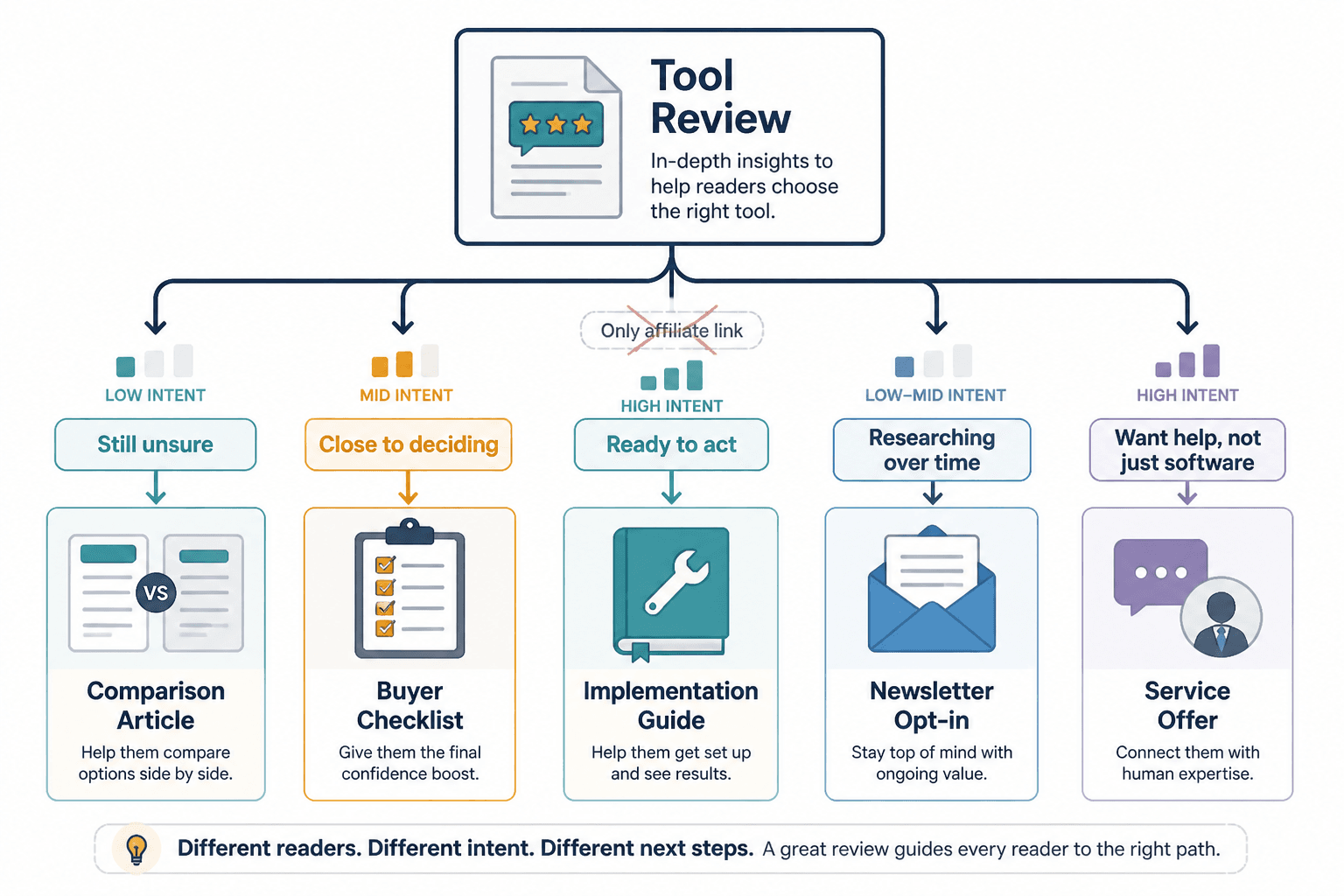
Use review CTAs that match the reader’s level of intent
One of the fastest ways to wreck a creator funnel is using the same CTA for every reader.
Someone casually researching does not want the same next step as someone ready to buy. If your review only says “Try it now,” you are ignoring everyone who needs one more nudge, one more comparison, or one more layer of trust.
Low-intent CTA examples
- Get the checklist I use to compare creator tools
- Read the full guide to choosing the right setup
- Join my newsletter for practical tool breakdowns
Mid-intent CTA examples
- See how this tool compares to the main alternatives
- Read my use-case breakdown for coaches and consultants
- Grab the setup guide before you choose
High-intent CTA examples
- Try the tool here if you want the fastest path to this workflow
- If this matches your setup, you can start here
- Use this link to test it and then follow my setup checklist
See the difference? Cleaner, calmer, less needy. The CTA fits the moment.
This matters even more if your business is not purely affiliate-driven. If you sell consulting, implementation, advising, or templates, your CTA should leave room for those offers too.
Match the review to the monetization model
Tool reviews can support different kinds of creator businesses. The funnel changes depending on what you actually sell.
| If you monetize through… | Your review should lead toward… |
|---|---|
| Affiliate commissions | Trial signup, purchase click, comparison guide |
| Newsletter growth | Opt-in tied to tool selection or setup help |
| Consulting or coaching | Strategy call, audit, implementation support |
| Templates or digital products | Checklist, setup resource, workflow bundle |
| Courses or memberships | Deeper training on the system around the tool |
This is where a lot of creators accidentally flatten their business. They have a service business, but all their review content pushes readers straight to affiliate links. That can work, but sometimes the higher-value move is to use the review as proof of expertise and send qualified readers toward your offer instead.
For example, a consultant reviewing a CRM might earn some affiliate revenue, sure. But the real upside may be attracting business owners who think, “Right, this person clearly understands systems. Can they help me set this up properly?”
That is a much better use of your authority than simply collecting the occasional software bounty and calling it strategy.
Create review clusters, not one-off articles
If you want tool reviews to support a funnel long term, build them as clusters around a topic, workflow, or audience problem.
One review is a page. A cluster is a system.
Example cluster for creators trying to improve their email setup:
- How to choose an email tool for a small creator business
- Tool A review
- Tool B review
- Tool A vs Tool B
- Best email tools for coaches
- How to set up a simple nurture funnel after choosing a tool
- My email automation checklist
Now the reader has options. They can enter through search, comparisons, educational content, or implementation help. They can move sideways if they are unsure, or forward if they are ready.
This is also good internal-linking hygiene. For readers and search engines, clusters make the topic easier to understand and navigate.
You can browse the broader money content category and the tool reviews section to map related content around your own review funnel.
What to include inside the review so the funnel converts better
A good creator-focused tool review usually needs more than features, pricing, and a generic thumbs-up.
Include these elements if you want the funnel to do more than just exist on paper:
Clear use-case framing
Tell readers who the tool is best for right away. “Good for creators” is too vague. Good for what kind of creator, with what kind of workflow, budget, and tolerance for complexity?
Decision-friendly pros and cons
Not fluffy pros. Not fake cons like “there are so many amazing features.” Real tradeoffs. Real friction. Real fit issues.
Alternatives
Readers compare anyway. If you do not help them compare, they leave your site and go do it somewhere else.
Implementation angle
What happens after signup? How hard is setup? How long until someone gets value? Reviews that answer this often convert better because they remove uncertainty, not just skepticism.
One clear next step
Do not spray five unrelated CTAs all over the page. Pick the primary next action based on the article’s role in the funnel, then maybe offer a secondary option for lower-intent readers.
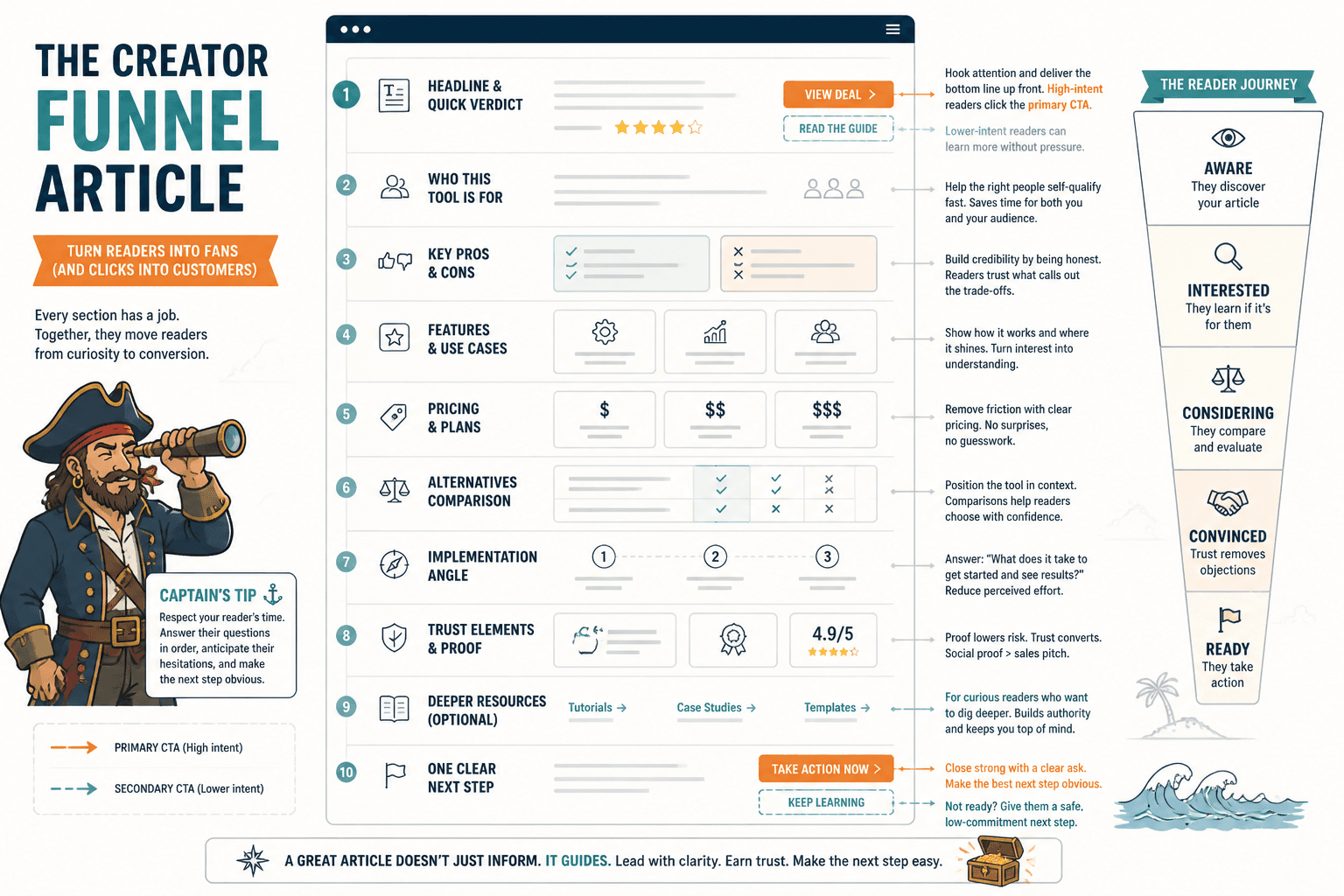
Common mistakes that make tool-review funnels underperform
Most weak review funnels fail for boring reasons. Not mysterious reasons. Not “the algorithm changed.” Usually the structure is just bad.
- The review has no audience fit. It talks about the tool in general, not in the context of the people you want to attract.
- The CTA is too aggressive. You ask for the click before earning enough trust.
- The CTA is too passive. You help the reader, then forget to guide them anywhere.
- The review is isolated. No internal links in, no internal links out, no path.
- The content is thin. It sounds like you skimmed the homepage and called it research.
- The monetization model is mismatched. You push affiliate links when the smarter business move is a lead capture or service inquiry.
- There is no segmentation. Every reader gets the same message even though their intent is wildly different.
And then there is the classic creator mistake: trying to sound unbiased by being vague. You are allowed to make clear recommendations. In fact, your funnel works better when readers can tell you have standards.
A practical review-funnel example
Let’s say you help coaches and consultants improve their lead generation systems.
Here is a simple funnel using tool reviews:
- Publish an educational article on why many small service businesses choose overcomplicated funnel tools too early.
- Inside that article, link to a review of a simpler email or CRM platform.
- In the review, explain who the tool fits, where it falls short, and what kind of business should use something else.
- Offer a downloadable setup checklist for readers who are interested but not ready.
- Offer your affiliate link for readers who are ready.
- On the thank-you page or follow-up emails, offer a paid setup audit or implementation session.
Now the review is doing multiple jobs:
- Qualifying readers
- Building trust
- Generating affiliate income
- Growing your list
- Creating a path toward services
That is much stronger than “Here are the features, here is my link, good luck out there.”
How to know if your tool reviews are helping the funnel
You do not need enterprise analytics drama here. A few simple questions will tell you whether the review is doing useful work.
- Is the review attracting the right kind of traffic?
- Are readers clicking to related content?
- Are they joining your list?
- Are they clicking your affiliate links?
- Are they booking calls or buying related offers?
- Which review topics bring in readers who actually convert later?
If a review gets traffic but leads nowhere, the problem may not be the review topic. It may be the missing next step. If a review gets fewer visits but drives better signups or inquiries, that is often a better asset than a noisier page with weak intent.
Quality of traffic beats vanity traffic. Every time.
If affiliate revenue is part of the model, how to turn tool reviews into affiliate revenue can help you tighten the monetization side without cheapening the content.
FAQ
Should every tool review include an affiliate link?
Not necessarily. If the review’s job is audience-building, lead generation, or positioning, the best CTA may be a guide, newsletter, or service offer.
Where should tool reviews sit in a funnel?
Usually in the consideration and decision stages. They work best after problem-aware content and before a conversion step.
Can tool reviews help service businesses?
Absolutely. They can demonstrate expertise, attract qualified leads, and create natural bridges to audits, implementation, consulting, or retainers.
What makes a review convert better?
Clear audience fit, honest tradeoffs, useful comparisons, practical implementation context, and a next step that matches reader intent.
How many CTAs should a review have?
One primary CTA is usually enough. A secondary option can help lower-intent readers, but too many choices often weakens action.
Use tool reviews like decision assets, not content clutter
If you want the real lesson behind How to Use Tool Reviews in a Creator Funnel, it is this: a review should not just describe a tool. It should help the reader make a decision and then move cleanly to the next relevant step.
That next step might be an affiliate click. It might be an email opt-in. It might be a service inquiry. The point is not to force every review into the same monetization box. The point is to make each one useful inside a bigger trust-building path.
Build the path before the review. Build the path after the review. Give the review a job. Then it stops being content clutter and starts acting like part of an actual business.
The bigger point is simple: clearer structure and clearer writing make the piece more useful. That is usually what makes the ending land better too.