Most affiliate articles do not fail because the writer forgot a clever headline trick.
They fail because the article has no structure, no buyer logic, and no workflow behind it. It is usually just a pile of features, a few affiliate links, and a vague hope that somebody feels inspired enough to click “buy.” That is not strategy. That is digital littering with a commission link attached.
If you want better affiliate content, you need two things: templates that stop you from rambling, and tools that speed up the parts that should be faster without flattening the writing into generic sludge.
This guide covers the best templates and tools for affiliate articles if you are a creator, coach, consultant, solo founder, or personal brand trying to turn useful content into actual revenue. We’ll look at what kinds of article templates work, which tools are worth your time, what each tool is actually good for, and where people manage to make the whole thing worse with “efficiency.”
You do not need a giant media company workflow. You need a repeatable system that helps you publish articles people trust enough to act on.
To see how this fits into the wider strategy, open the parent guide.
What makes affiliate articles work in the first place
Before getting into the best templates and tools for affiliate articles, it helps to be annoyingly clear about what the article is supposed to do.
A good affiliate article is not just “content with links in it.” It should help the reader make a decision. That usually means the article does at least one of these jobs:
- Compares options
- Explains which tool fits which use case
- Reduces buyer hesitation
- Answers practical objections
- Shows proof, context, or experience
- Moves the reader one step closer to a smart purchase
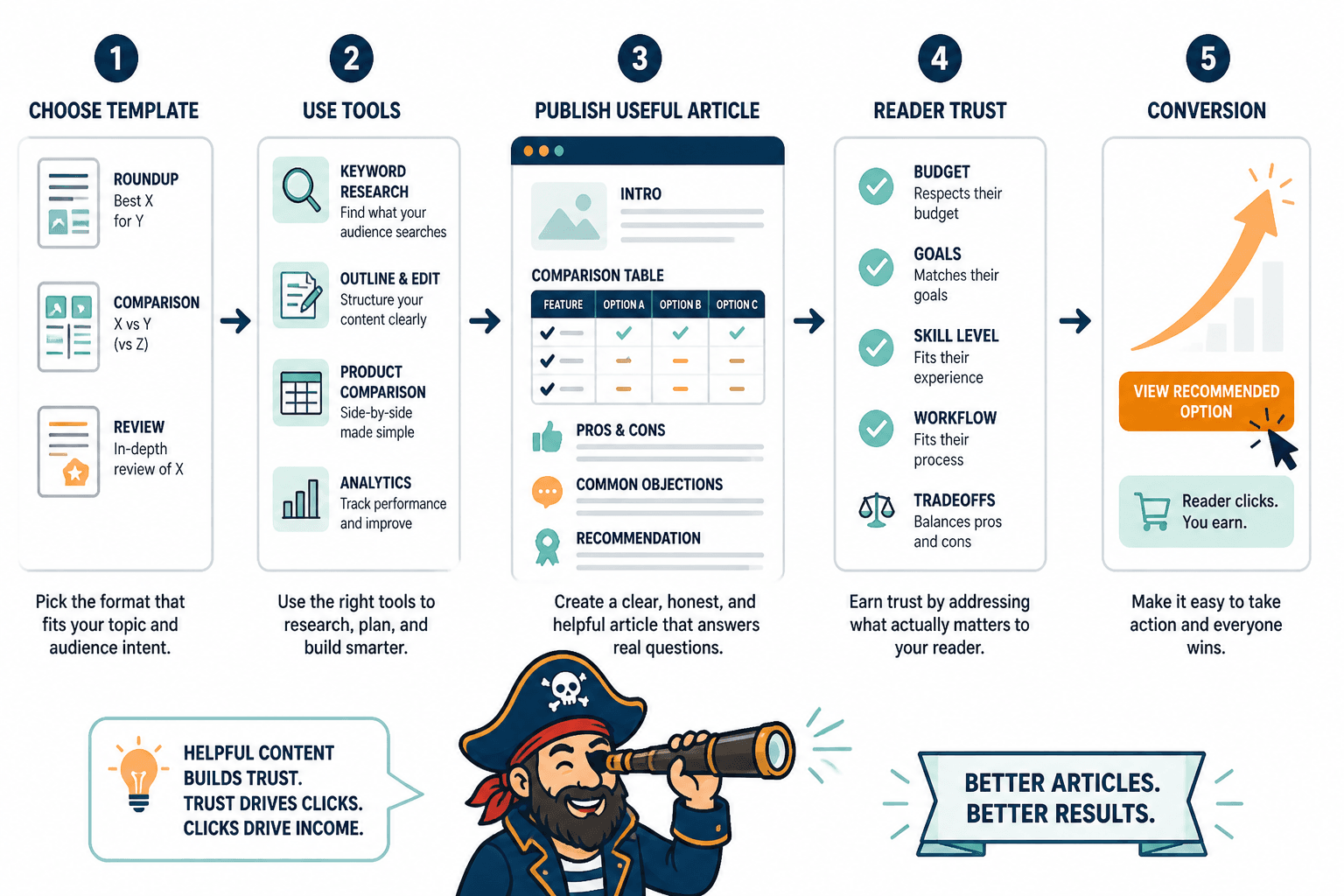
That means the structure matters more than people think. A random list of “best tools” is easy to publish and easy to ignore. A sharp article that helps the reader choose based on budget, goals, skill level, workflow, and tradeoffs is much more useful. Conveniently, useful is also better for trust and conversions.
If you want broader context on this kind of content model, the main affiliate articles hub is a good next stop after this piece.
The best affiliate article templates to keep on repeat
You do not need fifty templates. You need a small set that matches search intent and buying behavior. Here are the ones worth keeping.
1. The “best tools for X” roundup
This is the classic format, and yes, it still works when it is written with some actual judgment.
Best for:
- Mid-intent readers exploring options
- Search queries like “best email tools for creators”
- Topics where readers want a shortlist, not a dissertation
Basic structure:
- Quick intro that explains who the list is for
- Fast summary table of top picks
- Individual tool sections with use case, strengths, limitations, and fit
- How to choose section
- Final recommendation by scenario
What people do wrong:
- Write the same paragraph for every tool with a few nouns swapped
- Refuse to mention downsides
- Give no buying criteria
- Include too many tools just to look comprehensive
Five to eight tools is often enough. Once you hit fifteen, most writers are padding or hiding uncertainty behind volume.
2. The comparison template
This is your “Tool A vs Tool B” article. High buyer intent. Very useful. Also weirdly easy to butcher.
Best for:
- Readers already close to purchasing
- Queries with direct comparison intent
- Products with overlapping audiences
Basic structure:
- Who each tool is best for
- Fast verdict up top
- Core differences table
- Feature comparison with practical commentary
- Pricing and value section
- Workflow fit by user type
- Final recommendation
The key here is clarity. Readers do not want a feature spreadsheet disguised as prose. They want help choosing.
3. The “best for specific use case” template
This one is underrated. Instead of trying to rank every tool in a category, you narrow the promise.
Examples:
- Best newsletter tools for coaches
- Best creator CRM tools for solo consultants
- Best AI writing tools for affiliate articles
This structure tends to convert better because it feels more relevant. Specificity beats bloated comprehensiveness more often than people want to admit.
Basic structure:
- Define the specific reader and their problem
- Explain your selection criteria
- Recommend a small set of tools for that scenario
- Break down why each one fits that use case
- Close with a “choose this if…” section
4. The review template
A proper review article works best when you have direct experience, strong research, or a very clear evaluation framework. Otherwise it turns into recycled launch copy with your affiliate ID glued on top.
Basic structure:
- What the tool is and who it is for
- Your overall verdict
- Main pros and cons
- Key features in plain English
- Pricing and value
- Where it shines
- Where it falls short
- Alternatives worth considering
If you publish review-style content, it is worth also reading best tool reviews tools for creators in 2026 for adjacent workflow ideas.
5. The buyer-intent template with decision sections
This is one of the strongest affiliate formats because it mirrors how people actually buy. Instead of forcing the whole article into a flat list, you create decision-friendly sections like budget, team size, ease of use, integrations, setup speed, and content style.
For creators who need a more streamlined version, simple affiliate articles buyer intent sections templates for busy creators goes deeper on this exact approach.
Basic structure:
- State the buying problem clearly
- Give the shortlist
- Break choices down by decision factor
- Answer likely objections
- Recommend by reader type
- Add clear next steps
This format is especially useful if your readers are not just shopping for fun. They are trying to avoid buying the wrong thing and cleaning up the mess later.
A simple affiliate article template you can actually use
Here is a lean structure that works for most roundup-style affiliate articles without turning into a lifeless content stencil.
- Intro: Name the problem, the type of reader, and what the article will help them choose.
- Quick picks table: Best overall, best budget, best for beginners, best for advanced users, best for a specific use case.
- How we chose: Briefly explain the criteria.
- Individual reviews: One section per tool with fit, pros, cons, and why it made the list.
- How to choose: Help readers match the right option to their situation.
- FAQ: Handle practical objections.
- Final recommendation: Summarize by scenario, not by hype.
That is enough structure to keep the article useful without making every post sound like it came off the same tired assembly line.
The best tools for affiliate article research, drafting, and publishing
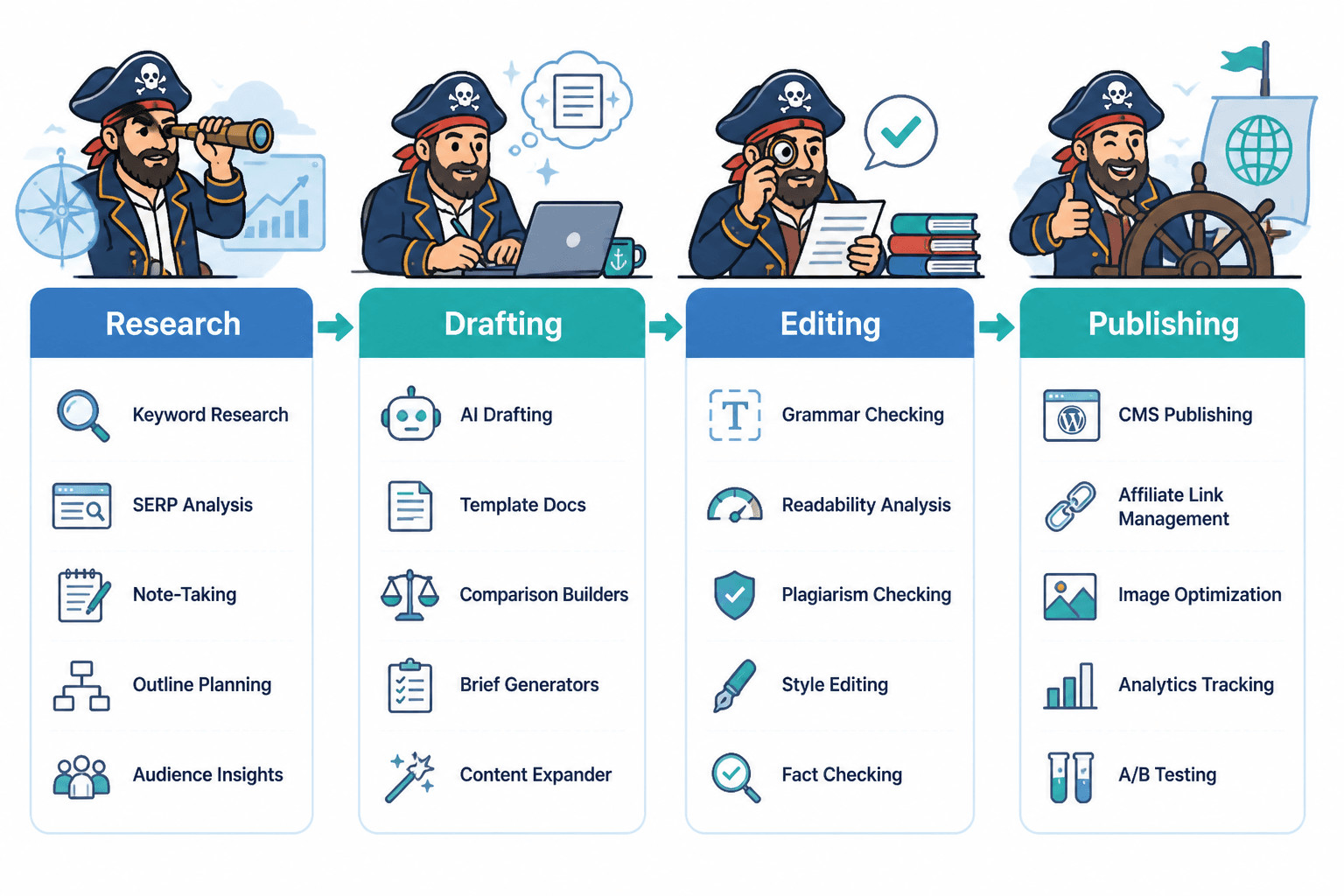
Tools are useful when they remove friction, not when they turn your content into smooth, confident nonsense. So instead of pretending there is one perfect stack, here is the smarter way to think about it: tool categories by job.
Research and SERP analysis tools
Use these to understand what readers are searching for, what article formats are already ranking, which subtopics show up repeatedly, and where the current results are weak.
Good for:
- Spotting search intent
- Finding related subtopics and questions
- Comparing article structures
- Seeing where competitors are thin or generic
Not good for:
- Deciding your actual opinion
- Replacing real product judgment
- Magically making a boring article useful
If your article does not match reader intent, no writing tool is going to save it.
Outline and brief tools
These help you turn messy notes into a structure before drafting. Very useful if you tend to collect twenty tabs, seven half-thoughts, and one dangerous level of optimism.
Good for:
- Turning research into a clean outline
- Creating repeatable briefs
- Standardizing sections across article types
- Keeping your comparison logic consistent
What matters is not the specific software logo. What matters is having a repeatable brief that asks the right questions:
- Who is this article for?
- What stage of buying are they in?
- What decision is the article helping them make?
- What criteria matter most?
- What proof or commentary makes this more trustworthy?
AI drafting tools
These can speed up first drafts, rewrite clunky paragraphs, generate variants, and help you move faster through repetitive sections.
They cannot supply taste, positioning, buyer empathy, or real editorial standards. They are assistants, not substitute brains.
Use AI drafting tools for:
- Drafting rough intros from a solid brief
- Summarizing feature lists into plainer language
- Generating comparison categories
- Creating first-pass FAQs
- Rewriting for clarity and tone variation
Do not use them for:
- Inventing experience you do not have
- Writing fake reviews
- Pumping out indistinguishable “best tools” articles at scale
- Replacing product-specific judgment
If AI is part of your workflow, best AI tools for affiliate articles is the natural next read.
Writing and editing tools
These are for tightening drafts, checking readability, cleaning repetition, and making sure the article does not sound like it was generated by a committee of mildly anxious robots.
Good for:
- Cutting fluff
- Improving sentence flow
- Fixing repetitive phrasing
- Cleaning awkward transitions
- Catching things your brain now refuses to see
Still, editing tools should not turn every sentence into beige paste. A little edge is allowed. In fact, it helps.
Affiliate link and monetization tools
Once your article starts performing, link management matters. Especially if you update offers, test placements, organize campaigns, or need cleaner tracking.
Useful functions include:
- Link cloaking or clean redirects where appropriate
- Click tracking
- Centralized affiliate link management
- Table and button support
- Disclosure handling
For the operations side of this, check best affiliate plugins and creator ops tools for affiliate articles.
Content management and update tools
Affiliate articles age. Prices change. Features change. Tools disappear. New competitors show up. So one of the most underrated “tools” is a content update system.
That can be as simple as a spreadsheet or as robust as a content operations setup with status tracking and review cycles. The point is to stop publishing affiliate content like it lives in a time capsule.
How to choose the right tools without building a ridiculous stack
People love to over-stack tools because buying software feels like progress. Sometimes it is. Sometimes it is just prettier procrastination.
For most creators and small teams, you usually need:
- One research workflow
- One place to outline and brief
- One drafting assistant, AI or otherwise
- One editing pass system
- One link management setup
- One update tracker
You probably do not need three AI writers, two SEO suites, a premium note-taking labyrinth, and some dashboard that promises “content velocity.” Those stacks often produce a lot of words and very little judgment.
| Job | What you need | What to avoid |
|---|---|---|
| Research | Intent, query patterns, competitor gaps | Copying top results blindly |
| Outlining | Repeatable article structure | Starting with a blank page every time |
| Drafting | Fast first pass with context | Publishing AI first drafts untouched |
| Editing | Clarity, rhythm, tighter language | Over-smoothing the voice |
| Monetization | Clean link management and tracking | Messy manual links everywhere |
| Maintenance | Update system for aging content | Letting old recommendations rot |
What a strong affiliate article workflow looks like
Here is a practical workflow you can borrow and adapt.
- Choose the article type. Roundup, comparison, review, or use-case-specific list.
- Define buyer intent. Are readers exploring, comparing, or nearly ready to buy?
- Research the query. Look at what exists, what is missing, and what decision criteria keep showing up.
- Use a template. Pick the structure that fits the intent instead of freewriting your way into a swamp.
- Draft fast. Use AI or writing tools to speed up rough sections, not to decide what matters.
- Add judgment. Include tradeoffs, use cases, limitations, and recommendations by scenario.
- Edit hard. Cut filler. Tighten claims. Remove fake certainty.
- Add affiliate links carefully. Place them where they help the decision, not every six inches like panic confetti.
- Publish and track. Watch clicks, behavior, and updates needed.
- Refresh regularly. Update old winners before writing ten new mediocre articles.
This is also where your broader content strategy matters. If you are building a revenue path from content, the larger monetization and affiliate content pathway is worth exploring alongside this article.
Mistakes people make with affiliate article templates and tools
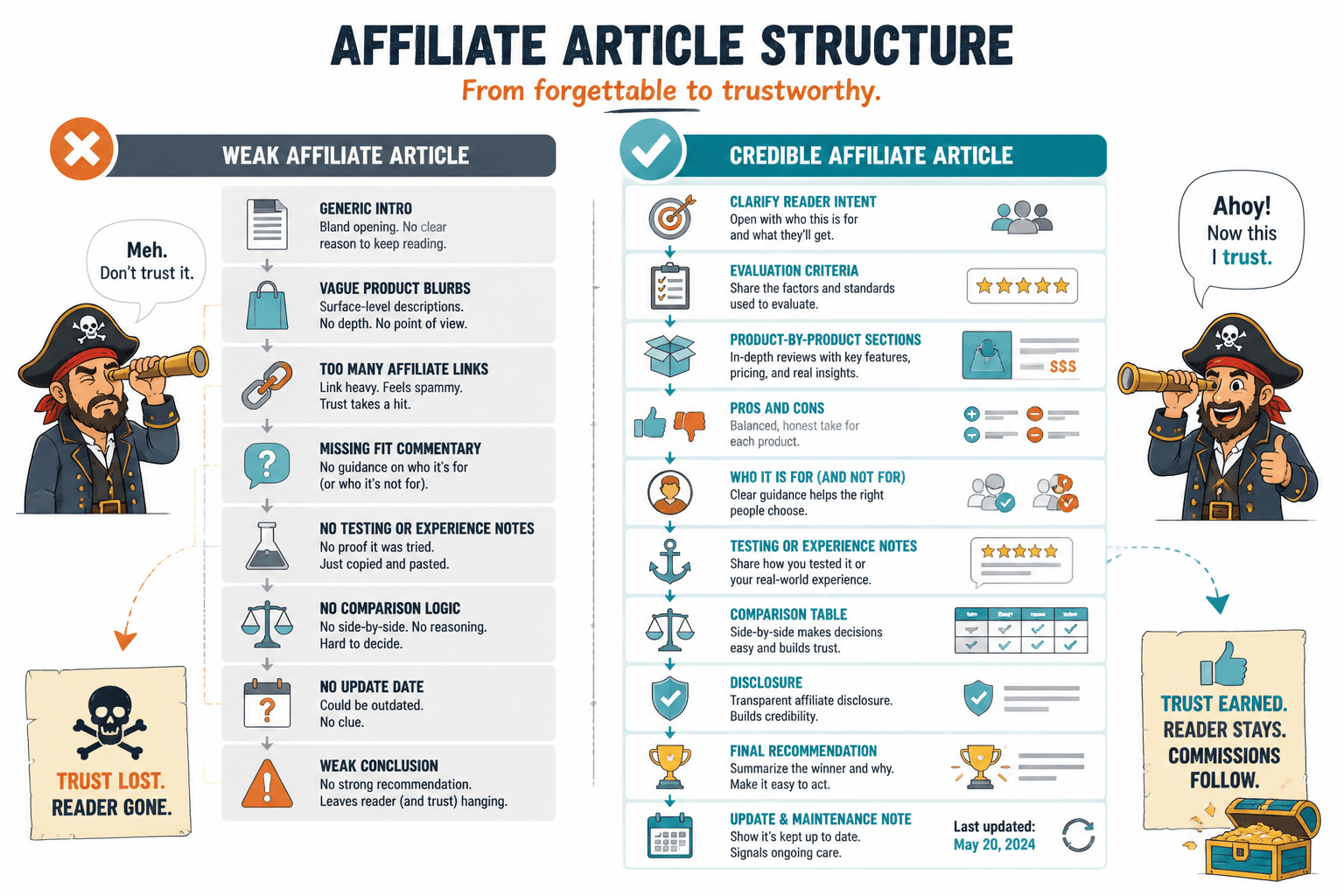
Templates and tools are supposed to reduce chaos. Used badly, they just industrialize mediocre content. Common mistakes:
- Using templates as a substitute for thought. A template should organize your judgment, not replace it.
- Letting AI flatten the voice. If every article sounds polished, vague, and oddly over-assured, readers notice.
- Skipping fit commentary. People need to know who each tool is for, not just what it does.
- Overstuffing links. More links do not automatically mean more revenue. Sometimes they just make the article look desperate.
- Ignoring maintenance. Outdated affiliate content quietly kills trust.
- Writing to rank without writing to help. Search traffic is useful. It is not impressed by empty competence theater.
The biggest mistake, though, is trying to automate your way around credibility. If readers do not trust your recommendations, better formatting and faster drafting will not rescue the article.
A practical stack for most creators and small brands
If you want a simple answer, here it is: build a small stack around your workflow, not around software hype.
A sensible setup might include:
- A keyword or SERP research tool for intent and structure
- A note or doc system for briefs and outlines
- An AI assistant for rough drafting and rewrites
- An editing tool or process for clarity
- An affiliate link manager for organization and tracking
- A simple content tracker for refresh cycles
That is enough to create a repeatable workflow without becoming the unpaid IT department for your own content business.
FAQ
What is the best template for affiliate articles?
Usually a roundup, comparison, or buyer-intent template. The right one depends on whether the reader is exploring options or choosing between specific tools.
Can AI write affiliate articles well?
It can help draft and speed up repetitive sections, but it should not be trusted to supply experience, judgment, or believable recommendations on its own.
How many tools should I include in a roundup article?
Usually five to eight is enough. More than that often creates clutter unless the category genuinely needs a larger breakdown.
Do affiliate article templates hurt originality?
No. Bad writing hurts originality. A good template just gives your article shape so the useful parts are easier to read and act on.
What tools matter most for affiliate content?
Research, outlining, drafting, editing, link management, and content updates. If one of those breaks, the article usually gets weaker fast.
Use templates for structure, tools for speed, and your brain for the part that actually matters
Better affiliate articles feel more like informed guidance and less like pressure wrapped in formatting. Stronger judgment is usually what makes the monetization work without corroding trust.