
Good X posts can still burn time, attention, and trust if they never point anywhere useful. The result is expensive busywork: the post gets shared, the likes show up, and the leads stay politely elsewhere. A sharper conversion plan does not make the writing louder. It gives the post somewhere to go.
The goal is not to turn every post into a billboard with opinions. It is to make the next step obvious enough that a relevant reader can move from interest to action without needing a small scavenger hunt.
What an X post can do in the buying path
An X post usually does not close the sale on its own. It does something slightly less dramatic and far more useful: it creates a reason to click, reply, visit, subscribe, or book.
That means the post is part of a path, not the whole path. A good conversion post:
- attracts the right kind of attention,
- signals the problem clearly,
- adds enough proof or relevance to earn a next step, and
- moves the reader toward a page or action that can actually convert.
That last part matters. A strong post paired with a weak destination is just a better-looking dead end.
What a good conversion post actually needs
The best X posts for leads or sales are not necessarily the flashiest. They are the ones that do three jobs without sounding like they were written by a committee in a blazer:
- They name a real problem. The reader should know quickly whether the post is for them.
- They show some credibility. That can be a result, a method, a comparison, a lesson, or a useful observation.
- They point to one next step. Not five. Not “DM me, subscribe, buy, and think about your childhood.” One step.
This is where a lot of X posts go sideways. They try to be broad enough for everyone and specific enough for no one. That usually produces a post that gets attention from browsers instead of buyers.
The simplest funnel ideas to pair with X posts
There is no prize for building the most complicated path between a post and a sale. Most of the time, the cleanest funnel wins because it is easier to understand and easier to trust.
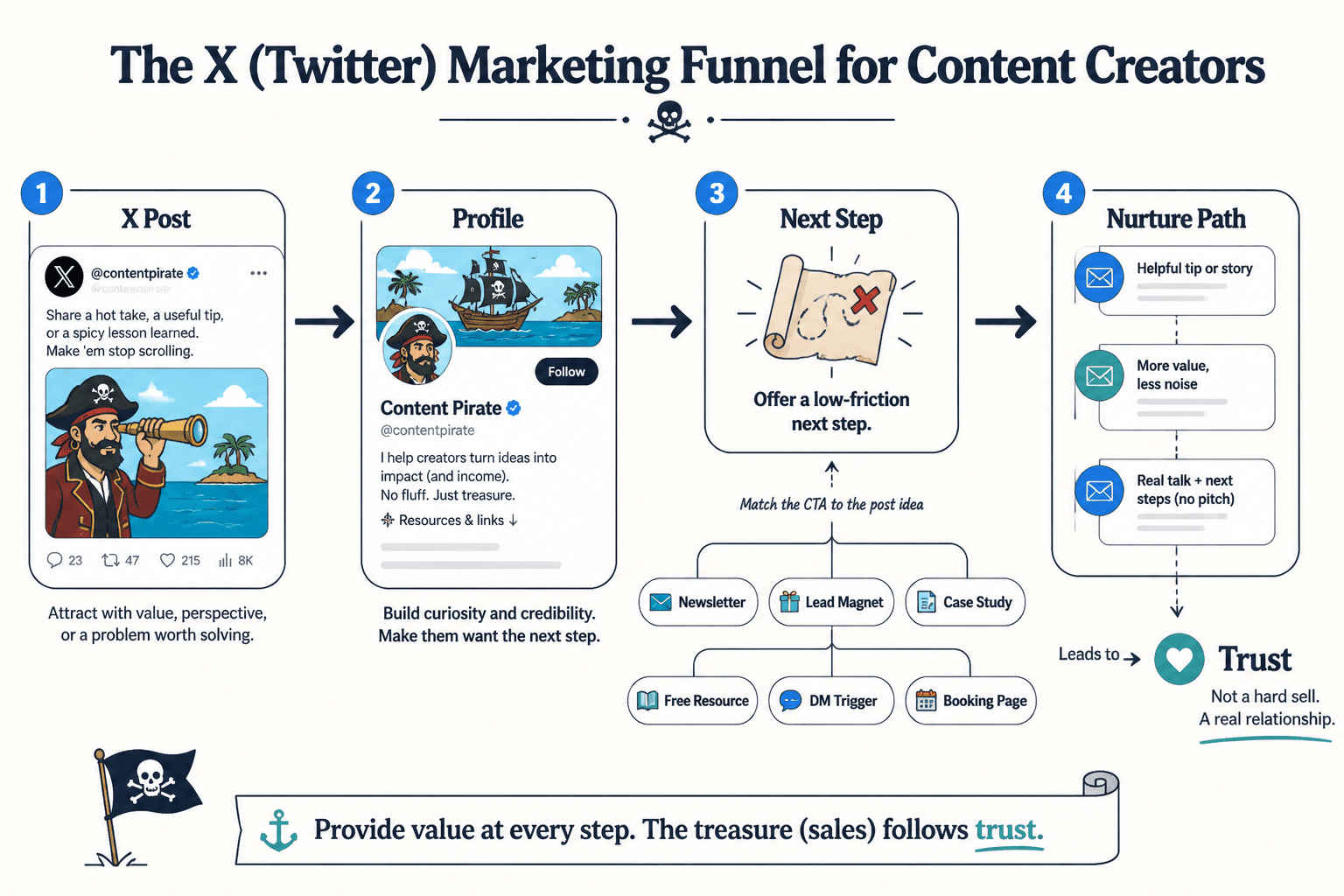
1. X post → profile → newsletter signup
This is the lightest-touch route. The post earns interest, the profile reinforces the offer, and the newsletter signup gives the reader a low-friction way to stay in touch.
It works well when the audience is curious but not ready to buy. The key is profile alignment. If the bio, link, and pinned post all point in slightly different directions, the funnel leaks immediately.
2. X thread → lead magnet → nurture emails
A thread can do more educational lifting than a single post, especially when the topic needs a little runway. A useful thread can introduce the problem, frame the mistake, and offer a practical download that continues the conversation.
The lead magnet should be specific. “Free guide” is not specific. “Checklist for turning X threads into booking calls” is much better. Specific beats vague because people are less interested in your theoretical generosity than in solving the thing that is bothering them.
3. X post → profile → booking page
This path suits higher-intent offers: services, consulting, audits, and other work where a call makes sense. The post should not pretend to be casual if the CTA is a booking request. That mismatch creates friction.
Make the transition simple: the post identifies the problem, the profile clarifies who you help, and the booking page handles the actual conversion. No interpretive dance required.
4. X post → case study or proof page → consultation
Proof-heavy pages are useful when trust needs a bit more support. A post can tease the result or the approach, then send readers to a case study or proof page that shows the work in context.
This is often stronger than sending people straight to a sales page, especially when the audience is skeptical or the offer is higher stakes. Buyers like evidence. Shocking, really.
5. X post → free resource library → segmented nurture
This works well for a content-led business with multiple offers or audience segments. The post drives interest, the resource library captures the click, and the nurture path sorts readers toward the most relevant next step.
It is more infrastructure than impulse, but it can be a smart move when one post can attract several types of buyers who need different follow-up paths.
Why most X post funnels fail
The problem is rarely that the post was “bad.” It is usually that the conversion path was vague, mismatched, or trying too hard to do everything at once.
- The CTA is too generic. “Check it out” is not a strategy.
- The destination does not match the promise. The post talks about one pain point and the page answers a different question.
- The profile does not back up the post. Readers click through and find a bio that sounds like it was built from leftover launch copy.
- The offer asks for too much trust too fast. A cold reader is not ready for an elaborate pitch ceremony.
- The next step is hidden. If people need to search for the point, many will not.
For help on the writing side, it can be useful to compare formats and hooks in the X posts examples guide, or to tighten the overall process with the X posts guide. If you are choosing tools, the best AI tools for X posts page is the place to start.
How to write the post so the next click feels natural
A conversion-friendly X post does not need to sound salesy. It needs to sound specific.
Start with the problem the buyer already feels
The opening should make the right reader think, “Yes, that.” Not because it is dramatic, but because it is accurate.
Good problem framing is one reason some posts convert better than others. It filters the audience before the CTA ever appears.
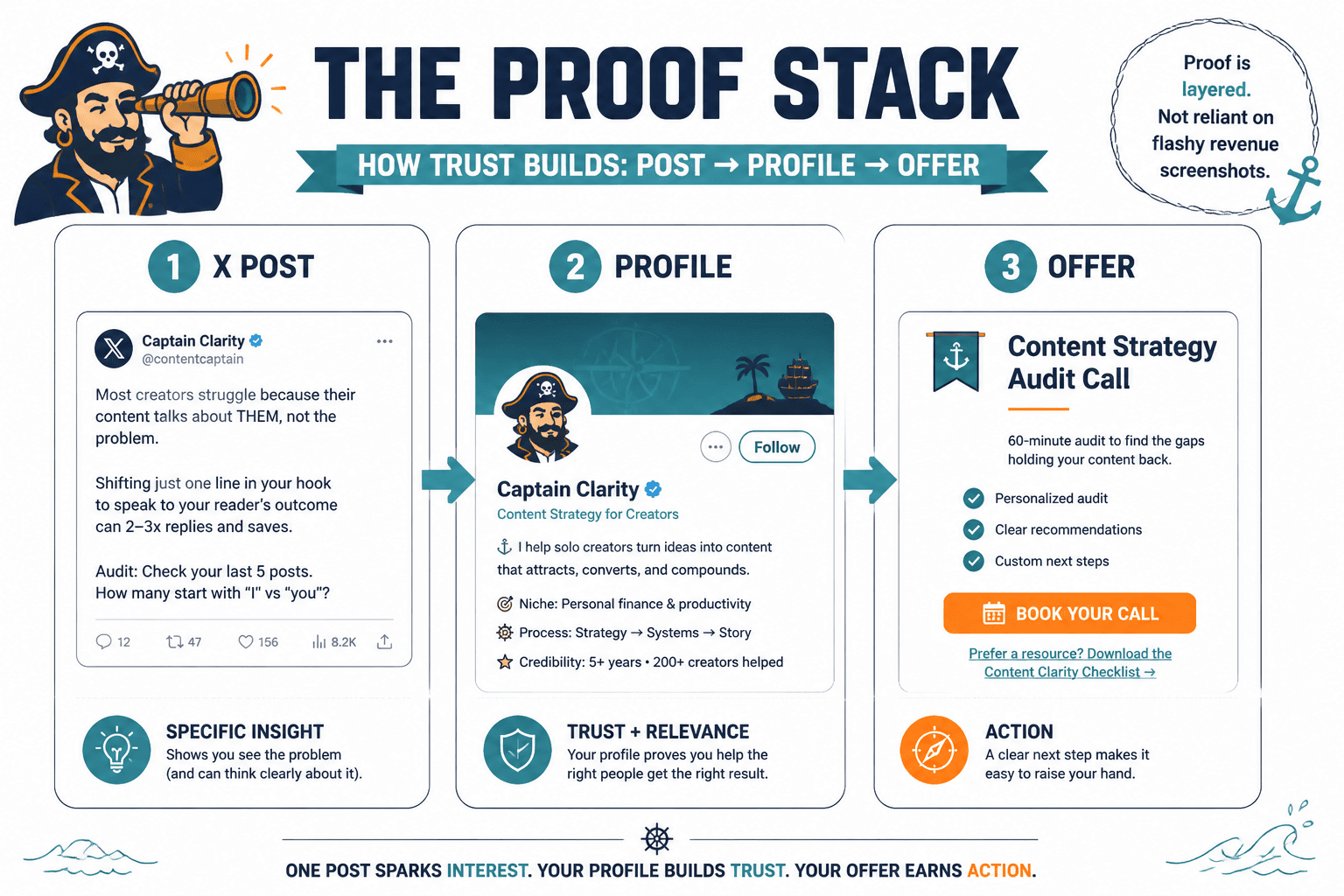
Add enough proof to make the claim believable
Proof does not always mean a hard number. It can be:
- a before/after contrast,
- a common mistake you keep seeing,
- a simple framework,
- a result pattern, or
- a short explanation of why the approach works.
The point is not to brag. The point is to reduce doubt.
Use one clear CTA
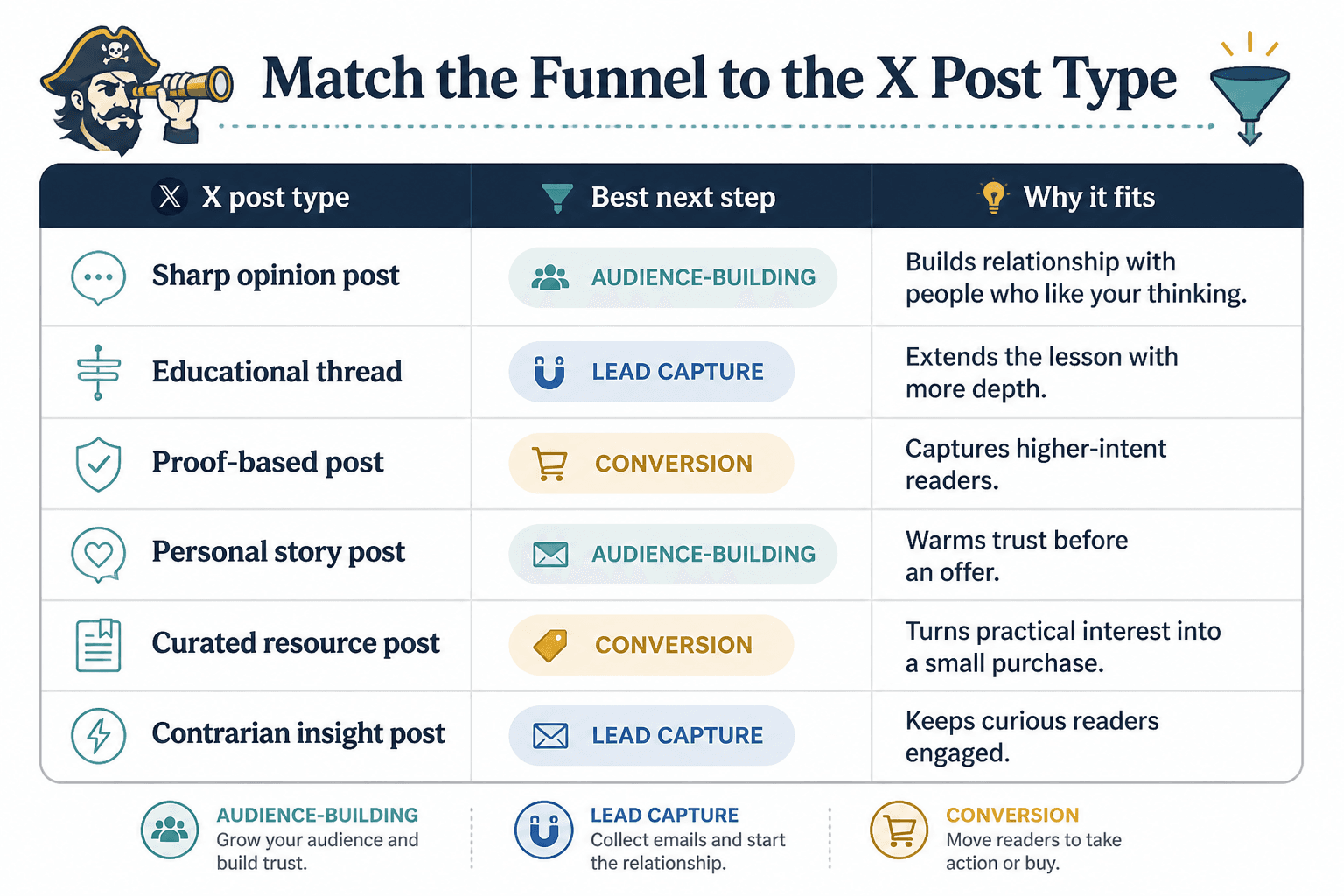
The CTA should fit the level of intent in the post. A high-intent post can point toward a call or offer page. A lower-intent post may work better with a resource, newsletter signup, or proof page.
Keep the ask simple. For example:
- “Read the full breakdown.”
- “Grab the checklist.”
- “See the case study.”
- “Book a call if this is your situation.”
That is enough. The post is not the place to host an Olympic event of CTAs.
Make sure the profile and linked page match the promise
The post does not work alone. The profile, pinned post, bio link, and landing page need to reinforce the same idea. If the post promises one result and the profile reads like a general opinion dump, trust gets diluted fast.
For landing page structure, the usual rules are boring because they work: one clear goal, one dominant action, tight copy, and no unnecessary detours. Even the Google helpful content guidance and broader CTA usability best practices point in the same direction: clarity beats cleverness when action matters.
When to sell harder and when to ease up
Not every post should try to generate an immediate sale. That is how trust gets chewed up.
A practical rule:
- Use softer CTAs when the reader is early in the relationship, the topic is broad, or the offer needs context.
- Use stronger CTAs when the reader already has the problem, the offer is a clear fit, and the post has done real trust-building work.
This is less about “being subtle” and more about timing. The wrong ask at the wrong moment makes even good content feel grabby.
If you want a deeper look at that balance, the companion article on X posts guide is a better strategic fit than trying to cram everything into one post.
A simple conversion checklist for one X post
Before publishing, check whether the post answers these questions:
- Does it speak to a real problem, not a vague theme?
- Does it give a believable reason to trust the next step?
- Is the CTA specific enough to act on?
- Does the destination match the promise in the post?
- Does the profile support the same offer or message?
- Is the conversion path short enough to make sense on mobile?
If the answer is “sort of” to three of those, the funnel probably needs another pass.
Bottom line
Turning X posts into leads or sales is mostly about reducing friction without flattening the message. A useful post names a real problem, earns trust fast, and points to a next step that matches the reader’s intent.
That is the whole trick. Not hype. Not extra software. Not a heroic thread with seven endings. Just a post that knows where it is going.
For the bigger content system behind it, see the X posts parent guide, along with the supporting pages on examples and tools.