
Most people do not have a content creation problem. They have a content reuse problem.
They have old posts, old emails, old half-decent takes, old client notes, old threads, old article drafts, and old “this did pretty well once” content sitting around doing absolutely nothing. Then they open Facebook, try to write a long-form post or rant from scratch, and end up with a bloated paragraph swamp or a dramatic mess with no point.
If you want to learn how to turn old content into better Facebook long-form & rants, the goal is not to recycle harder. It is to reshape old material so it actually fits how Facebook works: more conversational, more human, more emotionally alive, and much less like a polished business post trying to sneak into a dinner party.
Here’s how to find old ideas worth reviving, rebuild them into stronger Facebook posts, and make sure your rant has a point instead of just a pulse.
If you want the bigger picture, start with the parent guide.
Why old content usually fails when copied straight onto Facebook
The mistake is not reusing content. The mistake is dragging content from one format into another without changing its shape.
A LinkedIn post that felt clean and credible can sound stiff on Facebook. An old article paragraph can feel overexplained. A thread can become fragmented. A newsletter section might read like you are addressing an audience from a small podium.
Facebook long-form works better when it feels like a real person is saying something they mean, to other real people, with some emotional texture and actual momentum. Not polished for the sake of polish. Not flattened into “here are 5 lessons.” Not written like it went through legal review.
A good Facebook rant is not random complaining. It has shape. It starts with friction, builds an argument, sharpens the tension, then lands on a point worth remembering. If your old content does not have that shape yet, you do not need a repost. You need a rewrite.
What makes old content worth turning into a Facebook long-form post or rant
Not every old post deserves another life. Some content was mediocre the first time. We do not need to perform digital necromancy on it.
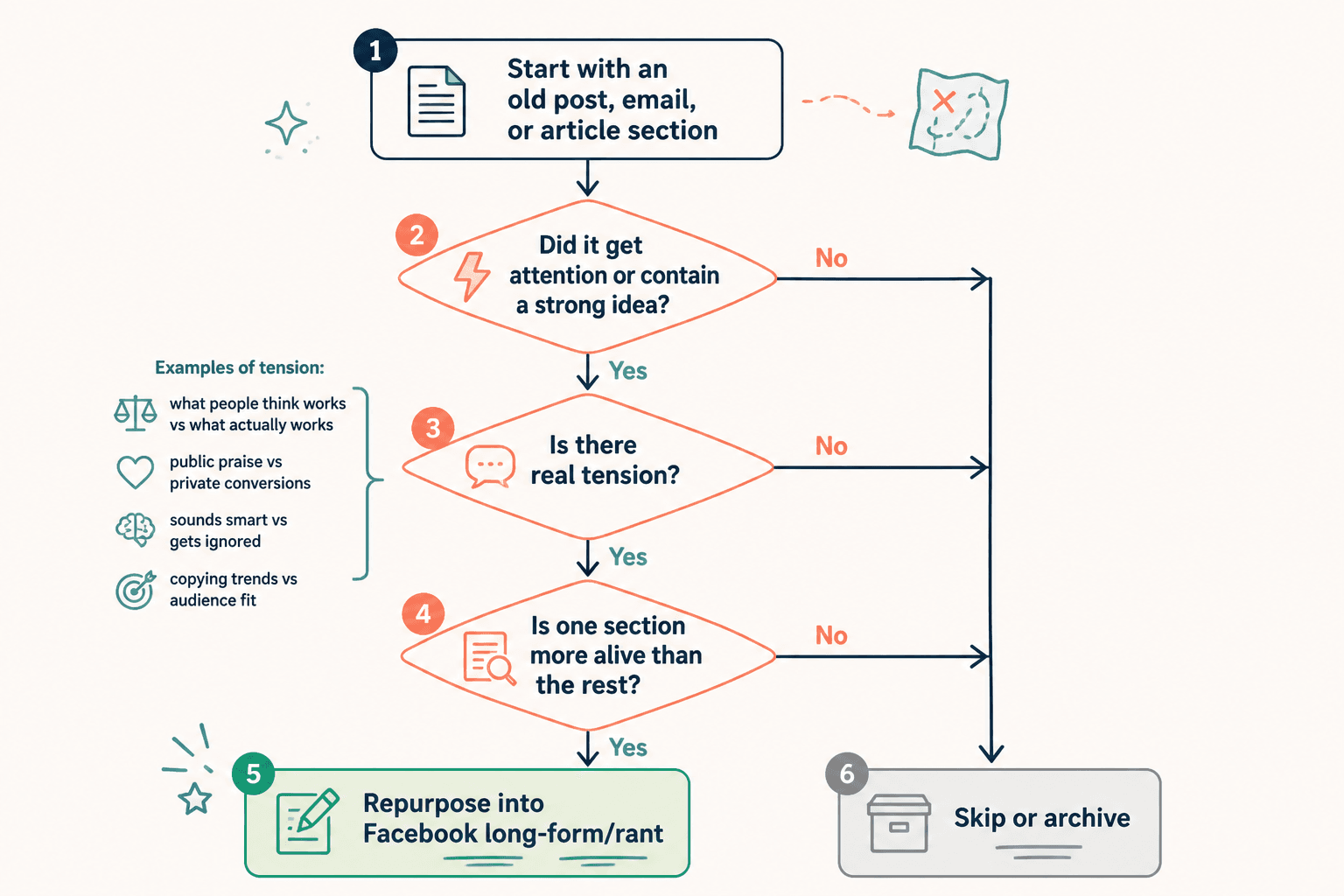
The best old content to reuse usually has one or more of these traits:
- A strong opinion people reacted to
- A common mistake your audience keeps making
- A useful lesson buried inside a dry post
- A sharp sentence or claim that could anchor a bigger argument
- A story, moment, or client pattern that still feels relevant
- A post that got attention but was underdeveloped
- An article or email with one section that clearly had more life than the rest
Look for content with tension in it. Tension is what gives a long-form Facebook post energy. Without tension, you are just expanding old advice into a longer version of the same beige thing.
Useful tension can sound like this:
- What people think works vs what actually works
- What gets praised publicly vs what converts privately
- What sounds smart vs what gets ignored
- What creators keep copying vs what fits their actual audience
If the old content contains one of those tensions, you probably have something worth rebuilding.
How to turn old content into better Facebook long-form & rants
This is where most people either overcomplicate the process or get lazy and paste the original with three new lines added. Neither works especially well.
Use this simple process instead.
1. Find the live nerve in the old content
Do not start by asking, “How can I repost this?”
Ask:
- What is the actual point here?
- What part still feels true?
- What line has the most bite?
- What would make someone comment, disagree, or say “yes, exactly”?
That is your starting point.
If your old content says, “Consistency matters in content marketing,” that is not the live nerve. That is wallpaper. But if buried in the post you also wrote, “Most people do not have a consistency problem. They have a standards problem and keep publishing things nobody would miss,” now we have something.
2. Strip out anything that sounds formal, padded, or platform-wrong
Facebook long-form posts do not need to be sloppy, but they do need to feel spoken.
Cut:
- Throat-clearing intros
- Corporate transitions
- Numbered list language unless the post really needs it
- Polite filler
- Overexplained context
- Lines that sound imported from LinkedIn with their shoes still on
For example:
| Old version | Better Facebook version |
| Many professionals underestimate the importance of clear messaging in content strategy. | Some of you do not have a visibility problem. You have a muddy-message problem. |
| In my experience, authenticity is an essential component of building trust online. | People keep saying “be authentic” like that means posting unedited feelings and calling it strategy. |
| Here are three lessons I learned from creating content for my brand. | I keep seeing the same 3 content mistakes from smart people who should know better. |
Same idea. More life. More tension. Less seminar voice.
3. Choose the right shape: story, argument, or controlled rant
Old content gets stronger fast when you stop treating every post like a generic “insight.” Facebook long-form works better when the structure matches the material.
Use a story shape when the old content comes from a moment, client interaction, mistake, or realization.
- What happened
- Why it mattered
- What it reveals
- What the reader should do with it
Use an argument shape when the old content is built around an opinion, correction, or critique.
- What people believe
- Why that belief fails
- What is more accurate
- What changes because of that
Use a controlled rant shape when the old content has heat and frustration, but still needs discipline.
- Name the thing that is annoying, broken, fake, or overrated
- Show why it matters
- Aim the frustration at the idea, not random humans
- Land on a useful takeaway or sharper standard
If you want more help with pacing and flow, this pairs well with how to improve Facebook long-form and rants rant structure without sounding generic.
4. Add emotional texture without turning it into a melodrama exhibit
Facebook gives you room to sound more human than LinkedIn, but that does not mean every post needs a wounded confessional opening.
Emotional texture is often just naming what is frustrating, surprising, awkward, exhausting, or absurd about the topic. It helps the post feel lived-in. It gives readers something to feel while they read.
For example, instead of this:
Many people create content without a clear strategy, which limits their results.
Try this:
A lot of people are posting constantly, getting polite little bursts of engagement, and still feeling that quiet dread that none of it is building anywhere.
That is not dramatic for the sake of it. It is specific emotional reality. Huge difference.
5. Expand the strongest part, not the whole original piece
This is where long-form often goes wrong. People think repurposing means preserving the original structure and adding more detail. Usually the opposite works better.
Take one sharp point from the original and build around it. Ignore the weaker sections. If the old article had seven lessons and only one still feels punchy, congratulations, you now have one Facebook post.
A good long-form post does not need to be comprehensive. It needs to be coherent. Readers will forgive a narrow post. They will not forgive a wandering one.
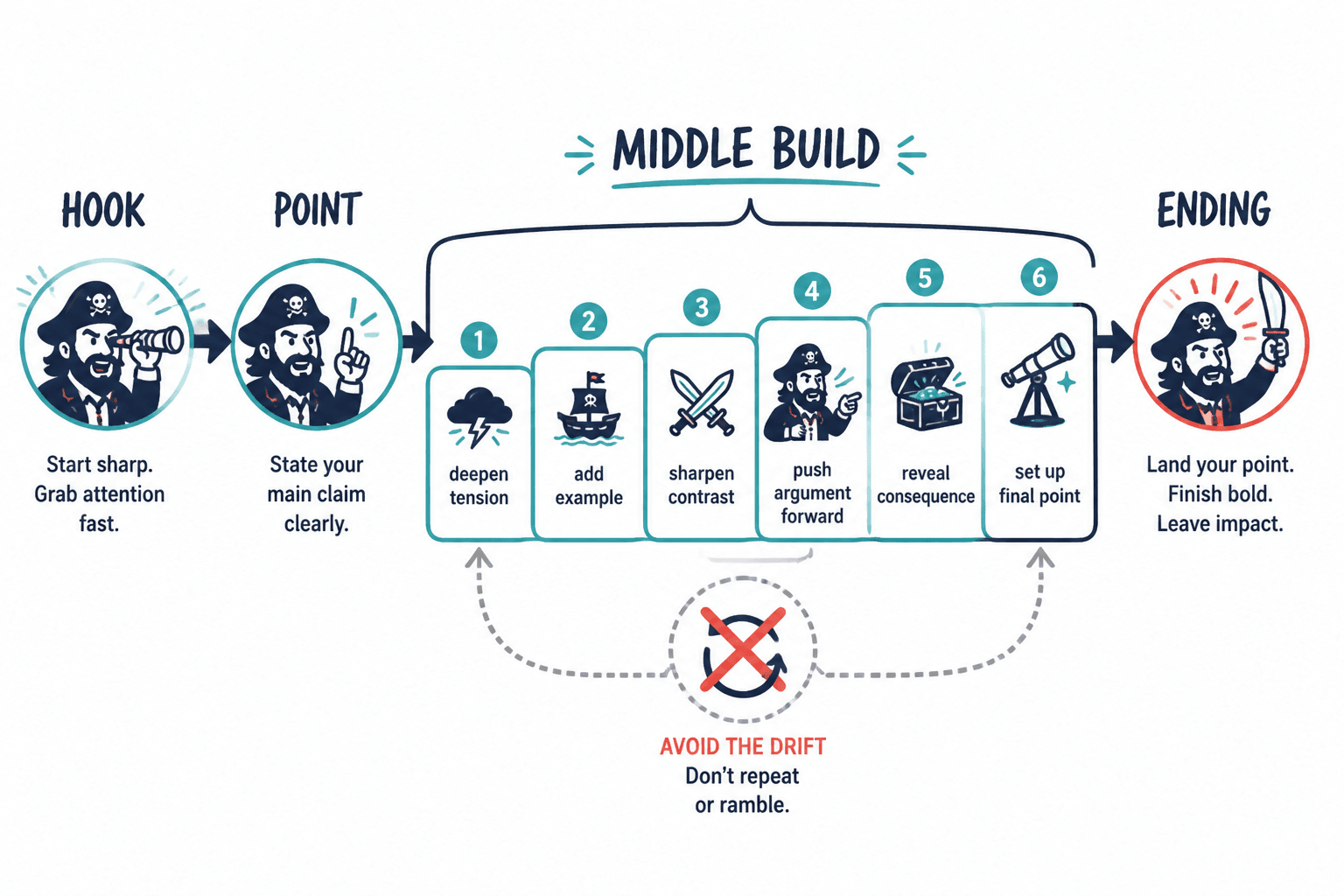
6. Make the middle move
The middle is where most rants die.
You start strong, make one good point, and then drift into repeating yourself with slightly different phrasing until everyone quietly leaves.
To keep momentum, each section should do one of these jobs:
- Deepen the tension
- Add a concrete example
- Sharpen the contrast
- Push the argument forward
- Reveal a consequence
- Set up the final point
If a paragraph does not do one of those jobs, it is probably decorative. Decorative writing is lovely in novels. In Facebook rants, it is where attention goes to die.
7. End with a point, not a shrug
One of the easiest ways to improve old content is to stop ending with vague moral-of-the-story fluff.
Weak endings sound like this:
- Just something to think about.
- Food for thought.
- Curious if anyone else feels this way.
- Hope this helps.
That is not an ending. That is the post wandering out through the side door.
Better endings do one of three things:
- State the standard clearly
- Challenge the reader to see the issue differently
- Invite conversation that actually matches the post
For stronger finishing moves, read better Facebook long-form and rants strong endings for personal brands.
A practical rewrite example
Here is a quick before-and-after to show how this works.
Old content idea
“Posting every day is not necessary for audience growth. Strategic posting with quality and consistency matters more.”
That is fine. Also boring.
Rebuilt as a Facebook long-form rant
I think a lot of creators have been bullied by content advice into producing too much mediocre work.
Not because they are lazy.
Because they keep hearing that if they are not posting constantly, they are falling behind.
So now they are stuck in this weird loop where they publish things they do not even like, get little spikes of attention from people who barely remember them, and call it momentum.
It is not momentum.
It is output without weight.
A quieter content strategy with better standards will usually beat a noisy one built on obligation.
You do not need to post every day if the posts are forgettable. You need posts with a pulse. Posts with a point. Posts that actually sound like you mean them.
More content is not automatically more trust.
Sometimes it is just more evidence that you are winging it in public.
Notice what changed:
- The point got sharper
- The language got more human
- The middle escalated the frustration
- The ending landed on a standard
That is the difference between reposting and rebuilding.
Best sources of old content to repurpose into Facebook rants
You do not need a giant content archive. You just need to know where to look.
- Old Facebook posts that had strong comments but weak structure
- LinkedIn posts with a strong opinion that felt too polished
- Email newsletter sections with emotional honesty
- Client call notes with recurring frustrations or objections
- X threads with sharp ideas that need more room
- Article drafts with one excellent section
- Voice notes or messy captions where your real voice shows up
The bigger point is simple: clearer structure and clearer writing make the piece more useful. That is usually what makes the ending land better too.