
Most creators with small Facebook audiences make the same mistake with long-form posts: they either write like they are auditioning for a keynote, or they rant like someone trapped in a comments section with Wi-Fi and unresolved feelings.
Neither works very well.
Facebook Long-Form & Rants for Creators With Small Audiences is not really about writing more words. It is about giving those words shape, tension, and a point. If you do that well, a smaller audience can still respond, remember you, and eventually buy from you. If you do it badly, you just posted 700 words of public journaling and called it strategy.
Here’s how to write Facebook long-form posts and rants that feel human, earn comments, build trust, and do not collapse into rambling, self-important mush.
To see how this fits into the wider strategy, open the parent guide.
Why long-form can work absurdly well for small creators on Facebook
Small audiences do not need watered-down content. They need content with stronger signal.
On Facebook, long-form works best when it creates a feeling of conversation with weight. Not polished “thought leadership.” Not a fake viral mini-essay. Something that feels like a real person has noticed something true, has the nerve to say it clearly, and can carry the thought all the way to a satisfying point.
That matters even more when your audience is small, because you are not playing a reach game first. You are playing a relevance game. A few good readers who feel seen and think, “Yes, finally, someone said it properly,” are worth much more than shallow attention from random people skimming while microwaving leftovers.
Long-form posts can help you do a few things especially well:
- Show how you think, not just what you know
- Build familiarity and trust faster
- Take a stronger stance without sounding shallow
- Create better comment conversations
- Turn personal perspective into business credibility
- Give your quieter audience something worth responding to
If you want the broader category view, this piece also fits nicely with the main hub on social media writing and the Facebook-specific section on Facebook writing.
A good Facebook rant is not just complaining with paragraph breaks
This is where people get sloppy.
A rant is not good because it is emotional. It is good because it has direction. The reader should feel tension building, not just witness your irritation doing laps around the same point.
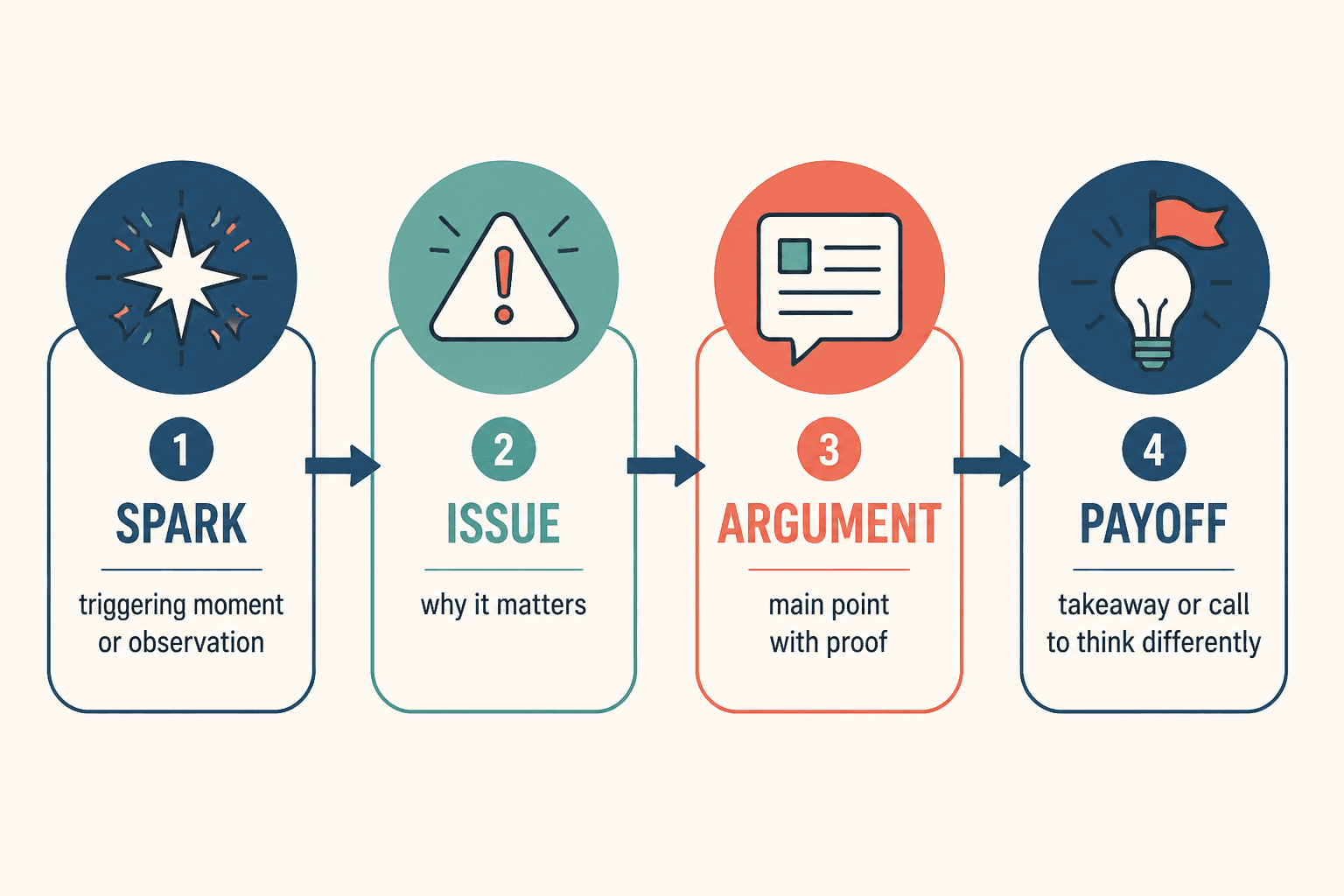
The strongest Facebook rants usually have four parts:
- The spark: what triggered the post
- The real issue: what the post is actually about beneath the trigger
- The argument: why this matters, what people get wrong, and what you believe instead
- The payoff: a sharper takeaway, a challenge, or an invitation to respond
Without that structure, you get flailing. With it, you get momentum.
A rant without a point is just noise with good posture.
That is why many “honest” posts still fall flat. They are technically sincere, but they do not go anywhere. Readers are left thinking, “Okay… and?” That is not engagement. That is polite confusion.
For more on the bigger strategy behind this format, you can also read Facebook long-form and rants and the related guide for creators who want better results.
What small audiences should do differently
If you have a small audience, do not copy the behavior of giant creators who can post one vague sentence like “Energy matters” and still get 413 comments from loyal followers and confused admirers.
You do not have that margin for laziness. You need clarity faster, specificity sooner, and more proof inside the post itself. Not because your ideas are worse, but because fewer people are already predisposed to care.
That changes how you should write.
Use sharper specifics
Do not say “people are tired of fake content.” Say what fake content actually looks like.
Example:
- Weak: “People can sense inauthenticity.”
- Better: “People can tell when your post was written to sound wise instead of written to say something real.”
Earn emotion with observation
If you are frustrated, good. Use that energy. But anchor it to something concrete the reader has seen before. That is what makes a rant feel shared instead of theatrical.
Write for the right people, not everyone
With a small audience, broadness is usually a tax on effectiveness. If your post could be for coaches, founders, freelancers, creators, consultants, marketers, and possibly your aunt Denise, it is probably not pointed enough.
Pick a lane inside the post. You can still be readable by others. But the person you most want should feel directly addressed.
Stop trying to sound important
This one hurts, because it gets a lot of otherwise smart people.
On Facebook especially, over-polished authority often reads as distance. People respond better when the writing feels like a clear human voice with a real point of view. Not sloppy. Not casual to the point of mush. Just normal enough that someone can actually connect with it.
How to structure a Facebook long-form post that people actually finish
A strong structure does not make your post robotic. It keeps the reader oriented.
Here is a simple framework that works well for Facebook Long-Form & Rants for Creators With Small Audiences:
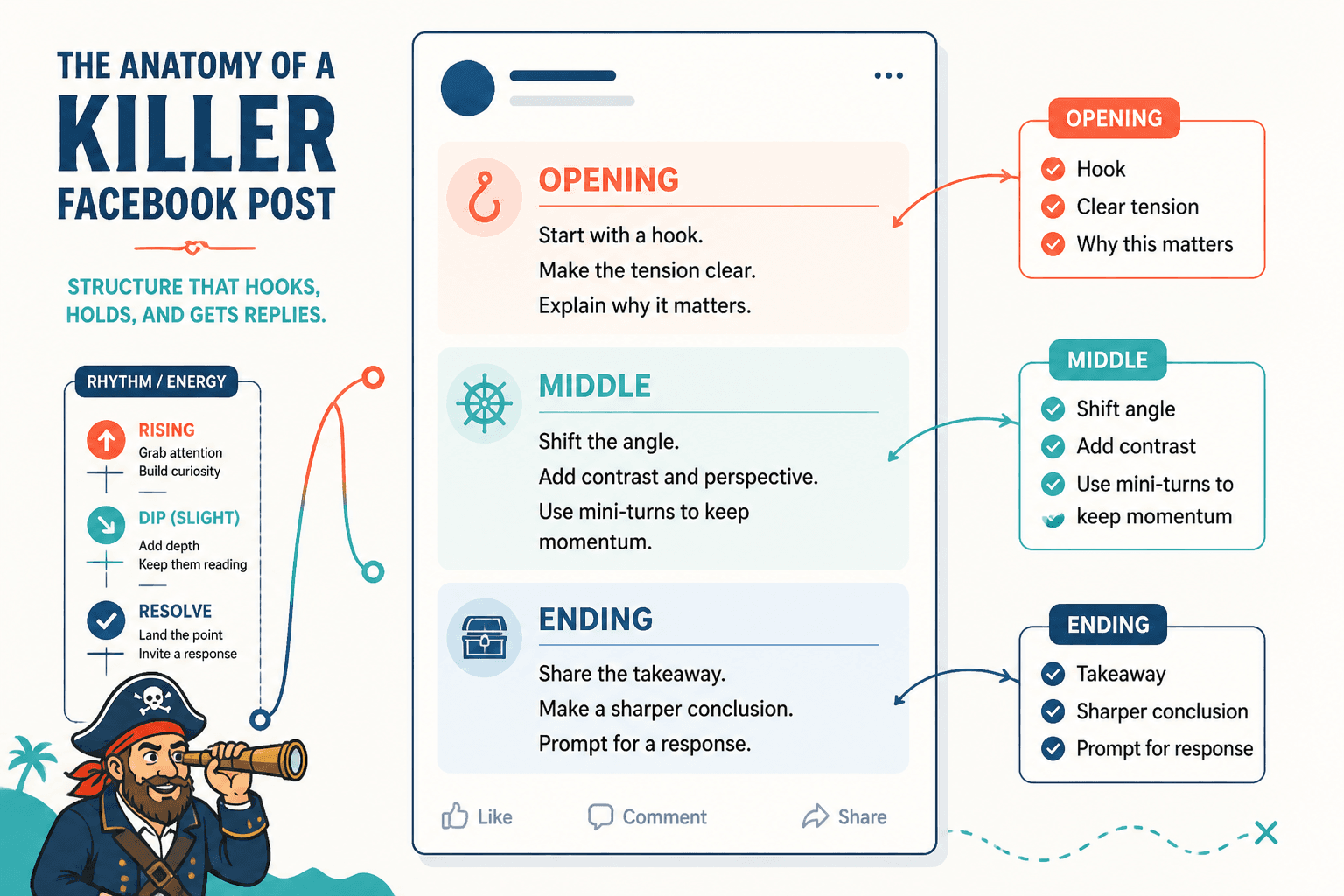
- Hook with tension
Open with the opinion, frustration, contradiction, or moment that makes someone care. - Name the pattern
Show the reader what keeps happening and why it matters. - Develop the argument
Add examples, contrast, mini-story, or analysis. - Land the point
Make the takeaway clearer and stronger than the opening. - End with a response path
Ask a real question, invite a story, or give the reader something clean to react to.
That response path matters. A good Facebook ending is not “Thoughts?” dropped onto the floor like an afterthought. It should feel like a natural handoff.
For example:
- Weak: “Thoughts?”
- Better: “What kind of post are you seeing too much of right now: fake vulnerability, recycled advice, or polished nothingness?”
- Better: “Have you noticed this in your own niche too, or is content on my feed just having a rough week?”
- Better: “If you write long-form on Facebook, what usually loses people first: the opening, the middle, or the ending?”
If you want more post models to steal responsibly, the examples in these Facebook long-form and rants ideas and examples should help.
The pacing problem: why many long posts die in the middle
Bad long-form usually does not fail at the beginning. It fails in the middle, where the writer starts circling, repeating, overexplaining, or adding filler because they think longer automatically means deeper.
It does not.
Depth comes from progression. Each section should add something: a sharper example, a stronger contrast, a more useful implication, a clearer truth. If the paragraph only says the same thing in slightly different pants, cut it.
Three ways to keep the middle alive
- Shift the angle: move from observation to example, or from example to implication.
- Add contrast: show what most people do versus what actually works.
- Use mini-turns: lines like “But that is not the real problem” or “The annoying part is…” can create forward motion when they are earned.
That pacing issue is exactly why templates can help. Not because templates make writing magical, but because they stop your post from wandering into a hedge. If you want a cleaner structure, these story pacing templates for busy creators are useful.
What to rant about when your audience is still small
You do not need bigger outrage. You need better relevance.
The best rant topics for small creators usually sit close to your audience’s lived frustrations. That gives the post traction even if your follower count is not huge.
Good categories include:
- Bad advice your niche keeps repeating
- Common behavior that wastes time, money, or trust
- The polished version of success people perform online
- Misunderstood client expectations
- Platform habits that make content worse
- Industry phrases that sound smart but mean nothing
- The gap between what people say they want and what they actually reward
Those topics work because they do two jobs at once: they let you show standards, and they help the reader feel understood.
For example, a writing coach with a small audience might rant about how creators keep posting “valuable” content that contains no actual opinion. A consultant might rant about discovery calls being used as unpaid consulting. A designer might rant about clients wanting “premium” branding on a coupon-bin budget.
All of those can work, if the post moves beyond annoyance and into insight.
Hook styles that fit Facebook long-form without sounding try-hard
The hook for a Facebook long-form post should feel like the opening sentence of an actual thought, not a bargain-bin trick for forced curiosity.
Some reliable hook styles:
1. The sharp opinion
- “Most ‘authentic’ content is still performance. It is just wearing messier clothes.”
- “A lot of business content is not underperforming because it is bad. It is underperforming because it is bloodless.”
2. The pattern callout
- “I keep seeing creators write long Facebook posts that sound brave until you realize they never actually say anything risky.”
- “There is a weird trend of people confusing emotional tone with substance.”
3. The lived frustration
- “One of the fastest ways to lose me is to write a rant that clearly exists just to lead into a pitch.”
- “Nothing kills a good Facebook post faster than a strong opening followed by six paragraphs of repeating the same complaint.”
Need more opening help? This collection of long-form hooks examples creators can adapt fast will save you time.
Before and after: one weak rant, one stronger one
Weak version
“I’m tired of how fake social media has become. Everyone is pretending and no one is real anymore. People need to be more authentic and stop copying each other. Just be yourself. The online world would be better if people were honest.”
The problem is not that this is wrong. The problem is that it is mush. No specifics. No tension. No shape. No fresh point. It sounds like a complaint assembled from spare parts.
Stronger version
“A lot of ‘authentic’ content is still performance. It is just swapped the polished blazer for curated chaos.
People cry on camera, share a messy lesson, confess a hard season, and somehow it still feels airbrushed.
Why?
Because honesty is not the same as usefulness.
If your vulnerable post still protects your image, avoids the real point, and teaches nothing except ‘I am a complex human with lighting,’ it is not actually brave. It is branding with better eyeliner.
What people respond to is not rawness by itself. It is recognition. A post that makes them feel seen, think harder, or understand something better.
That is why some quiet, plainspoken posts hit harder than polished oversharing ever will.”
The bigger point is simple: clearer structure and clearer writing make the piece more useful. That is usually what makes the ending land better too.