
Most people ruin Facebook content funnels by trying to force a sale before the post has earned a shred of trust.
They write a decent post, maybe even one that gets comments, and then immediately jam a booking link into the conversation like a guy handing out business cards at a funeral. It is too much, too soon, and usually way too obvious.
The best funnel ideas to pair with Facebook posts do not feel like funnels in the gross, over-engineered sense. They feel like a natural next step. The post helps. The profile adds context. The offer fits. The reader does not feel trapped in a marketing escape room.
If you want Facebook posts to do more than collect likes from cousins and old coworkers, you need a cleaner path from attention to action. Not a giant funnel map. Just a smart sequence that matches how people actually behave on Facebook: they notice, they lurk, they click your profile, they read more, they maybe comment, and only then do they decide if you are worth taking seriously.
Here’s how to build simple, effective funnel paths around your Facebook posts so they can generate leads, newsletter subscribers, consult calls, sales conversations, and actual business momentum without turning every post into a needy pitch.
To see how this fits into the wider strategy, open the parent guide.
Why Facebook posts need a different funnel approach
Facebook is not LinkedIn in a blue hoodie.
People are usually in a more conversational mode. They are scrolling faster, reacting more casually, and deciding very quickly whether something feels human or weirdly corporate. That matters because the funnel that works after a polished LinkedIn authority post will not always work after a Facebook story post, observational post, or mini-rant.
On Facebook, the post often works best as a trust starter, not a full sales asset. It opens the loop. It gets the right people curious. It invites a low-friction response. Then your funnel needs to carry that interest somewhere useful.
That means your funnel should usually be:
- simple
- easy to follow
- aligned with the tone of the post
- low-pressure at first
- clear about what happens next
If your Facebook post sounds like a real person but the next step sounds like a sweaty webinar script from 2018, the whole thing falls apart.
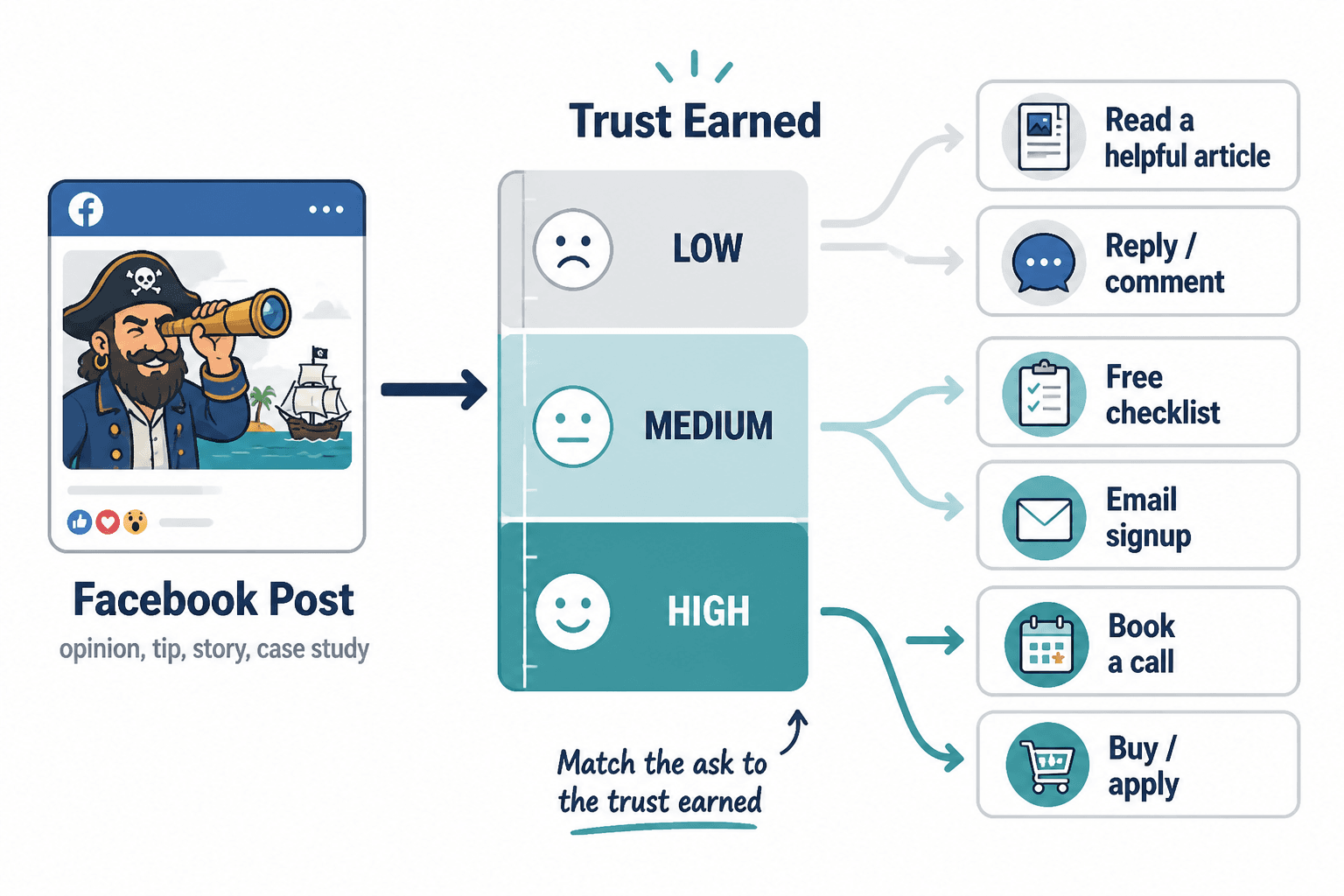
Before we get into the specific funnel ideas, one useful rule: pair the next step with the level of trust the post has earned. A light opinion post should not ask for a marriage-level commitment. A strong case study or high-value teaching post can ask for more.
What makes a Facebook post funnel actually work
Before choosing a funnel, make sure the post itself is doing its job. A funnel cannot rescue a weak post. It can only route attention that already exists.
A Facebook post is usually most useful when it does at least one of these well:
- shows your thinking clearly
- shares a relatable problem with a sharp point
- offers practical help
- creates conversation with the right kind of people
- gives a small proof signal of your expertise
Then the funnel takes over. Good funnel pairing depends on four things.
1. Match the ask to the post
If the post is casual, the next step should be light. If the post delivers serious value or proof, you can ask for something bigger.
For example, a quick post about one mistake coaches make in discovery calls is a decent setup for a free checklist or resource. A detailed post breaking down how you fixed a client’s messaging may justify a consultation CTA.
2. Reduce friction
People should not need a treasure map to figure out what to do next. If the next step is “check my profile for the link” then your profile better make that link painfully easy to find and understand.
3. Keep the transition emotionally consistent
A warm, conversational post should lead into a warm, conversational offer. If the post sounds thoughtful and grounded but the landing page screams in all caps about scaling to seven figures by Thursday, trust dies on contact.
4. Make the payoff obvious
People click when they know what they are getting and why it matters. “DM me” is not a payoff. “Comment ‘checklist’ and I’ll send the exact messaging framework” is better. “Grab the 10-minute client onboarding template from my profile” is better too.
Best funnel ideas to pair with Facebook posts
Here are the funnel paths that tend to work best for creators, coaches, consultants, freelancers, and service-based personal brands on Facebook.
1. Post → profile → lead magnet
This is one of the cleanest options if your posts are getting attention but you do not want to pitch hard inside the post itself.
The post creates interest. Your profile reinforces what you do. Then the reader finds a useful free resource that solves a specific problem.
This works especially well for:
- consultants
- coaches
- service providers
- educators
- writers building an email list
Good lead magnet examples:
- a short guide
- a checklist
- a template pack
- a swipe file
- a mini email course
- a diagnostic worksheet
What makes this work is relevance. The lead magnet should connect directly to the post topic, not vaguely to your business.
Weak pairing: A post about writing better hooks that sends people to a generic “join my newsletter” page.
Better pairing: A post about writing better hooks that sends people to a free hook template pack.
Soft CTA example inside the post:
“If this is a thing you’re working on, I’ve got a free messaging checklist linked on my profile. It’ll help more than another motivational carousel.”
2. Post → comments → soft DM → resource or offer
This one works well when you want the post to generate engagement and conversations without dropping a cold sales ask into the feed.
You write a post around a real problem. Then you invite people to comment for a specific resource, example, or next step. From there, you send the resource in DM and continue the conversation naturally if it makes sense.
Important phrase there: if it makes sense.
Do not turn every comment into an ambush sequence. People can smell that nonsense from space.
This funnel is useful for:
- service offers that need some conversation first
- audience research
- high-ticket work
- testing demand for a resource or offer
Good comment CTA examples:
- “Comment ‘outline’ and I’ll send the structure.”
- “If you want the template, drop ‘template’ below and I’ll message it over.”
- “If this sounds familiar, comment ‘audit’ and I’ll send the checklist I use.”
Keep the DM simple. Send the thing. Add one line of context. If they engage, continue. If they do not, leave them alone like a civilized person.
3. Post → newsletter signup
If your Facebook posts are opinionated, educational, or story-driven, a newsletter can be one of the smartest funnel destinations.
Why? Because email gives you a more stable place to build trust, teach consistently, and make offers without relying on whatever the feed feels like doing that week.
This is especially strong if your posts regularly touch on a few core themes and your newsletter expands on them.
Good fit for:
- writers
- consultants
- educators
- coaches with trust-based offers
- creators building long-term audience value
Post angle examples that pair well with newsletter funnels:
- a contrarian opinion with more detail available in email
- a short lesson that leads to a weekly deep-dive
- a story with a bigger framework behind it
- a practical tip that hints at an ongoing series
Example CTA:
“I write about this every week with more examples and fewer polite half-opinions. Link’s on my profile if you want in.”
If you need better topic formats for posts that feed this kind of funnel, articles like Best Facebook Posts Ideas and Examples for Creators and Facebook posts guidance can help you create stronger source content.
4. Post → booking page
This can work very well, but only when the post has enough weight behind it.
You should not send people from a fluffy thought-of-the-day post straight to a consultation booking page and expect serious results. Booking CTAs work better after posts that show proof, process, insight, or a clear problem-solution angle.
Best post types for this funnel:
- case studies
- before-and-after breakdowns
- posts exposing a costly mistake
- posts showing your method or audit process
- posts that attract buyers with urgent, relevant pain points
Example CTA:
“If your content is doing the polite applause thing but not turning into leads, I do a small number of messaging audits each month. Details are on my profile.”
This CTA works because it is direct without sounding desperate. It names the problem, frames the offer, and gives a clean next step.
5. Post → low-ticket offer
If you sell templates, mini products, workshops, guides, or audits at a relatively low price point, Facebook posts can feed those offers nicely.
This works best when the post gives enough value to build trust but leaves a useful gap the paid offer solves faster, deeper, or more completely.
For example:
- a post on weak calls to action can lead to a CTA swipe file
- a post on content planning can lead to a content calendar template
- a post on profile mistakes can lead to a profile rewrite workbook
The key is not to turn the post into a teaser that withholds all value. That approach is annoying and usually transparent. Give a real useful idea. Then offer the paid shortcut, tool, or system for people who want help implementing it.
6. Post → article, long-form post, or deeper resource
Not every Facebook funnel needs to jump straight toward a lead magnet or sale. Sometimes the best next step is more depth.
This is especially useful when your audience needs more education before they are ready to buy, or when the topic is too nuanced for one Facebook post.
A short Facebook post can spark curiosity. Then you send readers to:
- a full article
- a long-form Facebook note or post
- a deep tutorial
- a related content hub
This helps if your business depends on authority and trust rather than impulse clicks. It also creates a stronger bridge for people who need more evidence before taking action.
If your content strategy spans multiple Facebook formats, your broader Facebook writing system should make those jumps feel natural, not random.
7. Post → group, challenge, or community space
If your business model benefits from ongoing conversation, peer interaction, or trust built over time, sending people into a community can work better than sending them to a sales page.
This can include:
- a private Facebook group
- a short challenge
- a cohort waitlist
- a member community
This funnel tends to work well for coaches, educators, and personal brands whose offers involve transformation, accountability, or repeat interaction.
Just make sure the community has a reason to exist beyond “be near my brand.” People are busy. Give them a clear benefit.
8. Post → webinar, workshop, or live session
For some offers, especially those that need education and objection handling, a live event is a strong bridge between post and sale.
This works best when the post surfaces a problem and the live session promises a practical solution, framework, or walkthrough.
Good examples:
- a post about weak messaging leading to a live messaging workshop
- a post about Facebook content strategy leading to a planning session
- a post about funnel mistakes leading to a practical teardown session
Again, the event needs to be worth attending. If the live session is just a pitch in a trench coat, people will remember.
How to choose the right funnel for the post
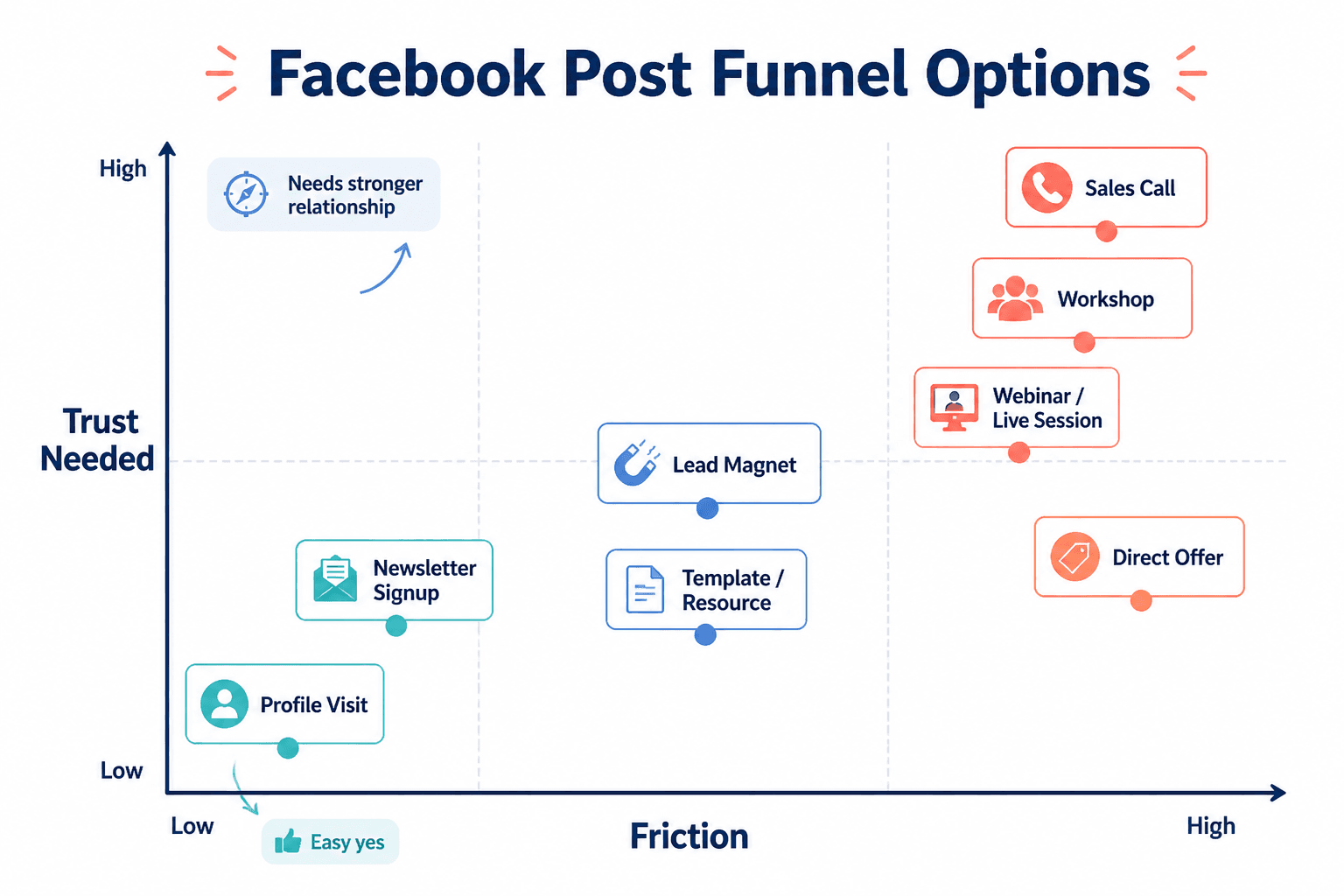
You do not need eight funnels running at once. That is how people end up with three disconnected offers, five confused CTAs, and a profile that looks like a garage sale.
Choose based on the post’s role.
| Post type | Best next step | Why it fits |
|---|---|---|
| Short opinion post | Newsletter or profile visit | Low friction, builds ongoing trust |
| Helpful how-to post | Lead magnet or template | Reader already wants a practical resource |
| Story post with lesson | Newsletter or deeper article | Keeps the relationship going without rushing |
| Case study post | Booking page or consultation | Shows proof and problem-solving ability |
| Comment-heavy conversation post | Soft DM follow-up | Turns active interest into a real conversation |
| Problem-aware rant or myth-busting post | Workshop, guide, or low-ticket offer | Reader feels the pain and wants a fix |
That simple matching process will save you from a lot of awkward CTAs.
How to write CTAs that do not wreck the post
A bad CTA can make a solid Facebook post feel manipulative in about three seconds.
The best CTAs on Facebook usually feel like a continuation of the post, not a sudden genre switch into internet marketer theater.
What good Facebook CTAs usually do
- name the next step clearly
- connect that step to the problem in the post
- keep the tone human
- avoid fake urgency
- sound like something a normal person would actually say
Weak vs stronger CTA examples
Weak: “DM me to learn how I can help you scale.”
Stronger: “If you want help fixing this in your own content, message me and I’ll tell you if my audit is the right fit.”
Weak: “Click the link and transform your business.”
Stronger: “I put the template on my profile if you’d rather not build this from scratch.”
Weak: “Seats are filling fast.”
Stronger: “I’m running this live next week if you want the walkthrough.”
Notice the pattern. Clear, grounded, specific. No fake adrenaline.
Common Facebook funnel mistakes
A lot of funnel problems are not funnel problems. They are judgment problems.
Here are the usual offenders.
Pitching too early
If the post has not earned enough trust, a hard sell will feel abrupt. The reader is still deciding if you are credible. Calm down.
Using the same CTA on every post
Not every post should send people to the same place. Different posts create different types of intent. Treating all of them the same is lazy and usually less effective.
No clear next step on the profile
If the post sends people to your profile but the profile is vague, cluttered, or missing direction, you lose people right there. Your funnel is only as good as the handoff.
Turning comments into a trap
If someone comments for a resource and gets a fake-friendly interrogation instead, they will remember. Badly.
Choosing offers that do not match audience temperature
Cold readers usually want a small next step. Warm readers might book. Hot readers might buy. If your CTA ignores that, response quality drops.
Using generic lead magnets nobody actually wants
The bigger point is simple: clearer structure and clearer writing make the piece more useful. That is usually what makes the ending land better too.
Facebook posts work best when the point is easy to follow and worth reacting to. Clearer structure usually beats longer wandering.