
Most people do not need more LinkedIn article ideas. They need better examples of what a useful LinkedIn article actually looks like when it is written by someone trying to build trust, not cosplay as a thought leader.
That is the problem with a lot of advice around LinkedIn articles. It tells you to “share insights” and “provide value,” which sounds nice and means almost nothing. So people publish a long, polite lump of professional oatmeal and then wonder why it gets skimmed, ignored, or forgotten.
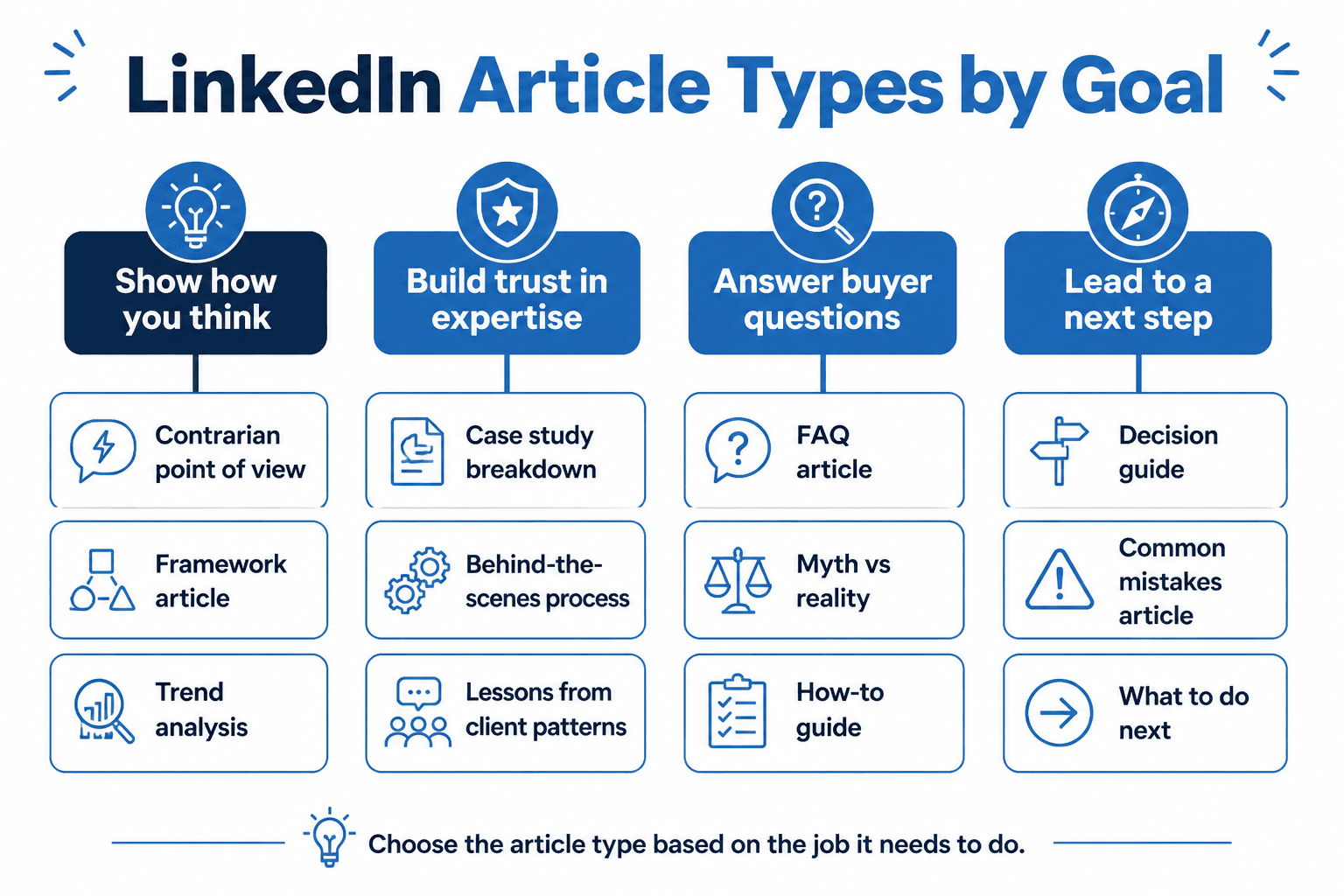
If you want better results, you need LinkedIn articles that do at least one of these jobs well: show how you think, make your expertise easier to trust, answer a real buyer question, or move readers toward a clear next step without sounding needy.
This guide gives you exactly that: practical LinkedIn Articles Examples for Coaches, Consultants, and Personal Brands, plus why they work, how to structure them, and how to make yours stronger. If your current articles feel too broad, too bland, or too much like stretched-out posts, this should help fix that.
Want the broader roadmap? Start with the parent guide.
What good LinkedIn articles actually do
LinkedIn articles are not just “posts, but longer.” That is where a lot of the trouble starts.
A post is usually trying to win attention quickly. An article has more room to build authority, rank for search inside and outside LinkedIn, and help someone understand your approach in a way a short post cannot. That makes articles especially useful for coaches, consultants, and personal brands selling expertise, judgment, and trust.
A strong article usually does a few things well:
- Solves a specific problem
- Shows your thinking, not just your opinions
- Uses examples instead of vague claims
- Feels relevant to a clear type of reader
- Ends with a next step that makes sense
A weak article usually does the opposite. It tries to sound smart instead of being useful. It covers too much. It avoids specifics. It says things like “consistency is key” and “authenticity matters,” which, thanks, groundbreaking.
If you want a broader foundation for what makes these pieces work, it helps to study more on LinkedIn articles before you start writing at scale.
5 LinkedIn article formats that work especially well
Before the examples, here is the bigger pattern: the best articles tend to fall into a few reliable categories. You do not need to invent a brand-new format every time.
1. The “how I think” article
This is great for consultants and strategists. Instead of just giving generic advice, you explain your framework, lens, or decision-making process.
Example angle: “How I decide whether a client needs better messaging or a better offer first.”
Why it works: readers get to see your judgment, which is often what they are really buying.
2. The myth-correcting article
This works well for coaches and educators. You take a common belief in your space, explain what is wrong with it, and replace it with something more useful.
Example angle: “Why posting more on LinkedIn will not fix weak positioning.”
Why it works: it creates contrast, sharpens your positioning, and shows you are not just recycling common advice.
3. The process breakdown
This is one of the easiest article types to make practical. Walk through a method, audit, client process, content workflow, or decision tree.
Example angle: “The 5-part content audit I use before rewriting a founder’s LinkedIn profile.”
Why it works: specificity builds trust fast.
4. The lesson-from-experience article
This can work beautifully if it has an actual point. Not “5 lessons from my journey,” which is usually code for “please clap.” More like a grounded reflection tied to a useful takeaway.
Example angle: “What rewriting 100 founder bios taught me about why clear positioning is so rare.”
Why it works: it combines lived experience with pattern recognition.
5. The buyer-question article
This is one of the most practical formats for lead generation. Take a question potential clients already ask, then answer it thoroughly.
Example angle: “Should a consultant use LinkedIn posts or LinkedIn articles to get leads?”
Why it works: it attracts relevant readers and naturally supports a soft CTA.
LinkedIn Articles Examples for Coaches, Consultants, and Personal Brands
Now for the useful part. Below are article examples you can adapt, along with what each one is trying to do.
Example 1: For a business coach
Article title: Why your content is not converting clients, even when people say it is “good”
What it does: Connects content quality to business outcome. Good for a coach selling strategy, offers, positioning, or messaging support.
Simple structure:
- Open with the mistake: useful content that does not lead anywhere
- Explain why likes and compliments are not enough
- Break down 3 conversion problems, such as vague audience, weak offer connection, and soft CTAs
- Give examples of better content angles
- End with a next step, like reviewing your profile or offer path
Why it works: It meets the reader at a frustrating point they already recognize. It also gives the coach room to demonstrate business thinking rather than tossing out empty content tips.
Example 2: For a consultant
Article title: The 4 signs a company has a messaging problem, not a marketing problem
What it does: Sharpens positioning and helps prospects self-diagnose.
Simple structure:
- Open by challenging the common assumption that more promotion fixes unclear messaging
- List 4 signs, each with a quick explanation
- Include a short before-and-after messaging example
- Explain what to fix first
- Invite the reader to audit their own homepage, pitch, or profile
Why it works: It reframes the problem in a way that makes the consultant’s expertise feel necessary. That is much stronger than posting broad “branding matters” content for the 800th time.
Example 3: For a personal brand strategist
Article title: What a strong personal brand really looks like when you are not famous
What it does: Cuts through influencer nonsense and gives grounded advice to normal professionals.
Simple structure:
- Open with the mismatch between “personal branding” advice and real-world experts
- Define what a strong brand actually includes: clarity, consistency, point of view, proof, and a clear next step
- Show examples of weak vs strong profile positioning
- Give a simple checklist readers can use
- Close with a profile-related CTA
Why it works: It speaks directly to readers who are tired of performative personal-brand content but still want practical help.
That kind of article also pairs nicely with other resources in the broader social media writing and LinkedIn writing category if you are building a stronger internal content path.
Example 4: For an executive coach
Article title: Why smart leaders sound vague on LinkedIn, and how to fix it
What it does: Addresses a painful credibility problem while staying relevant to leadership-focused readers.
Simple structure:
- Open with the irony: experienced people often write the blurriest content
- Explain why expertise can lead to abstract language
- Show examples of vague versus specific phrasing
- Offer a practical rewrite method
- Close with a prompt to revise one recent post or article
Why it works: It combines empathy, authority, and useful examples. Also, “smart people sounding vague” is a real problem, not just a catchy angle.
Example 5: For a marketing consultant or fractional leader
Article title: What I look at in the first 30 minutes of a content strategy audit
What it does: Shows process and competence.
Simple structure:
- Open with a common client assumption that turns out to be wrong
- Walk through your first audit checkpoints
- Explain what each checkpoint reveals
- Note common patterns and mistakes
- End with a clear service-related CTA or article CTA
Why it works: Good prospects love seeing how experts think. It makes your work feel concrete, not mysterious.
And if your articles usually fizzle out at the end, this is a good place to tighten the final action with ideas from better LinkedIn article CTAs for personal brands.
What these examples have in common
Different industries, different offers, same pattern.
The best LinkedIn Articles Examples for Coaches, Consultants, and Personal Brands are usually not trying to impress everyone. They are aimed at a very particular kind of reader with a very particular kind of problem. That focus is what makes them feel useful instead of generic.
They also tend to include at least three ingredients:
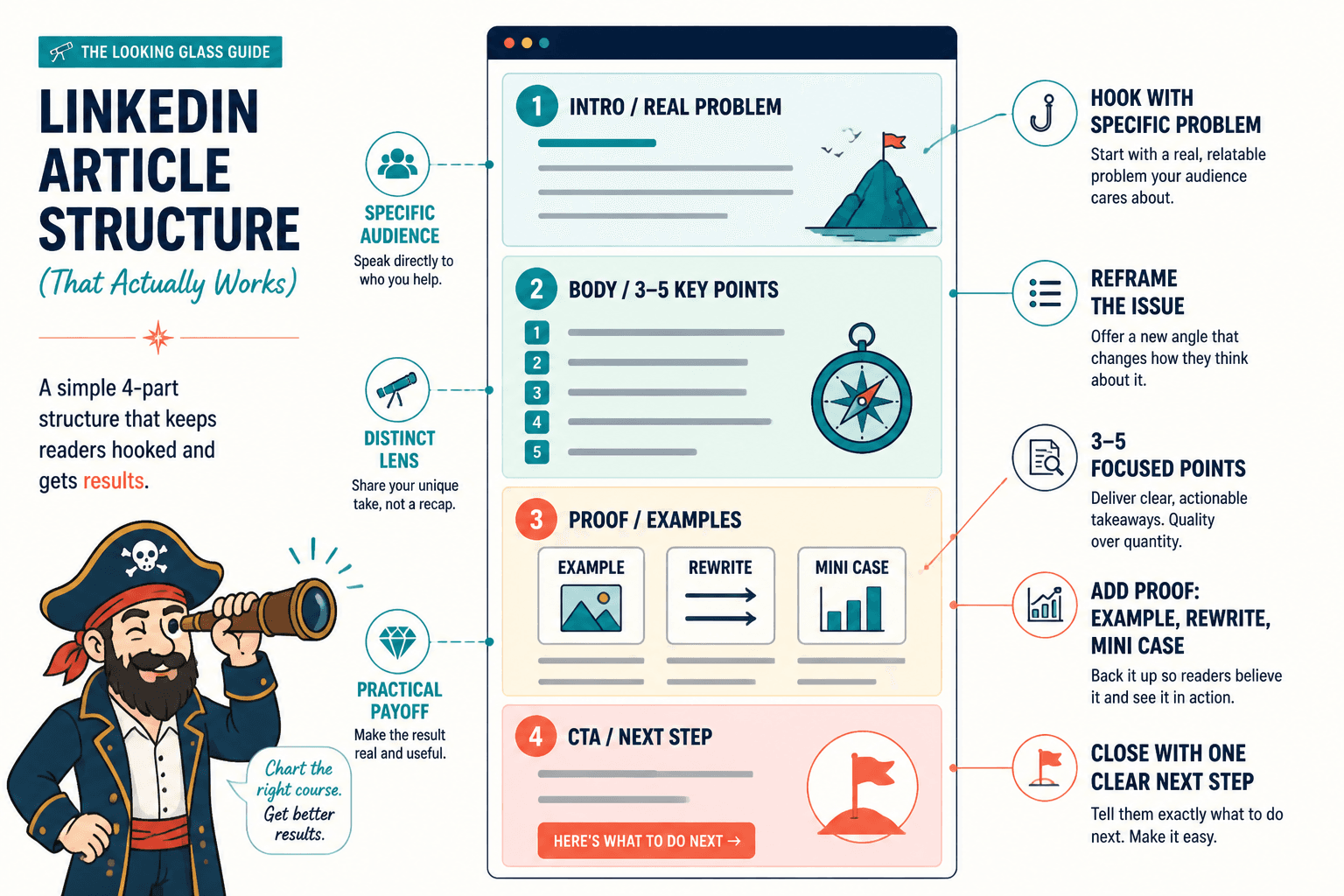
- A specific problem: not “how to grow,” but something more like “why your expertise sounds vague”
- A distinct lens: your method, framework, opinion, or pattern recognition
- A practical payoff: examples, steps, rewrites, or a checklist the reader can use
That sounds simple because it is simple. Not easy, but simple. Most article problems come from skipping one of those pieces.
For example, some people have a solid problem and no distinct lens. The article becomes generic. Others have a strong opinion but no practical payoff. The article becomes a rant in a blazer. Others have useful ideas but no specific audience, so the whole thing wanders off into broad, lifeless advice. None of these get fixed by adding more words.
A simple structure you can steal for your own LinkedIn article
If you are staring at a blank draft and feeling your soul slowly leave your body, use this structure.
- Open with the real problem. Name the mistake, frustration, or misunderstanding fast.
- Reframe it. Explain what is actually going on.
- Break it into 3 to 5 points. Each section should do one clear job.
- Add proof or examples. This can be a scenario, rewrite, mini case, or pattern you keep seeing.
- Close with a next step. Give the reader something sensible to do next.
That is enough for most articles. You do not need 17 sub-points, a fake story arc, and a dramatic ending that sounds like you are trying to win an award for B2B bravery.
Mini template
You might think [common assumption].
But the real issue is usually [actual problem].
Here are [number] signs/examples/steps that show what is really happening:
1. [Point one]
2. [Point two]
3. [Point three]
If you fix these first, [specific outcome].
And if you want the next step to be easier, [soft CTA].
If you want more structures like this, see best templates and tools for LinkedIn articles.
Common mistakes that make LinkedIn articles fall flat
The bigger point is simple: clearer structure and clearer writing make the piece more useful. That is usually what makes the ending land better too.
LinkedIn articles work best when the structure makes the main idea easy to follow and easy to act on. Clearer writing usually carries more weight than heavier formatting.