Most boring LinkedIn articles do not have a knowledge problem. They have a writing problem.
The ideas are usually fine. Sometimes even good. But the article arrives wearing three layers of throat-clearing, a polite corporate haircut, and the emotional range of a compliance memo. So nobody reads it, remembers it, or does anything after it.
If you want to know how to rewrite boring LinkedIn articles, the fix is not “add more words” or “sound more professional.” It is usually the opposite. You need a clearer point, a sharper opening, stronger structure, better examples, and a tone that sounds like a credible human instead of a committee.
Here’s how to take a flat LinkedIn article and turn it into something that actually builds authority, earns attention, and gives the reader a reason to keep going.
To see how this fits into the wider strategy, open the parent guide.
Why LinkedIn articles get boring so fast
LinkedIn articles are supposed to do something useful: build authority, explain a deeper idea, and give your reader more substance than a short post can carry.
Instead, a lot of them become padded mini-blog posts that say obvious things in a very formal voice. The writer mistakes length for depth and polish for credibility. That is how you end up with 1,400 words that feel like 4,900.
The usual problems look like this:
- The opening takes forever to get to the point
- The main idea is too broad
- Every section sounds the same
- There are no specific examples, rewrites, or proof
- The tone is stiff and generic
- The article explains things the audience already knows
- There is no clear takeaway or next step
Boring writing is rarely about the topic itself. Almost any topic can be made sharper if the article has tension, specificity, and a clear opinion.
That matters on LinkedIn because articles are not just content. They are positioning. A weak one does not just get ignored. It quietly tells the reader you may not be as sharp as you say you are.
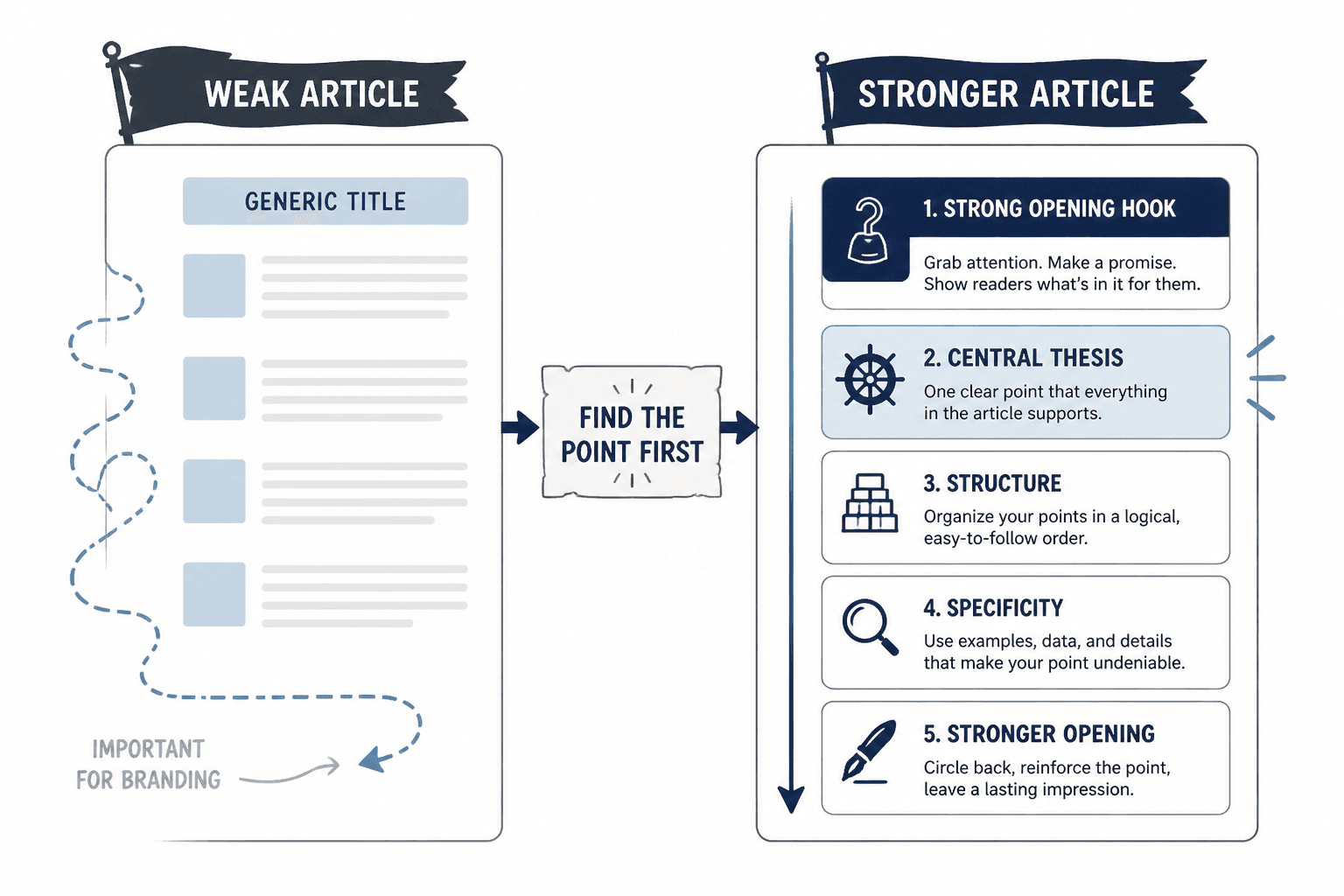
Start by finding the actual point
Before you rewrite a single sentence, figure out what the article is really trying to say.
This sounds basic. It is. And it is exactly where a lot of boring LinkedIn articles fall apart.
Writers often draft around a topic instead of making an argument. So the article becomes a tour of adjacent thoughts rather than a useful piece with a spine.
Ask these questions:
- What is the one thing this article should help the reader understand or do better?
- What is the common mistake or bad assumption behind this topic?
- What do I believe that weaker articles on this topic usually miss?
- What should the reader change after reading this?
If you cannot answer those clearly, the article is not ready to be polished. It needs a point first.
A boring article often has information. What it lacks is direction.
Here is a weak article idea:
“LinkedIn articles are important for professional branding.”
That is not a point. That is wallpaper.
Here is a better one:
“Most LinkedIn articles fail because they read like stretched-out posts. The fix is not more detail. It is more structure, more specificity, and a stronger opening.”
Now you have something to build around.
Cut the throat-clearing first
If you are rewriting a dull article, your first easy win is cutting the slow, polite, obvious opening.
LinkedIn writers love to spend 150 words warming up before they say anything remotely useful. They start with broad statements, generic context, and scene-setting nobody asked for. It feels safe. It also drains momentum immediately.
Here is the kind of opening that needs to go:
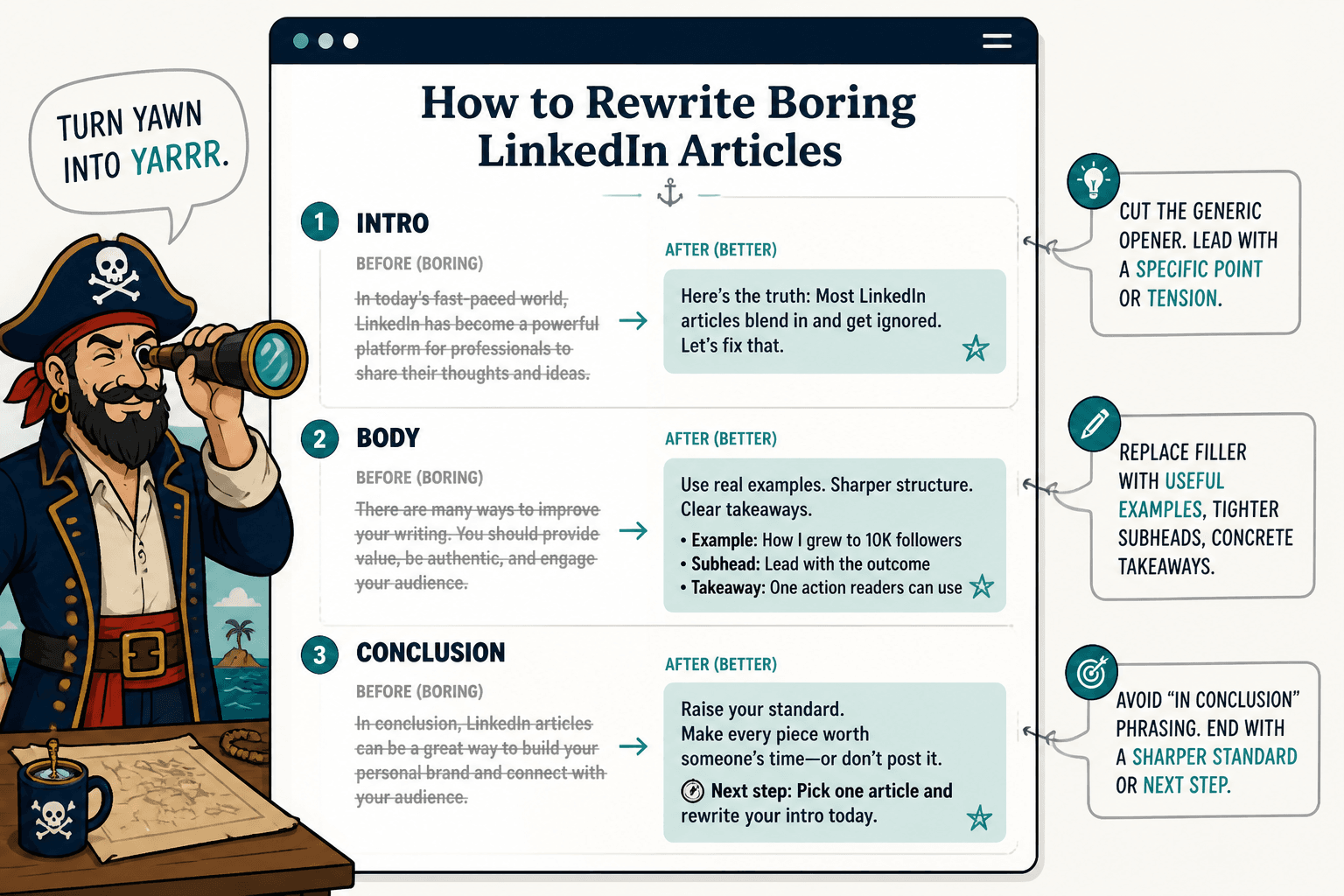
In today’s fast-paced professional environment, LinkedIn has become an essential platform for thought leadership, networking, and brand visibility. Writing articles on LinkedIn can be a powerful way to share your expertise and connect with your audience.
That opening says nothing with confidence. It is technically true and practically useless.
Rewrite it like this:
Most LinkedIn articles lose readers in the first minute because the opening is stuffed with generic context instead of a real point. If your article starts by announcing that LinkedIn matters, you are already behind.
Better. There is tension. There is a problem. There is a reason to continue.
If openings are a recurring weak spot, it would make sense to read how to start LinkedIn articles without a weak opening and how to improve LinkedIn article intros without sounding generic.
A simple cut test
Take the first 3 paragraphs of your article and ask:
- Can I delete this and lose nothing important?
- Does this sentence make a specific claim?
- Would my ideal reader care about this line right now?
- Is this context, or is it momentum?
If the opening is mostly context, cut harder.
Narrow the article until it can actually say something useful
A lot of LinkedIn articles are boring because they are trying to cover an entire continent of a topic.
“How to build your brand on LinkedIn” is too broad for one article unless you are comfortable producing vague mush. Broad topics tempt writers into list-heavy filler because they cannot possibly go deep on everything.
Rewriting often means reducing scope.
Instead of this:
- How to succeed with LinkedIn articles
Try this:
- How to write a stronger LinkedIn article intro
- How to structure LinkedIn articles so people keep reading
- How to rewrite boring LinkedIn articles that sound too corporate
- How to turn an old post into a useful LinkedIn article
Narrower articles are easier to rewrite because they force you to make choices. They also tend to perform better for authority because they feel more expert, more specific, and less inflated.
If your current draft feels foggy, there is a decent chance the real issue is not style. It is scope.
Replace vague claims with specifics, contrast, and proof
Nothing kills momentum faster than a parade of abstract claims.
Readers do not want to be told that authenticity matters, consistency matters, storytelling matters, value matters, and engagement matters. They have heard that sermon already. It is not helping.
When you rewrite, look for lines that sound professionally correct but mentally disposable.
Weak claim
“A strong article should provide value to the audience.”
Better rewrite
“A strong LinkedIn article should help the reader make one better decision, avoid one expensive mistake, or understand one useful idea more clearly by the end.”
See the difference? The second version gives shape to the idea. It is not just saying “be useful” in nicer shoes.
Three ways to make a sentence less boring:
- Add specificity: replace broad nouns with exact ones
- Add contrast: show what people usually do wrong versus what works better
- Add proof: use an example, observation, mini case, or rewrite
This is one reason before-and-after examples work so well in rewrite articles. They show the difference instead of politely describing it from a safe distance.
How to rewrite boring LinkedIn articles section by section
Do not try to “make it better” in one fuzzy pass. Rewrite by function.
That means treating the article like parts with jobs, not one giant slab of text. Each part should earn its place.
1. Rewrite the headline promise inside the intro
Even if the title is solid, the intro has to cash that promise quickly. The reader should know what problem you are solving and what kind of payoff they will get.
Bad intros meander. Good intros orient.
2. Rewrite each section so it has one job
Every section should do one of these things:
- Explain a problem
- Show a mistake
- Teach a method
- Give an example
- Offer a template or checklist
- Set up the next step
If one section tries to do all of them at once, it usually becomes mushy.
3. Rewrite generic paragraphs into usable guidance
If a paragraph could apply to almost any platform, any audience, and any topic, it is probably too generic for LinkedIn.
LinkedIn articles work best when they sound like they came from someone who understands professional attention, trust, expertise, and decision-making. Not someone churning out warmed-over content tips from 2019.
4. Rewrite conclusions so they actually land
Do not end with “in conclusion” energy. Give the reader a clean takeaway, a sharper standard, or a next step.
Weak ending:
By following these tips, you can improve your LinkedIn articles and create more value for your audience.
Stronger ending:
If your LinkedIn article feels dull, do not add more filler and call it depth. Cut the generic opening, sharpen the point, and give the reader something they can actually use before they scroll away and forget you exist.
Bit sharper. Much more memorable.
Before and after: boring article lines rewritten
Here are a few common LinkedIn article lines that need help, plus stronger rewrites.
| Before | After |
|---|---|
| LinkedIn articles are a great way to showcase your expertise. | LinkedIn articles work best when you have an idea worth developing, not when you are just stretching a post into a longer format. |
| It is important to know your audience. | If you are writing for everyone in your industry, the article will probably feel generic to everyone in your industry. |
| Consistency is key when creating content. | One sharp article a month is more useful than four padded ones nobody finishes. |
| Storytelling helps build connection. | A short, relevant story can make an article feel human. A dramatic life lesson taped onto a weak business point usually does the opposite. |
| You should provide actionable insights. | Give the reader something they can rewrite, test, cut, or improve today. “Be more authentic” is not an action. |
The pattern here is simple: stronger sentences make clearer claims, use contrast, and sound like someone with standards.
Keep the professional credibility, lose the corporate fog
Some people are scared to rewrite their LinkedIn articles in a sharper voice because they think “professional” means formal, neutral, and slightly lifeless.
It does not.
Professional writing is clear. It respects the reader’s time. It makes useful distinctions. It does not hide behind inflated phrasing.
That means you can cut things like:
- It is important to note that
- In order to effectively
- A wide range of different
- In the context of today’s business environment
- Leveraging LinkedIn articles for visibility
And replace them with normal language that still sounds smart.
The trick is not making the article casual for the sake of it. It is making it readable. There is a difference.
The bigger point is simple: clearer structure and clearer writing make the piece more useful. That is usually what makes the ending land better too.