
Most LinkedIn articles do not sound robotic because the writer used AI. They sound robotic because they were written like a cautious brochure for a business nobody trusts yet.
And the salesy part usually comes from the same place. The article is not actually trying to help. It is trying to “provide value” just long enough to steer the reader into a pitch. People can feel that. They may not say it out loud, but they feel it in the first few paragraphs and leave.
If you want to know how to write LinkedIn articles without sounding salesy or robotic, the fix is not to sprinkle in a few contractions and call it human. The fix is deeper than tone. You need better structure, better intent, sharper examples, and a point of view that does not read like it was approved by three nervous stakeholders and a webinar funnel from 2019.
This is about writing LinkedIn articles that sound like an expert with a brain, not a corporate pamphlet trying to hold eye contact. We’ll cover what makes articles feel stiff, how to make them more natural, how to teach without pitching too early, and how to end with a CTA that doesn’t smell like desperation.
To see how this fits into the wider strategy, open the parent guide.
Why so many LinkedIn articles sound fake in the first place
There are a few repeat offenders here, and they show up everywhere.
- The writer is trying to sound “professional,” so they strip out all rhythm, opinion, and specificity.
- The article is too broad, so every sentence becomes vague advice nobody can really use.
- The real goal is lead generation, so the article keeps nudging toward a pitch instead of building trust.
- The opening takes forever to say anything.
- The wording is polished to death and starts sounding like AI oatmeal.
LinkedIn articles are not the place for personality-free expertise. They are also not the place for fake warmth glued onto bland content. If your article says things like “businesses must adapt to the changing digital environment” then congratulations, you have written a sentence that could put a very alert person to sleep.
Good LinkedIn articles work because they go deeper than posts. They give the reader something more solid: a useful framework, a sharper argument, a clear explanation, a better way to think about a common problem. That depth is exactly why robotic writing stands out so badly here. The reader has more time to notice that nothing real is being said.
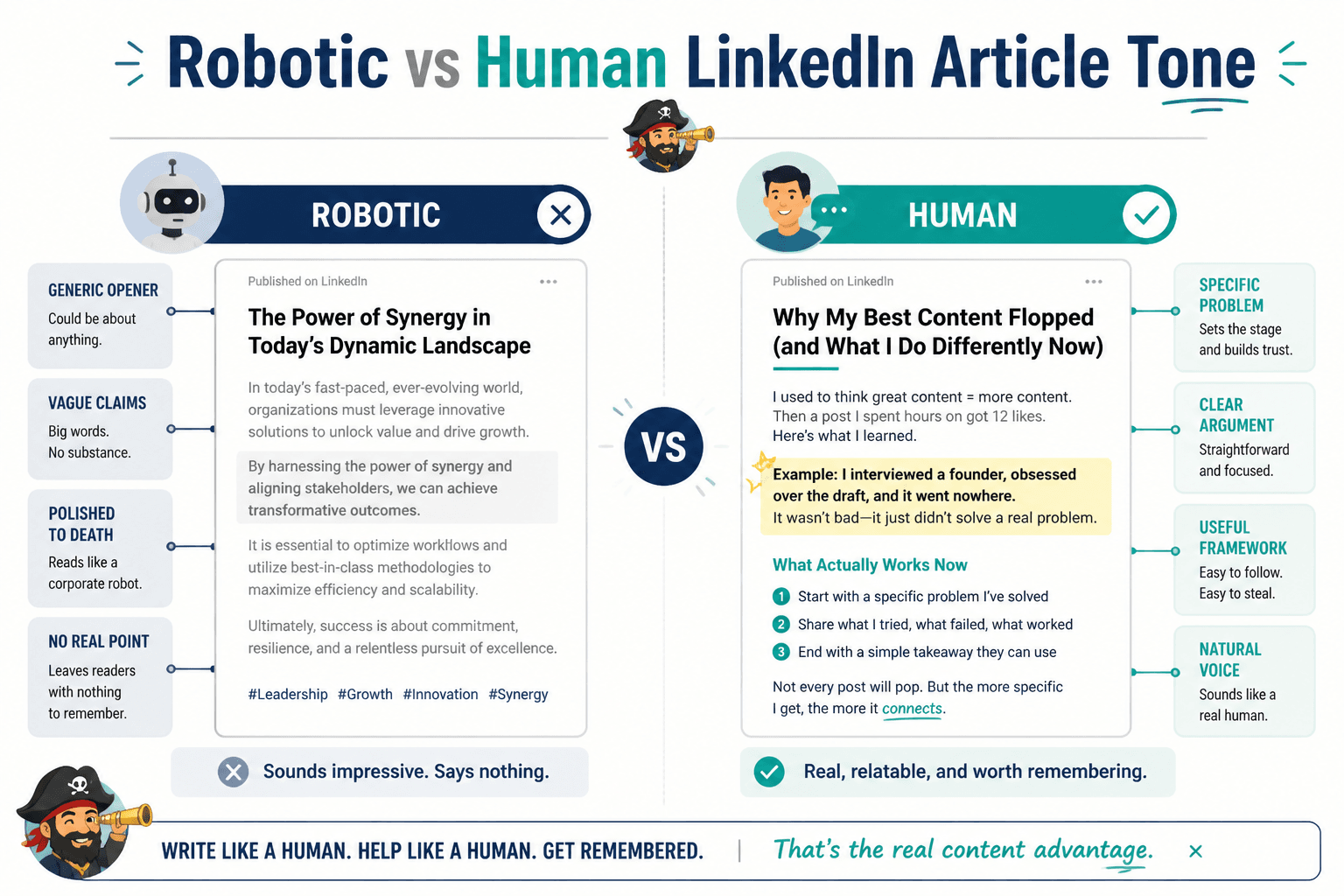
Start with a real problem, not a polished throat-clearing intro
Weak LinkedIn articles usually start by circling the airport.
“LinkedIn has become an important platform for professionals looking to build their brand and connect with their audience.”
That sentence is not wrong. It is just doing no work. Your reader already knows they are on LinkedIn. They clicked because they want help with a specific problem, not a ceremonial opening paragraph.
A stronger intro gets to the tension fast. It names the mistake, the frustration, or the gap between what people think works and what actually works.
Weak opening
Many professionals use LinkedIn articles to share thought leadership and create visibility in their industries.
Stronger opening
A lot of LinkedIn articles fail for a simple reason: they sound like they were written to impress a manager, not help a reader. So they end up polished, generic, and weirdly lifeless.
That second version has a pulse. It has tension. It gives the reader an immediate reason to continue.
If your intros are consistently weak, it’s worth reading how to improve LinkedIn article intros without sounding generic and how to start LinkedIn articles without a weak opening. The opening matters more than people admit, especially on a platform full of competent-sounding mush.
Pick one sharp idea instead of five safe ones
Another reason LinkedIn articles sound robotic is that they are trying to cover too much while offending nobody.
That usually creates a very specific kind of dead writing: broad statements, generic transitions, light advice, no examples, and a conclusion that says some version of “consistency is key.” Which is true, I guess. It is also the kind of truth that helps nobody by itself.
A better article usually does one of these things well:
- Explains one common mistake clearly
- Gives one useful framework the reader can apply
- Argues for one smarter approach
- Rewrites one bad habit with better examples
- Breaks one topic into a practical step-by-step process
Depth beats breadth here. If your article tries to cover hooks, storytelling, authority, sales funnels, profile optimization, mindset, and personal branding all at once, it’s going to sound thin and generic no matter how nice the wording is.
This is one reason tighter articles often outperform “ultimate guides” on LinkedIn. Readers are not always looking for a textbook. They want clarity. They want a useful angle. They want to leave with something they can actually change.
Write like you talk after you’ve edited yourself a little
No, this does not mean you should turn your article into a transcript of your voice notes. “Just write how you talk” is lazy advice. Most people talk in half-finished thoughts, loops, filler, and side quests.
But there is a useful version of that advice: write like a smart human explaining something they actually understand, then edit for clarity. That tends to produce writing with rhythm, texture, and intent. It also sounds much less robotic than content built from stiff business phrases.
Replace corporate language with plain English
| Robotic version | Better version |
| Leverage LinkedIn articles to enhance your professional visibility | Use LinkedIn articles to show how you think, not just that you exist |
| Provide value to your audience through actionable insights | Teach something useful people can actually apply |
| Establish trust and credibility in your niche | Give readers a reason to believe you know what you’re doing |
| Optimize your content strategy for engagement | Make the article easier to read and more worth sharing |
Plain English is not less intelligent. Usually it is more intelligent because it respects the reader’s time.
Use rhythm, not fluff
Human writing has movement. Some short sentences. Some longer ones. A little contrast. The occasional sharp line. Robotic writing tends to flatten everything into the same safe cadence.
That does not mean you need to force personality into every paragraph. It means you should stop sanding every sentence down until it becomes beige dust.
Teach first. Sell later. Preferably much later.
The easiest way to sound salesy is to write an article that keeps hinting at your offer before the reader has gotten anything useful.
You’ve seen this version before. The article opens on a broad pain point, gives three shallow tips, then lands on “if you want help implementing this in your business, book a call.” That is not content. That is a stretched-out pitch wearing a fake mustache.
A better LinkedIn article gives away enough substance that the reader trusts your thinking before they ever reach the CTA. That does not mean dumping everything you know into the piece. It means solving part of the problem for real.
What useful teaching looks like
- Explain why the common approach fails
- Show what to do instead
- Give an example, rewrite, or mini framework
- Make the advice specific enough to use today
- Leave the reader smarter even if they never buy anything
That last part matters. If your article only makes sense as a teaser for your service, readers will feel the withholding. And withholding is one of the fastest routes to salesy writing.
There is nothing wrong with wanting leads from content. Of course you do. But content that earns leads usually does it indirectly. The article builds trust. The profile supports that trust. The next step is clear but not pushy. That is a much healthier system than trying to force the sale from paragraph six.
Use examples so the article sounds lived-in, not generated
Specificity is one of the easiest ways to make writing feel human.
Generic advice feels robotic because it could have been assembled from ten other articles saying the same thing. Specific examples feel credible because they show you understand what bad content actually looks like in the wild.
Generic advice
Use a compelling introduction and provide actionable insights throughout the article.
More useful advice
Do not spend your first paragraph explaining that LinkedIn matters. Start with the problem your reader is dealing with, like why their articles sound polished but forgettable, or why every article keeps drifting into a soft sales pitch by the middle.
See the difference? The second one sounds like it came from someone who has read bad LinkedIn articles and knows exactly where they go wrong.
Examples also make it easier to introduce opinion without sounding dramatic. You are not just declaring that something is bad. You are showing the reader what it looks like and why it fails.
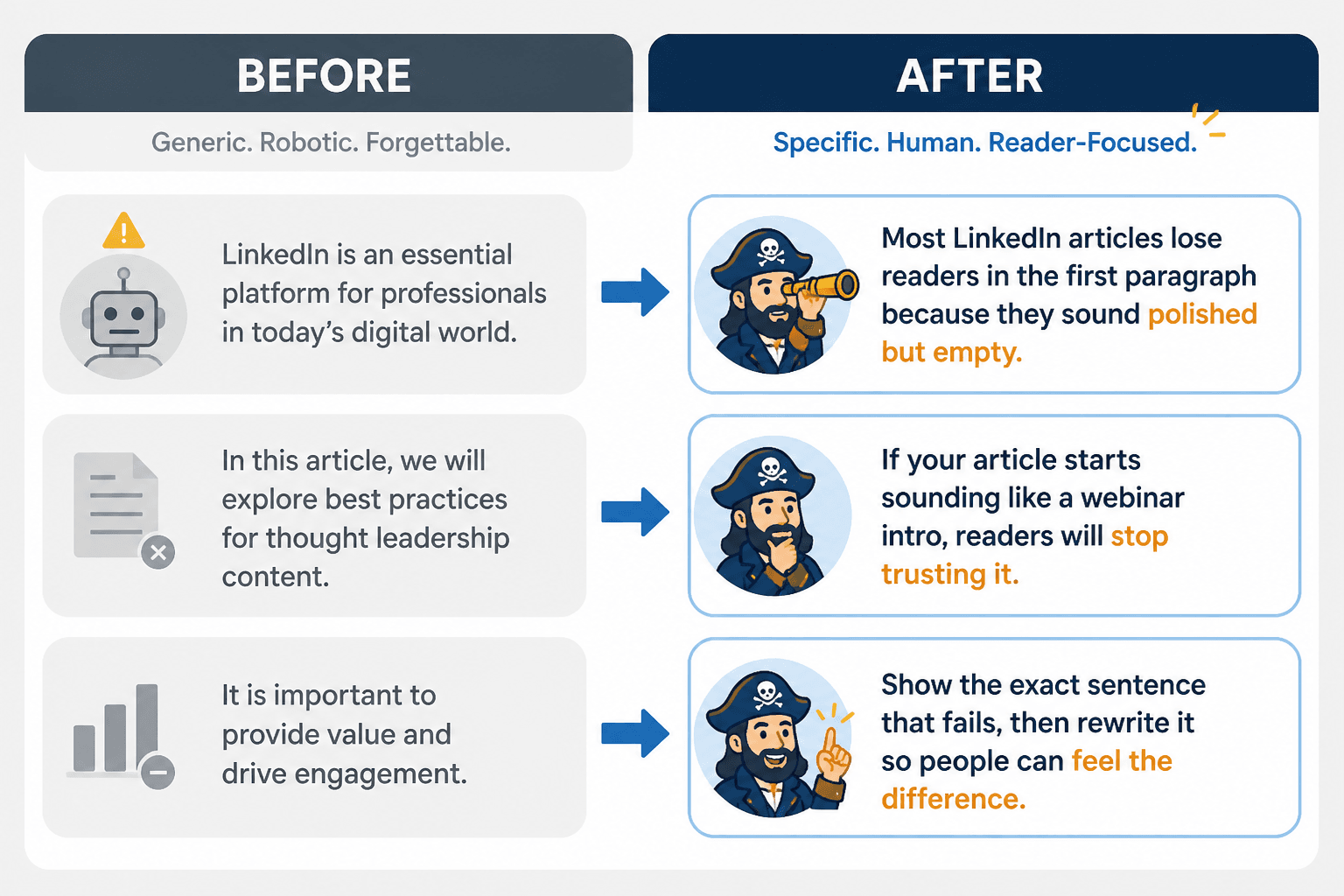
Cut the phrases that instantly make your article sound synthetic
Some phrases are not technically wrong. They are just exhausted. They have been used so often in low-substance business content that they now trigger suspicion.
Watch out for lines like these:
- In today’s fast-paced digital world
- Thought leadership
- Unlock your potential
- Drive meaningful engagement
- Leverage synergies
- As we navigate an ever-changing landscape
- It is important to note that
- Whether you are a beginner or a seasoned professional
None of these phrases make your article clearer. Most of them make it worse. They read like filler because they are filler.
When editing, look for any sentence that could appear unchanged in a generic company blog. That is usually your cue to rewrite it with more specificity, more tension, or more plainspoken language.
Structure your LinkedIn article like a clear argument
Good LinkedIn articles are not just longer posts. They need shape.
A solid structure helps the article feel more natural because the reader can follow your thinking without getting lost in rambling transitions or repetitive tips.
A simple structure that works
- Open with the real problem. Name the mistake or frustration quickly.
- Explain why it happens. Give context, not waffle.
- Break down what to do instead. Use clear sections.
- Add examples or rewrites. This is where trust gets built.
- End with a clean next step. No hard pivot into an infomercial.
If your article tends to ramble, this is where to fix it. Before drafting, write the subheads first. If the subheads already feel repetitive or vague, the article probably will too.
For broader help on article structure and quality, see how to write better LinkedIn articles and the main LinkedIn articles hub. If your draft already exists but feels flat, how to rewrite boring LinkedIn articles will save you from publishing another polished yawn.
Use a CTA that fits the article instead of hijacking it
You do not need to avoid CTAs. You need to stop using CTAs that sound like they were copied from a sales playbook with a ring light.
If your article was genuinely useful, your CTA can be simple. Calm, even. The best ones feel like a logical next step, not a trap door into your funnel.
Weak CTA
If you are ready to transform your LinkedIn content strategy and unlock greater visibility, book a free discovery call today.
Better CTA options
- If your LinkedIn articles are informative but still feel stiff, start by rewriting your intro and subheads. That usually fixes more than people expect.
- If you want more help with article structure, check the rest of our LinkedIn article guides.
- If your drafts sound polished but forgettable, review them line by line and cut every sentence that says nothing specific.
The bigger point is simple: clearer structure and clearer writing make the piece more useful. That is usually what makes the ending land better too.