
Most boring creator email sequences do not fail because the writer is untalented. They fail because the emails are too safe, too vague, too padded, and too obviously “part of a sequence.” You can feel the automation on them. They read like they were assembled in a funnel basement by someone who thinks personality is a conversion risk.
That is usually the real problem. Not email frequency. Not some mystical subject line hack. Not the exact number of emails. The problem is that the sequence says things the reader has seen 500 times before, in a voice they do not trust, with no real tension, proof, or payoff.
If you want to learn how to rewrite boring creator email sequences, the job is not to make them louder. It is to make them sharper. More specific. More human. More useful. Less “nurture sequence,” more “this person actually has a brain and might be worth paying attention to.”
Here’s how to do that without turning your emails into theatrical copywriting cosplay.
For the full path around this topic, head to the parent guide.
Why creator email sequences get boring so fast
A boring sequence usually comes from one of five problems:
- The emails are written around a funnel structure instead of a real idea
- The writer is trying to sound professional, which often means sanding off every interesting edge
- Every email is doing the same job
- There is no specificity, proof, or actual point of view
- The sequence keeps hinting at value instead of delivering any
This is why so many welcome, nurture, and sales-adjacent sequences blur together. Email one says thanks for joining. Email two shares a lesson. Email three tells a personal story with suspiciously tidy symbolism. Email four says “by the way, I help people with this.” Riveting stuff.
The sequence may be technically “there,” but the reader experiences it as beige wallpaper with buttons.
If your sequence feels flat, do not ask, “How do I make this more engaging?” That question is usually too fuzzy to help. Ask better questions:
- What is this email actually trying to make the reader think, feel, understand, or do?
- What part sounds generic enough to belong to anyone?
- Where am I talking around the point instead of making it?
- What would make this useful even if the reader never buys?
- Where am I hiding my strongest thought because I’m trying to sound polished?
How to rewrite boring creator email sequences: the practical process
Do not rewrite by fiddling with adjectives and hoping the vibe improves. Rewrite structurally. The fastest way to fix a dull sequence is to work through each email in this order.
1. Find the real job of each email
One major cause of boring email sequences is that every email is trying to “build trust” in the same mushy way. That is too vague. Each email needs a cleaner role.
For example, one email might challenge a bad assumption. Another might explain your method. Another might show proof. Another might answer an objection. Another might move the reader to a next step. Different jobs create different energy.
| Email type | Weak purpose | Stronger purpose |
|---|---|---|
| Welcome email | Introduce yourself | Set expectations and give the reader a reason to keep opening |
| Lesson email | Share value | Help the reader avoid one expensive mistake |
| Story email | Be relatable | Make a point memorable through tension and payoff |
| Proof email | Show credibility | Reduce doubt with evidence, outcomes, or concrete examples |
| Offer email | Pitch your service | Connect the reader’s problem to a clear next step |
If you cannot describe an email’s job in one sentence, it is probably trying to do too much or nothing at all.
2. Cut the throat-clearing
Most weak sequence emails take too long to get to the point. They start with soft filler like:
- Hope you’re having a great week
- I wanted to share something that has been on my mind lately
- As I was reflecting on my journey
- Today I want to talk about
- One thing I have learned over the years is
That is not warm. It is delay.
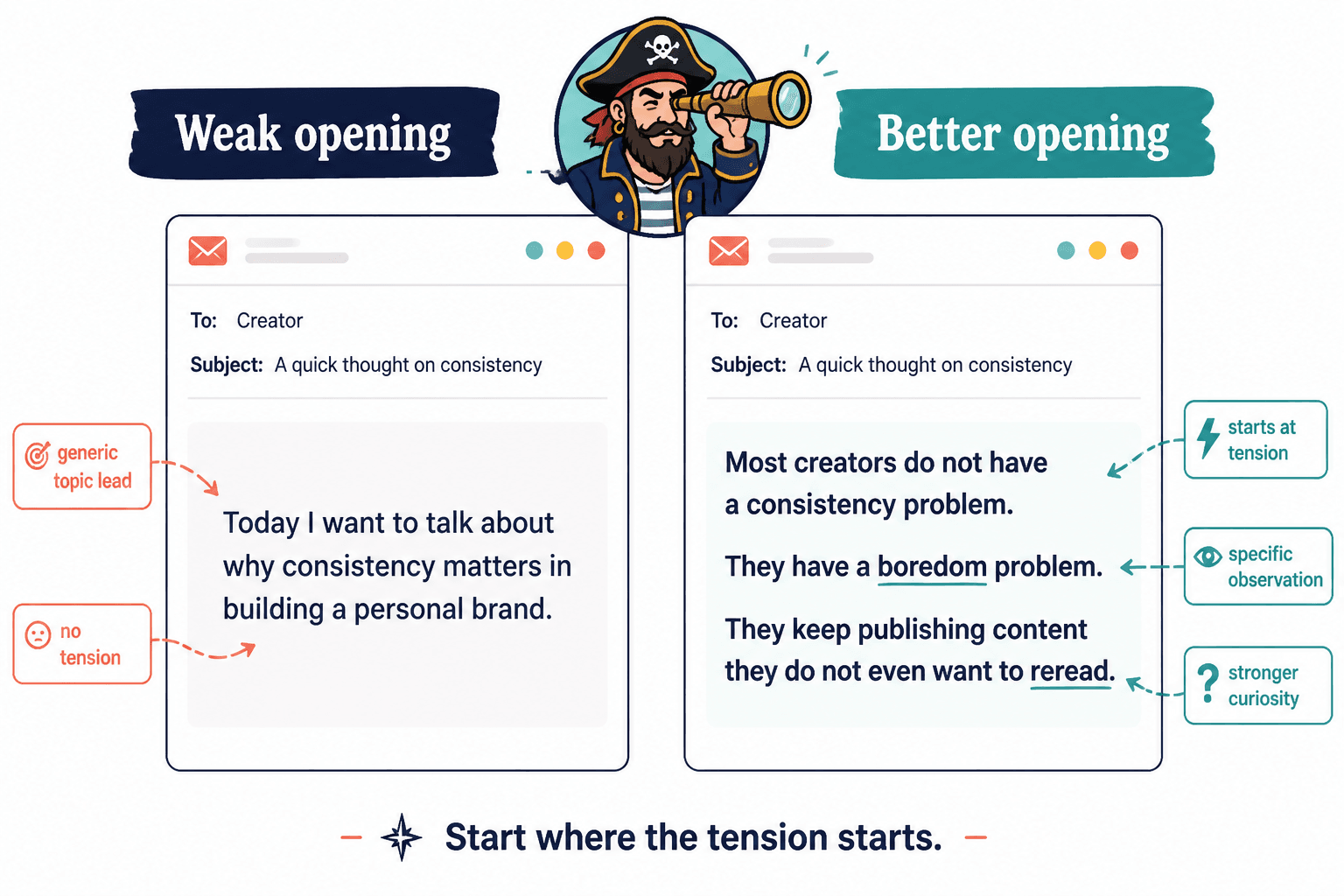
Your reader does not need a runway. They need a reason to keep reading. Start where the tension starts.
Weak: “Today I want to talk about why consistency matters in building a personal brand.”
Better: “Most creators do not have a consistency problem. They have a boredom problem. They keep publishing content they do not even want to reread.”
That single shift changes everything. Now the email has a pulse.
If you need help fixing weak starts specifically, it is worth reading how to start creator email sequences without a weak opening. Bad openings drag down the whole sequence faster than people realize.
3. Replace vague claims with specific observations
Generic writing sounds boring because it gives the reader nothing solid to grab onto. “Be authentic.” “Build trust.” “Show up consistently.” Fine. And?
Specificity is where authority starts to sound real. Not because it is more complicated, but because it is more concrete.
Vague: “A strong email sequence builds trust over time.”
Specific: “A strong email sequence gives readers a few quick wins, shows them how you think, and makes your offer feel like the logical next step instead of a trap door.”
One of those sounds like a recycled blog sentence. The other sounds like someone who has watched sequences succeed and fail in the wild.
As you rewrite, underline every sentence that could fit into almost any creator’s email sequence. Then rewrite those lines until they could only come from you, your audience, your method, or your point of view.
4. Add tension, contrast, or stakes
Boring emails often explain things flatly. They state information without contrast. But readers pay attention when there is a gap, a mistake, a misconception, a cost, or a friction point.
You do not need fake drama. You need shape.
- What do people think works here that actually does not?
- What are they wasting time on?
- What is the hidden downside of doing this badly?
- What truth are they avoiding because the generic version sounds nicer?
Example:
Flat: “Your welcome sequence is important because it introduces new subscribers to your brand.”
Sharper: “If your welcome sequence reads like a polite brochure, do not be surprised when subscribers treat you like background noise.”
You are still teaching the same thing. You are just giving the idea some spine.
5. Make each email earn its spot
Many creator email sequences are boring because they include emails that do not need to exist. If two emails make the same point, combine them. If one email just warms up for the next one, cut it or strengthen it. Readers do not care that your template said seven emails. They care whether email four was worth opening.
A tighter sequence usually performs better because every message carries more weight. Not always shorter overall, but cleaner. More distinct. More deliberate.
This matters even more in lesson-based sequences. If every lesson sounds like a slightly different version of “be clear and consistent,” your reader is not being nurtured. They are being gently bored into apathy. If that sounds familiar, this piece on creator email sequences lesson sequence mistakes that hurt performance will help you diagnose the usual mess.
A simple rewrite framework for each email
When you sit down to revise a sequence, use this quick framework. It keeps you from fiddling around at sentence level while missing the real issue.
- State the point in one line. What is this email actually saying?
- Identify the weak section. Usually the intro, the middle drift, or the vague close.
- Add one specific insight. A mistake, distinction, example, observation, or proof point.
- Cut one generic paragraph. Be ruthless here. Most emails have one paragraph that contributes nothing.
- Strengthen the close. End with a clear takeaway, question, or next step.
That process sounds simple because it is. It is also more effective than endlessly “optimizing” wording while the actual email remains bland.
Before-and-after rewrites: what boring usually looks like
Let’s make this less abstract. Here are a few common boring-email patterns and how to rewrite them.
Example 1: the empty welcome email
Before:
Hi and welcome.
Thanks for joining my newsletter. I’m so excited to have you here. Over the next few days I’ll be sharing tips, insights, and strategies to help you grow your creator business.
Stay tuned for more.
Best,
Name
This says almost nothing. It is polite wallpaper.
After:
You did not join this list for “tips and insights,” so let’s skip the ceremonial newsletter welcome.
Here is what you can expect from me: practical emails on content, positioning, and creator systems that help you earn more trust and waste less time sounding like everyone else.
I care a lot more about useful ideas than polished fluff. So some emails will be short, some will be pointed, and a few may step on the toes of popular creator advice that deserves it.
First useful thing: if your content gets polite engagement but weak leads, the problem usually is not volume. It is the bridge between attention and action.
I’ll show you how to fix that in the next email.
Now the reader knows what kind of voice to expect, what the emails are about, and why the next one is worth opening.
Example 2: the bland lesson email
Before:
Consistency is key as a creator. If you want to build trust with your audience, you need to post regularly and keep showing up. Over time, this compounds and leads to better results.
Yes, technically true. Also painfully forgettable.
After:
Creators love to say “be consistent,” which is convenient advice because it sounds wise and explains nothing.
Consistency is not just posting regularly. It is making your audience recognize your thinking fast.
If your posts, emails, and offers all sound like they came from different people, frequency will not save you. You are not building familiarity. You are producing random acts of content.
A better question than “How often should I send?” is “Would someone know this was from me without checking the name?”
That is the kind of consistency that compounds.
Same broad topic. Much stronger execution.
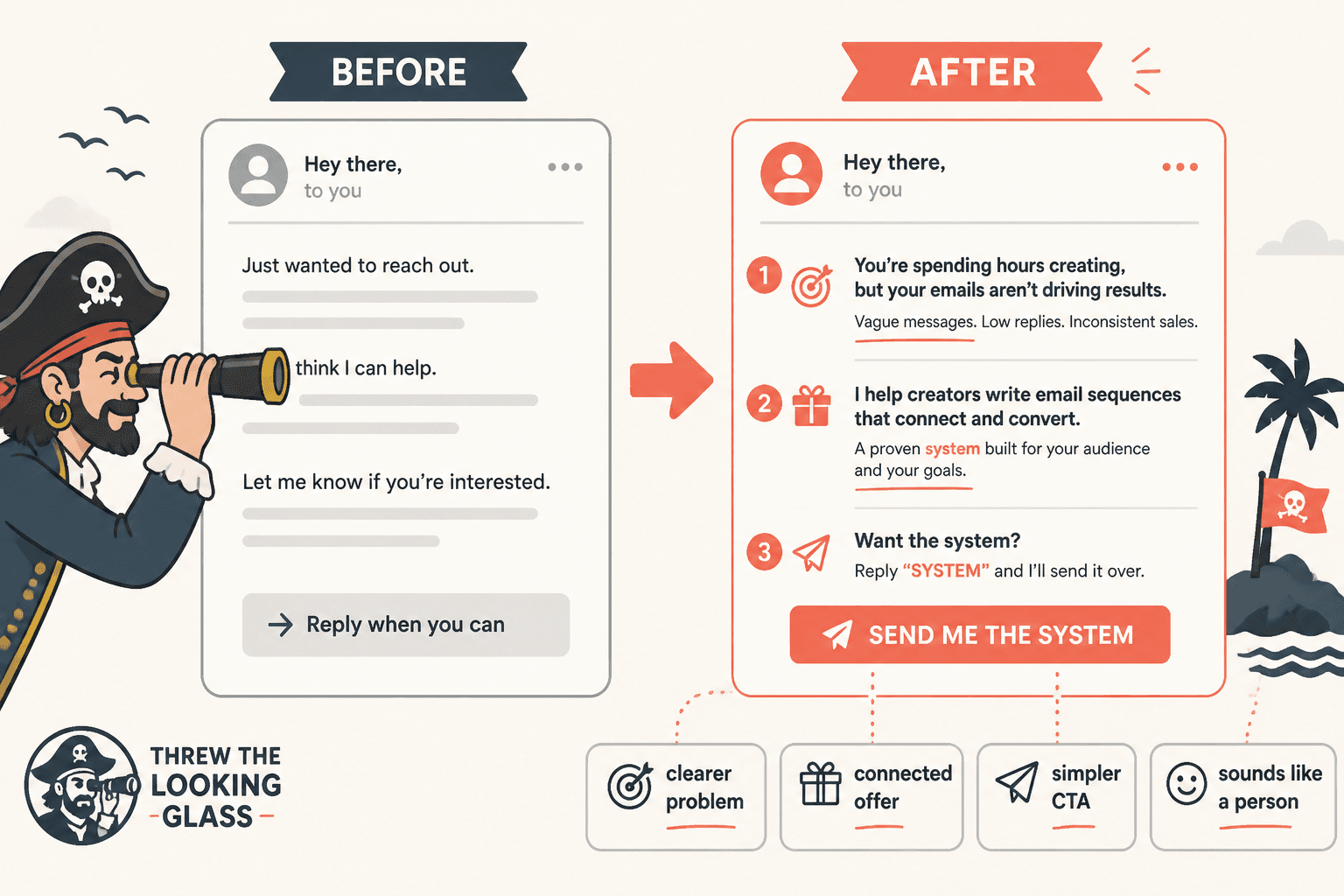
Example 3: the awkward soft pitch
Before:
If you are struggling with your content strategy and would like support, I do offer coaching and consulting services for creators who want to grow their brand. Feel free to reach out if you would like to learn more.
This is timid, vague, and easy to ignore.
After:
If your content is decent but your emails, profile, and offer are not working together, that usually creates a very specific problem: attention with no movement.
That is the kind of thing I help creators fix.
If you want a sharper content-to-client system instead of another month of posting into the void, reply with system and I’ll send details on how I work.
Notice what changed:
- The problem is clearer
- The offer is connected to that problem
- The CTA is simpler
- The language sounds more like a person and less like a brochure
What to add when an email feels flat
If an email is technically fine but still boring, it usually needs one of these ingredients.
- A sharper opinion: say what is overrated, misunderstood, or done badly
- A concrete example: show what you mean instead of describing it abstractly
- A useful distinction: explain the difference between two things people confuse
- A small proof point: a result, pattern, client observation, or repeat mistake
- A stronger sentence: one line with actual energy can wake up a sleepy draft
For creators especially, this matters because your emails are not just delivering information. They are teaching readers how you think. Bland sequences make you look interchangeable. Sharp sequences make you look chosen on purpose.
This does not mean every email needs to be full of hot takes and dramatic pronouncements. Calm, useful writing works beautifully. But calm is not the same as lifeless. Practical is not the same as generic. There is a difference between sounding clear and sounding pre-approved by committee.
How to rewrite the sequence, not just the emails
Sometimes the problem is not one weak email. It is the whole sequence arc.
A stronger creator email sequence usually has movement. The reader should feel like they are being led somewhere intentionally, not just receiving disconnected content nuggets in a branded bucket.
A simple arc might look like this:
- Set expectations and position your voice
- Challenge a common mistake
- Teach a practical framework or distinction
- Show proof or a real example
- Connect the problem to your offer or next step
That shape creates momentum. It also keeps you from sending four versions of the same lesson in slightly different clothes.
If your sequence needs a broader overhaul, spend some time with the main creator email sequences hub and the related email newsletter writing category. They are useful for mapping the system around the sequence, not just polishing individual emails.
And if the issue is that your sequence feels generic rather than strictly boring, this guide on how to improve creator email sequences nurture emails without sounding generic is the next logical read.
A quick checklist for rewriting boring creator email sequences
The bigger point is simple: clearer structure and clearer writing make the piece more useful. That is usually what makes the ending land better too.
Email sequences work better when each message has one clear role and the progression feels natural. Better sequencing usually beats more aggressive copy.