Most creator lesson sequences do not fail because email is dead, the market is crowded, or your audience has the attention span of a startled pigeon.
They fail because the sequence is badly built.
Some are too vague. Some teach too much too fast. Some sound like a webinar funnel wearing a fake mustache. And a lot of them confuse “sending multiple emails” with “guiding someone toward a result.” Those are not the same thing.
If you are creating a lesson-based email sequence to onboard subscribers, warm up leads, teach a framework, or move people toward an offer, the structure matters more than most people think. A decent idea can underperform badly when the sequence has no pacing, no payoff, and no reason for the reader to keep going.
This is what to fix. We’ll go through the most common creator lesson sequence mistakes that hurt performance, why they tank open rates, clicks, trust, and conversions, and what to do instead so your emails actually earn the next read.
If you want broader context first, it helps to understand how email newsletter writing fits into stronger creator email systems and more intentional creator email sequences.
If you want the bigger picture, start with the parent guide.
What a lesson sequence is actually supposed to do
A lesson sequence is not just a stack of educational emails.
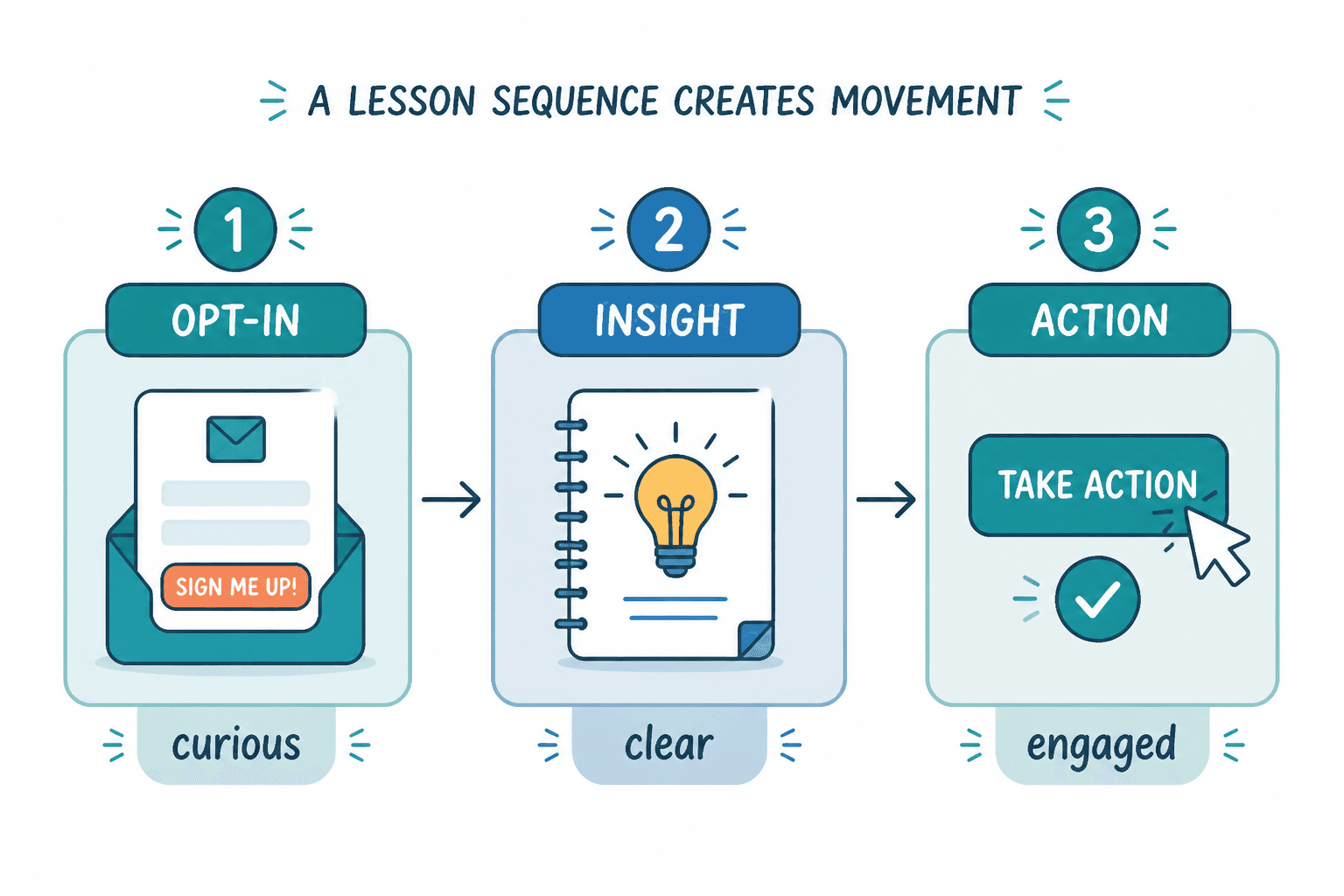
It is a guided progression. Each email should help the reader understand something, apply something, believe something, or want something they did not fully see before. Good lesson sequences create movement. Bad ones just create inbox wallpaper.
That movement might look like this:
- From confused to clear
- From curious to convinced
- From passive reader to engaged subscriber
- From problem-aware to solution-aware
- From “this is interesting” to “I want help with this”
If your sequence is not moving the reader anywhere, it is probably just a content pile. Useful, maybe. Effective, not necessarily.
Creator lesson sequence mistakes that hurt performance
1. Teaching random tips instead of one clear transformation
This is one of the biggest problems.
A creator builds a 5-email sequence and each email contains a decent tip. One is about hooks. One is about consistency. One is about mindset. One is about batching. One is about confidence. Nothing is technically wrong, but the sequence feels like a junk drawer.
The reader cannot tell what they are meant to get out of it as a whole. So they stop caring.
A stronger sequence has one central promise. Not ten. One.
For example:
- Help new subscribers write sharper LinkedIn posts in 5 days
- Help coaches fix weak profile copy in 4 lessons
- Help creators build a simple nurture funnel that does not feel slimy
Each email can cover a different part of that journey, but the destination should be obvious.
If your sequence could be rearranged in any order without anyone noticing, it probably is not a sequence. It is a pile.
2. Starting too broad and taking forever to get useful
Many lesson sequences begin with throat-clearing.
The first email says why the topic matters. The second says the creator’s philosophy. The third hints at a framework. By the fourth, the reader still has not gotten anything they can use.
That is a fast way to lose attention.
Your first lesson should give the reader a small win, a sharper distinction, or a useful reframe almost immediately. Not because every email needs to be packed with hacks, but because readers need proof that opening the next message will be worth it.
Good lesson sequences build credibility by being helpful early, not by warming up for three emails like a motivational speaker who missed their slot.
3. Making every email feel complete instead of connected
This one sounds backwards, but stay with me.
Each email should deliver value on its own. But if every email feels totally self-contained, with no connection to the bigger arc, the sequence loses momentum. Readers do not feel any pull toward the next lesson because nothing is unfolding.
You want each email to do two things at once:
- Deliver something useful now
- Create appetite for what comes next
That can be done with a natural bridge at the end:
- “Tomorrow I’ll show you why this breaks down when the audience is wrong.”
- “Next email, I’ll give you the template version so you can apply this faster.”
- “This works well until you hit the trust problem. That’s what the next lesson fixes.”
Small connective tissue matters. It gives the sequence shape.
4. Trying to teach everything you know
Creators often overstuff lesson sequences because they want to be generous. Admirable impulse. Bad execution.
When an email tries to teach six sub-points, three frameworks, two examples, and a partridge in a lead magnet, the reader gets tired. Educational overload does not feel premium. It feels heavy.
A lesson sequence should not try to replace your whole body of work. It should create clarity, momentum, and trust.
Pick the minimum effective lesson for each email. One strong idea with one example will usually outperform a rambling essay full of “bonus value.”
If your sequence is bloated, this is where rewriting boring creator email sequences becomes less about polishing lines and more about cutting what never needed to be there.
5. Writing educational emails with no emotional tension
Purely informative sequences tend to underperform because information alone is rarely enough to keep people reading.
Readers need tension. Not fake drama. Not manipulative urgency. Just a reason to care.
Tension can come from contrast:
- What most people do versus what works better
- What looks smart versus what gets results
- Why a common assumption quietly hurts performance
- What happens when a mistake goes uncorrected
For example, compare these two lesson openings:
- “Today we’re talking about welcome email strategy.”
- “Most welcome sequences lose good subscribers in the first two emails, usually because they are trying too hard to impress and not hard enough to help.”
Same topic. Very different grip.
6. Hiding the point under polished but generic copy
There is a certain kind of email that sounds smooth, professional, and completely forgettable.
It says things like:
- “I’m passionate about helping creators thrive”
- “Success comes from alignment and strategy”
- “Small changes can lead to big results”
None of this is technically offensive. It is just empty calories.
Lesson sequences need specificity. The reader should be able to tell what you mean, who it is for, and why it matters now. If your lesson could apply equally well to creators, dentists, SaaS founders, and a medium-sized candle company, it is too vague.
This is also why generic nurture copy tends to drag. If you want your educational emails to feel more human and more persuasive without becoming cheesy, read how to improve creator email sequences nurture emails without sounding generic.
7. Using weak subject lines that do not earn the open
You can write a brilliant lesson email that nobody reads because the subject line sounds like internal training material from a company that still uses “synergy” with a straight face.
Weak lesson sequence subject lines tend to be:
- Too formal
- Too vague
- Too similar to each other
- So clear they become dull
- So clever they become confusing
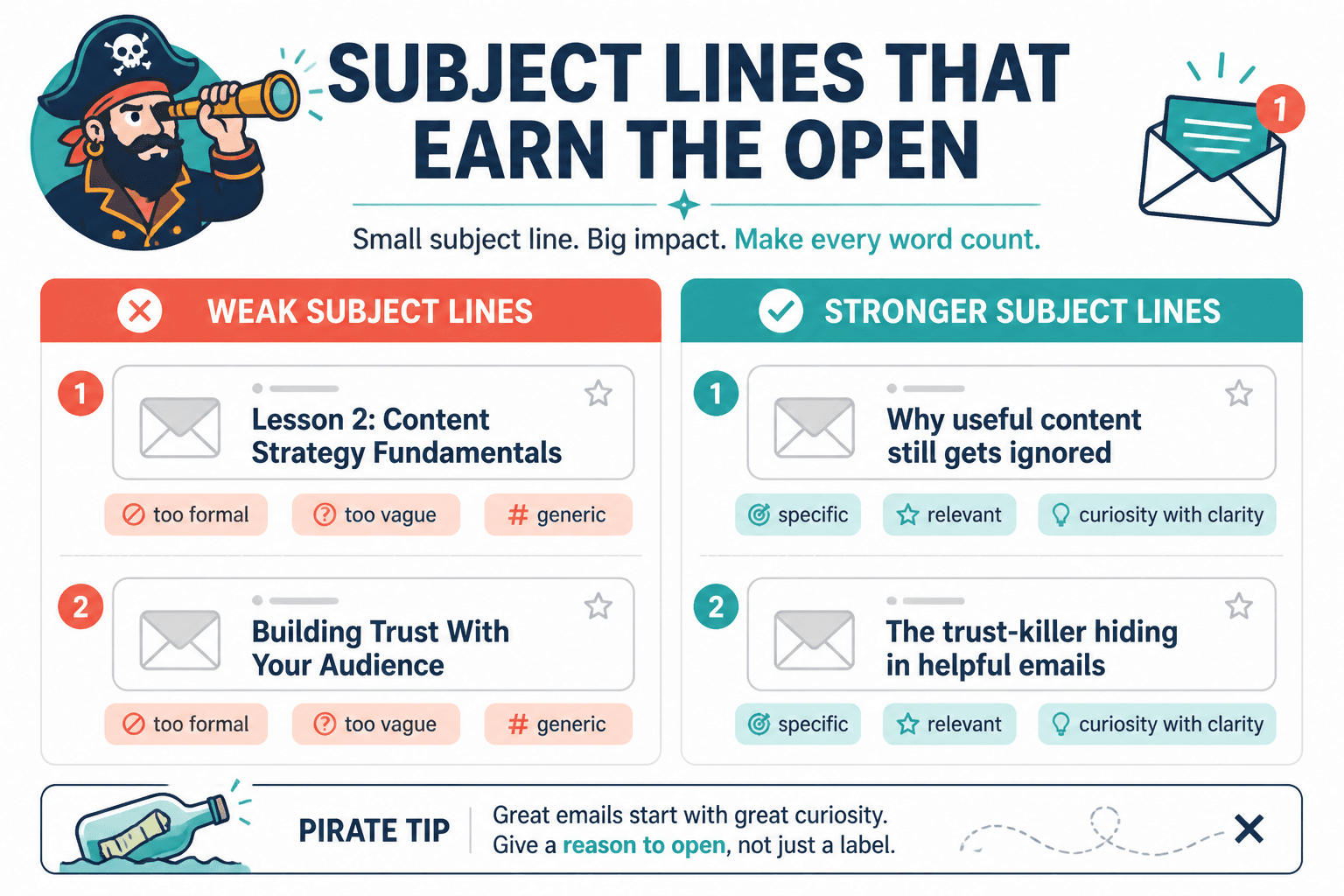
Compare these:
- Weak: “Lesson 2: Content Strategy Fundamentals”
- Better: “Why useful content still gets ignored”
- Weak: “Building Trust With Your Audience”
- Better: “The trust-killer hiding in ‘helpful’ emails”
You do not need clickbait. You need a subject line that makes the lesson feel relevant and concrete.
8. Teaching without proving anything
Advice lands harder when it is grounded.
If your sequence only states opinions without examples, readers may agree in theory but never fully trust the lesson. Proof does not have to mean giant case studies or screenshots every time. It can be much simpler.
Useful proof inside a lesson sequence can include:
- A before-and-after rewrite
- A short client pattern you have seen repeatedly
- A concrete bad example and a stronger version
- A quick explanation of why a change improves reader response
- A brief scenario that shows the lesson in action
Teaching gets stronger when the reader can see the point, not just hear it.
9. Dropping the offer in like it came from another planet
A lot of lesson sequences teach for a few days and then suddenly lurch into a hard pitch that feels wildly out of character.
That usually happens because the sequence was built in two disconnected halves:
- The “value” part
- The “now buy my thing” part
But a strong creator lesson sequence should naturally set up the offer. The lessons should reveal the problem, deepen the desire for the outcome, and clarify where DIY ends and support becomes useful.
Then the offer feels like the next logical step, not an ambush.
For example:
- Lesson 1: Diagnose the problem
- Lesson 2: Show a better framework
- Lesson 3: Help the reader apply part of it
- Lesson 4: Expose what makes full execution harder alone
- Lesson 5: Offer the shortcut, service, course, or system
That is a sequence. Not a bait-and-switch.
10. Ending lessons with dead, limp CTAs
The classic weak ending is something like:
Hope this helped.
It probably did not help enough if that is all we are working with.
Your CTA does not need to push a sale in every email. But it should do something. It can direct attention, prompt a reply, move the reader to the next lesson, or point to a resource or offer that fits.
Stronger lesson email CTAs might:
- Ask the reader to reply with the mistake they see most in their own work
- Point them to a related article or example bank
- Invite them to test a template before the next email
- Bridge clearly into the next lesson
- Offer a relevant next step for people who want help
Useful endings create motion. Weak endings just trail off politely.
11. Ignoring pacing and sending timing that fights the sequence
A lesson sequence has rhythm. If the timing is off, the whole thing feels awkward.
Send too slowly and readers forget the setup. Send too aggressively and the sequence feels like inbox harassment, especially if each lesson is dense.
There is no magic schedule, but the timing should match the complexity and intent of the sequence.
The bigger point is simple: clearer structure and clearer writing make the piece more useful. That is usually what makes the ending land better too.