
Most sales emails do not fail because the offer is terrible. They fail because the sequence is a mess.
One email vaguely announces something. The next one repeats it louder. Then there is a “just checking in” note nobody asked for, followed by a last-minute discount tossed in like a panic grenade. Busy creators do this all the time because they are busy, not because they are clueless. They are building the plane while emailing from the wing.
If you want Simple Sales Email Arc Templates for Busy Creators, the real goal is not to sound more “salesy.” It is to create a sequence with shape. A clear beginning, middle, and end. A sequence that earns attention, builds desire, handles friction, and gives people a reason to act before you vanish into the next project.
This article will give you simple sales email arcs you can actually use, adapt, and send without turning your week into a copywriting retreat. If you are still piecing together your broader email newsletter writing approach, or you need a bigger picture system for creator email sequences, this will fit neatly into that stack.
For the full path around this topic, head to the parent guide.
What a sales email arc actually is
A sales email arc is the progression of ideas across a sequence. Not just a pile of emails. Not “email 1, email 2, email 3” because a marketing blog told you to send five.
An arc gives each email a job.
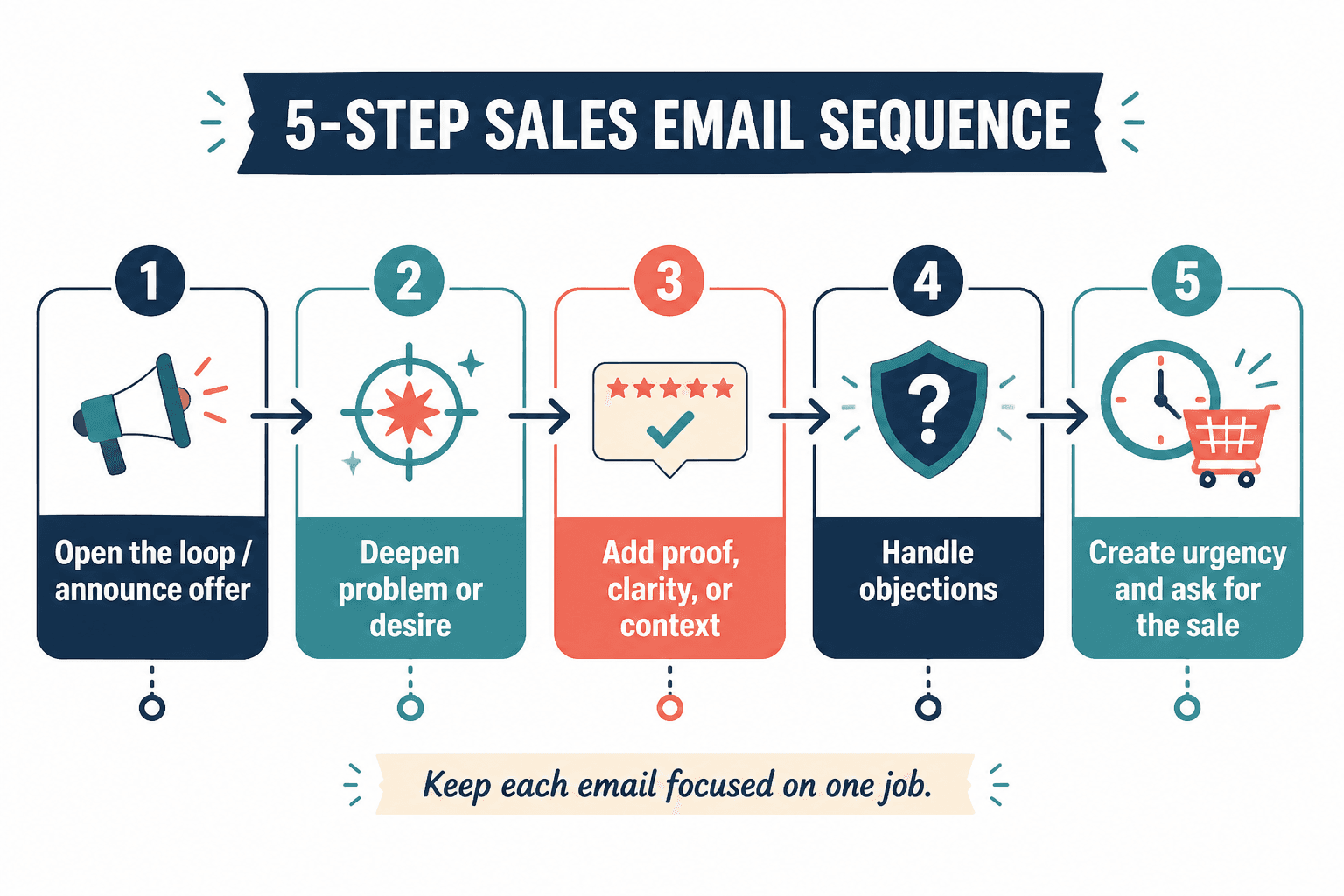
- Email 1 opens the loop and frames the offer.
- Email 2 deepens the problem or desire.
- Email 3 adds proof, clarity, or context.
- Email 4 handles objections.
- Email 5 creates urgency and asks for the sale clearly.
That is the basic shape. You can make it shorter, longer, softer, sharper. But if every email says the same thing in slightly different pajamas, performance usually drops off fast.
Creators often overcomplicate this part because email feels important. Fair enough. But for most offers, you do not need a cinematic ten-part funnel with thirteen audience branches and a post-purchase logic tree that looks like a subway map. You need a clean sequence that respects attention and moves people forward.
Why simple sales email arcs work better for busy creators
Simple sequences are easier to finish, easier to improve, and harder to ruin with fluff.
That matters because most busy creators are not suffering from a lack of email ideas. They are suffering from too many half-finished ideas and not enough time to turn them into something coherent. A simple arc forces you to focus on the few messages that actually move a sale:
- What this is
- Who it is for
- Why it matters now
- Why they should trust it
- What might stop them
- What to do next
That is usually enough. More emails can help when the offer is expensive, complex, or unfamiliar. But more emails can also just create more room for rambling. And creators are very talented at rambling when they care deeply about their work.
If the sequence is simple enough to send, it is simple enough to improve. That is a much better place to start than a “perfect” campaign that stays in drafts forever.
The 5-part sales email arc that fits most creator offers
If you sell a course, workshop, template pack, service, coaching offer, paid newsletter, or digital product, this is the default arc I would start with.
1. The announcement email
This is where you introduce the offer clearly. Not with a ten-paragraph origin story. Not with fake suspense. Just tell people what is available, who it is for, and what result it helps create.
Goal: clarity and first-wave interest.
Include:
- What it is
- Who it is for
- What problem it solves
- Why you made it or why it matters now
- A clear call to action
Basic template:
Subject: It’s live: [offer name]
[Offer name] is now available.
I made this for [specific audience] who want to [specific result] without [specific pain/friction].
Inside, you’ll get:
• [benefit 1]
• [benefit 2]
• [benefit 3]If you’ve been trying to [goal] but keep getting stuck on [problem], this is built to help.
You can check it out here: [CTA]
2. The problem agitation or opportunity email
This email makes the problem feel real or the opportunity feel more valuable. It gives emotional and practical context.
Do not confuse this with melodrama. You are not writing a breakup speech to their old workflow. You are showing them the cost of staying stuck or the payoff of doing things better.
Goal: relevance and desire.
Basic template:
Subject: The expensive way to keep doing this
A lot of creators are still trying to [old method].
The problem is not just that it is annoying. It usually leads to [bad outcome], [bad outcome], and [bad outcome].
That is why I built [offer name]. It helps you [new result] with a process that is much simpler:
• [step/benefit]
• [step/benefit]
• [step/benefit]If you want a cleaner way to [desired result], here’s the link: [CTA]
3. The proof email
People need reasons to believe. Not just reasons to click.
This is where you bring in examples, case studies, outcomes, screenshots, past client results, lessons from your own use, or a behind-the-scenes breakdown of how the thing works. If you skip proof, your sales emails end up sounding like claims in a trench coat.
Goal: trust.
Basic template:
Subject: What this looked like in practice
One reason [offer name] works is that it is built around [principle/process].
For example:
[short case study, result, transformation, or specific before/after]
This matters because most people try to [common mistake], when what they actually need is [better approach].
If you want the full system, you can get it here: [CTA]
4. The objection-handling email
By this point, interested people are usually not thinking, “What is this?” They are thinking:
- Do I have time for this?
- Is this actually for someone like me?
- What if I have tried similar things before?
- Is this worth the price?
- Will this be too basic or too advanced?
Good objection handling does not sound defensive. It sounds calm, specific, and honest. You are not trying to trap people into buying. You are reducing avoidable uncertainty.
Basic template:
Subject: A few fair questions before you buy
If you are considering [offer name], you might be wondering:
“Is this right for me if I’m [situation]?”
[clear answer]“What if I do not have much time?”
[clear answer]“How is this different from [alternative]?”
[clear answer]If that sounds like the kind of support or structure you need, you can join here: [CTA]
5. The close email
This one asks for the sale directly. A surprising number of creators mumble through the final email like they are embarrassed to be selling. Strange choice, given that the entire sequence is a sales sequence.
Goal: action.
Basic template:
Subject: Closes tonight
Last call for [offer name].
If you want help with [specific outcome], this is your chance to get:
• [benefit 1]
• [benefit 2]
• [benefit 3]Doors close at [time] / the price changes at [time] / bonuses end at [time].
If it is a fit, join here: [CTA]
If not, no problem. I would rather have the right buyers than reluctant ones.
Three simple sales email arc templates for different creator situations
Not every creator offer needs the same sequence. Here are three practical versions depending on how warm your audience is and how complex the offer is.
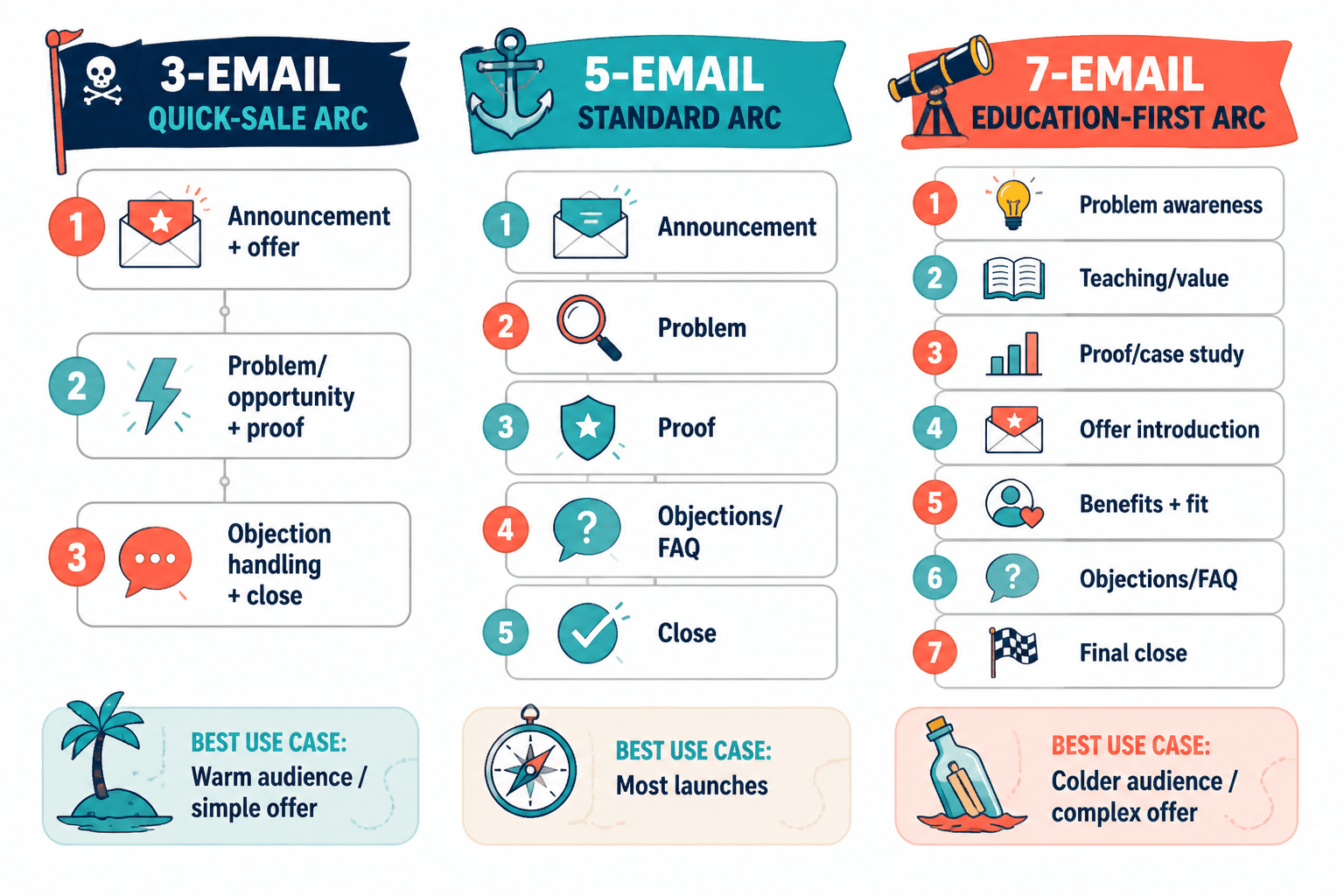
Template 1: The 3-email quick-sale arc
Best for warm audiences, lower-priced products, flash offers, mini workshops, template bundles, or simple services.
- Email 1: Announcement and offer
- Email 2: Problem/opportunity plus proof
- Email 3: Objection handling and close
This works when people already know you and the offer does not need much education. It is clean, fast, and much better than sending one lonely sales email and hoping your audience develops telepathy.
Template 2: The 5-email standard arc
Best for most launches, evergreen promos, service packages, courses, coaching offers, and higher-intent newsletter readers.
- Email 1: Announcement
- Email 2: Problem or opportunity
- Email 3: Proof
- Email 4: Objections
- Email 5: Close
If you need one default sequence, use this. It has enough room to persuade without turning your readers into hostages.
Template 3: The 7-email launch arc
Best for bigger launches, more expensive offers, or products that need more explanation.
- Email 1: Announcement
- Email 2: Why this matters now
- Email 3: Problem deep-dive
- Email 4: Proof or case study
- Email 5: Behind the scenes / what is inside
- Email 6: Objections
- Email 7: Final close
This version needs discipline. If you do seven emails badly, you do not have a launch. You have spam with a calendar. Keep each message distinct.
How to write these fast without sounding rushed
Busy creators need a repeatable process, not just inspiration. Here is a practical way to build your sequence quickly.
Step 1: Define the one-sentence offer
Before writing the emails, write this sentence:
This offer helps [specific audience] get [specific result] without [specific frustration], using [method or format].
If you cannot write that clearly, the emails will wobble. The sequence cannot save a fuzzy offer.
Step 2: List the five main things buyers need to hear
- What it is
- Why it matters
- Why it works
- Why they can trust it
- Why they should act now
Those become the bones of the sequence.
Step 3: Match one idea to each email
Do not cram every argument into every email. That is where things get bloated.
One email can still contain multiple points, sure, but it should have one dominant job. Readers can feel when an email knows where it is going.
Step 4: Reuse structure, not wording
A lot of creators hear “template” and immediately produce robotic sludge. That is not the template’s fault. The problem is copying phrases instead of using structure.
The bigger point is simple: clearer structure and clearer writing make the piece more useful. That is usually what makes the ending land better too.