
Most creators with small audiences make one of two mistakes with welcome emails.
They either send nothing at all and waste the highest-attention moment they are ever going to get from a new subscriber, or they overbuild a seven-email “nurture sequence” like they are a venture-backed funnel goblin with a team of twelve and a webinar problem.
Neither is especially smart.
Welcome Emails for Creators With Small Audiences do not need to be elaborate. They need to do a few jobs well: confirm the signup was worth it, set expectations, build a little trust, and point the reader toward one useful next step.
If you have 47 subscribers, 312 subscribers, or even 1,200 quiet but relevant people on your list, this matters more, not less. Small lists do not have the luxury of sloppy first impressions. Every new subscriber is a real person, not a dashboard decoration.
Here’s how to write welcome emails that feel human, useful, and surprisingly effective without sounding like a discount copywriting course escaped into your newsletter platform.
If you want the bigger picture, start with the parent guide.
Why welcome emails matter more when your audience is small
When your audience is small, every subscriber has more value.
That does not mean you should treat them like fragile royalty. It means you should stop acting like the first email is administrative fluff. It is one of the few moments when someone is actively paying attention. They just signed up. They remember who you are. They are at least a little curious. That window does not stay open for long.
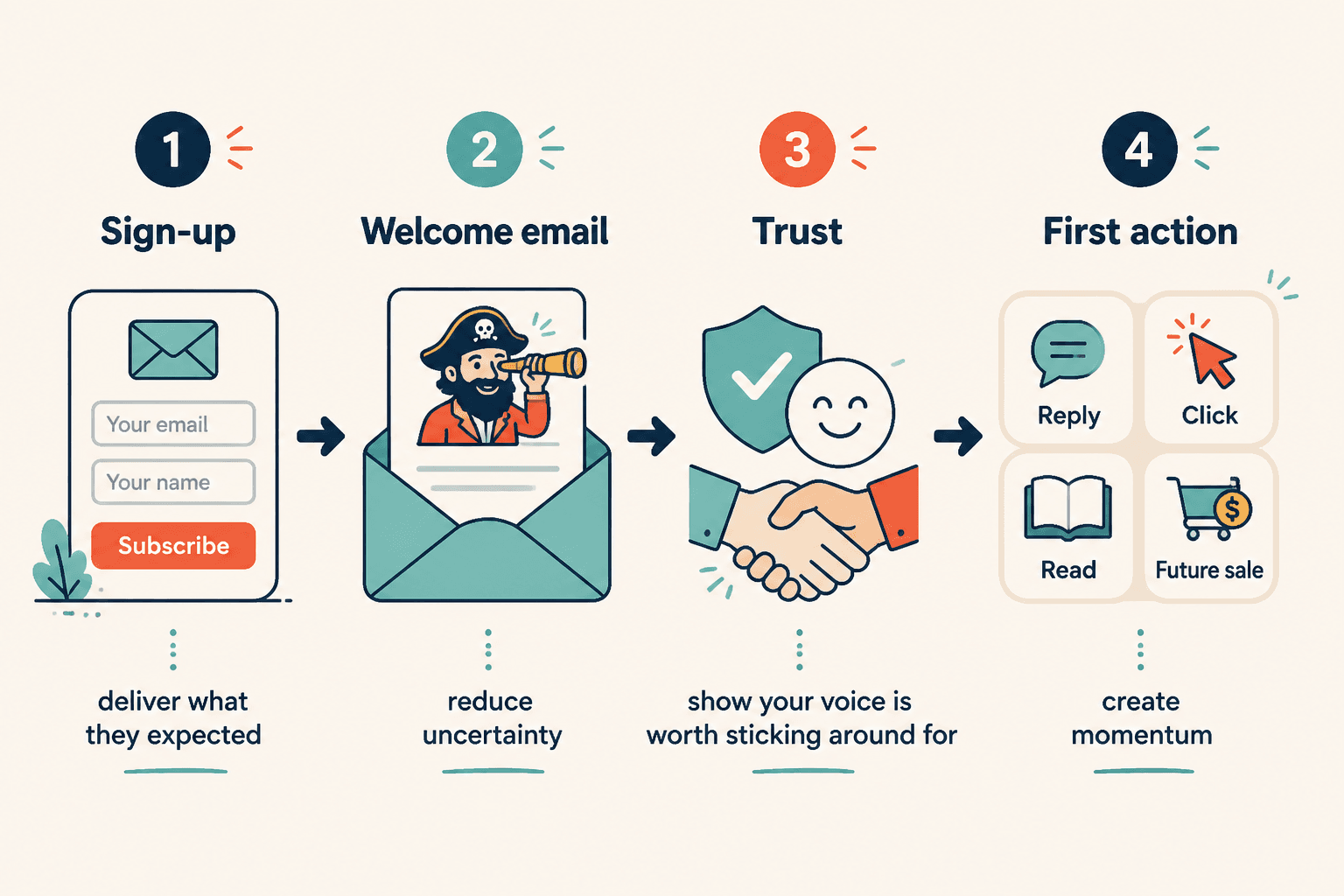
A good welcome email helps you do four things fast:
- deliver the thing they expected
- reduce uncertainty about what happens next
- show that your voice and ideas are worth sticking around for
- create a tiny bit of momentum toward a reply, click, read, or future sale
Small creators often assume welcome systems are for bigger brands with bigger lists. That is backwards. Bigger brands can get away with more generic automation because they already have recognition, proof, and scale. Small creators need sharper trust-building because they are still earning credibility one subscriber at a time.
What a welcome email for a small creator actually needs to do
You do not need a cinematic origin story. You do not need twelve links. You do not need a fake-intimate “I’m so honored you’re here” note if that is not how you talk.
You need clarity.
The best welcome emails for creators with small audiences usually cover these basics:
- Confirmation: they signed up successfully
- Delivery: give them the promised freebie, link, resource, or access
- Orientation: tell them what kind of emails you send and how often
- Positioning: remind them what you help with and who it is for
- Next step: ask for one simple action
That is the core structure. Everything else is optional.
A simple welcome email structure that works
If you want a practical structure, use this:
- Line 1: confirm what they just signed up for
- Line 2: give them the thing or tell them where to find it
- Short middle: explain what kind of emails they can expect
- Credibility line: show why your emails are worth opening
- One CTA: ask for one small next action
That is enough for a solid first email. It can be short. In many cases, short is better because the reader did not sign up to receive your memoir five seconds after entering their email.
Basic template
Subject: Here’s the resource + what to expect
Hey [First Name],
You signed up for [resource/newsletter], so here it is: [link]
I send emails about [topic] for [audience], usually [frequency]. Expect practical ideas, examples, and the occasional opinion when something is being done badly on the internet again.
If you’re here because you want help with [specific outcome], you’re in the right place.
Quick question: what are you trying to improve most right now when it comes to [topic]? Just hit reply and tell me.
— [Name]
That works because it is clear, low-friction, and useful. No dramatic throat-clearing. No weirdly intense intimacy. Just a competent first impression.
What small creators should say in the first welcome email
Small creators usually undersell the most important part: relevance.
Your new subscriber is trying to answer a simple question very quickly: Is this for me, and is it worth paying attention to? Your first welcome email should answer that without making them work for it.
Useful things to include:
- what you write about
- who your emails are for
- what kind of result or improvement the reader can expect
- how often you send
- what makes your angle different
For example:
I write weekly emails for creators and solo business owners who want sharper content, better positioning, and more sales without sounding like an over-caffeinated funnel template.
That does a lot in one sentence. It defines the audience, topic, outcome, and tone. Nice.
If you need help shaping the bigger system around your sequence, this welcome emails hub is a smart place to keep reading.
One email or a short sequence?
For most creators with small audiences, one strong email is better than five mediocre ones.
That said, a short sequence can work well if each email has a clear job. Not “nurture.” That word has done enough damage. A job.
Here’s a simple version that works for a lot of creators:
- Email 1: deliver the promised resource, explain what to expect, ask one easy reply question
- Email 2: share your best starting point, most useful article, or most relevant lesson
- Email 3: introduce your offer, service, or next step softly if it fits
That is enough. Three good emails beat an eight-email sequence where half the messages sound like they were stitched together from recycled launch copy and mild desperation.
If you want a deeper breakdown, this guide to better welcome email results can help you think beyond the first send.
The best CTA for small-audience welcome emails
The CTA in your welcome email should be small, easy, and useful.
This is where a lot of creators get weirdly ambitious. Somebody joins your list and within forty seconds you are asking them to book a call, follow you on six platforms, read your manifesto, and buy the thing. Relax.
Good first-email CTAs for small creators:
- hit reply and answer one question
- read one strong article
- download or open the promised resource
- whitelist your email address
- tell you what they are struggling with
Bad first-email CTAs:
- book a sales call immediately
- fill out a long survey
- follow me everywhere
- read these nine links
- buy now unless the signup was directly tied to a buying decision
The point of the CTA is not to squeeze maximum action out of the reader. It is to create the next bit of engagement with minimum friction.
Reply CTAs are especially good for small lists
If your audience is small, replies are gold.
Not because some mythical deliverability wizard said so on a podcast, but because replies give you real language, real objections, real questions, and real relationship-building. They also make your list feel less like a one-way broadcast and more like an actual creator-reader connection.
Good reply prompts:
- What are you trying to improve most right now?
- What made you sign up for this?
- What kind of content are you tired of seeing in this space?
- What are you stuck on when it comes to [topic]?
Keep it to one question. One. You are starting a conversation, not assigning homework.
For more ideas, these first email hooks and examples are useful if your opener keeps sounding too stiff.
Examples of welcome emails for creators with small audiences
Example 1: Newsletter signup
Subject: You’re in
Hey [First Name],
You’re on the list.
I send practical emails about content, positioning, and audience growth for creators who want better leads without sounding like internet wallpaper.
Most emails are short. Some are a bit sharper. All of them should help you make your work easier to notice and easier to trust.
Quick favor: hit reply and tell me what you’re trying to improve right now. Hooks, posts, offers, emails, profile, any of it.
That helps me send stuff you’ll actually want to read.
— [Name]
Example 2: Free resource delivery
Subject: Your template is here
Hey [First Name],
Here’s the template you signed up for:
[Download link]
I also send weekly emails for creators and consultants who want clearer messaging, stronger content, and less vague “personal brand” advice.
You’ll get practical breakdowns, examples, and the occasional strong opinion when the advice in this space deserves it.
If you want, reply and tell me where your content feels weakest right now. I read every reply.
— [Name]
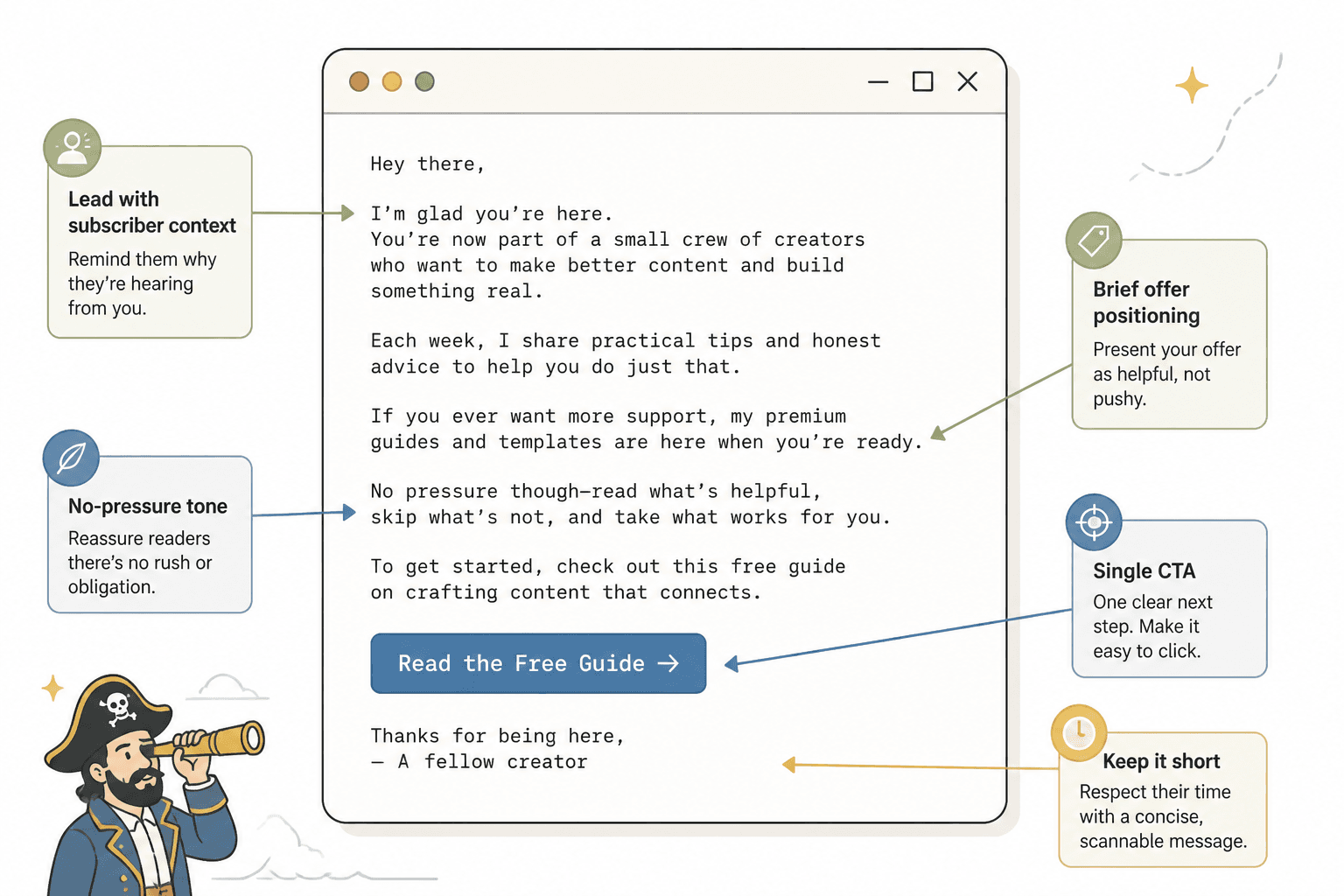
Example 3: Soft offer introduction in email two or three
Hey [First Name],
Since you joined for [topic], one quick note:
If you want help tightening your messaging or content strategy, I offer [service/product]. It is for [specific audience], and it helps with [specific result].
No pressure. If now is not the time, keep an eye on the emails. I share plenty you can use without buying anything.
If you do want details, here’s the next step: [link]
That is how you introduce an offer without sounding like you had a personality swap with a sales funnel template.
If you want more models to swipe thoughtfully instead of lazily, these welcome email ideas and examples are worth bookmarking.
Common mistakes creators make with welcome emails
1. Writing like a brand deck instead of a person
Your welcome email is not the place for “We empower modern visionaries to step into aligned authority.” Nobody knows what that means, including the person who wrote it.
Say what you help with. Say who it is for. Use adult language.
2. Making it all about you
A little context is fine. A mini autobiography is not. The reader cares about your story mostly in relation to whether you can help them, teach them, entertain them, or guide them somewhere useful.
3. Having no clear expectation-setting
If people do not know what they signed up for, they unsubscribe faster. Tell them what kind of emails you send and how often. This is basic. Still ignored constantly.
4. Stuffing the email with too many links
One primary action is enough. Two links can be fine. Nine links is chaos.