
Most people do not have a content creation problem. They have a content recycling problem.
They keep writing fresh posts, fresh emails, fresh threads, fresh hot takes, while a pile of decent older material sits around doing absolutely nothing. Then they wonder why Substack feels hard to sustain.
If you want to know how to turn old content into better Substack posts and series, the answer is not “copy, paste, publish.” That is how you end up with recycled mush. The real move is to extract the strongest idea, reshape it for email reading, and build a cleaner arc around it than the original content had.
Done well, old content becomes a faster way to publish sharper posts, stronger series, and more consistent newsletters without sounding lazy or repetitive. Done badly, it reads like stitched-together leftovers wearing a new subject line.
Here’s how to do it properly, so your back catalog becomes useful again instead of just emotionally supportive clutter.
For the full path around this topic, head to the parent guide.
Why old content usually fails on Substack
Old content often fails on Substack for one simple reason: the format changed, but the writing did not.
A LinkedIn post can survive on punchiness. A thread can survive on momentum. A webinar can survive on your voice and slides doing half the work. A Substack post has to hold attention on the page. It needs shape, pacing, a stronger throughline, and a reason to keep reading beyond “this person had a thought.”
That means your old content probably needs more than cleanup. It usually needs repositioning.
- A social post may need more context
- A blog post may need a better angle
- A thread may need fewer repeated points
- A talk transcript may need actual structure
- A lead magnet may need more personality and less brochure energy
Substack rewards writing that feels deliberate. Not just published. That is a useful standard, honestly.
What makes old content worth repurposing
Not every old piece deserves resurrection. Some content should be reused. Some should be mercy-killed.
The best source material usually has one or more of these traits:
- It got strong replies, saves, shares, or email responses
- It addresses a recurring question from clients or readers
- It contains an opinion you still stand behind
- It has useful proof, examples, or a process
- It was good, but trapped in the wrong format
- It can expand into a stronger idea with better framing
The key question is not “Did this perform?” It is “Is there a durable idea here?” Performance helps, sure. But some of your best newsletter material may come from posts that underperformed because the platform was wrong, the hook was weak, or the timing was off.
Good ideas do not stop being good just because the algorithm yawned.
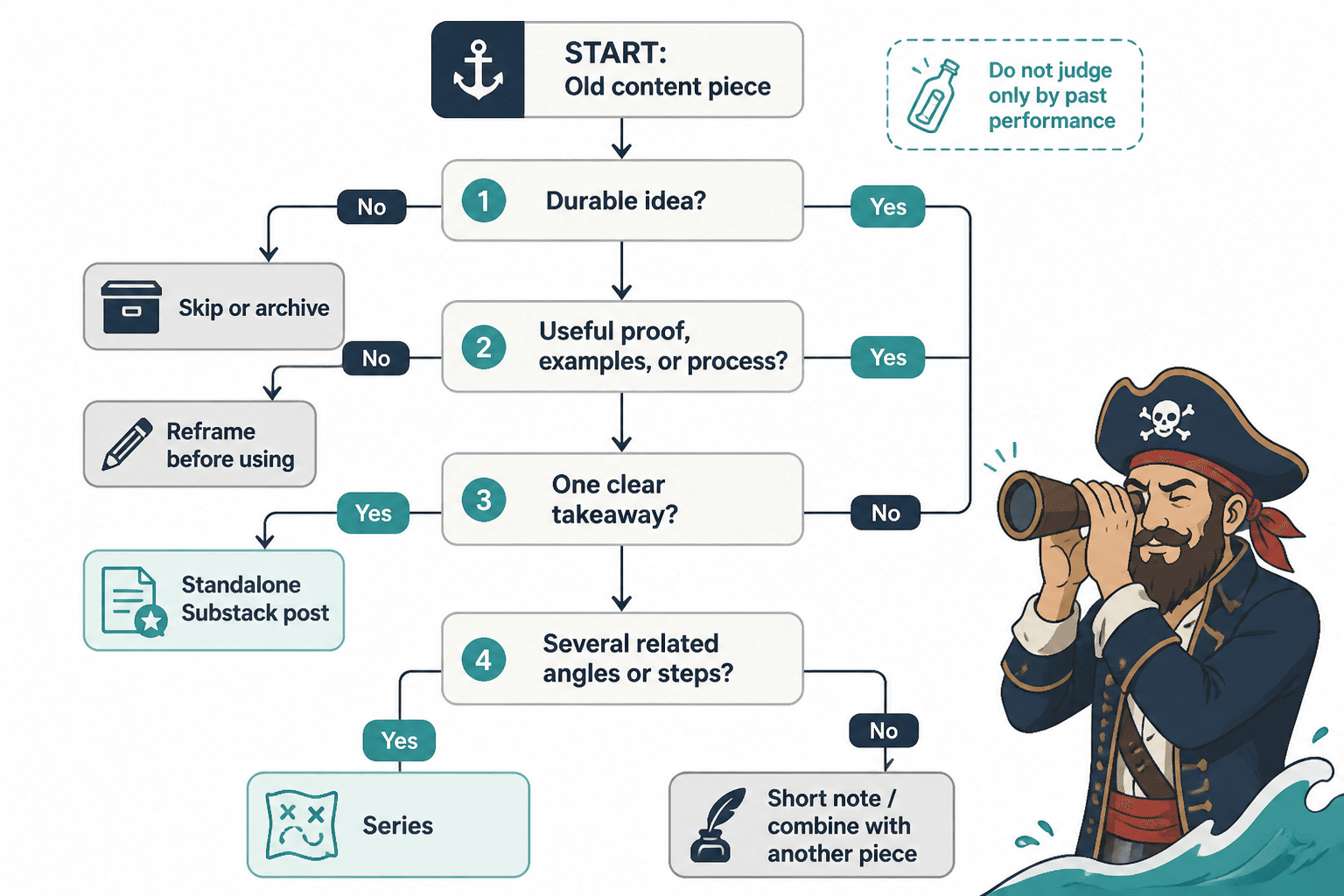
Start by sorting your old content into 3 buckets
If you want to turn old content into better Substack posts and series, do not start rewriting randomly. Sort first. This saves time and stops you from building a newsletter from mismatched scraps.
1. Standalone post material
These are ideas that can carry one focused newsletter on their own.
- A strong opinion
- A useful framework
- A case-study-style lesson
- A tactical breakdown
- A mistake people keep making
If the idea has one main takeaway and enough substance for 600 to 1,200 solid words, it probably belongs here.
2. Series material
These are broader topics with multiple clean subtopics.
- A recurring client problem
- A multi-step process
- A bigger belief with several practical angles
- A theme you have written about in fragments across platforms
If one post would become bloated, rushed, or weirdly broad, that is usually your cue to split it into a series.
3. Scrap material
This bucket matters more than people think.
These are fragments, examples, lines, stats, stories, screenshots, objections, punchy phrases, and half-formed ideas that are not enough on their own but can strengthen future posts. Keep them. Just stop pretending every note deserves a newsletter.
How to turn one old piece into a better Substack post
The cleanest process is this: identify the actual point, rebuild the structure, then rewrite for reading depth instead of platform speed.
Step 1: Find the real idea
Many old posts are padded with scene-setting, throat-clearing, and “what I’ve been thinking about lately” fluff. Under that, there is often one useful argument trying to escape.
Ask:
- What is the actual claim here?
- What does this help the reader understand, do, avoid, or decide?
- What is the most interesting or sharp part?
- What can be cut without harming the point?
If you cannot explain the piece in one sentence, it is not ready to rewrite.
Step 2: Choose a sharper angle
A lot of old content is too broad. Broad content feels safe, but it usually reads like wallpaper.
Instead of:
- “What I learned about content marketing”
- “Thoughts on building an audience”
- “Why consistency matters”
Go narrower and more useful:
- “Why useful content still gets ignored”
- “The audience-building advice that wastes small creators’ time”
- “Consistency is overrated if your angle is blurry”
Substack readers are not looking for a museum tour of your general thoughts. They want a clear reason to open and keep going.
Step 3: Rebuild the structure for email reading
A better Substack post usually needs this basic shape:
- A strong opening that names the problem or tension
- A clear point of view
- Useful development with examples, breakdowns, or proof
- A practical takeaway or next step
- A soft close that leads naturally to reply, subscribe, read more, or take action
Notice what is missing: long warmups, generic backstory, and three paragraphs of “there’s nuance here.” Of course there is nuance. Write the useful part anyway.
Step 4: Add depth, not padding
This is where old content gets better instead of just longer.
You add depth by including one or two of the following:
- A specific example
- A before/after contrast
- A short breakdown of why something works
- A useful objection and answer
- A mini framework
- A sharper implication for the reader
You do not add depth by repeating the same point in six slightly different sweaters.
Step 5: Rewrite the ending so it earns the next step
Substack posts should not just stop. They should land.
A good close can do one of four things:
- Invite a reply
- Set up the next post
- Point to a related resource
- Lead naturally to an offer
If you need help with that side of it, you can pair this with how to turn Substack posts and series into more leads or sales.
How to turn scattered old content into a Substack series
This is where things get much more interesting.
A series is not just several posts on the same topic. It is a guided sequence. It should make the reader feel like each post builds on the last instead of wandering around the neighborhood of a theme.
If you have old posts, notes, threads, workshop bullets, client emails, and half-finished drafts around one topic, you probably have the raw material for a series already. You just need to stop treating every fragment like a separate content event.
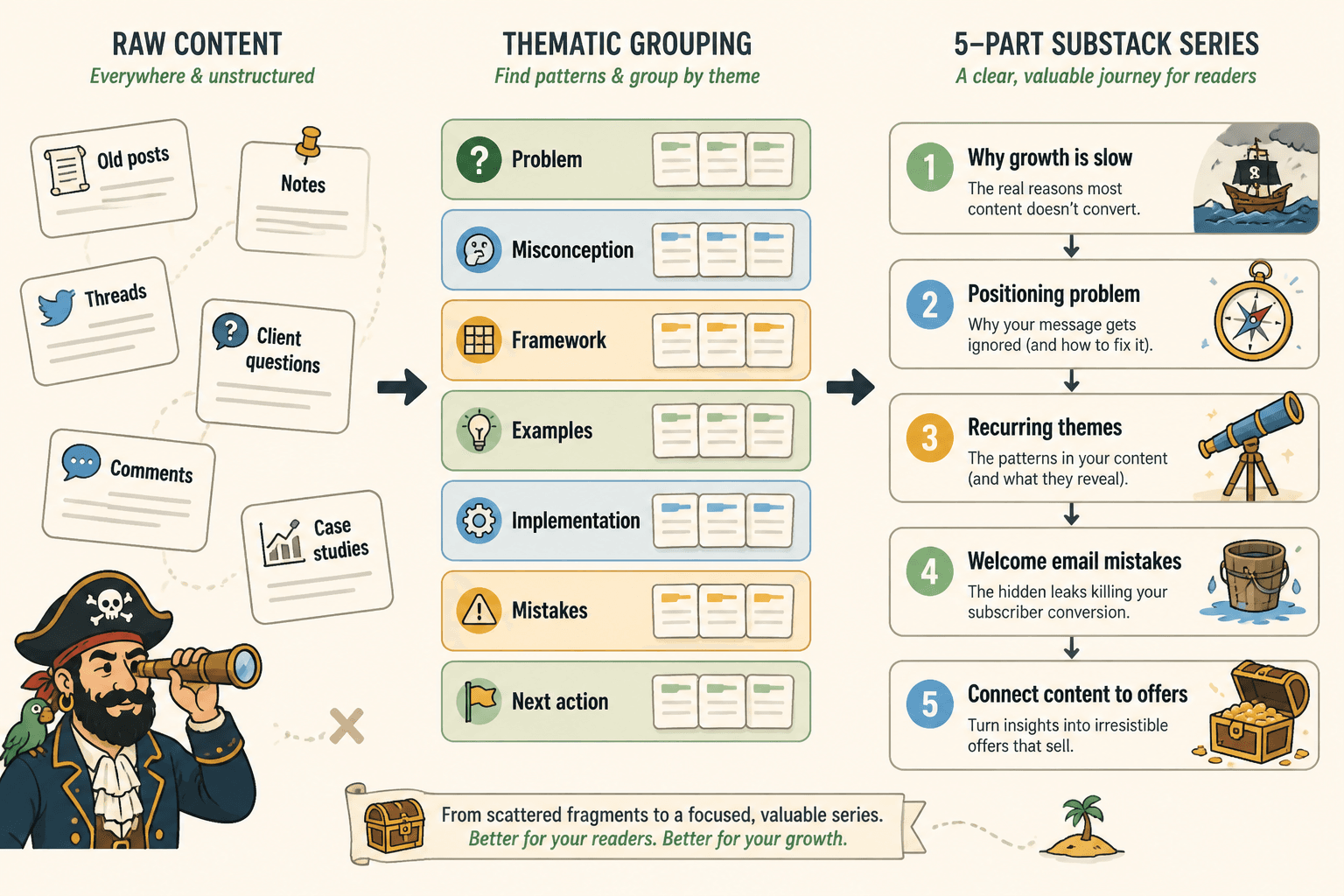
Build the series around a reader journey
A simple way to structure a Substack series is to move through the stages a reader actually needs:
- The problem
- The misconception
- The framework
- The examples
- The implementation
- The mistakes to avoid
- The next action
For example, if your old content is about newsletter growth, your series might look like this:
- Why most newsletters grow slowly even with solid writing
- The positioning problem hidden inside your topic choice
- How to create recurring themes readers remember
- 3 welcome email mistakes that quietly kill retention
- How to connect newsletter content to offers without getting weird
That is a series. It has sequence. It has progression. It does not feel like five leftovers dumped onto a plate.
Create a content inventory before you draft
Before writing the series, collect all related material into one working document.
Pull in:
- Old posts
- Notes
- Threads
- Client questions
- Comments or replies from readers
- Case-study snippets
- Examples you have used before
Then tag each piece by purpose:
- Problem
- Belief
- Example
- Framework
- Story
- Objection
- CTA
This makes it much easier to assemble each post with intention. It also shows you where the series is thin. Maybe you have opinions but no proof. Maybe you have examples but no clear framework. Better to notice that early.
Make each post complete, but not closed off
Every post in a series should stand on its own enough to satisfy the reader. But it should also create momentum toward the next entry.
That can look like:
- Referencing the previous lesson briefly
- Teasing the next practical step
- Carrying one ongoing theme through the series
- Using repeated section patterns so the series feels coherent
If you want a broader foundation for this format, see Substack posts and series guide for creators who want better results and how to write better Substack posts and series.
What to rewrite and what to keep
Repurposing works best when you are ruthless about what survives the move.
| Keep | Rewrite or cut |
|---|---|
| Strong opinions you still believe | Weak intros and throat-clearing |
| Useful examples and proof | Platform-specific filler |
| Sharp phrases with personality | Repetitive explanation |
| Clear frameworks | Generic takeaways |
| Reader questions and objections | Old references that no longer matter |
| Stories with a point | Anything that only worked because of format gimmicks |
This matters because old content often carries weird baggage from its original platform. Social posts may include awkward hooks. Threads may be too fragmented. Webinars may explain too much too slowly. Blog posts may be stuffed with bland SEO fog.
Substack gives you room, but room is not permission to be baggy.
A quick before-and-after example
Here is the kind of shift you are aiming for.
Old LinkedIn-style post
The bigger point is simple: clearer structure and clearer writing make the piece more useful. That is usually what makes the ending land better too.
Stronger Substack posts usually come from a clearer point, tighter structure, and a more deliberate series flow. Better pacing often matters more than more volume.