
Most AI title tools are not bad because the software is broken. They are bad because people use them like a slot machine.
They dump in a vague prompt, get 30 lifeless headline variations back, pick the one that sounds the most “content-y,” and then wonder why nobody clicks. Or worse, why the clicks come from the wrong people.
The best AI tools for blog titles and headlines can absolutely help. They can speed up ideation, show you angles you missed, and help you test stronger phrasing faster. What they cannot do is magically turn a foggy idea into a sharp one. That part is still your job. Annoying, I know.
If you want better titles, the goal is not to find a robot that writes “perfect” headlines. The goal is to find tools that help you get to clear, specific, useful headlines without sounding like a spammy content goblin. That is what this guide covers.
You will get a practical breakdown of the best AI tools for blog titles and headlines, what each kind of tool is actually good at, where they tend to fail, and how to use them without publishing the same glazed-over headline everybody else’s software also suggested.
What makes an AI title tool worth using
A useful AI headline tool does at least one of these well:
- Generates multiple angles quickly
- Helps you tighten wording
- Improves specificity
- Surfaces SEO phrasing or topic variations
- Lets you compare headline options
- Fits into your writing workflow instead of creating more mess
A useless one gives you endless versions of the same headline with slightly shuffled filler words like “ultimate,” “essential,” “proven,” and “best.” If the tool writes like it is trying to sell a webinar from 2018, that is not inspiration. That is cleanup.
So before we get into specific tools, here is the practical filter: the best tools do not replace your judgment. They improve your speed, variation, and clarity.
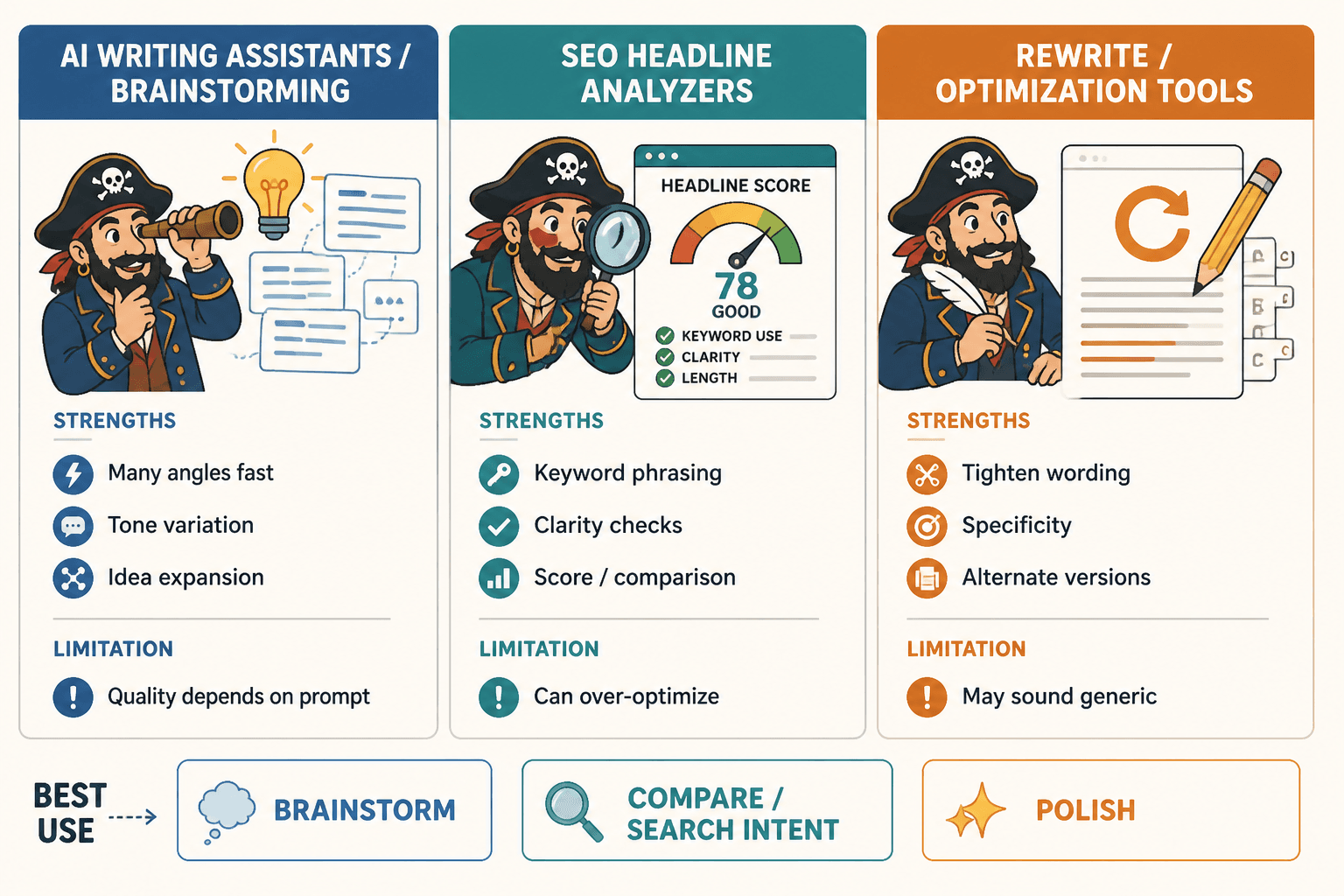
The main types of AI tools for blog titles and headlines
Not every title tool does the same job. Lumping them together is how people end up disappointed.
1. AI writing assistants
These are your ChatGPT, Claude, Jasper-style tools. They are best for:
- Brainstorming headline directions
- Rewriting weak titles
- Creating title variations for different audiences
- Matching title tone to your brand voice
- Turning a rough article idea into better headline options
They are weak when your prompts are weak. If you ask for “10 catchy blog titles about SEO,” do not act shocked when you get beige soup.
2. SEO headline and topic tools
These tools help you align titles with search demand, keyword phrasing, topic intent, and content planning. They are useful for:
- Finding search-friendly headline structures
- Validating topic phrasing
- Comparing keyword variations
- Planning title clusters around one topic
They are not great at voice. They can tell you what people might search. They cannot tell you if the result sounds like a human with standards.
3. Headline scoring tools
These tools rate your headline based on factors like length, sentiment, readability, word balance, or click potential. They can help with:
- Spotting clunky titles
- Comparing options quickly
- Catching overlong wording
- Pushing you toward clearer structure
What they cannot do is understand nuance perfectly. A title can score well and still be generic. A title can score modestly and still outperform because it is more relevant and more specific to the right reader.
4. Workflow and template tools with AI baked in
Some tools are less about headline generation itself and more about helping you organize swipe files, title templates, test variants, and content systems. These are underrated if you publish regularly.
If you want a stronger foundation before tool shopping gets too exciting, the broader guide to blog titles and headlines is worth reading first. It makes the tool choices make more sense.
Best AI tools for blog titles and headlines by use case
Here is the cleaner way to choose: do not ask, “What is the best tool?” Ask, “What part of headline writing am I bad at, slow at, or tired of doing manually?”
Best for flexible brainstorming: ChatGPT or Claude
If you want raw headline ideation with decent range, general AI writing assistants are still the most flexible option. They work best when you give them context like:
- The article’s audience
- The article’s core promise
- The tone you want
- What to avoid
- Examples of titles you like
- The keyword or search phrase if SEO matters
Bad prompt:
Write 20 catchy blog titles about email marketing.
Better prompt:
Generate 20 blog title ideas for a practical article aimed at consultants and creators who struggle to get replies from email newsletters. Keep the titles specific, clear, and useful. Avoid hype words like ultimate, game-changing, or secrets. Include a mix of SEO-friendly and curiosity-based options.
That one change usually gets you dramatically better output.
Best for:
- Fast idea generation
- Rewrites
- Tone matching
- Audience-specific variations
- Turning rough concepts into usable options
Watch out for:
- Repetitive phrasing
- Overuse of list-post formulas
- Titles that sound polished but say nothing
- Keyword stuffing if you over-prompt for SEO
Best for search-aligned title planning: SEO research and headline tools
If your article needs to rank, not just charm people on social, you need tools that help you understand how topics are phrased in search. This is where SEO title and planning tools earn their keep.
The best use of these tools is not letting them write the final title for you. It is using them to pressure-test phrasing and intent.
For example, you might start with:
How to Name Blog Posts Better
Then realize search intent is much closer to:
Best AI Tools for Blog Titles and Headlines
That shift matters. The first one sounds broad and homemade. The second one matches a clearer intent and gives you a stronger framing for the whole article.
If you want more on this side of the process, read Best SEO Headline Tools and Content Planning Tools for Blog Titles and Headlines. It pairs well with this article because SEO tools and AI writing tools solve different problems.
Best for:
- Keyword-informed title planning
- Topic clustering
- Matching search language
- Avoiding titles nobody actually searches for
Watch out for:
- Robotic SEO phrasing
- Choosing volume over clarity
- Writing titles for software instead of readers
Best for improving weak drafts fast: headline analyzers and scoring tools
These are useful when you already have a title but suspect it is dragging a little.
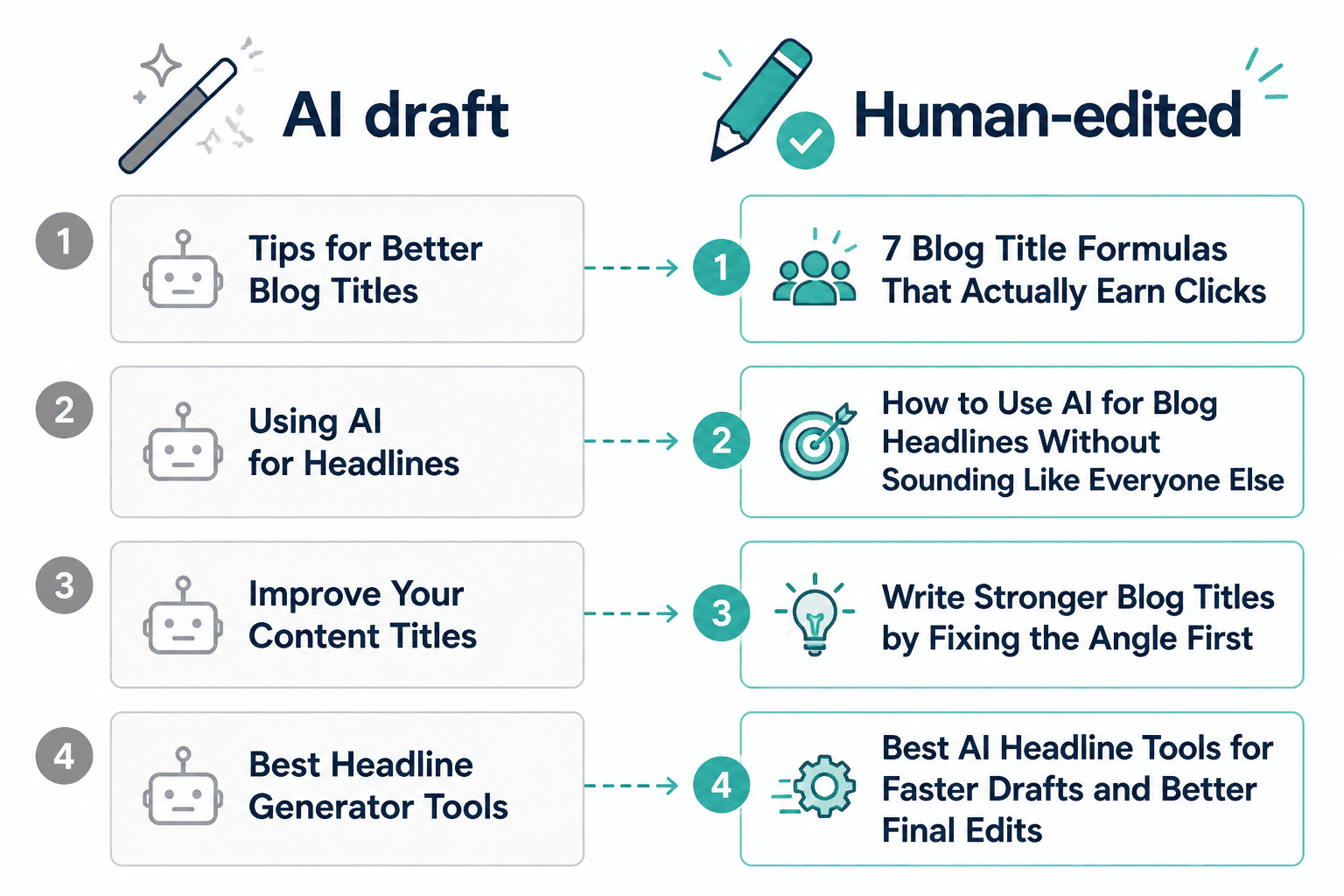
Say your draft title is:
Helpful Ways to Improve Your Blog Headlines
A decent analyzer might force you to notice that the title is vague, low-energy, and packed with filler. The stronger rewrite might become:
How to Rewrite Boring Blog Titles and Headlines That Nobody Clicks
Much better. More specific. More tension. More likely to attract the right reader.
Best for:
- Tightening wording
- Comparing headline options
- Catching vague structures
- Improving readability
Watch out for:
- Blindly chasing scores
- Forcing emotional language where it does not fit
- Trading relevance for “power words”
If rewrites are your bigger problem, How to Rewrite Boring Blog Titles and Headlines will help more than another scorecard ever will.
Best for repeatable workflows: templates plus AI
This is the least flashy option and often the most useful one. If you publish a lot, your bottleneck is usually not creativity. It is consistency.
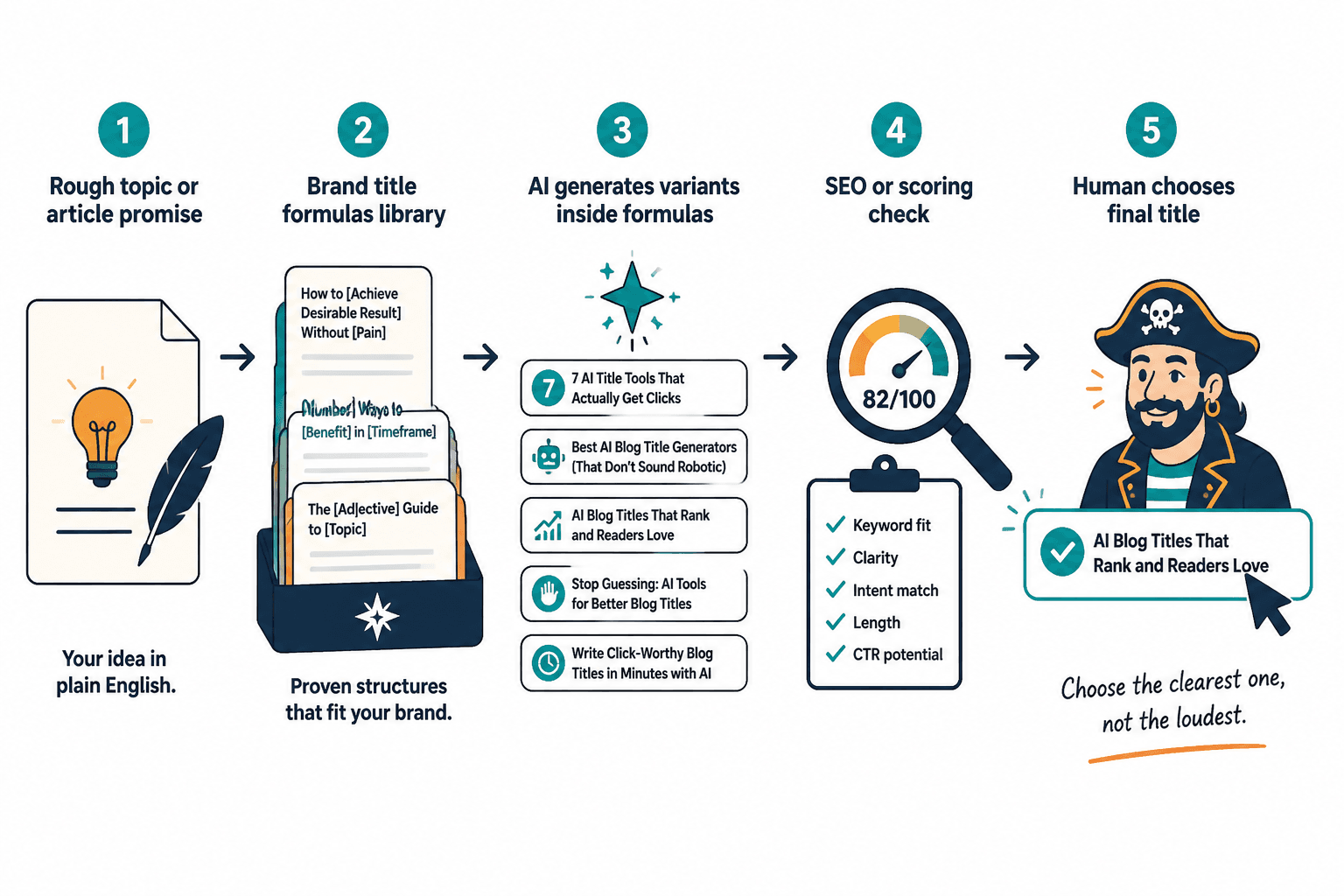
A smart workflow looks more like this:
- Keep a library of title formulas that fit your brand
- Use AI to generate variations inside those formulas
- Run the best versions through an SEO or scoring check
- Choose the clearest one, not the loudest one
That approach beats asking AI to freestyle from scratch every single time.
For that side of the system, see Best Templates and Tools for Blog Titles and Headlines and Simple Blog Titles and Headlines: Click-Worthy SEO Titles Templates for Busy Creators.
How to use AI tools without getting generic headline sludge
This is where most people go wrong. They use decent tools in a lazy way and then blame the tools.
Start with the article’s real promise
Before you generate a single title, answer this:
- What will the reader be able to do after reading?
- Who is the article really for?
- What specific pain, outcome, or question does it address?
- What makes this angle different from the usual generic advice?
If you cannot answer those clearly, no tool will save you. It will just generate polished confusion at scale.
Prompt for contrast, specificity, and audience
Good headline prompts usually include some mix of these instructions:
- Make the title specific, not vague
- Avoid clickbait
- Write for creators, coaches, consultants, or founders
- Give 10 SEO-friendly options and 10 curiosity-driven options
- Use plain English
- Avoid hype words and filler adjectives
- Include practical outcomes
You are not just asking for titles. You are directing a junior assistant who has zero taste unless you lend it some.
Generate in batches, then combine
One prompt rarely gives you the winner. A better process is:
- Generate 20-30 title options
- Pick the 5 with the strongest core angle
- Ask the AI to rewrite those 5 for clarity and specificity
- Mix and match the best phrases manually
- Choose the title that best fits search intent and reader promise
The final title is often not one the tool gave you. It is one you assembled from the best parts. That is normal. That is also usually where the quality lives.
Cut dead words ruthlessly
AI loves filler. It really does. Some of the most common title dead weight includes:
- Ultimate
- Essential
- Powerful
- Amazing
- Complete
- Proven
- That Actually Work
- You Need to Know
Sometimes those words are fine. Most of the time they are decorative fluff trying to compensate for a weak idea.
Compare these:
- Weak: 10 Powerful AI Tools You Need to Know for Better Blog Headlines
- Better: 10 AI Tools That Help You Write Better Blog Headlines
- Best: Best AI Tools for Blog Titles and Headlines
The strongest option usually sounds more confident because it is cleaner.
A practical workflow for choosing the right title
If you want a repeatable process instead of headline chaos, use this.
Step 1: Write the ugly working title
Start with the blunt version. Something like:
AI tools for writing blog titles
It does not need charm yet. It needs clarity.
Step 2: Add context before using AI
Tell the tool:
- Who the article is for
- What the article helps them do
- What tone you want
- What types of titles to avoid
- Whether SEO matters
Step 3: Generate multiple headline styles
Ask for several categories:
- Direct SEO titles
- Benefit-focused titles
- Problem-solution titles
- Comparison titles
- Sharp curiosity titles
This keeps you from getting 20 variations of the same slightly tired list post.
Step 4: Pressure-test the top options
For each finalist, ask:
- Would the right reader instantly know this is for them?
- Is the outcome clear?
- Is there any vague filler I can cut?
- Does it match search intent?
- Would I still respect this title if I saw it on somebody else’s site?
That last one matters more than people admit.
Step 5: Choose clarity over cleverness
A slightly less clever title that makes the value obvious usually beats a cute one that hides the point. You are trying to earn the click, not applause from other marketers.
Common mistakes people make with AI headline tools
Some of these are painfully common.
- Using vague prompts: vague input creates vague output
- Taking the first suggestion: the first batch is often just warm-up
- Chasing clickbait: more intrigue is not always more trust
- Ignoring audience fit: a title for broad traffic may not fit a niche buyer
- Letting SEO flatten the voice: search-friendly does not have to mean lifeless
- Trusting headline scores too much: scoring tools are useful, not sacred
- Forgetting the article itself: a strong title on a weak article just increases bounce and disappointment
The title has one main job: make the right person think, “Yes, that is what I need.” Not, “Wow, what a thrilling arrangement of adjectives.”
What the best AI tools for blog titles and headlines still cannot do
Worth saying plainly: no AI tool can give you taste.
It cannot know which promise is strongest for your audience without context. It cannot feel when a title is technically fine but slightly embarrassing. It cannot judge when a headline sounds overcooked for your brand. It cannot tell that your title problem is actually an idea problem.
And this part matters more than people think. Sometimes your title is weak because the article itself is mush. The AI is not failing. It is accurately reflecting that there is no sharp angle to work with yet.
That is why the best setup is not AI instead of judgment. It is AI plus a human who knows the audience, the promise, and the line between compelling and corny.
Simple title formulas AI tools handle well
If you want cleaner outputs, give the tool stronger title structures to work within. These formulas tend to produce usable results.
- Best [tool/type] for [specific goal]
Best AI Tools for Blog Titles and Headlines - How to [solve problem] without [common frustration]
How to Write Better Blog Headlines Without Sounding Clickbait-y - [Number] ways to [get result]
7 Ways to Write Blog Titles People Actually Want to Click - [Problem]: [solution or promise]
Boring Blog Titles: How to Make Boring Blog Titles More Click-Worthy
AI tends to do better when the structure is clear and the ask is narrow. Give it a strong frame, then edit for specificity, tone, and actual human curiosity.