
Your website bio or profile copy is not just there to sound competent and vaguely impressive. It has a job. Usually, several jobs. It should tell the right people they are in the right place, make your positioning clearer, build a little trust fast, and help someone take the next step without wandering around your site like they’ve entered a softly branded maze.
That is where most bios fall apart. Not because the writing is terrible, though sometimes it is. They fail because they are disconnected from any actual funnel. You get a polished intro, maybe a smiling headshot, a line about helping people do something meaningful, and then… nothing useful happens next.
The best funnel ideas to pair with website bio and profile copy are the ones that match what your visitor is ready for. Not everyone should be shoved toward a sales call. Not everyone wants your newsletter. Not everyone needs a 14-email nurture sequence because they read three lines about your work.
Here’s how to connect your bio and profile copy to funnel paths that actually make sense, feel natural, and move the right people forward without making your website sound like it was written by a funnel goblin in a blazer.
For the full path around this topic, head to the parent guide.
What your bio is supposed to do before the funnel begins
A strong bio is not the funnel itself. It is the bridge into one.
Before someone clicks anything, your bio or profile copy should answer four basic questions:
- Who are you for?
- What do you help them do?
- Why should they trust you?
- What should they do next?
If your bio misses those, the funnel has to work much harder than it should. And if the funnel starts with a CTA that doesn’t fit the copy above it, conversion drops for a very boring reason: the page feels off.
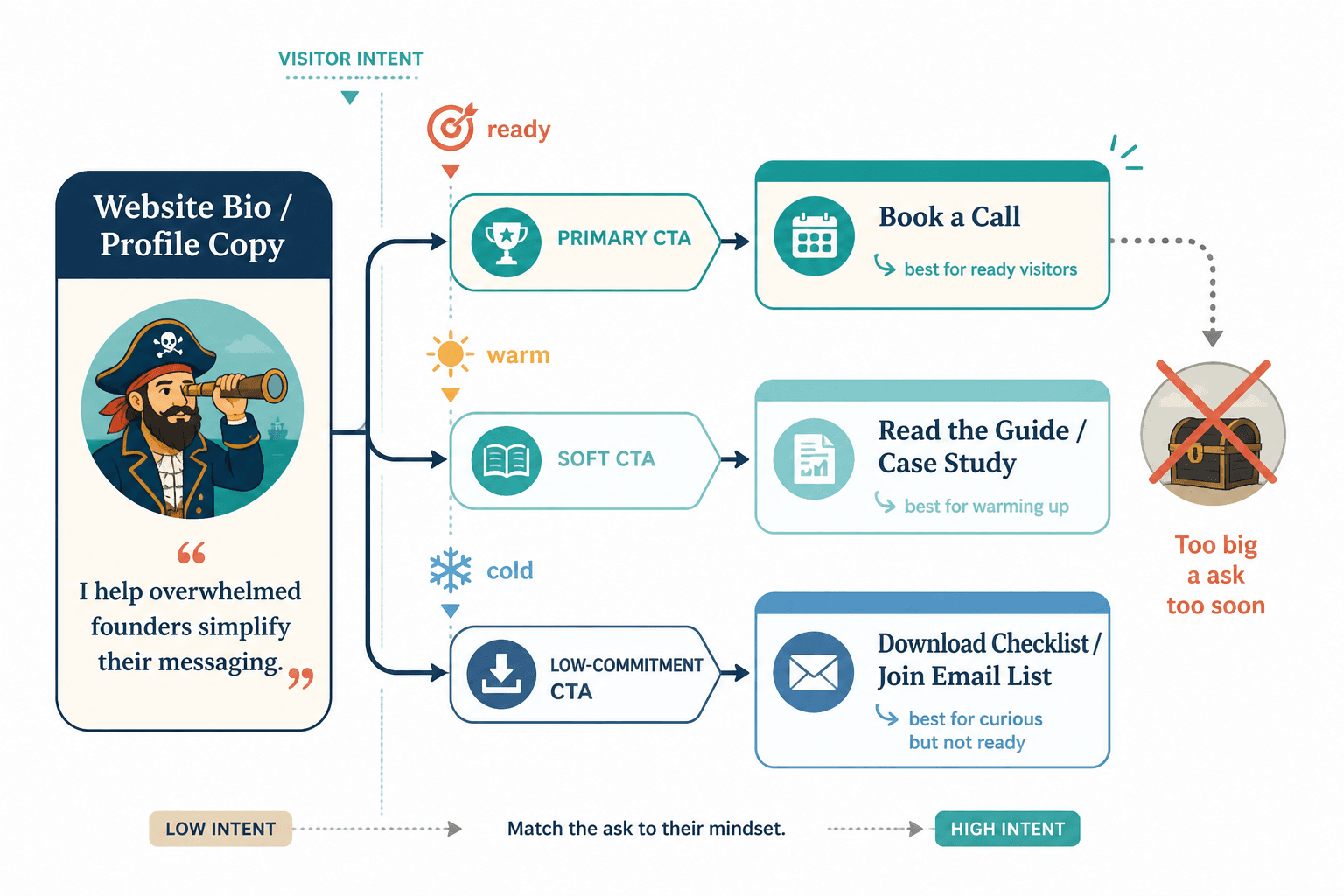
For example, if your bio says you help overwhelmed founders simplify their messaging, and your main CTA is “Book a 90-minute strategic revenue acceleration intensive,” you’ve already made the page feel more complicated than your promise.
That mismatch happens a lot. A website bio promises clarity. The funnel asks for commitment too early. People leave.
If you want a stronger foundation first, this guide on bio and profile copy for websites is the right place to tighten the core message before you start attaching funnel pieces to it.
How to choose the right funnel for your website bio
The best funnel ideas to pair with website bio and profile copy depend on three things:
- Traffic temperature: Are these cold visitors, warm referrals, or repeat readers?
- Offer complexity: Is this a simple product, a service, a consultation, or a longer buying decision?
- Visitor intent: Are they browsing, comparing, learning, or ready to talk?
Most websites make one funnel and hope everyone magically fits inside it. That’s lazy. A better approach is giving the bio one clear primary next step and, where needed, a softer secondary path for people who are interested but not ready.
A clean setup often looks like this:
- Primary CTA for people ready to act
- Secondary CTA for people who need a little more trust or context
- Bio copy that makes both options feel coherent
A simple rule that saves a lot of bad funnel decisions
The more commitment your CTA asks for, the more proof and specificity your bio needs above it.
If you want someone to book a call, your profile copy should make the value, audience, and credibility obvious. If your bio is still vague, ask for a lower-friction step instead. Not every visitor needs to leap straight into your calendly with trust issues and mild confusion.
Best funnel ideas to pair with website bio and profile copy
These are the funnel models that tend to work best for creators, consultants, coaches, freelancers, solo founders, and personal brands. Not because they are trendy. Because they match how people actually decide.
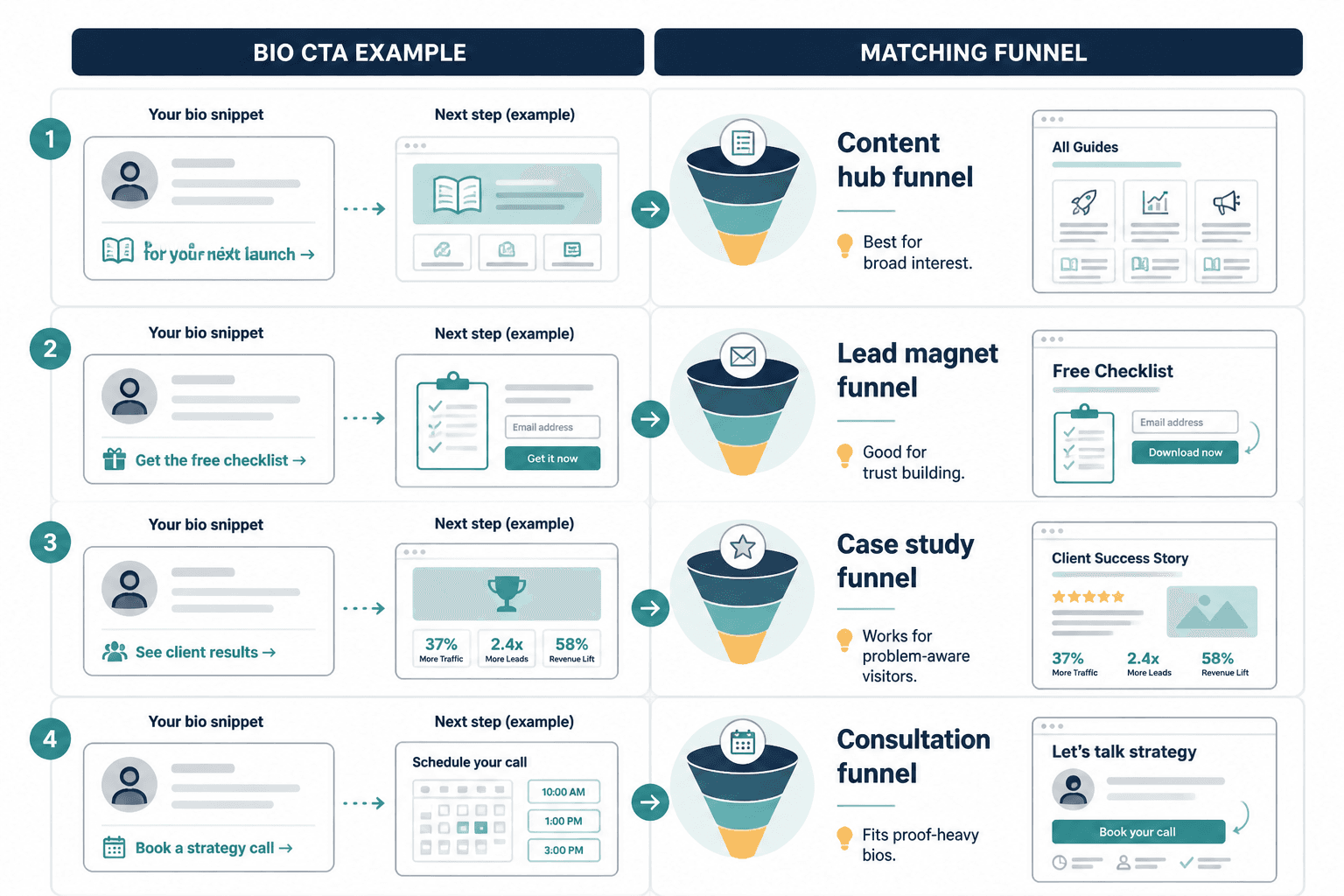
1. Bio to lead magnet to nurture sequence
This is the classic trust-building funnel, and yes, it still works when the lead magnet is actually useful and not just a recycled PDF with suspiciously large margins.
Best for: consultants, coaches, service providers, educators, and anyone selling expertise
How it works:
- Bio explains who you help and what problem you solve
- CTA offers a relevant free resource
- Visitor joins your email list
- Nurture sequence builds trust and points toward your offer
Why it works: it gives people a low-pressure first step. That matters when your service is not an impulse buy.
Good CTA examples:
- Get the 5-part homepage copy checklist
- Download the client messaging template
- Grab the positioning guide for solo consultants
Bio example: “I help service businesses turn vague website messaging into clear conversion copy that attracts better-fit leads. Get the homepage checklist I use to spot weak copy fast.”
The trick here is relevance. If your bio talks about website messaging and your freebie is a generic productivity planner, that’s not a funnel. That’s a content shrug.
2. Bio to case study or proof page to consultation
This is one of the best options when your audience is already problem-aware and evaluating providers.
Best for: copywriters, strategists, consultants, designers, brand experts, fractional service providers
How it works:
- Bio states the value and audience clearly
- CTA sends visitors to results, examples, or case studies
- Proof page warms them up
- Secondary CTA invites them to book a call or inquiry
Why it works: some people do not want a lead magnet. They want evidence. Reasonable of them.
Good CTA examples:
- See recent client results
- Read a few project breakdowns
- Browse website copy examples
If you have article-level examples or portfolio-style pages, this path often converts better than “book now” because it answers the question behind the question: can you actually do what you say?
You can also support this path with stronger example-driven content like bio and profile copy for websites examples for coaches, consultants, and personal brands.
3. Bio to newsletter for ongoing authority and warm leads
If your business relies on trust over time, a newsletter can be a better funnel than forcing an immediate conversion.
Best for: writers, creators, educators, thought leaders, niche experts, consultants with longer sales cycles
How it works:
- Bio positions your expertise and angle
- CTA invites people into a clear newsletter promise
- Email content deepens authority
- Offers appear naturally later
Good CTA examples:
- Join 2,000 founders getting one useful website fix each week
- Get weekly content strategy notes without the fluff
- Subscribe for practical conversion copy breakdowns
This works best when the newsletter promise is specific. “Join my newsletter for updates” is not a funnel. It is a checkbox with self-esteem problems.
4. Bio to low-ticket offer to higher-ticket service
This is a smart model if you sell services but want a lighter entry point for people who are interested yet not ready to hire you fully.
Best for: consultants, coaches, designers, strategists, educators, productized service businesses
How it works:
- Bio communicates the bigger outcome you help with
- CTA leads to a small paid offer, audit, template pack, or workshop
- Buyer gets value fast
- Higher-ticket offer is introduced after trust builds
Good low-ticket offers:
- $29 website bio rewrite template pack
- $49 homepage messaging audit
- $97 positioning workshop replay
- Mini strategy review
This funnel can filter for serious buyers nicely. It also gives your bio a practical CTA that feels useful rather than pushy.
5. Bio to direct booking page
Yes, direct booking still has a place. But it only works well when the visitor is warm enough and the offer is clear enough.
Best for: referral-heavy businesses, established consultants, specialists with clear positioning, personal brands with high trust
How it works:
- Bio states who the offer is for
- Credibility or proof lowers risk
- CTA sends users to book
- Booking page qualifies and converts
Good CTA examples:
- Book a strategy call
- Apply for a website messaging review
- Schedule a consult
Do not use this if your website is attracting mostly cold traffic and your bio is still broad. People are not refusing your call because they hate calendars. They’re refusing because they don’t yet understand why this call should exist.
6. Bio to content hub to segmented next step
This is one of the most underrated funnel structures for personal brands and expertise-led sites.
Best for: people with multiple audience segments, layered offers, or strong educational content
How it works:
- Bio frames your core expertise
- CTA invites visitors to explore a relevant content hub
- Articles, guides, or examples help them self-sort
- Each content path points to a more relevant offer or lead magnet
This works especially well when your site needs to serve different stages of awareness. Someone might not be ready to buy, but they are ready to read the right article.
You can support this approach with broader category pages like website conversion copy resources and more specific bio-focused guidance.
How to match funnel type to the kind of bio you have
Not all bios are built the same. The right funnel often depends on how much authority, specificity, and trust your bio already carries.
| Bio style | Best next step | Why it fits |
|---|---|---|
| Clear but broad expert bio | Lead magnet or newsletter | Builds trust before asking for commitment |
| Specific niche service bio | Case study page or consultation | Visitors are more likely to be problem-aware |
| Strong proof-heavy bio | Direct booking page | Credibility reduces friction |
| Multi-offer personal brand bio | Content hub or segmented resource page | Helps visitors choose the right path |
| Audience-building creator bio | Newsletter or free resource | Supports long-term trust and monetization |
If your current bio is too vague to support any of these well, fix that first. This related guide on bio and profile copy for websites for creators with small audiences is especially useful if you do not yet have massive traffic or giant proof assets doing the heavy lifting for you.
What a good bio-to-funnel handoff actually looks like
The handoff between bio and funnel should feel obvious, not abrupt.
Here is a weak version:
I help ambitious brands grow with strategic storytelling and authentic messaging.
CTA: Book a discovery call
There is no audience specificity. No proof. No clear outcome. “Strategic storytelling” could mean anything from website copy to ghostwriting to interpretive dance with a Notion dashboard.
Here is a stronger version:
I help consultants and solo service businesses turn unclear website messaging into sharper copy that earns more inquiries and better-fit leads.
CTA: See how I rewrite weak bios and homepage sections
That CTA works because it follows naturally from the promise. The visitor gets more evidence before being asked to commit. Cleaner. Smarter. Less weirdly needy.
A simple bio-to-funnel formula
You can use this structure:
- Who you help
- What you help them achieve
- How or through what expertise
- Most logical next step
Example:
I help coaches and consultants clarify their website messaging so more of the right visitors turn into inquiries. Start with the free messaging checklist or book a homepage review.
That gives both a lower-friction path and a higher-intent one. Useful when your traffic includes a mix of curious readers and ready buyers.
Mistakes that make bio funnels underperform
A lot of conversion problems blamed on traffic are actually handoff problems between the copy and the funnel.
Using a generic CTA under specific bio copy
If your bio is specific, your CTA should be too. “Learn more” is rarely pulling its weight.
Asking for too much too soon
If the visitor just met you, jumping straight to a strategy call can be a bit much. Especially if your copy has not earned that leap yet.
Offering the wrong freebie
Your lead magnet should solve the next obvious problem after the bio promise. Not just exist because someone on the internet said every site needs one.
Burying proof
If your funnel asks for trust, show credibility near the bio or in the immediate next click. Do not hide proof three pages deep.
Trying to make one CTA do everything
You may need one primary CTA and one secondary CTA. That is not overcomplicating things. It is respecting that not every visitor is at the same stage.
If your goal is more leads or sales specifically, this article on how to turn bio and profile copy for websites into more leads or sales pairs well with the funnel setups here.
Best CTA types to place near website bio and profile copy
If you want a practical shortlist, these CTA types usually perform best near bios because they fit the moment.
- Get the guide for cold traffic and trust-building
- See examples for proof-seeking visitors
- Read case studies for service evaluation
- Join the newsletter for authority-driven brands
- Book a consult for warm leads and referral traffic
- Start with the template for low-ticket product paths
One thing worth saying plainly: CTA wording matters, but fit matters more. A beautifully written CTA attached to the wrong funnel is still the wrong funnel.
If you use AI to draft bios or funnel copy, keep it on a short leash
AI can help you draft options, tighten phrasing, or generate CTA variations. Fine. Useful, even. What it cannot do on its own is decide what trust level your audience needs, what proof matters most, or which funnel path matches your actual buying process.
That is why AI-assisted bio and profile copy often ends up sounding polished but strategically flimsy. It says nice words. It does not make enough decisions.
If you want help using tools without letting them flatten your positioning into bland soup, this guide on best AI tools for bio and profile copy for websites is worth reading next.
A practical setup most websites can use
If you want a sane default, use this:
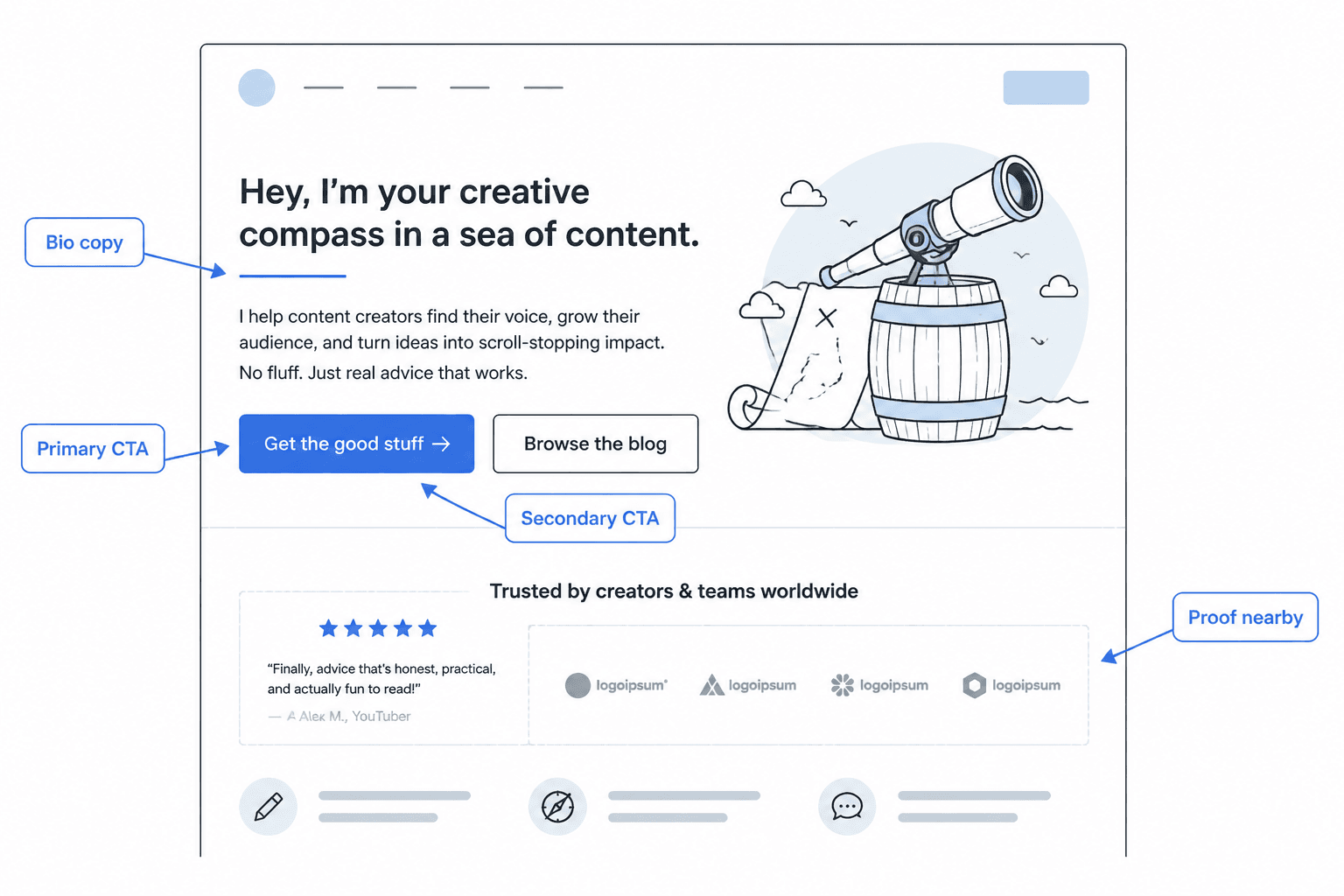
- Bio: clear audience, outcome, and credibility
- Primary CTA: the action for high-intent visitors
- Secondary CTA: a lower-friction trust step
- Proof nearby: examples, results, testimonials, or recognizable context
Example:
I help personal brands, consultants, and service businesses sharpen website copy so visitors actually understand the value and take action.
Primary CTA: Book a website messaging review
Secondary CTA: See before-and-after copy examples
That structure works because it respects both kinds of visitors: the one ready now, and the one who needs another five minutes of reassurance before becoming useful to your pipeline.
The bigger point is simple: clearer structure and clearer writing make the piece more useful. That is usually what makes the ending land better too.