
Most boring lead magnets are not boring because the topic is bad.
They are boring because the packaging is vague, the promise is limp, and the whole thing reads like it was assembled by a committee trying not to offend Excel.
A lot of creators, coaches, consultants, and personal brands do this by accident. They have something useful. Sometimes very useful. But then they wrap it in a title like “The Ultimate Guide to Growth” or “5 Steps to Better Content” and wonder why nobody wants to hand over an email address for it.
If you want to know how to rewrite boring lead magnets, the fix usually is not “make it prettier” or “add more pages.” It is to make the thing feel sharper, more specific, easier to trust, and much more obviously worth downloading.
Here’s how to do that without turning your lead magnet into a hypey little monster. We’ll cover what makes lead magnets feel dead on arrival, how to rewrite the title and promise, what to cut, what to add, and how to make the whole thing feel like it solves an actual problem instead of vaguely waving at one.
Why most lead magnets sound dead before anyone opens them
A boring lead magnet usually has one of these problems:
- It is too broad
- It sounds like generic advice people have already seen 400 times
- It promises a result without showing a mechanism
- It tries to impress instead of help
- It feels padded, vague, or weirdly corporate
- It is named like a school handout no one asked for
And yes, the title matters a lot. But the problem usually runs deeper than the title.
If your lead magnet is called “Content Strategy Checklist” but the actual content is a sleepy list of obvious reminders like “know your audience” and “be consistent,” the title rewrite won’t save you. You need a clearer angle, a better promise, and content that gets to the point faster.
People do not want more free stuff. They want a faster path to a result they already care about.
That is the standard your rewrite has to meet.
If you need broader context on strategy first, it helps to read the main lead magnet hub at lead magnets and related monetization content in this funnel cluster. But for now, let’s fix the thing in front of us.
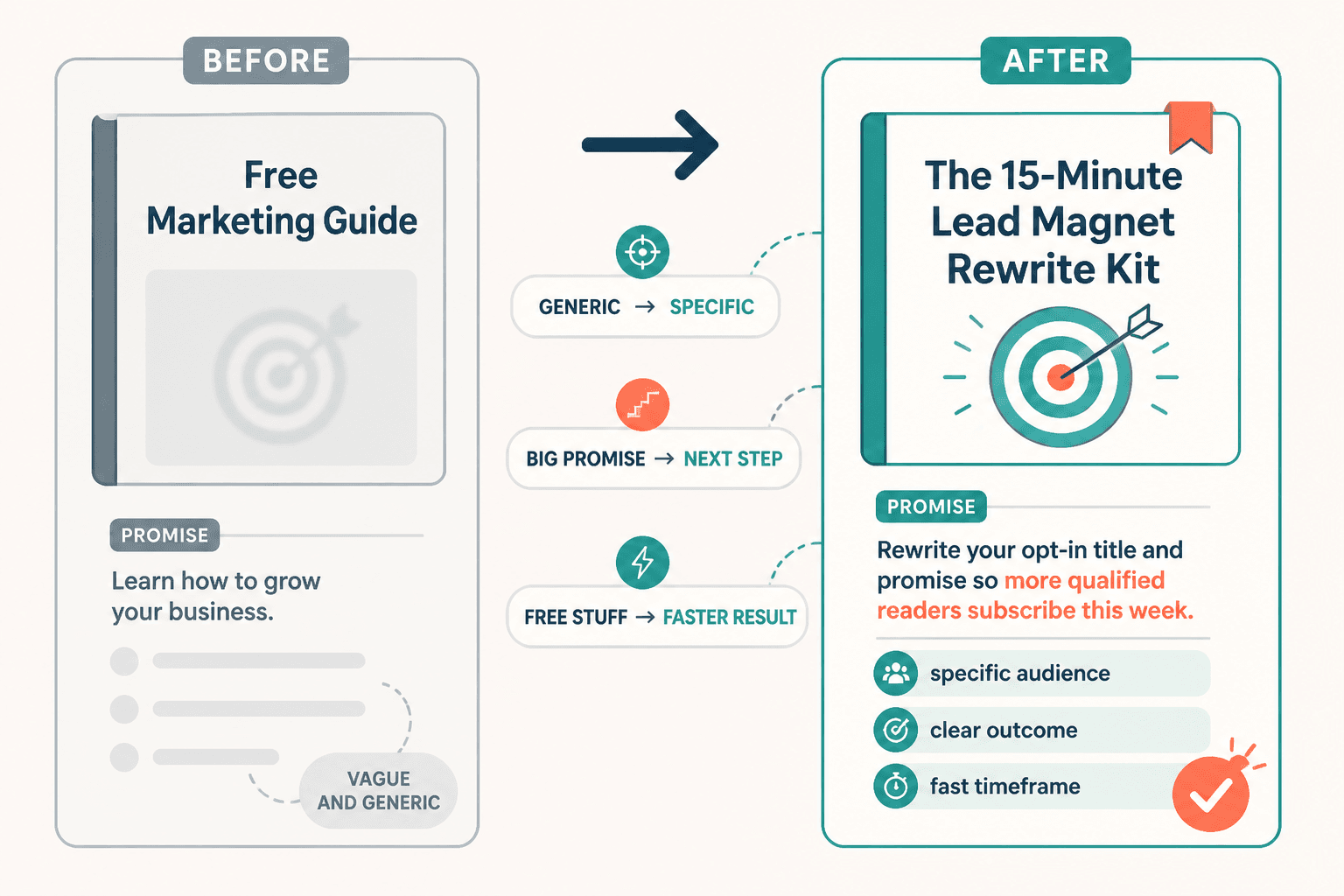
How to spot a boring lead magnet fast
You can usually tell in under 20 seconds.
It sounds interchangeable
If five people in five industries could use the exact same title, it is probably too generic.
“Guide to Building Your Brand” is interchangeable. “The 15-Minute Personal Brand Fix for Consultants Whose Profiles Sound Like Everyone Else’s” is not.
It promises a destination, not a step
“Grow your business” is a destination. Nobody trusts it because it is too big and too foggy.
“Steal this 5-email nurture sequence that turns new subscribers into consultation calls” is a step. It is narrower, easier to picture, and easier to believe.
It has no tension
Boring lead magnets often describe a topic, not a problem.
People are not out here craving a PDF on “content planning.” They want to stop staring at a blank page every week, stop posting random thoughts, and stop wondering why useful posts get ignored.
It sounds too polished
If the wording feels like “solutions-oriented framework for scalable visibility,” congratulations, you have created a lead magnet no human wants to read.
Clean and professional is good. Inflated and bloodless is not.
The rewrite process: how to rewrite boring lead magnets without making them obnoxious
Here’s the simple process.
- Find the real problem the lead magnet solves
- Narrow the audience or situation
- Rewrite the promise so it feels concrete
- Cut generic filler
- Add proof, examples, or usable assets
- Make the next step obvious
That may sound basic. It is basic. Most good rewrites are. The point is not to be clever. The point is to make the value clearer and more usable.
1. Find the actual point
A lot of lead magnets are written from the creator’s point of view, not the reader’s.
The creator thinks, “I should make a resource about content strategy.”
The reader thinks, “Why do my posts get polite silence even when the advice is good?”
That gap matters.
Before you rewrite anything, answer these questions:
- What exact problem is this meant to solve?
- What situation is the reader in when they want this?
- What result will they get faster, easier, or with less confusion?
- What makes this different from random free advice online?
If you cannot answer those clearly, the lead magnet is still too mushy.
2. Narrow the audience or use case
Broad lead magnets feel safer to make. They also tend to convert worse because they feel less relevant.
Specificity is not a limitation. It is a trust signal.
| Weak | Stronger |
|---|---|
| Social Media Guide | 30 LinkedIn Post Starters for Coaches Who Sound Too Generic |
| Email Marketing Tips | 7 Welcome Emails to Warm Up New Leads Before You Pitch Anything |
| Branding Workbook | The Personal Brand Positioning Worksheet for Consultants Who Need Better Referral Language |
| Sales Funnel Template | The Simple Post-to-Booking Funnel for Service Providers With Tiny Audiences |
Notice what changed. The stronger versions define the person, the problem, and often the format. They do not just name a category.
3. Rewrite the promise so a human can picture it
A boring promise sounds like this:
- Improve your content
- Grow your audience
- Build your brand
- Get more leads
Those are outcomes people want, sure. But they are too abstract. Strong lead magnet promises have shape.
Better promises sound like this:
- Write 10 better LinkedIn hooks in 15 minutes
- Turn one client result into three authority-building posts
- Fix the bio that makes qualified leads bounce
- Map a simple nurture sequence without sounding like a funnel goblin
The best promises usually include at least one of these:
- A concrete result
- A specific format
- A time saver
- A clear use case
- A named pain point
4. Cut every page that exists just to look substantial
This is where a lot of lead magnets go floppy.
People think more pages equals more value. Not really. More relevance equals more value. More usefulness equals more value. More pages often just means more throat-clearing and more “before we begin” nonsense.
If the first three pages are a welcome note, a brand story, and a broad explanation of why the topic matters, cut them or compress them hard.
Your reader did not sign up for a warm-up lap. They signed up because they want the shortcut, the checklist, the framework, the examples, or the template.
5. Add assets, not fluff
One reason some lead magnets feel boring is that they offer information when the reader really wanted implementation help.
Information is cheap. Usable structure is not.
Good additions include:
- Templates
- Fill-in-the-blank prompts
- Before-and-after examples
- Mini checklists
- Scripts
- Swipe lines
- Decision trees
- Frameworks with real examples
If you want your lead magnet to pull harder, make the reader feel like they can use part of it today, not “sometime after a productive quarter.”
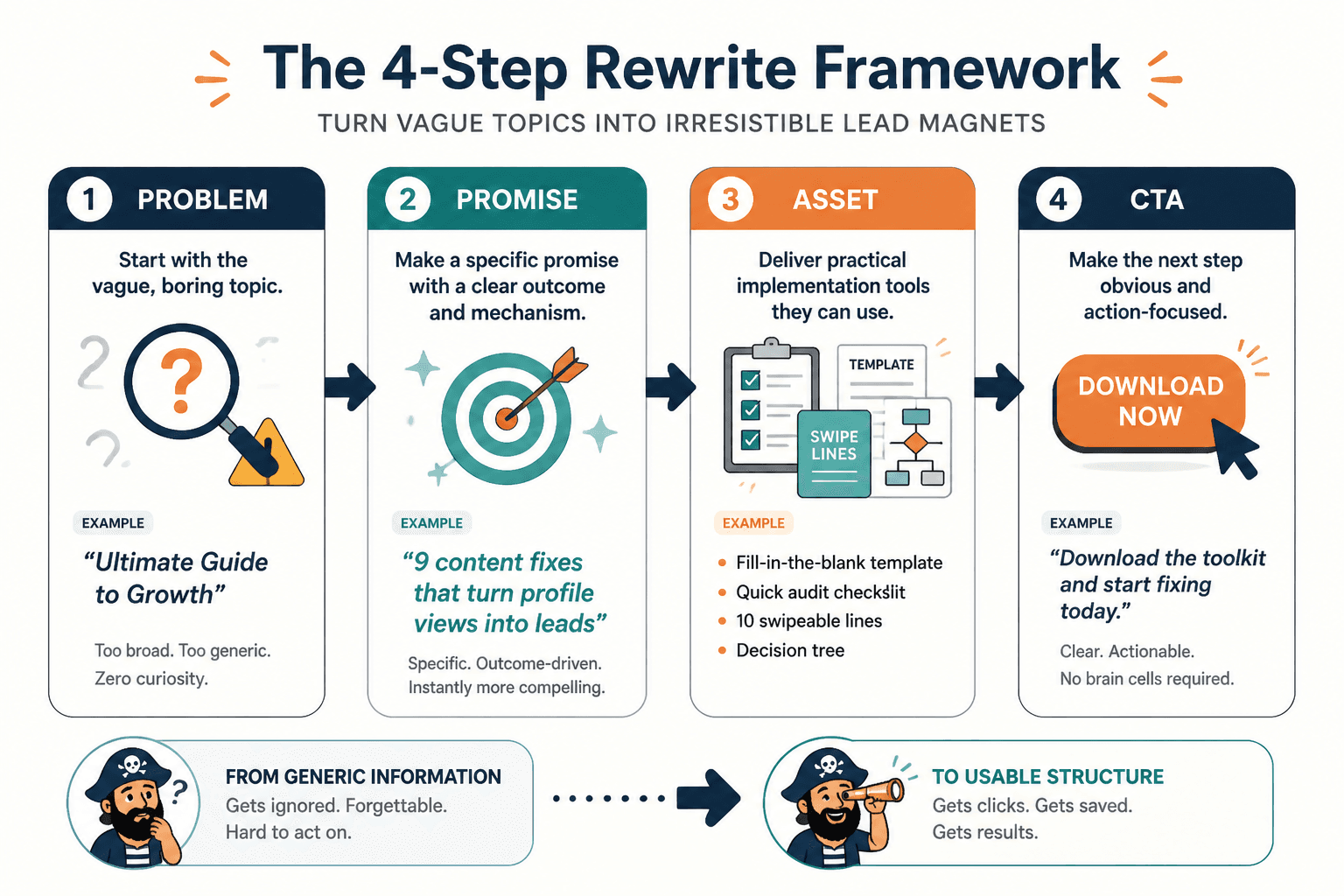
Before-and-after rewrites for boring lead magnets
This is where the problem usually becomes obvious.
Example 1: Generic business freebie
Before: The Ultimate Guide to Online Growth
What is wrong with it: Too broad. Too big. Sounds recycled. No one knows what they are getting or why it is useful.
After: The 9 Content Fixes That Turn Profile Views Into Inbound Leads
Why it works better: Clear mechanism. Clear result. Feels practical instead of grand.
Example 2: Weak content lead magnet
Before: 50 Content Ideas for Entrepreneurs
What is wrong with it: Not terrible, but generic. “Entrepreneurs” is broad enough to include everyone with a Wi-Fi signal and a vague dream.
After: 50 Authority-Building Post Ideas for Coaches and Consultants Who Need Better Leads
Why it works better: Better audience fit. Better intent. Better reason to download.
Example 3: Bland nurture resource
Before: Email Marketing Starter Kit
After: The 5-Email Welcome Sequence That Builds Trust Before You Sell
That rewrite works because people can picture the asset. It sounds like something they can use, not a folder full of vague marketing intentions.
Example 4: Fancy but empty brand workbook
Before: Elevate Your Brand Presence Workbook
After: The Messaging Workbook for Personal Brands Whose Bios and Offers Sound Too Generic
The original sounds polished. It also says almost nothing. The rewrite gives a clear problem and a likely use case.
What to rewrite inside the lead magnet, not just on the cover
This part gets ignored all the time.
You can rewrite the title, subtitle, and landing page all day, but if the inside still feels generic, trust drops fast. The lead magnet has to deliver in the same voice and with the same sharpness as the promise.
Open faster
Your intro should tell the reader what this is, who it is for, and how to use it in a few short paragraphs. That is enough.
You do not need a dramatic founder letter. You do not need to explain the history of content. You do not need to spend two pages proving that leads are important. They know.
Replace generic advice with decisions
Weak lead magnets tell people things they already know.
- Be consistent
- Know your audience
- Provide value
Cool. Groundbreaking. Next we will reveal that water is occasionally wet.
Strong lead magnets help people make decisions. For example:
- Which of these three lead magnet formats fits your offer?
- When should you use a checklist instead of a guide?
- What kind of CTA belongs at the end of this resource?
- How specific should your promise be if your audience is still small?
Decisions are useful. Generic reminders are wallpaper.
Use examples that sound like your audience’s life
If your examples are too generic, the whole thing feels generic.
Compare these:
- “Improve your content strategy”
- “Turn your best client objection into a lead magnet section that pre-sells your process”
The second one sounds like someone who has seen the problem in the wild.
End with a next step that fits the promise
A boring lead magnet often ends in one of two bad ways:
- No next step at all
- A sudden hard pitch that feels like a trap door
The better option is a soft, relevant next action.
If the lead magnet helped them fix messaging, invite them to a related audit, article, or consultation. If it gave them content prompts, point them to a deeper resource on turning those ideas into leads. There should be a clean bridge between the free help and the paid or next-stage help.
For that, the best follow-ups usually deepen the same problem instead of changing the subject completely. The lead magnet should open a path, not dump the reader into a random hallway.
That is what makes a rewrite worth doing. A stronger lead magnet does not just sound better. It creates a cleaner bridge between free help, real trust, and the next useful offer.