Most affiliate disclosure advice is either too vague to trust or so legal-sounding it makes your article feel like it was reviewed by a nervous blender.
That is the problem.
Personal brands do not need affiliate disclosures that sound stiff, hidden, or weirdly defensive. They need disclosures that are clear, honest, easy to notice, and written in the same voice as the rest of the article. If your disclosure feels like a sneaky fine-print maneuver, readers notice. And they do not reward that with trust.
Better Affiliate Articles Affiliate Disclosures for Personal Brands comes down to one simple idea: say what the relationship is, say it early enough to matter, and say it like a normal person. Not a compliance robot. Not a hype merchant. A person.
This guide will help you write affiliate disclosures that protect trust instead of quietly draining it. We will cover where disclosures should go, what they should say, what not to do, and how to make them fit naturally inside articles, reviews, comparison posts, and resource pages. If you are building monetized content as a creator, coach, consultant, or solo business, this part matters more than people like to admit.
If you are still building your broader affiliate article strategy, it helps to start with the main affiliate articles hub and the more complete affiliate articles guide for creators who want better results. Disclosures are one piece of the machine. A very important piece, but still one piece.
Why affiliate disclosures matter more for personal brands
Big publishers can sometimes get away with looking cold. Personal brands cannot.
When people read your content, they are not just assessing the tool, product, or recommendation. They are assessing you. Your taste. Your honesty. Your standards. Your willingness to make money without acting slippery about it.
That is why weak affiliate disclosures do more damage for personal brands than for faceless review sites. If someone feels even slightly tricked, it does not just hurt the article. It stains the relationship.
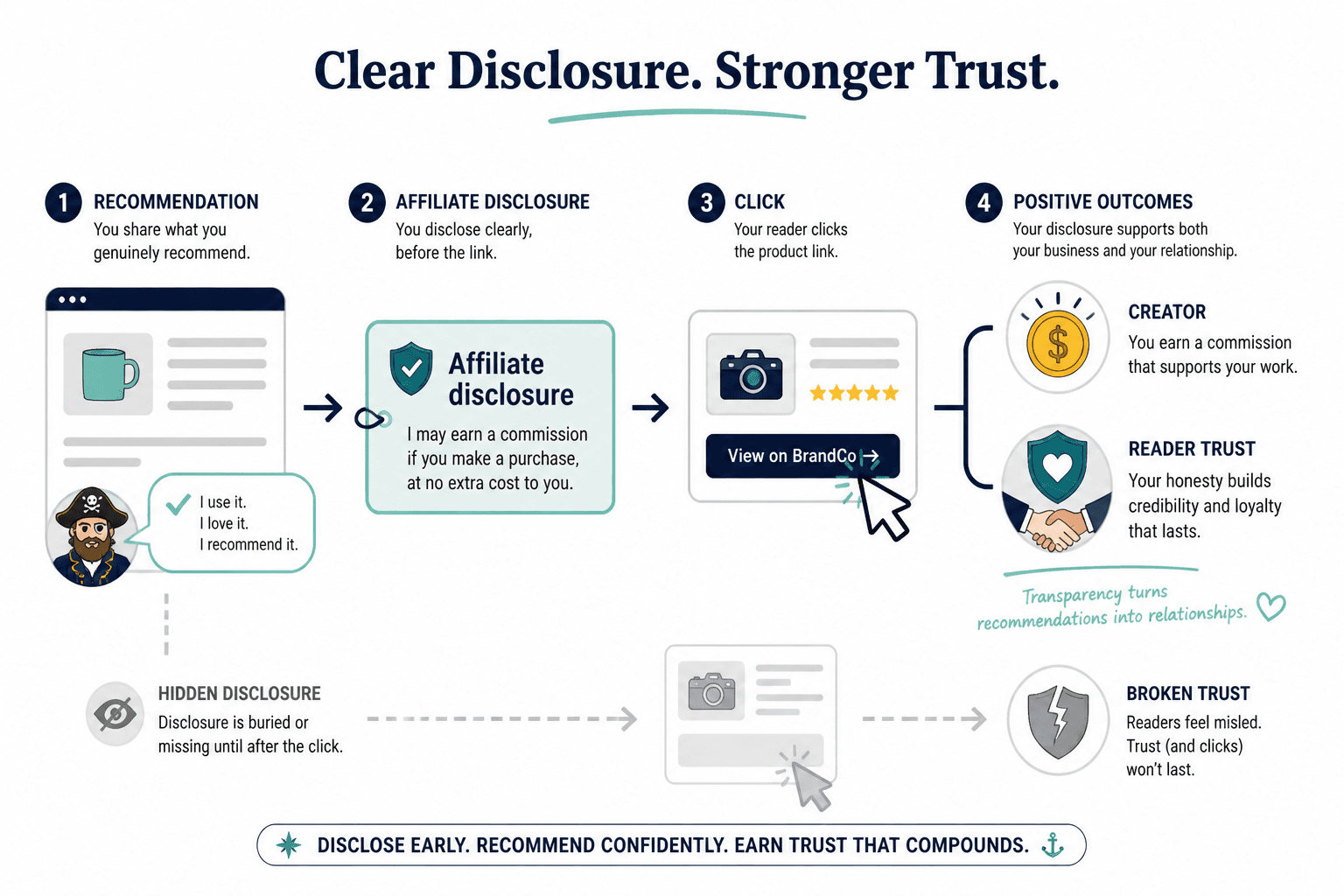
A good disclosure does three jobs at once:
- It tells readers you may earn a commission.
- It makes the commercial relationship visible before they act.
- It reassures them that the recommendation is still filtered through your actual judgment.
That third point is where a lot of creators fumble it. They disclose the link, but they do it in a way that raises a bigger question: “So are you recommending this because it is good, or because it pays?”
Your wording should answer that without sounding theatrical. Calm beats dramatic here.
What a better affiliate disclosure actually needs to do
Good disclosures are not about dumping a legal phrase somewhere near the footer and hoping nobody notices. They need to be noticeable, readable, and understandable in about two seconds.
At minimum, your disclosure should make these things obvious:
- You may receive a commission if someone buys through the link.
- There is no extra cost to the reader, if that is true.
- Your recommendation is based on real use, real judgment, or a clearly stated reason.
That is enough in most article contexts. You do not need to write a tiny legal novella every time you mention software.
The standard you should aim for
If a smart reader skims your article, they should not have to hunt for the disclosure, decode it, or wonder what it means. The clearer you are, the more relaxed the article feels. Strange little secretive disclosures create friction because readers can smell the intent.
And yes, this is one of those places where trying to sound more “professional” usually makes the writing worse.
Where to place affiliate disclosures in articles
Placement matters almost as much as wording.
If your disclosure appears only after five scrolls, three glowing recommendations, and a button, that is not a great look. A better approach is to place it where readers can see it before they are likely to click or form the impression that your recommendations are purely editorial.
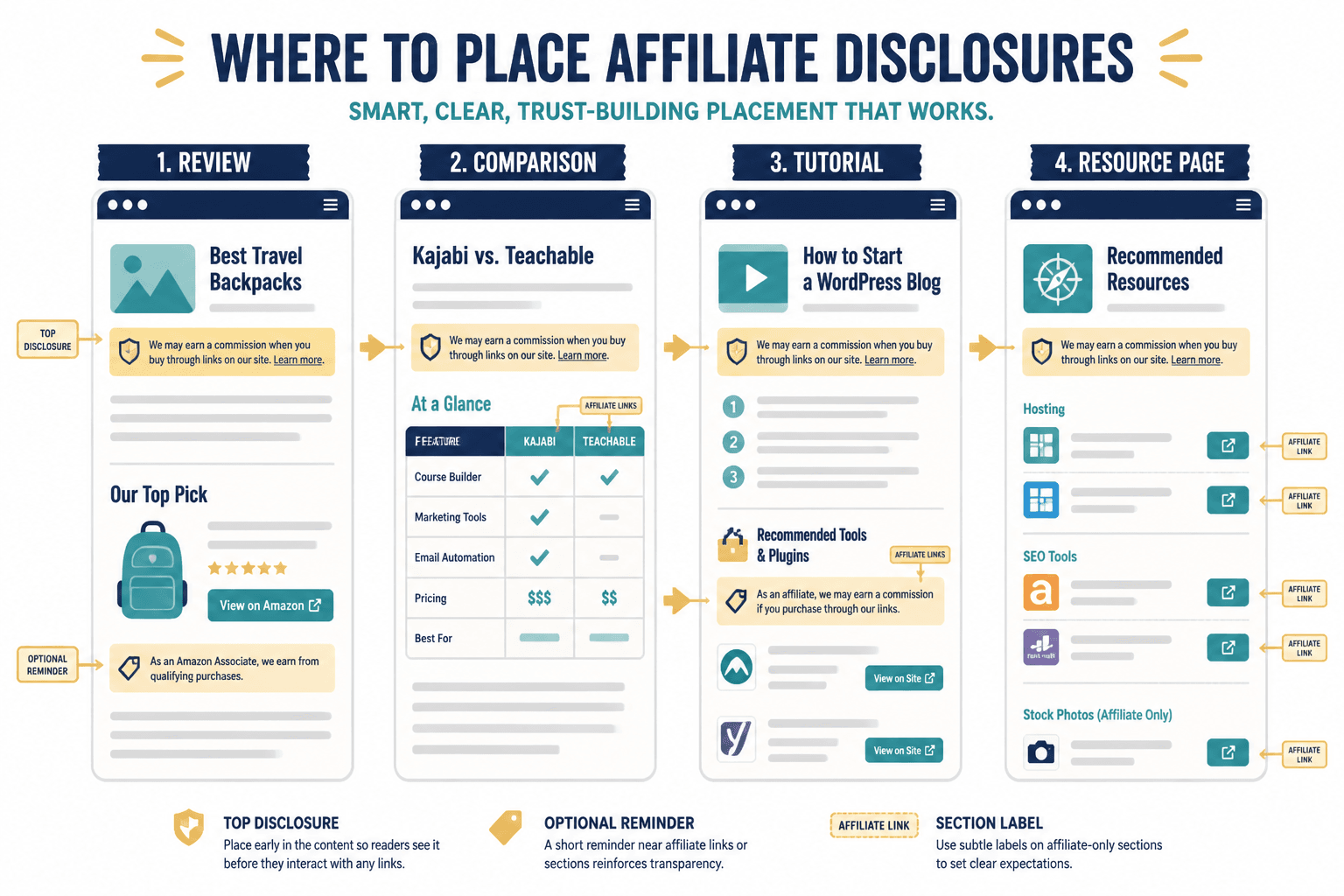
For most personal-brand affiliate articles, use disclosures in one or more of these spots:
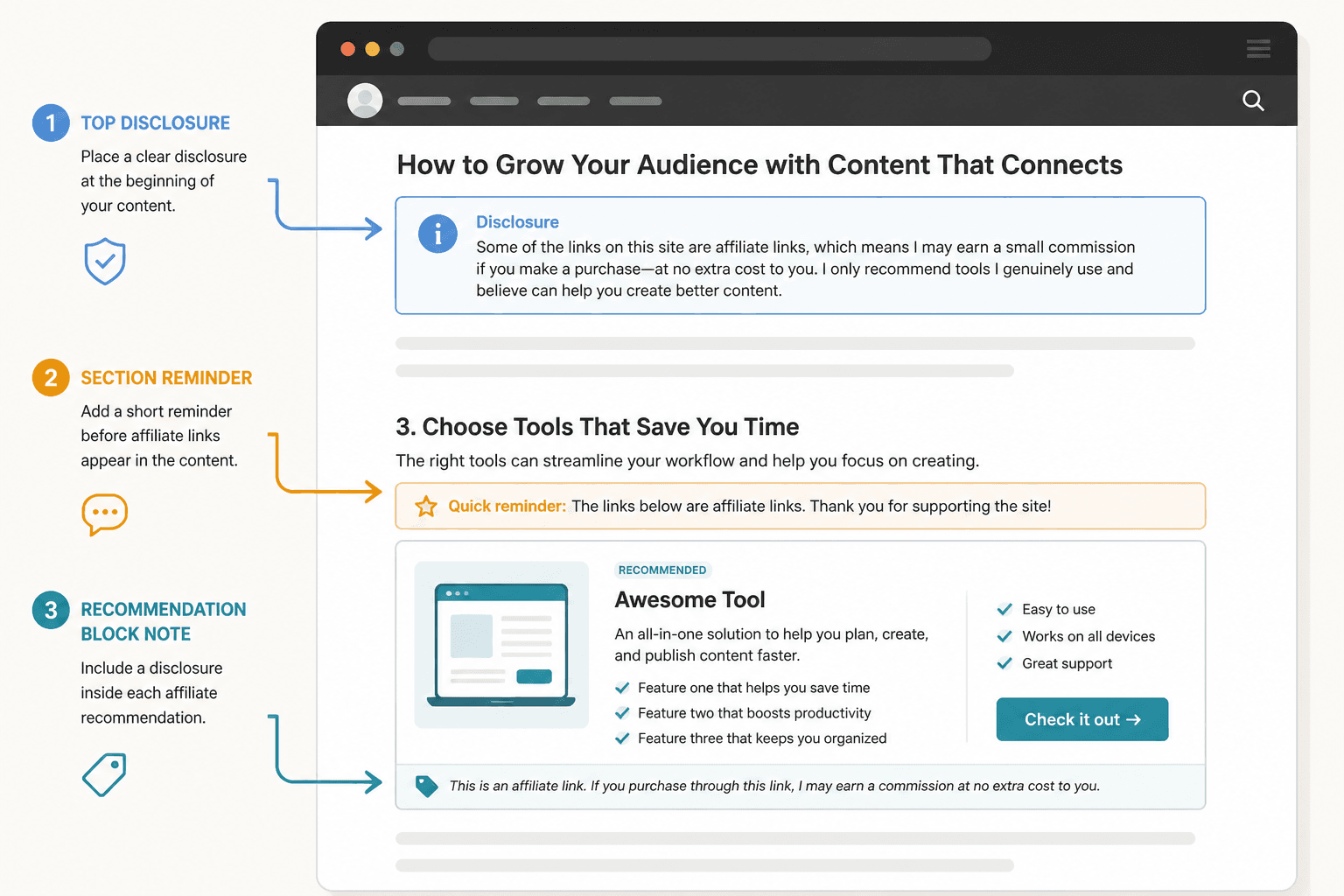
- Near the top of the article, before the first affiliate link
- Near product sections or recommendation blocks
- Right before a call to action or button-like recommendation line
- On resource pages or tools pages, near the intro
This does not mean you need to repeat the same sentence every six inches like an anxious parrot. It means readers should not miss it if they are reading normally or skimming like a caffeinated raccoon.
A practical placement rule
If the first meaningful opportunity to click comes before the disclosure, your disclosure is too late.
Simple affiliate disclosure examples that do not sound awful
Here are a few disclosure examples that work well for personal brands because they are clear, human, and not drenched in corporate varnish.
Short intro disclosure
Some links in this article are affiliate links, which means I may earn a commission if you buy through them. I only recommend tools I believe are genuinely useful.
Warmer creator-style disclosure
A quick note: a few links below are affiliate links. If you decide to buy through them, I may earn a commission at no extra cost to you. I do my best to recommend things I would still mention if there were no commission attached.
Tools page disclosure
This page includes some affiliate links. If you use them, I may earn a commission. I have included these tools because they fit the kind of work I do and recommend, not because they happen to have an affiliate program.
Section-level disclosure for product recommendations
This section includes affiliate links. If you buy through them, I may earn a commission. I have noted where I have direct experience and where a recommendation is based on specific features or fit.
Notice what these do well: they are plain, visible, and calm. No strange overexplaining. No dramatic “full transparency” speech. No guilt perfume.
What bad affiliate disclosures usually get wrong
Bad disclosures tend to fail in one of four ways.
- They are hidden.
- They are vague.
- They are too legalistic to understand quickly.
- They sound more trustworthy than the article actually is.
That last one matters. You cannot patch over weak recommendations with a very noble-sounding disclosure. If the article is thin, generic, or obviously written to farm commissions, the disclosure will not rescue it. It just becomes lipstick on a trust issue.
Weak vs better disclosure examples
| Weak | Better |
|---|---|
| Disclaimer: Compensation may be received from partners referenced herein. | Some links in this article are affiliate links, which means I may earn a commission if you buy through them. |
| This post may contain promotional considerations. | A few recommendations below use affiliate links. If you buy through them, I may earn a commission at no extra cost to you. |
| I am an affiliate for some tools. | I use affiliate links for some tools mentioned here, but I only include tools I believe are worth considering for this specific job. |
See the difference? The better versions sound like somebody trying to be understood. The weak versions sound like they were extracted from a haunted PDF.
How to match the disclosure to the type of affiliate article
Not every article needs the exact same disclosure style. The right version depends on what kind of affiliate article you are publishing and how recommendation-heavy it is.
For review articles
Be especially clear. Readers are making a judgment about your impartiality. A review article disclosure should make the affiliate relationship obvious and, if true, mention direct experience with the product.
This review includes affiliate links. If you buy through them, I may earn a commission. I have used this tool in my own workflow, and the review reflects my actual experience with its strengths and limitations.
For comparison articles
Comparisons can get messy because different products may pay differently. That is exactly why the disclosure needs to be simple and visible. The article itself should also show balanced reasoning, not suspiciously convenient enthusiasm for the highest-paying option.
This comparison includes affiliate links for some of the tools mentioned. If you choose one through these links, I may earn a commission. I have tried to focus on fit, tradeoffs, and who each option is actually best for.
For resource pages and tool stacks
These pages often get skimmed fast, so the disclosure should appear near the intro. If nearly every link is affiliated, just say that plainly and move on.
This page includes some affiliate links. If you buy through them, I may earn a commission. These are the tools I use, recommend, or think are worth considering for this kind of work.
For tutorial or educational articles
Educational content can feel especially slippery if the disclosure only appears right at the moment of recommendation. It is usually cleaner to note the affiliate relationship near the top, then add a brief reminder near the product section if needed.
If you want stronger article formats for these monetized posts, read affiliate articles examples for coaches, consultants and personal brands and how to write affiliate articles without sounding salesy or robotic. Good disclosure works best when the article itself already feels useful and fair.
How to keep disclosures clear without killing the flow
A lot of people worry that disclosures make articles feel clunky. Usually that happens because the disclosure is trying too hard to sound official or persuasive at the same time.
The fix is simple: separate the disclosure from the pitch.
Your disclosure is not the place to sell. It is the place to clarify. Once you start stuffing in lines about how much you “absolutely love” the product or how “proud” you are to partner with a tool, the sentence stops sounding like a disclosure and starts sounding like a sponsored wink.
Keep it clean. Then let the actual article make the case.
A useful formula
- State the relationship
- Explain the commission plainly
- Clarify cost to reader if true
- Add one brief credibility line if needed
For example:
Some links below are affiliate links, so I may earn a commission if you buy through them. It does not cost you extra. I only include tools that fit the work this article is actually about.
That is enough. You do not need to perform sincerity like you are auditioning for ethical content theater.
What to say if you have not personally used every product
This is where many affiliate articles start getting slippery.
If you have not used something personally, do not write around that fact like a politician trapped in a swivel chair. Just be clear. You can still include products you have researched well or that fit a certain use case, but your wording should reflect reality.
For example:
Some links in this guide are affiliate links. If you buy through them, I may earn a commission. I have used some of these tools directly, and others are included because they are strong options for specific needs based on research, feature fit, and market reputation.
That is honest. It also keeps you from implying hands-on experience you do not have, which is one of the fastest ways to rot your credibility from the inside.
How disclosures connect to trust, conversions, and long-term monetization
Some creators still treat disclosures like a conversion threat. They worry that if they are too direct, fewer people will click.
Maybe a few will not. Fine.
The people who do click will be doing it with cleaner expectations, which usually means better trust and less friction after the click. That matters more than squeezing out a few extra shaky clicks from people who feel mildly tricked once they realize what is happening.
Good monetization is not just about making the click happen. It is about making the recommendation feel earned. Clear disclosures support that. Hidden ones undermine it.
If your goal is to build affiliate income without turning your content into a low-grade trust leak, read how to monetize affiliate articles without wrecking trust. That article covers the bigger monetization strategy around this, not just the disclosure line itself.
A simple disclosure workflow for personal brands
If you want this process to stay easy, do not reinvent your disclosure every time. Build a small system.
- Create 2 to 4 disclosure templates that match your article types.
- Place one near the top of each affiliate article draft.
- Add a shorter reminder near heavy recommendation sections if needed.
- Check that the first affiliate link does not appear before the disclosure.
- Make sure the article does not imply personal use where none exists.
- Read the disclosure out loud once. If it sounds stiff, rewrite it.
This is one of those boring little systems that saves you from future mess. Useful, unglamorous, and far more important than another color-coded content dashboard.
Quick disclosure templates you can adapt
Basic template
Some links in this article are affiliate links, which means I may earn a commission if you buy through them.
Basic plus trust line
Some links in this article are affiliate links, which means I may earn a commission if you buy through them. I only include products that are relevant to the topic and worth considering.
With no extra cost line
A few links below are affiliate links. If you buy through them, I may earn a commission at no extra cost to you.
Mixed direct use and research-based recommendations
This article includes affiliate links. If you buy through them, I may earn a commission. Some recommendations are based on direct use, while others are included because they are strong fits for specific needs.
Resource page template
This page includes some affiliate links. If you use them, I may earn a commission. These are tools I use, recommend, or believe are worth considering for this kind of work.
Common disclosure mistakes personal brands should stop making
- Hiding the disclosure at the very bottom of the article
- Using vague terms like “partners” or “promotional considerations”
- Making the disclosure so formal that readers barely understand it
- Pretending every recommendation comes from personal use
- Using the disclosure as a mini sales pitch
- Only disclosing once on a broad site-wide page nobody reads
- Copy-pasting a disclosure that does not fit the article format
If you fix just those seven things, your affiliate content already starts feeling more credible.
FAQ
Where should an affiliate disclosure go in an article?
Place it before the first affiliate link and near the top if the article is recommendation-heavy.
Does every affiliate article need a disclosure?
Yes. If affiliate links are present, readers should be told clearly and early enough for it to matter.
In practice, the best disclosure is the one that is easy to notice, easy to understand, and honest enough that readers do not feel managed. That kind of clarity protects trust better than any legalistic wording ever will.