Most affiliate articles do not fail because the links are wrong. They fail because the article is weak long before the link shows up.
The creator has no angle, no proof, no useful structure, and no real reason for the reader to trust the recommendation. Then they wonder why the post gets traffic but no clicks, or clicks but no sales, or sales once and never again. Shocking.
If you want better results from affiliate content, you need better article strategy, not more random product mentions sprinkled into tired blog posts. A strong Affiliate Articles Guide for Creators Who Want Better Results is really a guide to trust, specificity, and buying intent. The money part comes later.
This article will show you how to write affiliate articles that actually help people decide, click, and buy without turning your content into a thinly disguised ad. We’ll cover what makes affiliate articles work, what formats tend to perform best, how to structure them, where creators usually sabotage themselves, and how to make your recommendations feel credible instead of convenient.
What affiliate articles are supposed to do
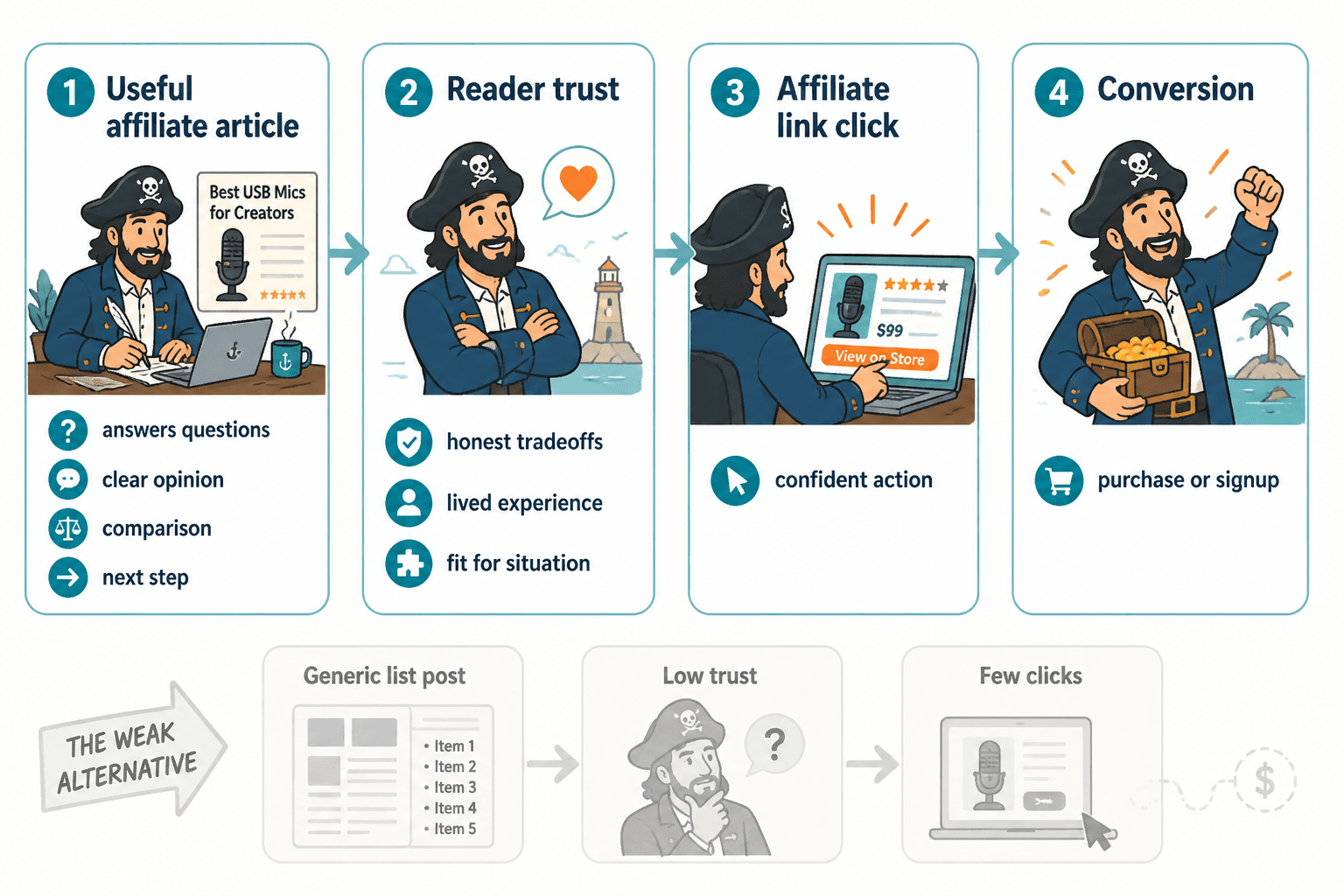
A good affiliate article does not just “mention a product.” It helps a reader move from uncertainty to decision.
That means your job is not only to attract traffic. Your job is to reduce friction. You are helping someone answer questions like:
- Is this thing actually worth it?
- Is it right for my situation?
- What are the tradeoffs?
- How does it compare to alternatives?
- Can I trust the person recommending it?
- What should I do next?
If your article does not answer those questions, the affiliate link is just decoration.
This is why bland “Top 10 Tools” content often underperforms unless the creator already has strong authority or search traffic. The article is usually assembled, not argued. It lists products, says they are “great,” and gives the reader almost nothing they could not skim elsewhere in thirty seconds.
Useful affiliate content has shape. It has judgment. It tells the reader what is good, what is overrated, who each option is for, and where people waste money.
Why most creators get weak affiliate results
Usually, it is one of these problems.
- They pick topics with weak buying intent. Helpful topic, wrong moment. Readers are curious, not ready.
- They write broad articles instead of decision-making articles. Broad gets views. Decision-making gets clicks.
- They sound too polished. Readers can smell “I am pretending to be neutral while clearly trying to sell this” from across the internet.
- They recommend too many things. More choice often means less action.
- They add no lived perspective. No use case, no opinion, no comparison, no proof.
- They hide the affiliate relationship awkwardly. That does not build trust. It does the opposite.
- They treat SEO and conversion like separate jobs. They are not.
Creators especially make one avoidable mistake: they write affiliate content like a review site, even when what they actually have is personal brand trust. That is backwards. A faceless site can try to win on volume and keyword spread. A creator usually wins by being specific, credible, and human.
If you want more depth on article quality itself, read how to write better affiliate articles. If you want angle ideas before you even draft, these affiliate article ideas and examples for creators will help.
Pick affiliate article formats that match real buying intent
Not every affiliate article works the same way. Some attract search traffic. Some convert warm readers. Some build trust and lead to later clicks. If you use one format for every offer, results will get weird fast.
1. Best-for articles
Example: “Best email platforms for solo coaches”
These work when the audience already knows the category and wants help choosing. Good for search. Good for comparison. Good for people close to buying.
They fail when they become lazy listicles stuffed with generic praise.
2. Comparison articles
Example: “ConvertKit vs MailerLite for creators with small lists”
These are often stronger than broad list posts because the reader is further along in the decision process. The intent is sharper. The job is clearer.
If you can write a clean comparison with honest tradeoffs, this format punches above its weight.
3. Use-case articles
Example: “The writing tools I use to turn one idea into five posts”
This format works well for creators because it connects the tool to a workflow. Readers do not just see the product. They see the product doing something useful in context.
4. Problem-solution articles
Example: “How I organize content ideas without losing half of them”
This approach can convert well because it starts with a pain point, then introduces the tool or resource as part of the fix. The trick is not to force the product in too early. Solve first. Recommend naturally.
5. Honest review articles
Example: “My honest review of [tool] after 6 months”
These can work beautifully if you have actual experience and actual opinions. They fail miserably when they read like a press release in a fake moustache.
6. Resource roundups
Example: “My favorite tools for running a one-person content business”
These are useful for warm audiences who already trust you. They are usually weaker for cold search traffic unless the angle is specific enough to compete.
How to choose the right affiliate angle
The product is not the angle. The reader’s decision is the angle.
That shift matters. A boring affiliate article says, “Here are some tools I like.” A better one says, “If you are trying to do this specific thing, here is the option I would pick, who it is best for, and where I would not waste my money.”
Before you write, answer these five questions:
- What exact problem or purchase decision is this article helping with?
- How aware is the reader already?
- What makes my perspective more useful than a generic roundup?
- What objections or doubts need to be addressed?
- What action should the reader take by the end?
If those answers are fuzzy, the article probably will be too.
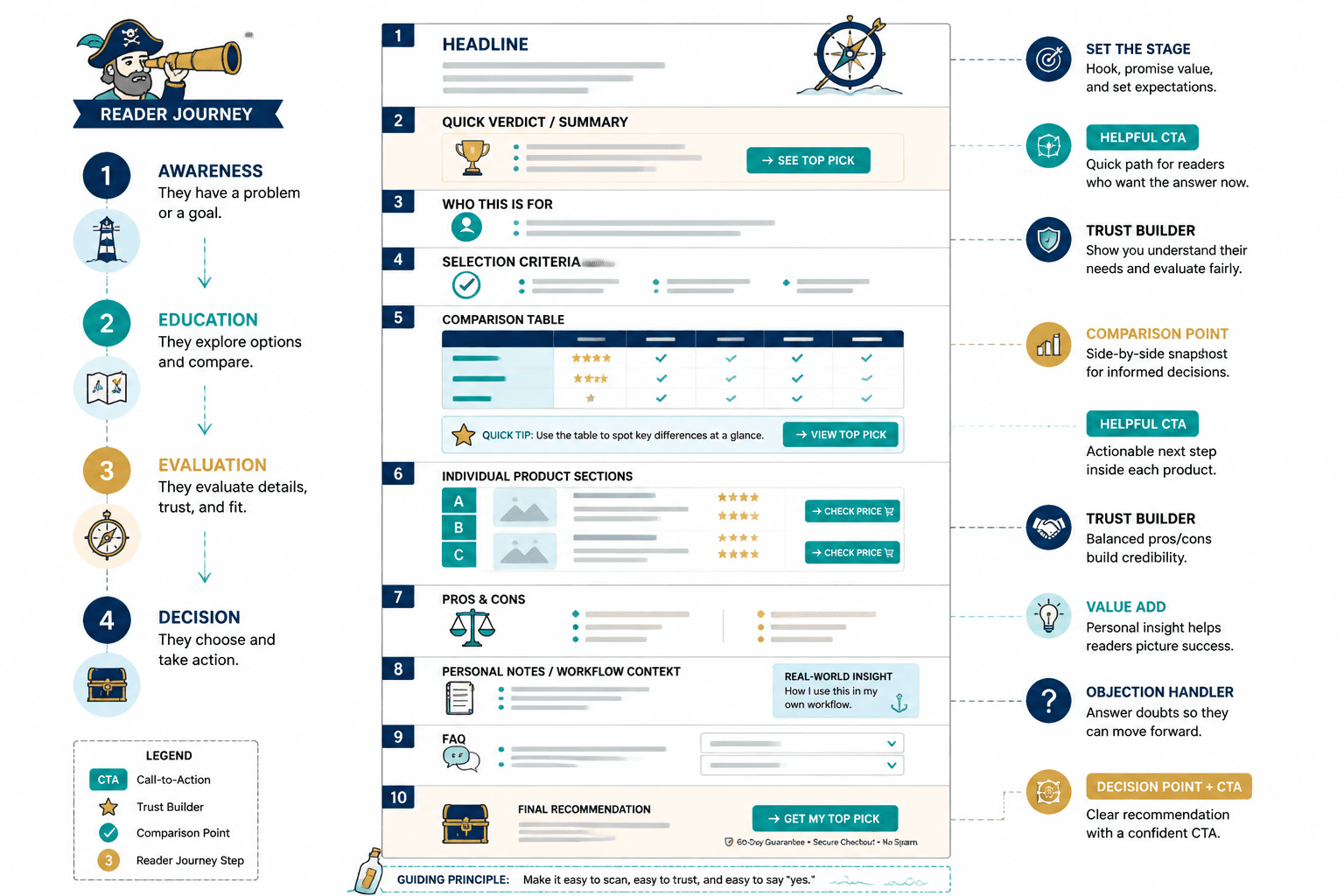
A simple structure for affiliate articles that convert better
You do not need a fancy funnel dissertation. You need a structure that respects the reader’s brain.
Here is a practical affiliate article structure for creators.
Start with the decision, not the category
Weak opening: “There are many tools available for creators today…”
That line should be fined.
Better opening: name the actual choice, frustration, or tradeoff.
If you are trying to pick an email platform as a solo creator, the hardest part usually is not finding options. It is figuring out which one fits your stage, budget, and actual workflow before you migrate half your business into the wrong tool.
Show how you are evaluating the options
This builds trust quickly. It also helps readers understand that your recommendation is based on criteria, not random vibes.
- Price
- Ease of use
- Best use case
- Features that matter most
- Limitations
- Who should skip it
Give clear recommendations with honest qualifiers
Readers do not need neutral mush. They need useful judgment.
Say things like:
- Best if you want simplicity over endless features
- Worth it if email is central to your business
- Overkill for most early-stage creators
- Good tool, annoying interface
- Cheaper upfront, but the automation limits matter later
That kind of specificity is what makes people trust your recommendation.
Add proof, context, or examples
This is where creator affiliate articles can beat generic sites. You can explain how the tool fits into a real workflow, what changed after using it, where it saved time, or where it disappointed you.
You do not need to manufacture dramatic case studies. Even modest specifics help.
I like this tool for outlining article ideas because it lets me sort rough drafts by topic and stage. That sounds tiny. It is not. Tiny workflow friction is how good ideas quietly die.
Use CTAs that fit the article
A CTA in an affiliate article should help the reader act, not shove them toward a checkout page like a pushy sales intern.
Better CTA examples:
- If you want the simplest option, this is the one I would start with.
- If your priority is better automation, check this one first.
- If you are still comparing options, start with the free trial and test the workflow that matters most to you.
- If you need a beginner-friendly pick, this is probably the least annoying place to start.
Notice the difference. Helpful. Specific. No fake urgency fog machine.
What to include in a high-trust affiliate article
If you want affiliate articles to perform over time, include elements that make decisions easier and trust stronger.
| Element | Why it matters |
|---|---|
| Specific audience fit | Helps readers quickly see if the recommendation is for them |
| Selection criteria | Shows your logic, not just your preference |
| Pros and cons | Builds credibility through honesty |
| Best-for statements | Moves people toward the right option faster |
| Comparisons | Reduces friction for readers deciding between alternatives |
| Personal context or workflow notes | Makes the article feel lived-in, not assembled |
| Clear disclosures | Protects trust and keeps things clean |
| Natural CTAs | Improves clicks without making the article feel gross |
And yes, disclosures matter. If you are vague or sneaky about affiliate links, you are not being strategic. You are being cheap with trust. Read this guide to affiliate disclosures for personal brands if that part of your setup needs work.
How to write affiliate content without sounding like a brochure
This is the part a lot of creators get wrong because they think “professional” means emotionally airbrushed and weirdly formal.
It does not.
If you want your affiliate article to sound credible, do these things:
- Use plain language
- Make direct recommendations
- Name tradeoffs
- Cut generic praise
- Explain who should not buy
- Use examples instead of adjectives
Here is a quick before and after.
Weak affiliate copy
This amazing platform offers a robust suite of features for entrepreneurs looking to streamline their operations and maximize productivity.
Better affiliate copy
This tool is useful if you want one place to manage client notes, content ideas, and light project tracking. I would not use it for complex team operations, but for a solo business it removes a lot of admin clutter without much setup pain.
The second version sounds like a person who has seen the thing. The first sounds like it was generated by an office printer.
SEO matters, but search traffic alone will not save weak affiliate articles
Yes, affiliate articles should be SEO-aware. No, that does not mean stuffing the same phrase into every heading and hoping Google has a lapse in judgment.
Search-friendly affiliate content usually works because it matches intent well. That means:
- The topic reflects a real decision or comparison
- The headline is specific
- The intro confirms the exact problem quickly
- The structure makes scanning easy
- The article actually answers what the searcher came for
For creators, there is a useful middle ground here. You do not need to become a niche affiliate SEO goblin publishing seventy-six mediocre posts a month. You can create fewer, better articles with stronger opinions and better conversion paths.
That approach is especially useful if your traffic also comes from your audience, newsletter, profile, or social posts. In that case, the article is doing two jobs at once: capturing search intent and reinforcing personal trust.
Best practices for creators with smaller audiences
You do not need a huge audience to make affiliate articles work. You need relevance, trust, and enough distribution to get the article in front of the right people.
Smaller creators often do better when they stop copying giant review sites and start leaning into narrower, clearer angles.
- Write for a specific audience, not “everyone”
- Recommend fewer products more thoughtfully
- Focus on tools you genuinely use or understand
- Create problem-based articles, not giant catch-all roundups
- Link articles from your newsletter, bio, and social posts
- Build clusters around one category so trust compounds
If that is your situation, read affiliate articles for creators with small audiences. It is a better playbook than trying to out-volume websites with teams, budgets, and enough spreadsheet energy to ruin a weekend.
A practical workflow for better affiliate article results
If you want this to become a repeatable channel instead of a random side tactic, use a workflow.
- Choose one monetizable category
Pick a category that fits your audience and content naturally. - List the decision-stage questions people ask
Think best options, comparisons, alternatives, reviews, beginner picks, budget picks, and use-case articles. - Map each article to one clear intent
Do not mix “what is this category” and “which one should I buy” in the same article unless you can do it cleanly. - Write with criteria, context, and recommendations
Make the article useful enough to stand even without the affiliate link. - Add a clean disclosure
Visible, honest, not buried in tiny print guilt. - Use internal links smartly
Connect related articles so readers can keep evaluating. - Promote the article through your existing channels
Especially social posts, newsletter mentions, and related articles. - Update based on changes and feedback
Products evolve. So should your article.
That last point matters more than people think. One decent affiliate article that gets updated and strengthened over time can beat five stale ones that slowly become internet wallpaper.
Internal linking and article clusters make affiliate content stronger
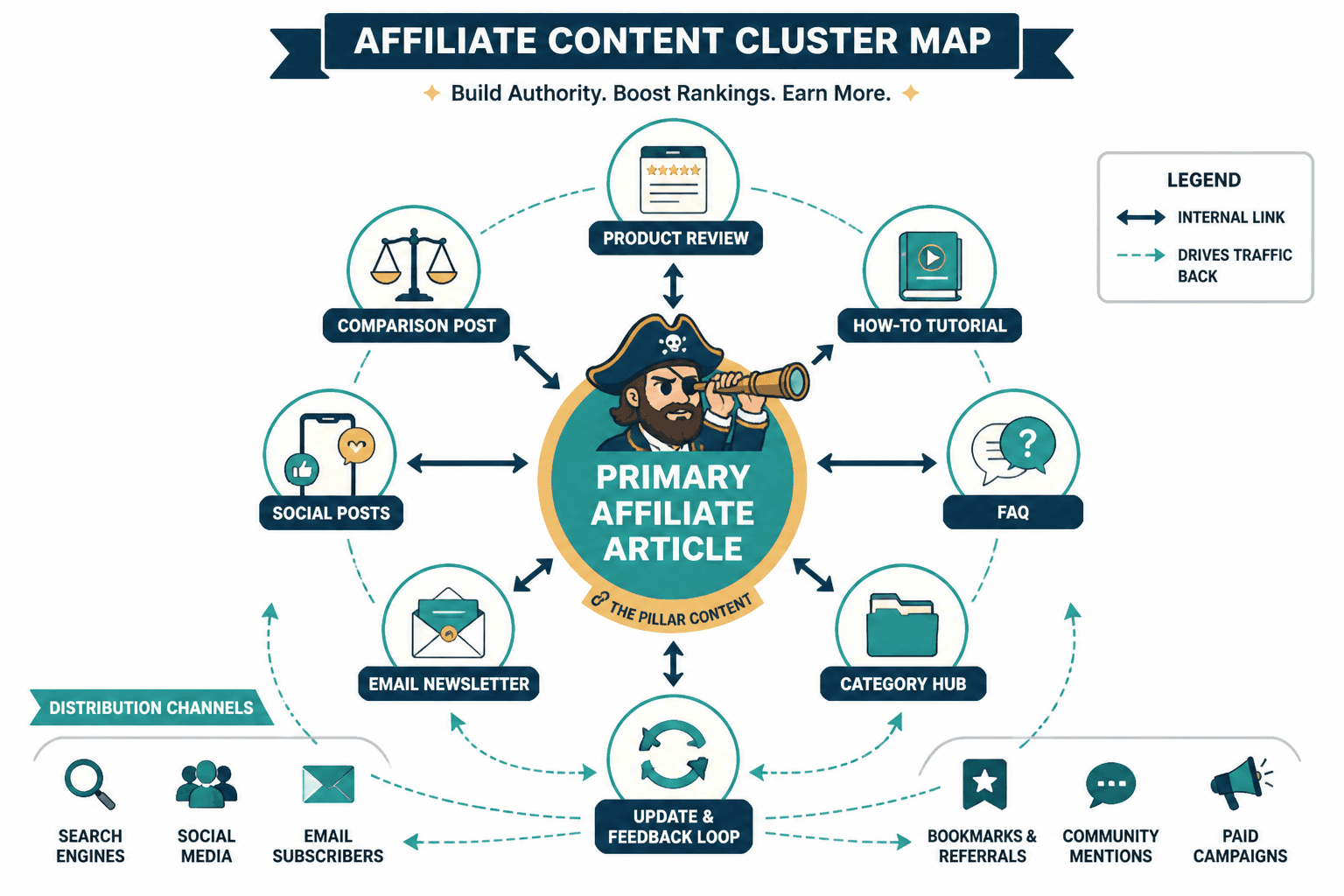
Affiliate articles work better when they are not isolated.
If you have one main monetization category, build supporting content around it. That creates a better reader journey and gives each article more context.
For example, you might connect:
- A broad category page on affiliate articles
- Your larger monetization content hub at related monetization resources
- A guide on writing better affiliate articles
- A piece with affiliate article ideas and examples
- A guide for small-audience creators
- A post on affiliate disclosures
This kind of cluster helps both readers and your site. Readers can move from awareness to comparison to action. Your content stops acting like isolated islands and starts acting like a real system.
Common affiliate article mistakes worth fixing immediately
- Leading with the product instead of the problem
Readers care about their decision first. - Sounding too neutral
Useful affiliate content needs judgment. - Sounding too salesy
Trust collapses when every paragraph is steering too hard. - Listing features with no interpretation
Features matter less than fit. - Recommending products you barely know
If you cannot explain the tradeoffs, do not pretend. - Ignoring objections
Price, complexity, alternatives, and audience fit should be addressed. - Using weak CTAs
“Click here now” is not exactly persuasive genius. - Writing one-off articles with no content strategy
Affiliate content performs better as a connected body of work.
FAQ
How long should an affiliate article be?
Long enough to help a real decision. For many topics, 1,200 to 2,500 words is plenty. Add more only if the comparison or buying decision actually needs it.
Should every affiliate article be a review?
No. Comparisons, best-for articles, use-case articles, and problem-solution pieces are often stronger.
Do affiliate disclosures reduce conversions?
Usually, honest disclosures help trust more than they hurt clicks. Sneaky disclosure habits are a worse long-term bet.
Can small creators make money from affiliate articles?
Yes, if the audience is relevant and the articles are specific. A small audience with buying intent is more useful than a large audience with no clear need.
What is the best affiliate article format for creators?
Usually the one that matches a clear audience decision: best-for, comparison, honest review, or workflow-based use case.
Write affiliate articles like recommendations, not bait
The best affiliate content does not feel like monetization first. It feels like useful judgment first.
That is the real point of an Affiliate Articles Guide for Creators Who Want Better Results. Better results come from better recommendations, better structure, better trust, and better alignment between the reader’s problem and your suggested solution.
If your article can genuinely help someone make a smarter decision, the click has a reason to happen. If it cannot, no amount of “top picks,” button colors, or polite funnel wizardry is going to save it.
So before you publish your next affiliate article, ask one blunt question: is this helping the reader choose, or am I just hoping they buy? That answer tends to explain the results pretty quickly.