
Bad X threads are usually not failing because the platform is broken or because people “don’t read anymore.” They fail because the thread never earns the next post. A topic is not a thread strategy. It is just raw material. The useful work is turning that topic into a sequence with a clear hook, a clean line of thought, and a finish that gives the reader somewhere to go.
If you want the broader system around this, the parent guide is here: X threads. This page is the practical write-up: how to shape a thread so it feels specific, readable, and worth the scroll.
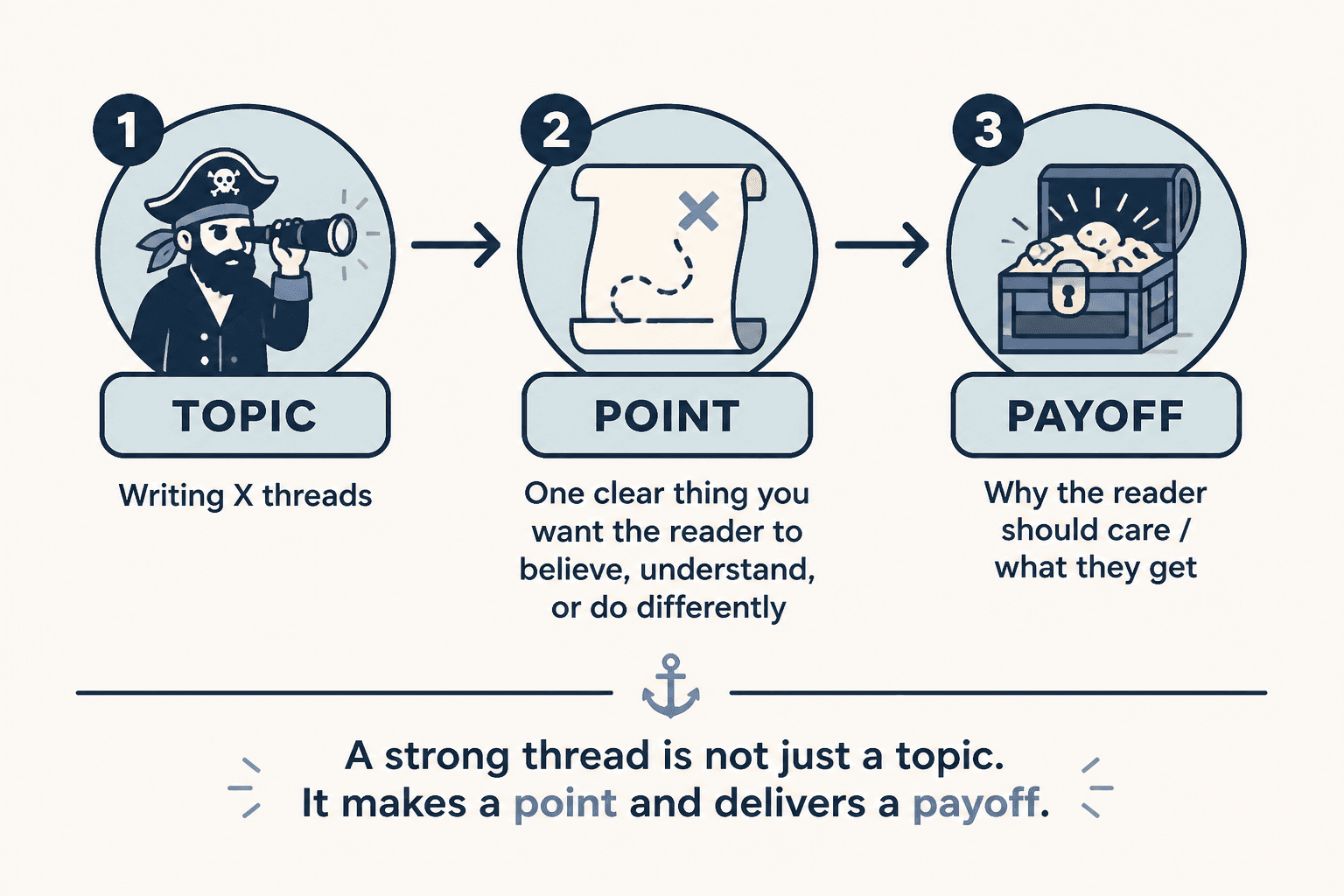
For a simple visual, this is the core problem a good thread solves: one topic, one point, one clean payoff.
What an X thread is actually good for
An X thread is best when one post is not enough to make the point cleanly. That usually means you need a little setup, a few supporting points, and a payoff that benefits from movement. Not every idea deserves six tweets. Some ideas deserve one sharp post and a walk offstage.
Threads work well when you want to:
- teach a small concept step by step
- build an argument with a little momentum
- show contrast between a weak way and a better way
- share a process, framework, or teardown
- earn attention for a bigger idea without burying the point
That is why structure matters so much. A thread is not just “more tweets.” It is a sequence with jobs to do.
If you are comparing thread types, related guides like X Threads Guide for Creators Who Want Better Results and How to Improve X Thread Structure Without Sounding Generic cover the next layer down: what the thread is for, and how to keep it from turning into mush.
The real job of the first post
The opening post has one job: make the next post feel necessary. That is it. Not “be clever.” Not “sound important.” Not “announce that a thread is coming like it has a reservation at a restaurant.” It needs enough tension, specificity, or promise that the reader wants to continue.
Weak openings usually do one of three things:
- they start with broad, context-heavy throat-clearing
- they make a vague promise with no concrete payoff
- they sound like the thread was assembled from a content template with a filing cabinet problem
Stronger openings usually do the opposite. They point at a real problem, a clear claim, or a useful surprise. They suggest shape. They give the reader a reason to keep moving.
If you want to go deeper on openings specifically, see How to Start X Threads Without a Weak Opening. That article is the dedicated “fix the first line before everything else falls apart” version.
Weak thread hooks vs stronger ones
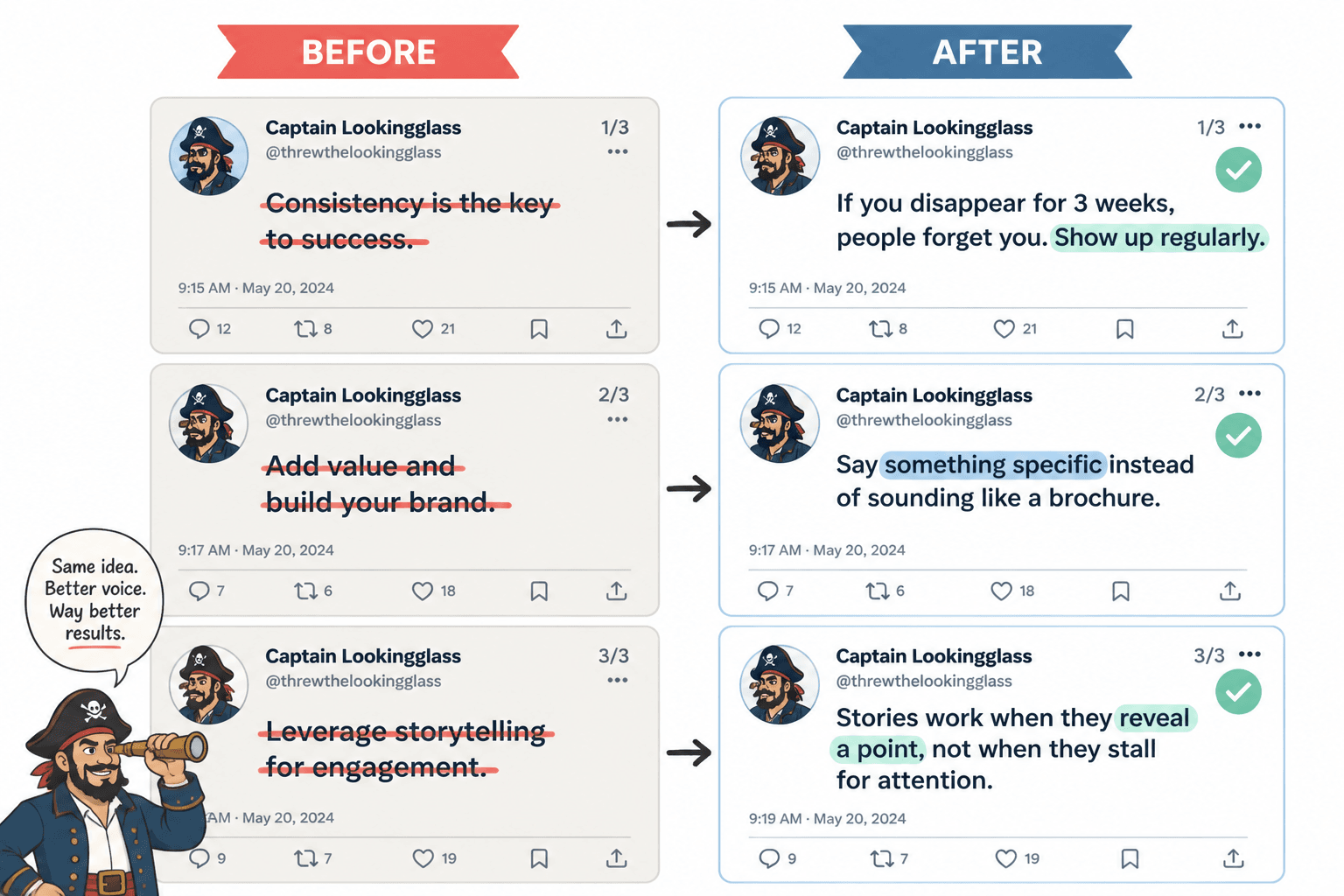
A weak hook usually sounds broad, polite, or interchangeable. It tells you the subject, but not the angle. A stronger hook gives the reader a reason to care now.
Compare these patterns:
- Weak: “Here are some tips for writing better threads.”
- Stronger: “Most X threads fail in the first two posts because the opening gives the reader no reason to continue.”
- Weak: “Thread strategy matters.”
- Stronger: “A good thread is not longer. It is easier to follow.”
The difference is specificity. The stronger version makes a claim, not just a topic label. That is what earns the second post.
If you want examples of cleaner, less robotic hooks, the sibling page How to Write X Threads Without Sounding Salesy or Robotic is a good companion read.
A simple structure for X threads that do not wander off
The safest thread structure is not fancy. It is orderly. Each post should move the idea forward instead of circling it like a cautious intern.
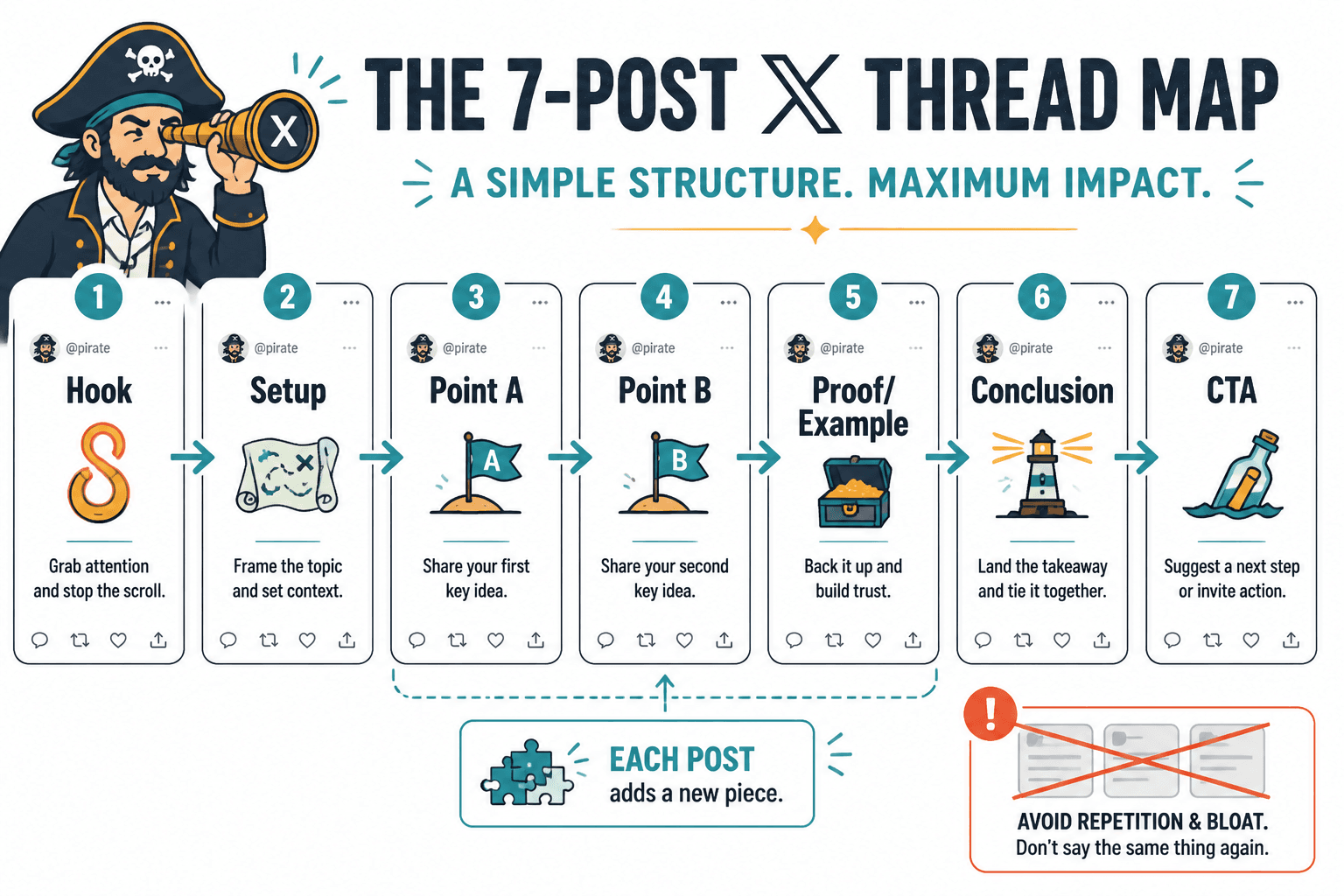
A useful default structure looks like this:
- Hook: state the problem, claim, or tension
- Setup: give just enough context to make the hook believable
- Point 1: make the first meaningful step or argument
- Point 2: add the next logical layer
- Proof or example: show what this looks like in practice
- Conclusion: tie the idea together
- CTA: ask for a next step that fits the goal
That is not the only structure that works, but it is a sane one. The main rule is simple: every tweet should have a job.
For a compact visual model, this is the kind of flow worth aiming at: hook, problem, specificity, payoff. No wandering. No decorative detours.
What “one idea per post” actually means
“One idea per post” does not mean each tweet has to be tiny or simplistic. It means each post should do one clear piece of work.
That could mean:
- introducing a tension
- adding a reason
- showing proof
- making a contrast
- moving to the next step
What it does not mean is packing in three claims, two side notes, and a mini autobiography because the draft looked too short. That is how threads become sludge with line breaks.
A good test: if you removed a tweet, would the thread lose a step or just lose clutter? If it only loses clutter, cut it.
A quick structure example
Here is a simple composite example you could adapt for a thread about writing better posts:
- Hook: “Your thread is not underperforming because it is too short. It is underperforming because the first post does not earn the next one.”
- Setup: “Most people write the topic first and the sequence later.”
- Point 1: “The hook should promise a shape, not just a subject.”
- Point 2: “Each follow-up post should move the idea forward.”
- Proof: “If a tweet can be removed without changing the argument, it probably should be.”
- Conclusion: “Threads work when the reader can feel the next step before they reach it.”
- CTA: “Want the template? Save this and rewrite your next thread from the hook down.”
The point of the example is not the wording itself. It is the shape. The reader can feel the sequence instead of wrestling the thread like it owes them rent.
How long should an X thread be?
The right length is the length required to make the point cleanly. Not the length that looks serious. Not the length that signals effort. Not the length that makes the scroll bar feel like a moral achievement.
Short threads work when the idea is simple, the hook is strong, and the payoff arrives quickly. Longer threads work when the topic needs more setup, more proof, or a step-by-step build.
For the length-specific version of this question, see How Long Should X Threads Be in 2026?. The short answer here is practical: use as many posts as the idea actually needs, then stop.
The 5 thread formats creators can keep reusing
You do not need a brand-new format every time. Reusable structures are fine. In fact, they are usually better. The goal is not originality for its own sake. The goal is clarity with enough variation to stay readable.
- Teach a process – step-by-step, from problem to result
- Break down a mistake – what goes wrong, why it goes wrong, what to do instead
- Compare weak vs strong – useful for hooks, structure, or CTAs
- Show a framework – useful when the idea has repeatable parts
- Use a before/after – useful when the reader needs contrast to see the value
Those formats are especially useful if you are also repurposing material. If that is part of your workflow, the related page How to Turn Old Content Into Better X Threads is the right companion piece.
How to make an X thread sound less generic
Generic threads usually have one or more of these problems:
- the hook sounds like every other hook in the niche
- the posts repeat the same idea in slightly different clothes
- the language is abstract when it should be concrete
- the thread never earns its own ending
The fix is not to add more adjectives. It is to make the thread specific enough that the reader can picture what you mean. Use examples. Use numbers when they help. Use contrast. Use a real process instead of a vague promise.
One simple rule: if a tweet could fit in almost any thread on the same topic, it is probably too generic.
What to do with the ending
The ending should match the thread’s purpose. A thread that teaches something useful does not need a begging-for-engagement outro. A thread that introduces a bigger idea does not need to collapse into a hard sell.
Better endings usually do one of four things:
- invite a relevant reply
- point to a follow-up resource
- ask readers to save or share the thread
- bridge naturally to the next step in your offer
If you want a focused breakdown of endings, use Better X Thread CTA Endings for Personal Brands. It covers the part most people bolt on at the end and hope nobody notices. People notice.
A practical editing pass before you publish
Before you post, run the thread through a quick check:
- Does the opening make me want the second tweet?
- Does each post have one clear job?
- Is there any tweet that repeats the same point?
- Did I use specifics where the thread needed them?
- Does the ending fit the goal of the thread?
If the answer is no to any of those, fix the sequence before you polish the wording. A clean structure with plain language beats a shiny mess every time.
Final take
Better X threads are not about sounding more important. They are about making the reader’s path easier to follow. A good thread opens with a claim worth continuing, uses each post for a single step, and ends in a way that fits the goal instead of hijacking it.
If you want the broader framework again, go back to the parent guide: X threads. If you want to keep building the system around thread writing, the sibling pieces on openings, structure, robotic writing, and CTAs are the next sensible stops.