
People love to say Facebook rewards “real posts” and “storytelling,” then proceed to write 1,400 words nobody finishes.
That is the problem with a lot of Facebook long-form and rant advice: it assumes longer automatically means deeper, stronger, or more persuasive. It does not. A short Facebook long-form post can hit harder than a sprawling one because it gets to the point before the reader wanders off to look at dog photos, local drama, or someone arguing about seed oils.
When Short Facebook Long-Form & Rants Beat Long Ones comes down to one simple thing: does the post earn its length? If the answer is no, shorter usually wins.
This article will help you figure out when a shorter rant or long-form Facebook post is the smarter move, how to tell when your post is dragging, and how to tighten your argument without gutting the personality that makes Facebook work in the first place.
If you write for creators, coaches, consultants, service businesses, or your own personal brand, this matters. Facebook readers will absolutely give you time when the post has shape, tension, and payoff. But they will not reward rambling just because you had feelings about a topic.
For the full path around this topic, head to the parent guide.
Long does not mean strong
On Facebook, long-form can work beautifully. Rants can work beautifully too. But “long-form” is a format, not a quality marker.
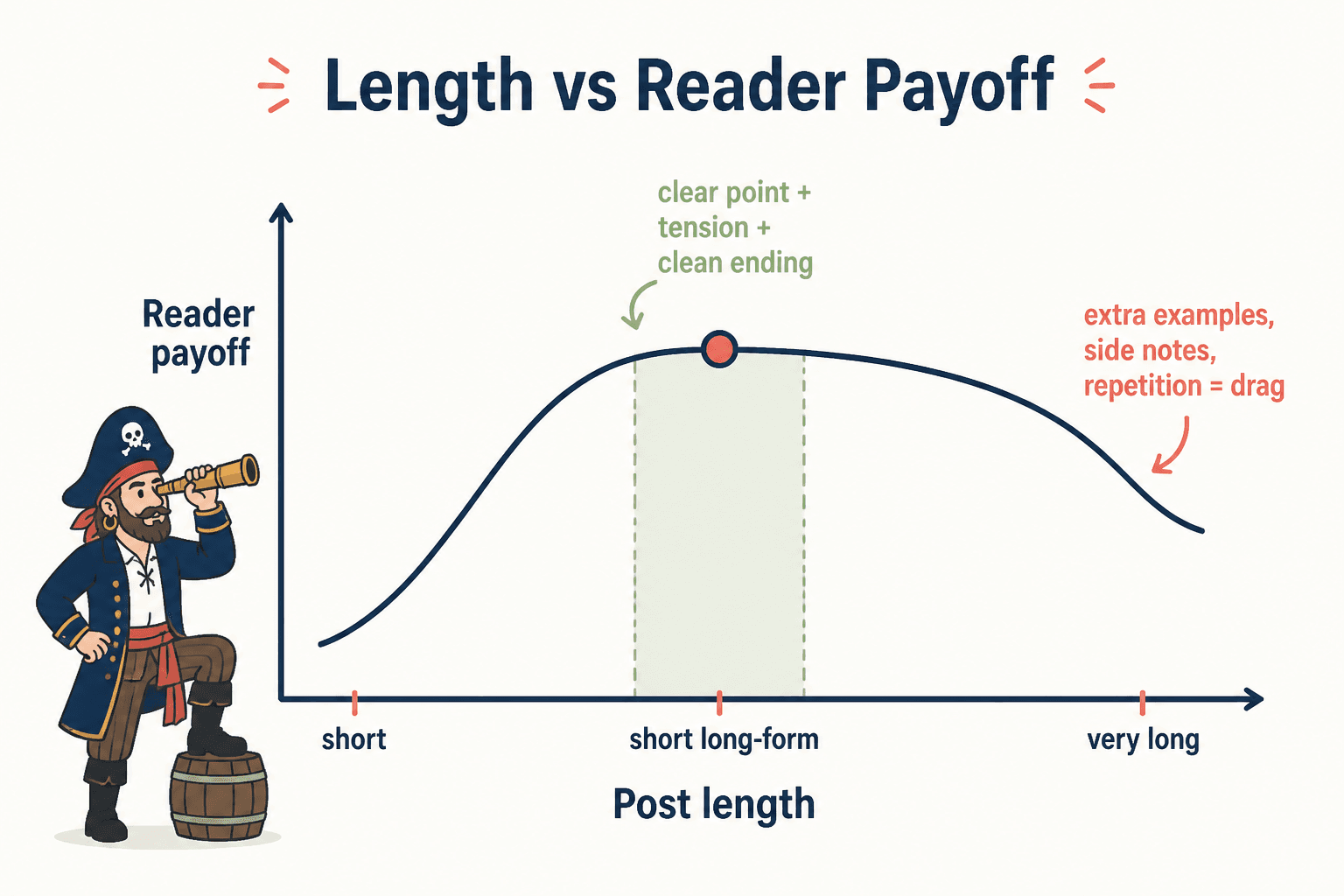
A shorter long-form post often beats a longer one when the main idea is simple, the opinion is sharp, and the reader only needs one clean argument to care. If you keep adding extra examples, side notes, throat-clearing, and mini TED Talks inside the same post, you are not adding value. You are adding drag.
The best shorter rants usually feel like this:
- Clear point
- Recognizable tension
- Specific opinion
- A little heat
- A clean ending that gives people something to respond to
That is enough. You do not need to write a manifesto every time someone on the internet is wrong.
When short Facebook long-form and rants usually beat long ones
There are predictable situations where shorter wins. Not because attention spans are fried beyond repair, but because the idea simply does not need more space.
1. When the point is obvious after the first few paragraphs
If the reader gets your point early, every extra paragraph has to do real work. It needs to deepen the argument, add proof, sharpen the emotional tension, or move the story forward.
If it is just repeating the same point in slightly different clothes, shorter will land better.
A rant stops being powerful the second it starts circling its own point.
2. When the post is driven by opinion, not story
Some Facebook posts earn more room because they are telling a story. Stories need setup, movement, and payoff. But if your post is mostly an opinion or argument, it often works better with tighter pacing.
Example:
- A story about firing a bad client might need more room.
- A post saying “stop treating every post like a brochure” probably does not.
Opinion posts thrive on momentum. The longer they go, the more they risk sounding preachy, defensive, or bloated.
3. When the emotional temperature is already high
Shorter rants often work better when the emotion is strong. Anger, frustration, disbelief, annoyance, sharp honesty. These can create instant energy. But if you stretch that energy too long, the post starts to feel like overcooked outrage.
A good short rant feels controlled. It has edge, but it still has a point. A bad long rant feels like the reader got trapped in someone else’s unedited voice note.
4. When the audience already understands the context
You do not need a long setup if your audience already knows the pattern you are calling out.
If you write for freelancers, and you post “Stop saying yes to clients who want premium work on a grocery budget,” they probably get it immediately. You do not need six paragraphs proving cheap clients exist. We know. Sadly.
Shorter works well when context is shared and the reader can jump straight into the tension.
5. When the post is meant to spark comments, not close a case
Some posts should feel open enough for people to jump in. If you explain every angle, cover every exception, and pre-argue with every imaginary critic, you leave no room for response.
Shorter Facebook long-form often gets better engagement because it leaves a little air in the room. Not confusion. Space.
Signs your long Facebook post should have been shorter
If you are not sure whether your post is too long, these are the usual clues.
- You repeat the same opinion three different ways.
- Your strongest line is buried halfway down.
- The first paragraph takes forever to get to the point.
- You include examples that do not really change the argument.
- You keep adding “and another thing” paragraphs.
- The ending fades out instead of landing.
- You are writing to prove you are right, not to make the post worth reading.
That last one catches a lot of people. Especially on Facebook. You start with a useful point, then drift into building a legal defense for your opinion. Now the post is not strong. It is just armed.
Short does not mean shallow
This is where people get weirdly dramatic. They hear “make it shorter” and assume that means flattening the post into bland, thin content.
That is not the goal. The goal is density. A shorter post can still have:
- A strong opinion
- Emotional charge
- Nuance
- Specific examples
- Personality
- A memorable ending
It just needs tighter control.
Think of it this way: readers do not usually want “more words.” They want enough substance to justify their attention. Sometimes that is 250 words. Sometimes it is 900. The right length is the amount needed to make the point properly, not the amount needed to feel impressive.
What shorter Facebook long-form posts do better
They keep the energy up
A shorter rant has less room to sag. That matters on Facebook, where pacing is everything. If a post starts strong and stays tight, people keep going.
They make the opinion feel sharper
Concise opinion posts often feel more confident. Not because they are more aggressive, but because they are less padded. The writer sounds like they know what they mean.
Overexplaining can make a decent point sound less certain. You do not always need more nuance. Sometimes you need cleaner delivery.
They are easier to finish
Obvious point, still worth saying. A post people actually finish has a much better shot at earning comments, reactions, saves, shares, and follow-through.
Completion matters because Facebook posts are not judged only by how good they are in your head. They are judged by whether real humans make it to the end without mentally leaving halfway through.
They leave room for conversation
Good Facebook writing is not just broadcasting. It is social writing. Shorter long-form often leaves enough tension unresolved that people want to respond with their own examples, disagreements, or stories.
Examples: when shorter wins
Here is a simple before-and-after to show the difference.
Example 1: The bloated opinion post
Too long:
I keep seeing people on Facebook and across social media talking about consistency as if it is the only thing that matters in building a business and brand online. And while I do think consistency matters to some degree, I also think it can be overrated when people are consistently posting content that is not specific, not resonant, and not actually designed to connect with the right audience. If you are posting every day but not saying anything meaningful or distinct, then I am not sure that consistency is the flex people think it is. In fact, it may even reinforce a weak brand position because people get repeatedly exposed to bland ideas…
Shorter and stronger:
Consistency is overrated if you are consistently forgettable.
Posting every day does not fix weak positioning, vague ideas, or content with no point.
People do not reward frequency just because you showed up again. They reward relevance.
I would rather see two sharp posts a week than seven beige ones pretending to be discipline.
What gets praised too often online is consistency without quality. That is not strategy. That is a schedule.
This version is still long-form by normal Facebook standards. It just stops wasting your time.
Example 2: The rant that needed trimming
Too long:
If your entire content strategy is built around educating your audience but you never actually make a clear offer, then you are probably running into the issue where people see you as helpful but do not necessarily understand what you do, how you help, or why they should move forward with you. I think there is a real problem with creators and service providers who spend months building trust and visibility only to avoid the sales part because they are afraid of sounding pushy…
Shorter and stronger:
A lot of “valuable content” is just unpaid consulting with no sales path attached.
If people keep thanking you but never buying, the issue may not be trust.
It may be that your content teaches well and sells nothing.
You do not need to pitch in every post. But if your audience can consume weeks of your work and still not know what you offer, that is not subtle marketing. That is a visibility hobby.
Shorter. Clearer. More likely to spark comments.
For more examples like this, it helps to study Facebook long-form and rant ideas and examples for creators and compare how different post shapes create different reactions.
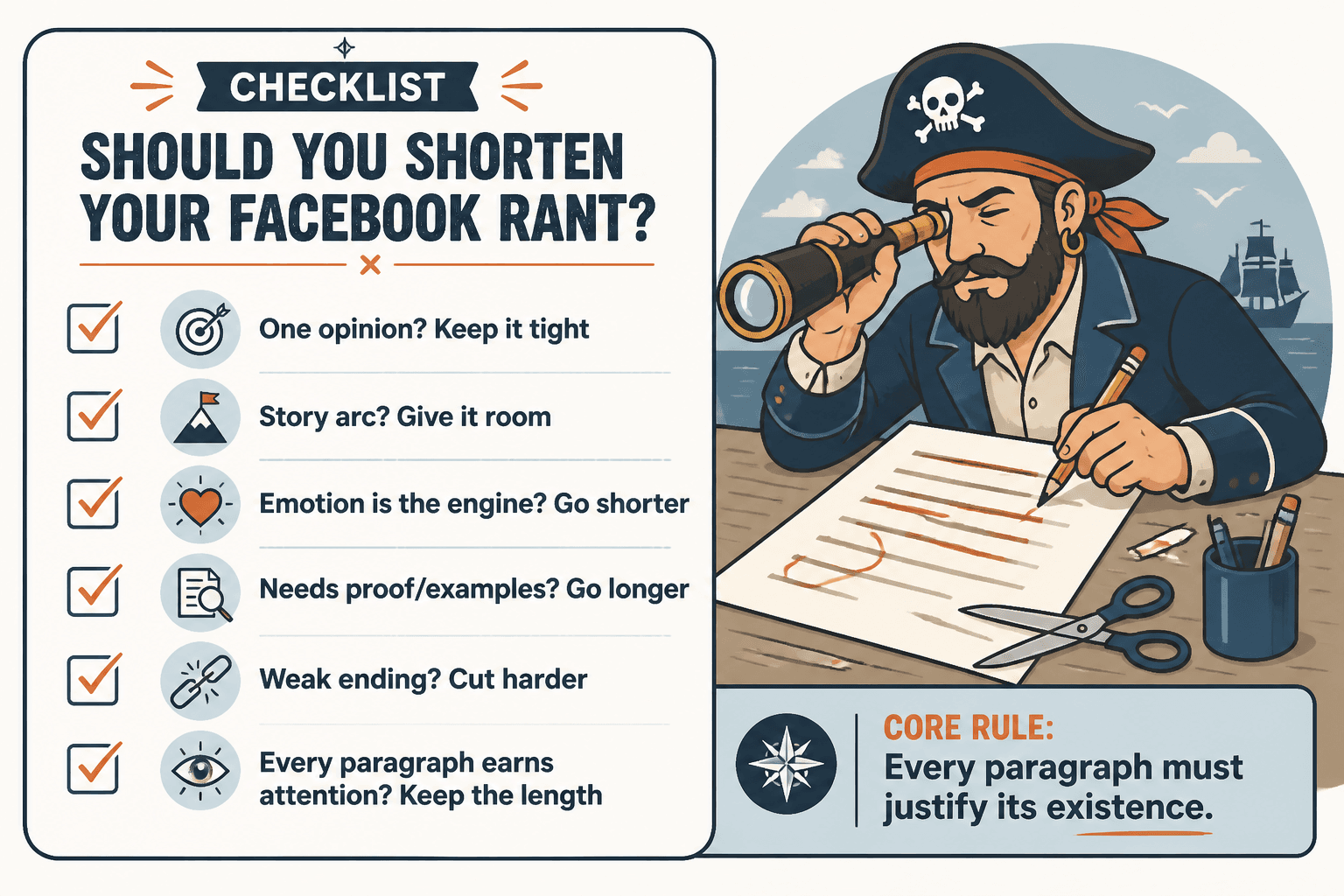
How to decide if your Facebook rant needs more room or less
You do not need a mystical intuition for this. Use a practical test.
- If the post is built on one opinion: keep it tighter.
- If the post includes a story arc: give it room.
- If the emotional force is the main engine: shorter often works better.
- If the lesson requires proof or examples: longer may help.
- If the ending is weaker than the opening: cut harder.
- If every paragraph earns attention: keep the length.
That last one is the only real rule worth respecting. Every paragraph should justify its existence. Harsh, yes. Useful, also yes.
A simple editing method for making long posts shorter without killing them
If your draft is too long, do not just hack random sentences off the bottom and call it editing. Use a cleaner process.
Step 1: Find the real point
Can you summarize the post in one sentence?
If not, the draft is probably trying to do too much. Pick the real point first. The rest gets easier.
Step 2: Cut the warm-up
Most drafts begin too early. Remove the setup where you explain how you have been “thinking a lot lately” about the issue. Nobody needs your preamble. Start where the tension starts.
Step 3: Remove duplicate paragraphs
If two paragraphs make the same point, keep the stronger one. This alone can cut a post by 20 to 30 percent.
Step 4: Keep one strong example, not four decent ones
Examples help. Too many examples slow the post down. One sharp example usually beats a pile of medium ones.
Step 5: End on the cleanest line
Do not keep writing after the post lands. A lot of writers ruin a strong ending by adding two more paragraphs of explanation. Trust the reader a little.
The bigger point is simple: clearer structure and clearer writing make the piece more useful. That is usually what makes the ending land better too.