
Most Facebook rants fail for a very simple reason: they are not rants. They are long complaints with no structure, no point, and no payoff.
That is why they feel exhausting instead of magnetic. People start reading, sense there is no destination, and leave. Fair enough.
Good Facebook long-form posts do something much harder. They hold attention, make an argument, build trust, and still sound like a human with a pulse. For coaches, consultants, and personal brands, that matters. Facebook is one of the few places where a strong opinion, a sharp story, or a controlled rant can still spark real conversation instead of disappearing into polished thought-leadership paste.
This guide gives you practical Facebook Long-Form & Rants Examples for Coaches, Consultants, and Personal Brands, plus the structures behind them so you can write your own without sounding unhinged, self-righteous, or weirdly salesy halfway through.
To see how this fits into the wider strategy, open the parent guide.
What makes a Facebook long-form post worth reading
Long-form on Facebook works when it earns the length.
That means one of three things is happening:
- You are telling a story with tension and a point
- You are making an argument people care enough to follow
- You are unpacking a useful lesson with personality, proof, and specificity
What does not work is dragging out a basic idea because you think longer means deeper. It usually means slower.
A strong Facebook rant has shape. It starts with friction, builds momentum, and lands somewhere useful. It does not just spray frustration in every direction and call that authenticity.
For more on the broader format, structure, and strategy behind these posts, see Facebook long-form and rants.
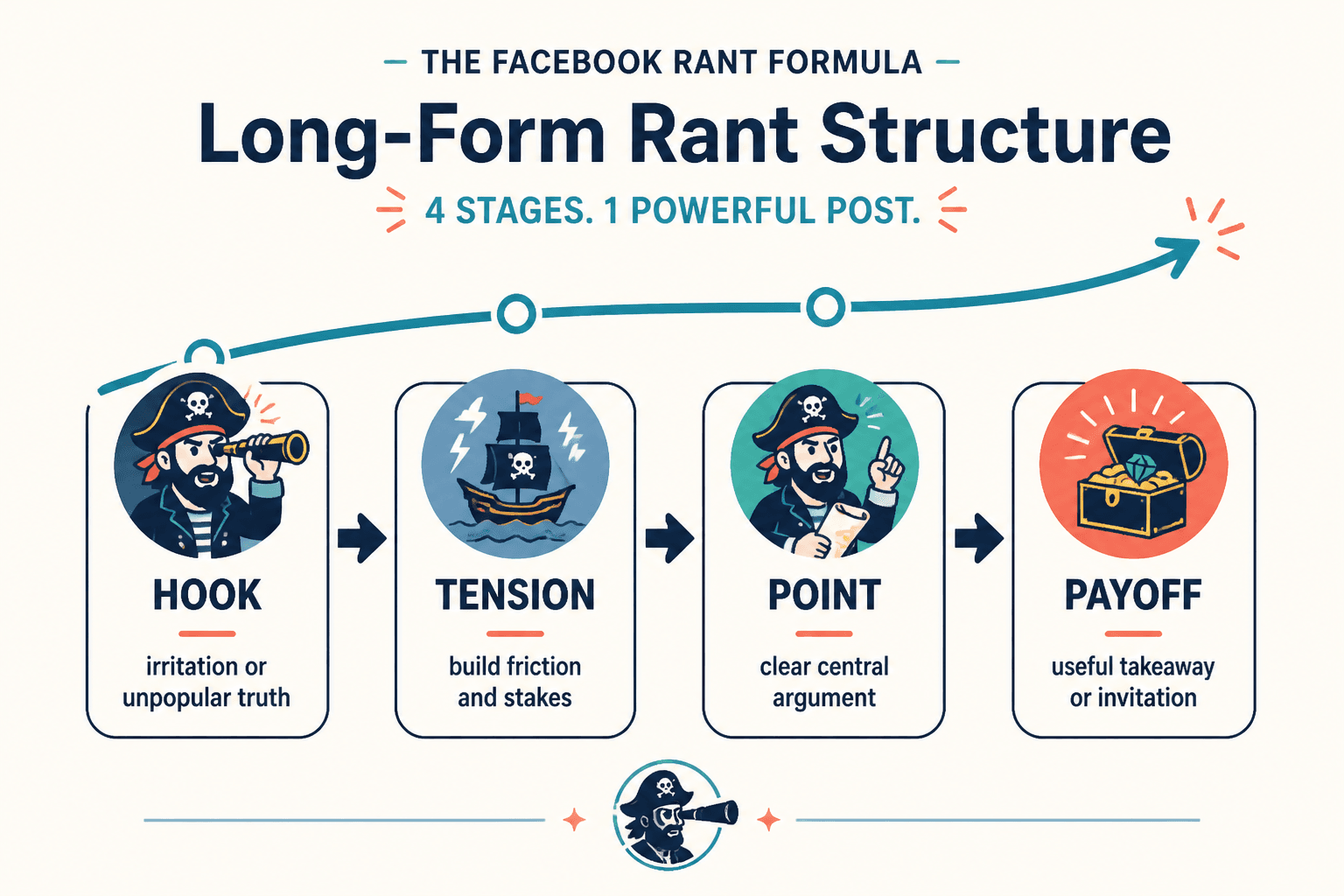
The 5 parts of a good Facebook rant
Before the examples, here is the simplest framework to steal.
- Hook: Start with the irritation, contradiction, or unpopular truth.
- Context: Show what you are reacting to and why it matters.
- Argument: Make the case clearly. One central point. Not seven.
- Turn: Add nuance, lesson, or a more useful way to think about it.
- Ending: Land with a sharp takeaway, invitation, or question worth answering.
That fourth part matters more than people think. Without the turn, a rant is just heat. The turn is what makes it useful. It is the moment where the post stops being “here is what annoys me” and becomes “here is what actually works instead.”
Facebook Long-Form & Rants Examples for Coaches, Consultants, and Personal Brands
Below are practical examples by post type. These are not magic scripts. They are good bones. Adapt the tone, examples, and topic to your niche and audience.
1. The “stop doing this” credibility rant
This works well for consultants, strategists, and coaches who are reacting to bad industry advice.
Can we stop pretending that posting more is a strategy?
If your content is vague, forgettable, and aimed at everyone, posting five times a day just means more people get to ignore you faster.
I keep seeing business owners blame the platform when the real problem is simpler: the message is weak, the positioning is muddy, and the posts sound like they were assembled by a committee that fears verbs.
More volume helps when the foundation is strong.
It does not rescue boring ideas.
If you want better results, fix the point of view first. Fix who the content is for. Fix the opening lines. Fix the offer behind the post.
Then post more, sure.
But content quantity is a multiplier, not a substitute.
That distinction would save a lot of people from months of very enthusiastic underperformance.
Why it works: It opens with a direct opinion, targets a common mistake, builds an argument quickly, and lands on a practical distinction.
Why it does not feel like empty complaining: It gives the reader something to do instead.
2. The story-driven rant with a lesson
This is a strong option for personal brands who want personality without drifting into diary mode.
I read a sales page this week that said a coach helps people “step into aligned expansion and embodied visibility.”
I still have no idea what that means.
And this is the problem.
Somewhere along the way, a lot of smart people started believing that sounding elevated is the same thing as sounding credible. It is not. It usually means the reader has to do unpaid translation work just to understand your offer.
Clear beats mystical.
If you help consultants get better clients, say that.
If you help new coaches sign their first three paying clients, say that.
If you help founders write better landing pages, say that.
People do not trust what they cannot picture.
You are not losing buyers because your message is too simple.
You are losing them because they cannot tell what you actually do.
Why it works: It starts with a concrete example, then broadens into a sharper point about clarity, trust, and messaging.
3. The boundary-setting post that attracts the right people
Useful for coaches and consultants who need to signal how they work and who they are not for.
A quick note for anyone looking for a coach who replies to every panic spiral within six minutes:
I am not your coach.
I care deeply about clients. I do not run an emotional emergency hotline disguised as a business model.
Good coaching is not constant access.
Good coaching is clear thinking, honest feedback, useful structure, and support that helps you make better decisions without becoming dependent on me to function.
There is a version of premium service online that is really just badly managed boundaries in expensive packaging.
I am not interested in selling that.
The right clients tend to appreciate this immediately.
The wrong ones usually get annoyed.
Honestly, that is quite efficient.
Why it works: It is opinionated, but controlled. It filters the audience while reinforcing brand values and expectations.
4. The myth-busting rant for consultants
This format works when you want to challenge common advice in your field.
One of the worst pieces of business advice is “just give value.”
Not because value is bad. Because the phrase is so lazy it becomes useless.
Most people hear “give value” and start posting generic tips that anybody could have written, including people who are not qualified to write them.
Useful content is not random helpfulness.
It is relevant helpfulness.
It meets a specific person at a specific stage of a specific problem.
That is why one short post can bring in leads while 50 “valuable” posts get polite silence.
The issue is not effort. It is alignment.
So no, I do not think you need to “just give more value.”
I think you need to say something sharper, for someone clearer, in a way that actually connects to the work you sell.
Why it works: It takes a familiar phrase, exposes the flaw, and replaces it with a more useful standard.
5. The anti-trend rant for personal brands
Great when your audience is tired of platform nonsense and wants a saner voice.
I am begging personal brands to stop treating every post like it needs a performance arc.
You do not need a shocking confession, a cinematic breakdown, and a redemptive lesson every time you want to talk about email strategy.
A lot of content right now feels emotionally overproduced.
Not honest. Produced.
There is a difference.
You can just teach something useful.
You can just say what you believe.
You can just tell people what works, what does not, and why.
Not every post needs to sound like the trailer for a documentary about your nervous system.
Sometimes a clean point is enough.
Why it works: It has personality and bite, but it is aimed at a recognizable content problem. It also gives the reader relief. That matters more than hype.
For more inspiration, pair this with Facebook long-form and rant ideas and examples for creators.
How to shape a rant so people actually finish it
The biggest mistake in Facebook long-form writing is confusing emotional intensity with momentum.
A loud opening can grab attention, sure. But if the middle sprawls, repeats itself, or starts shadowboxing with imaginary critics, readers bail. Even people who agree with you.
Here is a cleaner structure to use when writing your own:
- Open on the problem: Name the thing you are reacting to fast.
- Make it specific: Use an example, phrase, pattern, or behavior.
- Explain why it matters: Show the cost, confusion, or consequence.
- Offer the stronger view: Replace the bad advice with better thinking.
- Finish with a line that sticks: Not a weak fade-out. A real ending.
That “why it matters” section is where a lot of writers get lazy. They name what annoys them, but never explain the actual business consequence. For coaches and consultants, this matters because your content is not just expression. It is positioning. If you attack weak messaging, weak sales tactics, weak client boundaries, or weak strategy, tie it back to trust, leads, buyer clarity, or outcomes.
Otherwise the post may get agreement, but not authority.
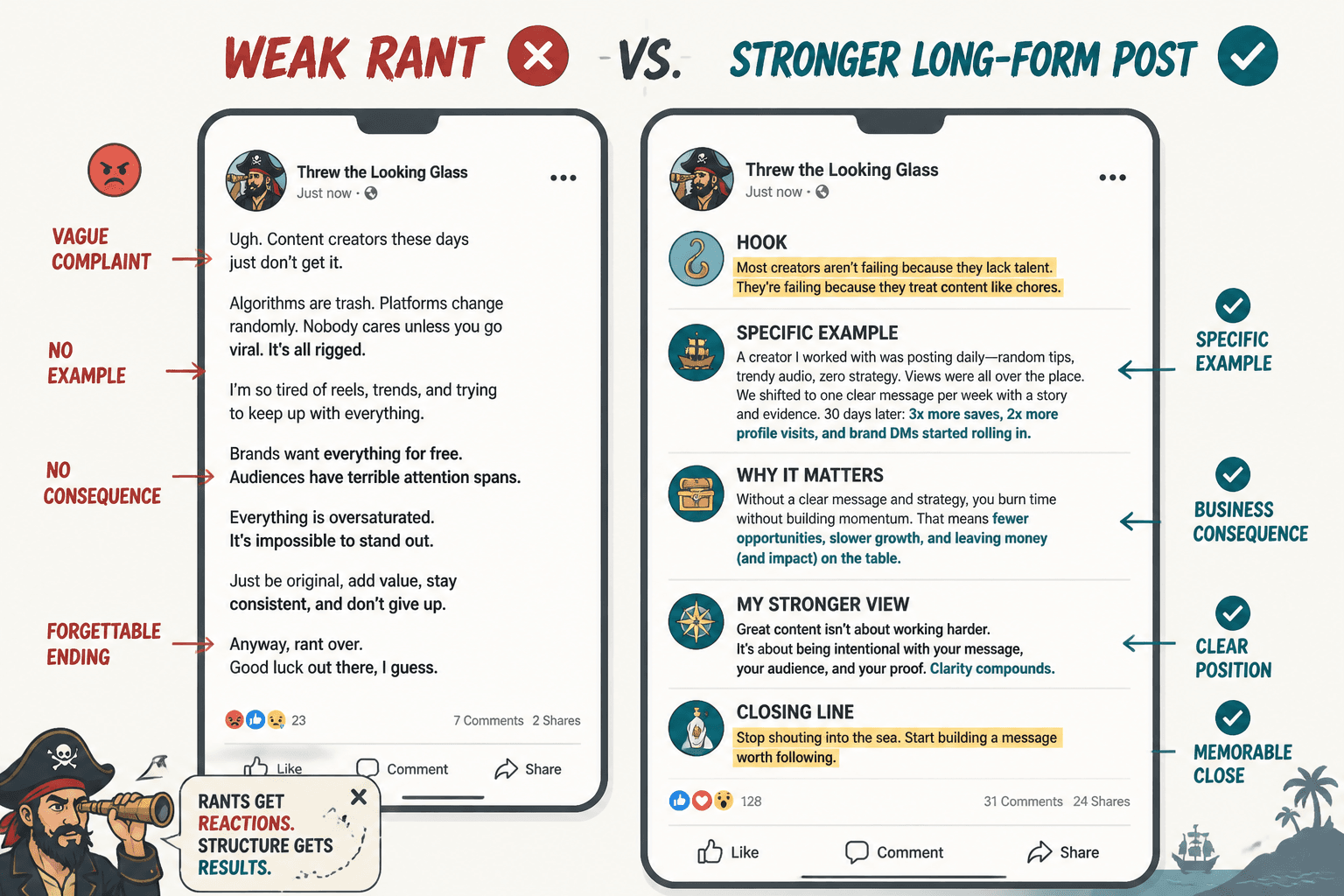
Before and after: weak rant vs stronger rant
Here is what this looks like in practice.
Weak version
I am so tired of fake gurus on Facebook. Everyone is selling nonsense and making ridiculous claims and it is ruining the online space. People need to be more honest. There is too much fake marketing and I am over it.
The issue here is not passion. It is vagueness. Nothing specific is being said, so nothing memorable lands.
Stronger version
I have zero interest in marketing that requires people to pretend certainty they have not earned.
If your whole sales strategy depends on inflated screenshots, vague income claims, and implying every client gets life-changing results in 14 minutes, that is not confidence.
It is costume jewelry for credibility.
The annoying part is not just that it is dishonest.
It also trains good business owners to think they have to oversell to compete.
They do not.
Specific proof beats inflated promises.
A clear process beats peacocking.
A believable outcome beats a dramatic one.
Trust is slower to build, yes. It is also much harder to refund.
This version gives the reader something concrete to react to. It has imagery, contrast, and a stronger ending. It also does not wander off into five adjacent grievances. A small miracle, really.
Best Facebook rant angles for coaches, consultants, and personal brands
If you are not sure what to write about, start with tensions you already see in your work.
- Bad advice your audience keeps hearing
- Misunderstandings about what your service actually does
- Client expectations that need correcting
- Industry trends you think are overrated
- Messaging habits that quietly hurt trust
- Sales tactics that get attention but damage reputation
- Productivity beliefs that sound smart but fail in real life
- Things beginners copy from advanced creators that do not transfer well
The best angle usually lives where irritation meets expertise.
If something repeatedly makes you think, “That sounds clever but it is going to hurt people if they follow it,” you probably have the seed of a strong long-form post.
If you want help generating more angles, templates, and starting points, see templates and tools for Facebook long-form and rants and AI tools for Facebook long-form and rants.
How to end a Facebook rant without ruining it
A bad ending makes the whole post feel less confident.
The usual problems are:
The bigger point is simple: clearer structure and clearer writing make the piece more useful. That is usually what makes the ending land better too.