
Most Facebook long-form posts do not fail because the idea is bad. They fail because the pacing is off.
The writer takes 11 sentences to get to the point, dumps every thought into the middle, then ends with a question so limp it barely qualifies as a pulse check. Or they call it a rant when it is really just unedited irritation wearing paragraphs.
If you want Simple Facebook Story Pacing Templates for Busy Creators, that is the real job: helping your post move. Not just exist. Move. Pull someone from first line to last line without sounding rehearsed, overbranded, or weirdly desperate for comments.
Here’s how to pace Facebook stories, long-form posts, and controlled rants so they actually hold attention, make a point, and spark conversation. Fast. No fluffy “storytelling framework” fog. Just useful structures you can steal and adapt.
If you want the broader strategy behind this format, start with social media writing, then go deeper with the main Facebook writing section and the full Facebook long-form and rants hub.
For the main guide behind this topic, visit the parent guide.
What pacing actually means in a Facebook post
Pacing is the speed and shape of the post.
It decides when you introduce tension, when you explain, when you sharpen the point, and when you stop talking. Good pacing makes a post feel easy to read even when it is long. Bad pacing makes 180 words feel like a legal deposition.
On Facebook, pacing matters more than people admit because readers are usually not sitting down with scholarly intent. They are scrolling, half-distracted, mildly skeptical, and very willing to leave if you start throat-clearing.
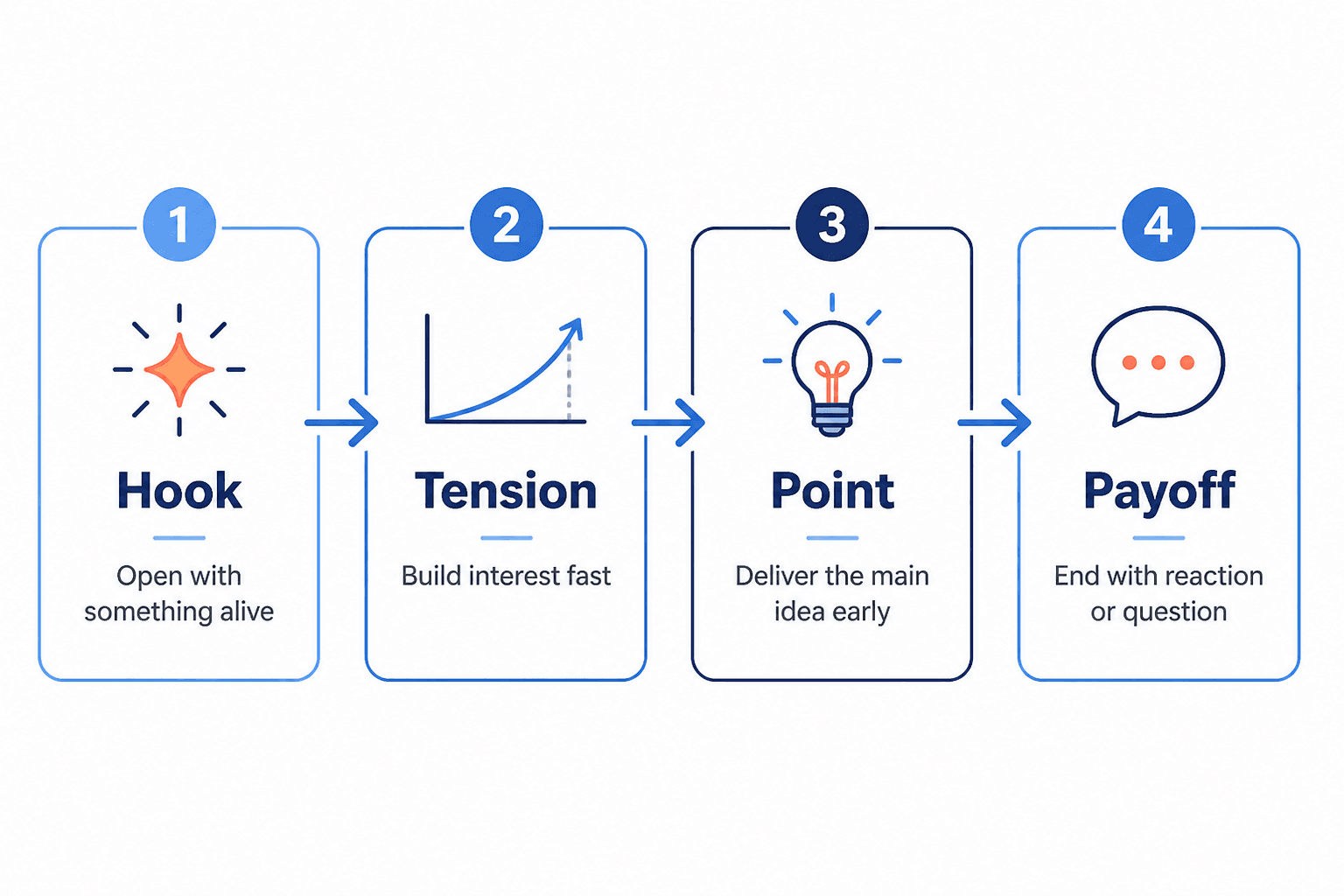
So your post needs a shape. Usually that shape looks something like this:
- Open with something alive
- Build tension or interest quickly
- Deliver the actual point before attention leaks out
- End with a clean payoff, reaction, or question
That is it. Not mystical. Not precious. Just structured enough to keep a human reading.
Why busy creators need templates instead of vibes
If you are a creator, coach, consultant, writer, or solo business owner, you probably do not need more inspiration. You need fewer decisions.
Templates help because they remove the blank-page drama. They give you a reliable post shape so you can spend your energy on the opinion, the example, or the story itself.
Important distinction, though: a template should support your voice, not replace it. If your post sounds like a laminated content worksheet, the template is not helping. It is committing a crime.
Good pacing templates do three things:
- Get you to the point faster
- Stop you from rambling in the middle
- Make the ending feel intentional instead of abandoned
The 5 easiest Facebook story pacing templates to use
These are simple on purpose. You should be able to use them in 10 to 15 minutes without opening a tab called “storytelling principles” and ruining your afternoon.
1. The moment → meaning → question template
Use this when you have a small real-life moment, observation, or client-facing lesson that leads to a broader takeaway.
- Start with a specific moment
- Explain what it revealed
- End with a question or opinion prompt
Structure:
- Yesterday, this happened
- It reminded me of this bigger problem
- Here is what I think people get wrong
- What do you think?
Example:
I saw a business owner post “consistency is key” for the 400th time this morning.
Not the worst advice. Just aggressively incomplete.
Consistency only helps if people can recognize what you are consistent about. If every post sounds like it came from a different personality in a different niche, posting more often does not build trust. It builds confusion.
I think a lot of creators do not have a consistency problem. They have a clarity problem.
Curious if you have noticed that too.
This works because the moment is small, the meaning is clear, and the ending invites response without begging for one.
2. The complaint → why it happens → better way template
This is your useful mini-rant. Good for myths, bad habits, and tired advice you want to push back on.
- Name the thing that annoys you
- Explain why people do it
- Offer a smarter alternative
Structure:
- I keep seeing this
- Here is why it happens
- Here is what works better
- Optional closing line with a little bite
Example:
I am tired of Facebook posts that spend six paragraphs warming up before saying anything.
I get why people do it. They are trying to sound thoughtful. Careful. Nuanced.
But on social platforms, too much warm-up just reads like uncertainty.
If your point is “most content advice is too generic,” say that in line one or two. Then support it. Do not make readers dig through a ceremonial fog bank to find your opinion.
You are allowed to arrive at your point sooner.
This kind of post works well on Facebook because it feels conversational and opinionated, but still lands on something useful.
3. The setup → tension → turn → takeaway template
Use this when you want a fuller story with a little movement in it. This is especially strong for creators who want to sound like humans instead of content vending machines.
- Set the scene quickly
- Introduce the tension or problem
- Reveal the shift, realization, or contrast
- End with the lesson
Structure:
- At first, it looked like this
- Then this problem showed up
- That changed how I saw it
- Here is the lesson worth keeping
Example:
I used to think long Facebook posts needed big emotional stories to work.
So I kept trying to make every post deeper, more meaningful, more cinematic.
The result was not better writing. It was slower writing and weaker posts.
What actually helped was simpler pacing. One clear setup. One real tension point. One takeaway people could use.
Turns out a post does not need to feel profound. It needs to feel worth reading.
Notice the turn. That is the hinge. Without it, the post is just journaling with punctuation.
4. The blunt opinion → support → example → closing punch template
This is excellent for stronger takes, industry observations, and posts that are meant to attract the right people by sounding like an actual person.
- Say the opinion clearly
- Back it up
- Show a concrete example
- End with a sharp closing line
Structure:
- Hot take, minus the drama
- Why I think that
- What it looks like in practice
- The line people remember
Example:
Most “authentic” Facebook content is still wildly performative.
Not because people are lying. Because they are editing themselves toward applause.
You can see it in posts that start vulnerable, then somehow loop back to how resilient, insightful, and impressive the writer is. Funny how that keeps happening.
Real connection usually sounds less polished than that. More specific. Less flattering.
If the post makes you look amazing in every paragraph, readers can tell.
If you are going to be slightly sharp, earn it with clarity. Random smugness is not a strategy.
5. The list-story hybrid template
This is for busy creators who want structure without writing a full narrative. It mixes a short setup with a practical list, which tends to do well when your audience wants insight fast.
- Open with a short story or observation
- Bridge into 3 to 5 lessons
- Close with one unifying point
Structure:
- This happened
- It reminded me of three things
- Lesson one
- Lesson two
- Lesson three
- Closing thought
Example:
I rewrote a post this morning that was technically fine and painfully forgettable.
The fix had nothing to do with adding better adjectives. It came down to three things:
1. The opening finally made a point.
2. The middle stopped repeating itself in business-casual tones.
3. The ending gave readers something to react to.That is usually the job.
Better content is often not more content. Just cleaner movement.
How to pace a Facebook rant without sounding unhinged
A rant needs shape. Otherwise it is just leakage.
The best Facebook rants feel controlled. There is energy, yes, but also direction. The writer is not just mad. They are making a case. That is why some “rant” posts get thoughtful comments and shares, while others feel like someone accidentally published their internal monologue.
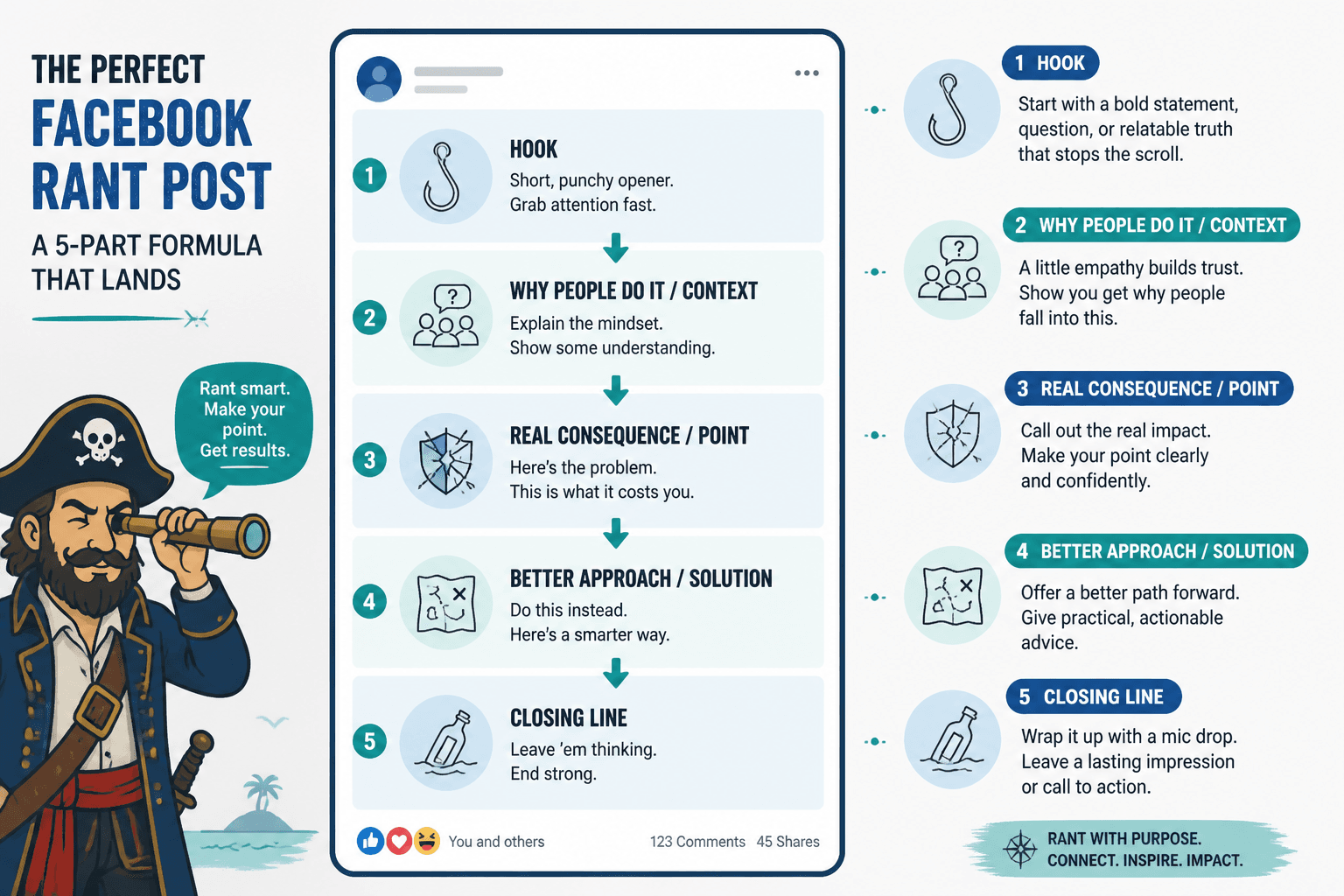
Use this simple pacing formula:
- Hook: State the frustration clearly
- Context: Explain what keeps happening
- Point: Say why it matters
- Solution or standard: Offer a better way
- Close: End with a line that sticks
Quick rant template:
Can we stop pretending [common bad habit] is a smart strategy?
I keep seeing people do it because [reason].
But the real result is [actual consequence].
A better approach is [better standard].
[Closing line with bite or clarity.]
Want more help with the bigger structure of this kind of content? Read Facebook Long-Form and Rants Guide for Creators Who Want Better Results.
Common pacing mistakes that make Facebook stories drag
You do not need advanced storytelling theory to improve. You mostly need to stop doing the few things that quietly kill momentum.
Starting too far from the point
If your first paragraph is pure scene-setting with no tension, readers bail. Give them a reason to care early.
Explaining the same idea three different ways
This is common when people want to sound thoughtful, but it just slows the post down. Make the point once. Support it well. Move on.
No turn in the middle
A story needs movement. A rant needs escalation. A useful post needs development. If the middle says exactly what the opening already said, there is no reason to keep reading.
Ending with a weak generic question
“Thoughts?” is not a real ending. It is content shrugging.
If you want comments, ask something sharper:
- Have you noticed this too?
- What is your version of this mistake?
- Do you agree, or am I being unfair?
- What would you add?
Trying to sound profound instead of clear
Facebook is full of posts that sound meaningful until you actually read them. Do not write for vague admiration. Write so a real person can follow your point without needing a flashlight.
The bigger point is simple: clearer structure and clearer writing make the piece more useful. That is usually what makes the ending land better too.