
Most people do not ruin trust on Facebook because they sell. They ruin trust because they sell like they just discovered manipulation and got a little too excited about it.
You have seen the pattern. A decent post turns into a weird bait-and-switch. A story that pretends not to be a pitch suddenly swerves into “DM me ‘READY’ for details.” Every comment gets treated like a warm lead. The vibe goes from human to funnel with a pulse.
That is the real problem behind How to Monetize Facebook Posts Without Wrecking Trust. The issue is not monetization itself. It is clumsy monetization. It is asking for too much, too early, with too little relevance, and then acting confused when people stop engaging.
If you want your Facebook posts to bring in leads, clients, sales, or conversations that actually go somewhere, you need a better system. One that respects the platform, respects the reader, and does not make every post feel like it wandered out of a stale sales script.
Here is how to monetize Facebook posts in a way that still feels useful, credible, and worth following.
To see how this fits into the wider strategy, open the parent guide.
First, stop treating every post like a cash register
Facebook is not great for constant hard pitching. It is better for relationship-driven attention.
That matters because the platform rewards interaction patterns that feel social, not sterile. People respond to stories, observations, strong opinions, useful mini-lessons, timely questions, and posts that sound like a person talking to other people. They do not love being cornered into a funnel every time they open the app.
If your content strategy is basically “post anything, then tack on a CTA,” you are going to burn goodwill fast.
A better mindset is this:
- Some posts should build attention.
- Some should build trust.
- Some should create conversation.
- Some can create demand.
- A few should ask for action.
Not every post needs to do all five. In fact, most of them should not.
If every post is trying to convert, the audience starts protecting itself.
That protection looks like lower engagement, less curiosity, fewer replies, and a general sense that your content is technically “valuable” but somehow exhausting.
If your Facebook content already feels too polished, too pitchy, or too performative, it is worth reading how to write Facebook posts without sounding salesy or robotic. The monetization problem usually starts there.
What trust-friendly monetization actually looks like
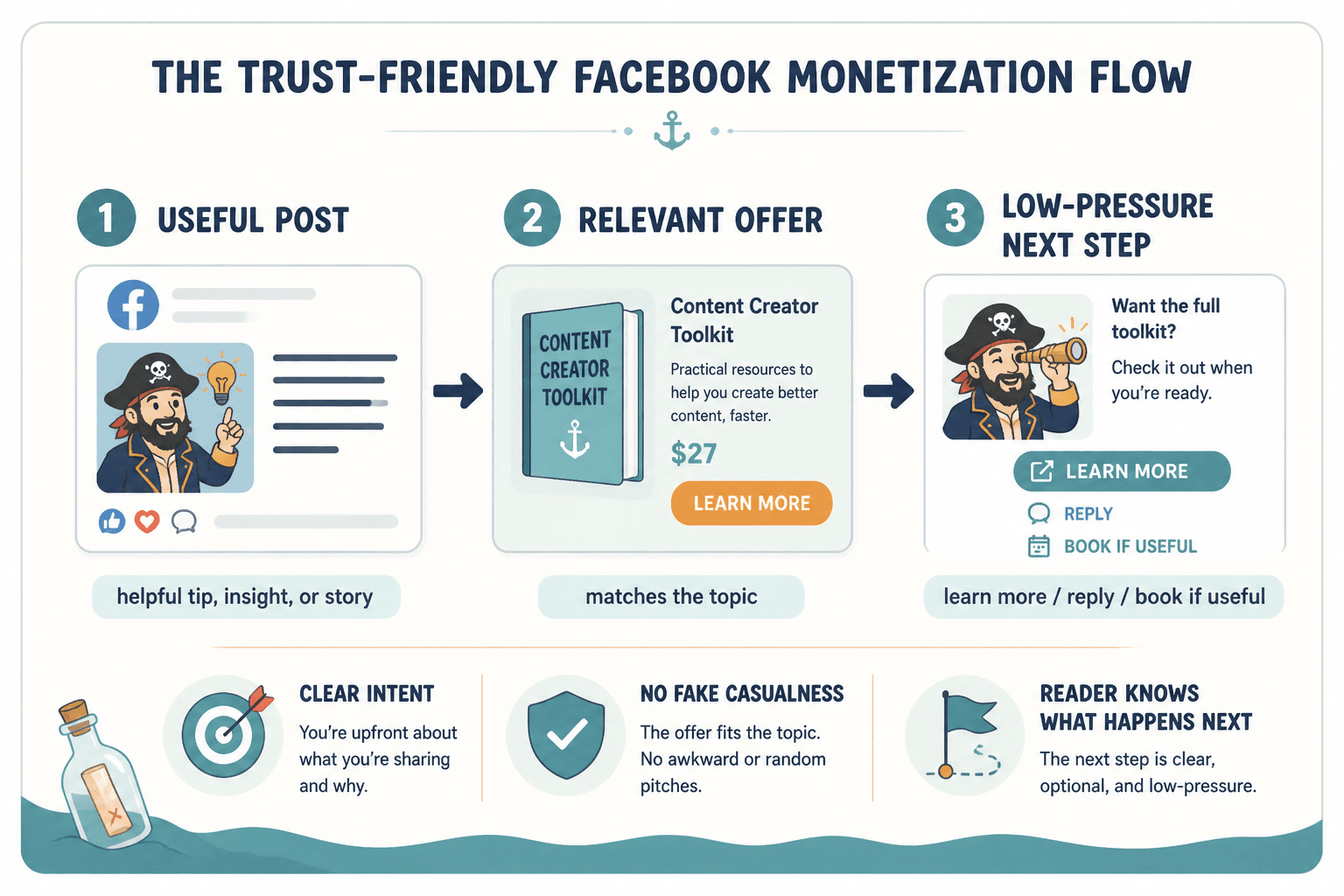
Monetizing Facebook posts without wrecking trust usually comes down to one thing: the post gives the reader something real before it asks for anything.
That “something real” could be clarity, a useful idea, a reframed problem, a practical example, a caution, a lesson, a story with a point, or a specific next step they can use. The point is that the post stands on its own even if the reader never buys.
When people can benefit from your content without immediately entering your pipeline, they are far more open to taking the next step later.
Trust-friendly monetization tends to include these traits:
- The post is genuinely useful or interesting by itself.
- The offer is relevant to what the post is about.
- The CTA feels proportionate, not desperate.
- The writer sounds like a person, not a funnel template.
- The reader can tell what happens next.
- The post does not pretend not to be selling.
That last one matters more than people think. Fake casualness is one of the fastest ways to damage trust. If you are making an offer, make an offer. Do not wrap it in fake vulnerability, fake curiosity, or a fake “just wondering…” post that somehow ends in a booking link.
People are not mad that you sell. They are mad when they feel played.
The four post types that monetize best on Facebook
You do not need one magic Facebook post formula. You need a few post types that naturally lead to business without making every sentence smell like intent.
1. The useful insight post
This is a short lesson, opinion, or practical observation that solves a small but real problem.
Good for: coaches, consultants, service providers, writers, marketers, and experts with a clear point of view.
Example structure:
- Name the mistake people keep making.
- Explain why it fails.
- Offer a sharper alternative.
- Invite the right people to go deeper.
Example:
Most Facebook posts do not fail because the advice is bad.
They fail because the opening is too polite.If your first line sounds like you are clearing your throat, people scroll.
Instead of opening with “A quick thought on content…” try opening with the actual tension:
“Your content is not too boring. It is too careful.”If you want help tightening post openings and turning them into lead-generating content, message me and I will show you what I would fix first.
The post teaches something. The CTA is directly related. No weirdness required.
If your first lines are weak, fix that before worrying about monetization. Start with how to start Facebook posts without a weak opening.
2. The story-with-a-point post
Facebook is still a strong platform for story-led content, but the story needs to earn its place. A good story creates recognition, tension, and a takeaway. A bad one just circles your feelings until the CTA limps in.
Use stories when the experience naturally illustrates a problem your audience faces.
Strong structure:
- Set up a relatable moment.
- Show the mistake, tension, or shift.
- Pull out the lesson.
- Connect that lesson to your offer.
Weak version:
I had a huge realization today about authenticity and alignment. If this resonates, DM me “ALIGN” to work together.
Stronger version:
I rewrote a client’s Facebook post this morning.
Same offer. Same audience. Same basic idea.The only real difference?
We removed three paragraphs of throat-clearing and replaced one vague sentence with one specific one.
The original said:
“I help businesses grow online through content strategy.”The rewrite said:
“I help consultants turn quiet social posts into client conversations without posting every day.”That is what better messaging usually looks like. Not louder. Just clearer.
If your posts sound fine but never seem to move people, that is usually the issue. I help with that.
No fake drama. No emotional hostage situation. Just a story that leads somewhere useful.
3. The opinion post that filters the right people in
Good opinion posts can monetize beautifully because they attract the people who already agree with your approach or are at least curious about it.
This works especially well if your service or offer is partly based on your philosophy, process, or standards.
Example:
I do not think every content creator needs a giant top-of-funnel machine.
Sometimes you need 20 better posts, a clearer profile, and a cleaner next step.
Audience growth is useful. But if your content attracts attention and creates zero trust, more reach just gives you a bigger trust problem.
I would rather help someone build a smaller, sharper system that actually converts than chase vanity metrics all year.
If that is your kind of strategy, you would probably like how I work.
This kind of post sells indirectly by making your thinking visible. That is often enough to start inbound conversations.
4. The soft offer post
Yes, you can make direct offers on Facebook. You just cannot make them sloppy.
A good soft offer post is clear, specific, and low-pressure. It does not pretend to be “just a thought.” It says what you are offering, who it is for, and why someone might care.
Simple structure:
- Who this is for
- What problem you help solve
- What the offer includes
- Why now or why it matters
- How to take the next step
Example:
I have opened 3 content feedback spots this week for consultants and personal brands whose Facebook posts are getting polite silence.
If your ideas are solid but your posts are not creating conversations, leads, or any real traction, I will review your content and show you what is not landing.
You will leave with clearer hooks, better structure, and sharper CTAs.
Comment “review” or message me if you want details.
That is a sales post. It is also readable, clear, and not trying to trick anyone.
How to make the CTA feel natural instead of needy
This is where a lot of trust goes to die.
The CTA should match the level of interest the post has earned. If your post gives one quick thought and then demands a call booking, that is a mismatch. If your post unpacks a painful problem clearly and offers a relevant next step, that feels much more natural.
A useful rule: the colder the post, the lighter the CTA.
| Post strength | Better CTA | Riskier CTA |
|---|---|---|
| Short opinion or observation | Invite replies or DMs | Push straight to a sales call |
| Useful lesson with specifics | Offer a resource or audit | Hard-close the service |
| Case-study style post | Invite qualified inquiries | Use hype or scarcity |
| Direct offer post | Clear booking or message CTA | Pretend it is not a pitch |
Some CTAs that usually work better on Facebook:
- “If you want help with this, message me and I’ll tell you if I can help.”
- “If this is the part you’re stuck on, I’ve got a simple process for it.”
- “If you want the template, comment ‘template’ and I’ll send it over.”
- “If your posts are doing the quiet, disappointing kind of nothing, this is exactly what I help fix.”
- “If you want a second set of eyes on your content, send me a message.”
And some CTAs that tend to feel too slick, too vague, or too thirsty:
- “DM me ‘SUCCESS’ to unlock the next level.”
- “Comment YES if you are ready to transform.”
- “Spots are disappearing fast.”
- “Who wants in?”
- “Drop a fire emoji if this resonates.”
You are not hosting a live webinar in 2018. Calm down.
Use a simple monetization path instead of random pitching
If you want Facebook posts to make money consistently, your monetization path needs to be obvious. Not complicated. Just obvious.
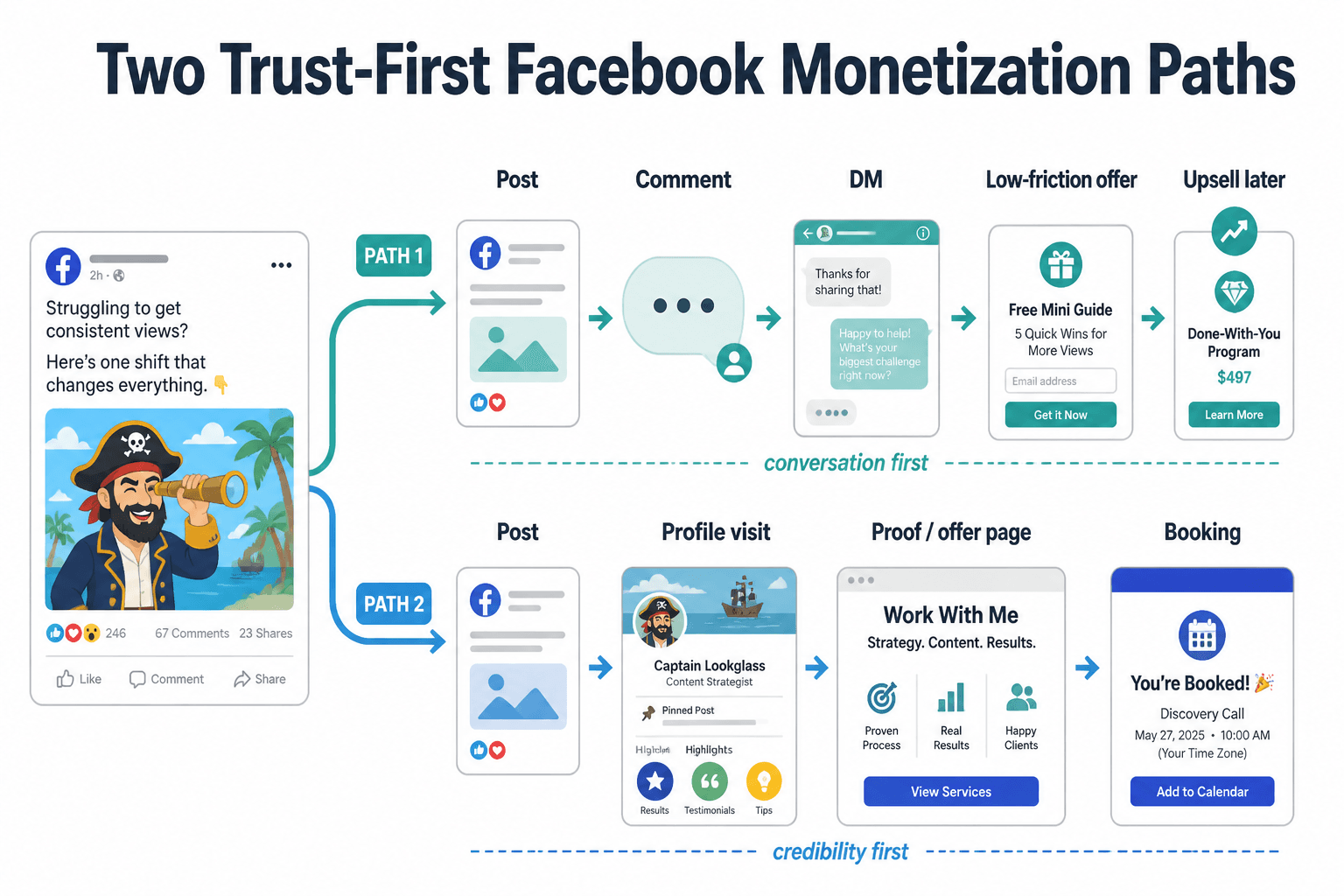
Here are a few trust-friendly paths that work well:
- Post → conversation in comments → soft DM → offer
- Post → profile visit → clear bio CTA → booking page
- Post → free resource → email nurture → service offer
- Post → case study/article → consultation
- Post → low-friction paid offer → upsell later
The key is that the post does not need to do every job. It just needs to move the right person to the next sensible step.
This is where many people overcomplicate things. They assume monetization means every post needs a sales angle. It does not. A lot of monetization happens because your posts repeatedly prove you understand the problem, have a sharp take on it, and can explain solutions without sounding like a motivational fax machine.
If you want a broader system for this, read how to turn Facebook posts into more leads or sales. It pairs well with this article because trust is only useful if it leads somewhere.
What to post more often if you want sales later
People often ask how frequently they should pitch on Facebook. The more useful question is: what should you publish between offers so the offers work better?
These are the post categories that tend to support monetization without draining trust.
Problem-awareness posts
Help readers notice the real problem, not just the symptom.
Example: “Your Facebook posts may not be underperforming because the algorithm hates you. They may be underperforming because the first sentence says nothing worth stopping for.”
Myth-busting posts
Challenge bad assumptions your audience keeps following.
Example: “You do not need to post every day to get clients from Facebook. You do need posts that create memory and movement.”
Process posts
Show how you think, how you solve, how you decide, or how you improve something.
These build trust because they make your expertise visible. Not just your conclusions, but your method.
Case-example posts
You do not need dramatic client wins to use examples well. Even a small before-and-after can work if it is specific.
Example: show how you rewrote a weak hook, reframed a pitch, clarified an offer, or improved a CTA.
Belief posts
These shape your positioning. They tell readers what you stand for, what you reject, and what kind of results or approach you care about.
That kind of clarity does more for monetization than endless generic tips.
Three trust-killing mistakes to stop making
1. Hiding the pitch inside fake value
If the post exists only to maneuver people toward a CTA, they can usually feel it. Especially on Facebook, where people are used to more conversational content.
A post should still be worth reading if the CTA were removed.
2. Treating comments like prey
Someone comments on your post. Great. That does not mean you should immediately pounce with a copy-pasted sales DM.
Reply like a person first. Continue the conversation. If the situation naturally leads to a deeper discussion, fine. But forced transitions from comment to pitch are one reason people stop engaging publicly.
3. Posting nothing but value, then suddenly hard selling
This one surprises people, but it matters. If you spend weeks sounding like a helpful teacher and then abruptly switch into “buy now” mode with zero setup, the jump feels jarring.
Your audience should already know:
- What you do
- Who you help
- How you think
- What kind of offer exists
- Why someone would choose you
If they do not know those things, trust is not your only problem. Positioning is.
A simple weekly rhythm that helps monetize Facebook posts
You do not need a rigid content calendar printed on ceremonial parchment. But a loose rhythm helps.
Here is one practical mix:
- 2 useful insight posts
- 1 opinion or belief post
- 1 story-with-a-point post
- 1 engagement or conversation post
- 1 direct or soft offer post
This keeps your feed from becoming one-note. It also makes offers feel normal instead of intrusive because they are part of a broader pattern of useful, relevant communication.
If your posting rhythm is chaotic or your content quality swings wildly, this is worth tightening with how to write better Facebook posts and the broader Facebook posts hub.
Before-and-after: a post that wrecks trust vs one that builds it
Here is a typical trust-killer:
I have been thinking a lot lately about how so many entrepreneurs are struggling to show up authentically online. The truth is, I have created a powerful framework to help aligned business owners step into their next level. DM me “LEVEL UP” if you are ready.
The problems:
- Vague
- No real insight
- Overcooked language
- No proof
- CTA feels detached from anything concrete
Now the rewrite:
The bigger point is simple: clearer structure and clearer writing make the piece more useful. That is usually what makes the ending land better too.