
Most creator email sequences do not fail because the emails are bad.
They fail because they are attached to a weak funnel. The opt-in is vague, the next step is fuzzy, the offer shows up too early or too awkwardly, and the whole thing feels like somebody duct-taped a newsletter onto a sales process and hoped for the best.
If you want better results from your email, you need a better path into it and out of it. That is what this article is about: the best funnel ideas to pair with creator email sequences, based on what actually makes sense for creators, coaches, consultants, writers, freelancers, and personal brands who are trying to build trust and sell without acting like a dehydrated webinar bro.
You will get practical funnel models, what each one is good for, where people usually mess it up, and how to choose the right setup based on your audience, offer, and content style.
If you want the bigger picture, start with the parent guide.
What makes a funnel work with creator email sequences
A good funnel is not just “freebie goes in, sales email comes out.” It is a sequence of small trust-building steps that match how your audience actually buys.
For most creators, the real job of the funnel is simple:
- Get the right people onto your list
- Help them understand what you do
- Show them why your approach works
- Move them toward one clear next action
That next action could be buying a product, booking a call, replying to an email, joining a membership, reading a case study, or consuming more of your content. Not every funnel needs to sprint toward a sale. In a lot of creator businesses, that is exactly how you wreck trust.
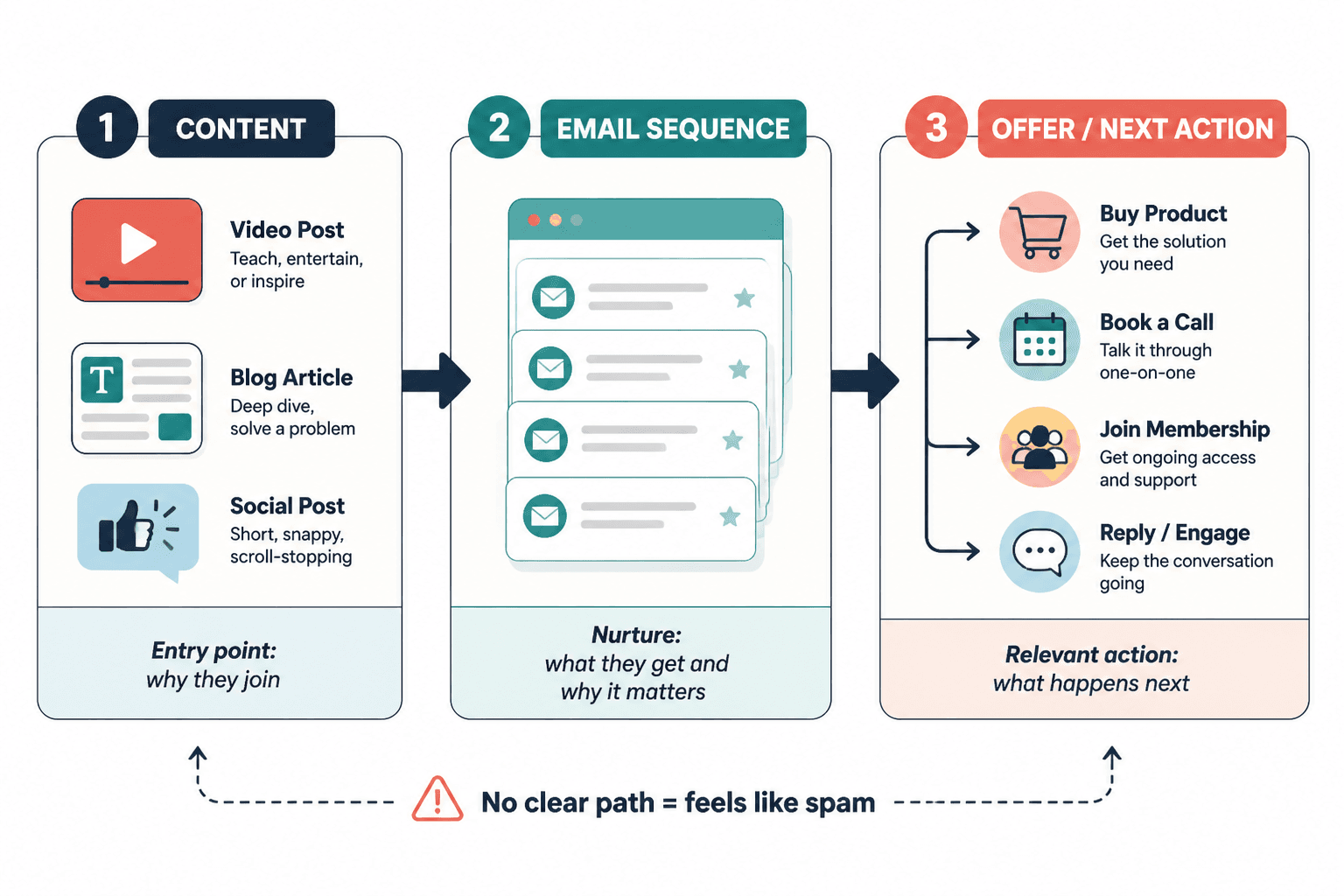
Email sequences work best when the funnel around them has three things:
- A clear entry point: why someone joins
- A logical nurture path: what they get and why it matters
- A relevant offer or action: what happens next
Miss one of those, and the sequence starts feeling like polite spam.
Before you pick a funnel, know what your email sequence is supposed to do
This is where people get weirdly lazy. They build one generic welcome sequence and try to force every lead through it, even though different people joined for different reasons.
Before picking a funnel, decide what role the sequence plays. Usually it is one of these:
- Welcome and orient: introduce your work, values, and best content
- Educate and qualify: help subscribers understand the problem and your approach
- Build trust with proof: case studies, examples, process, results, credibility
- Convert: move people toward a paid offer
- Re-engage: wake up quieter subscribers and point them somewhere useful
If your sequence is trying to do all five at once, it usually does none of them well. This is also why segmented creator email systems tend to outperform one giant “hello friend” automation blob. If you want a broader foundation for that, this parent guide on creator email sequences is the right rabbit hole.
Best Funnel Ideas to Pair With Creator Email Sequences
Here are the funnel types that make the most sense for most creator businesses, especially when you care about trust, positioning, and not sounding like your business was raised by pop-up ads.
1. Content to lead magnet to welcome sequence to core offer
This is the classic one because it works. A piece of public content brings in the subscriber. A relevant lead magnet gives them a reason to opt in. A welcome sequence builds trust. Then you point them to one clear paid offer.
Best for:
- Coaches
- Consultants
- Writers selling templates or products
- Creators with one main offer
Simple flow:
- Post, article, thread, or video
- Lead magnet tied to that topic
- 5 to 7 email welcome sequence
- CTA to your service, product, workshop, or membership
Why it works: the subscriber enters through a specific problem, so the emails can stay focused. That makes the offer feel like a continuation, not a sudden ambush.
Where people ruin it: they use a generic lead magnet that attracts random people, then wonder why nobody buys. “Join my newsletter for insights” is not a funnel. It is a shrug.
A better version looks like this:
- Content topic: writing sharper LinkedIn hooks
- Lead magnet: 25 hook rewrite examples
- Email sequence: hook mistakes, examples, positioning, proof, CTA
- Offer: hook template pack or content strategy service
2. Content to newsletter signup to nurture sequence to soft conversion path
Not every funnel needs a lead magnet. Sometimes the cleanest move is getting people onto your newsletter directly, then using the sequence to set expectations and guide them toward your ecosystem.
Best for:
- Personal brands with strong content
- Writers and thought leadership creators
- Founders building trust over time
- People whose sales cycle is slower or relationship-based
Simple flow:
- Content
- Newsletter opt-in
- 3 to 5 email welcome sequence
- Links to best articles, case studies, profile, and eventual offer
This works especially well if your content itself is the product preview. You are not bribing people with a PDF they forget in six minutes. You are saying, plainly, “If you like how I think, subscribe.” That can be a much better filter.
The catch is that your positioning has to be clear. If your newsletter signup page and first emails are fuzzy, this funnel becomes a soft little cloud of nice intentions and low conversions.
3. Free resource to educational sequence to consultation funnel
This is one of the best funnel ideas to pair with creator email sequences if you sell high-trust services. Think consulting, coaching, audits, retainers, or strategy sessions.
Simple flow:
- Free checklist, framework, audit guide, or mini training
- Email sequence that teaches your method
- Case study or proof email
- Soft CTA to book a consultation or apply
Best for:
- Consultants
- Service providers
- Coaches with a defined methodology
- B2B creators with higher-ticket offers
This funnel works when the emails help the subscriber understand both the problem and the cost of not fixing it. Not in a fear-mongering way. In a clarity way.
For example, if you help founders improve their outbound messaging, your sequence might cover:
- Why most cold outreach sounds interchangeable
- The messaging gaps that kill replies
- A teardown example
- A short case study
- An invitation to book a messaging consult
What not to do: ask cold subscribers to “jump on a quick call” before they know who you are. That is not a funnel. That is calendar optimism.
4. Mini-course funnel for expertise-heavy offers
If your topic needs more explanation, a mini-course funnel can work beautifully. The sequence delivers lessons over several days, with each email building understanding and trust before making the pitch.
Best for:
- Educators
- Creators selling courses
- Consultants with a strong framework
- Niche experts whose audience needs warming up
Simple flow:
- Opt-in for a free 3 to 5 day email course
- Daily educational emails
- Examples and proof
- Offer for the deeper paid solution
The appeal here is obvious: the sequence itself delivers value. The downside is that people often overbuild it. Suddenly the “mini-course” is 11 emails, 4 worksheets, and a nervous breakdown. Keep it tight. Every email should move the reader toward one sharper understanding.
5. Case study funnel for skeptical buyers
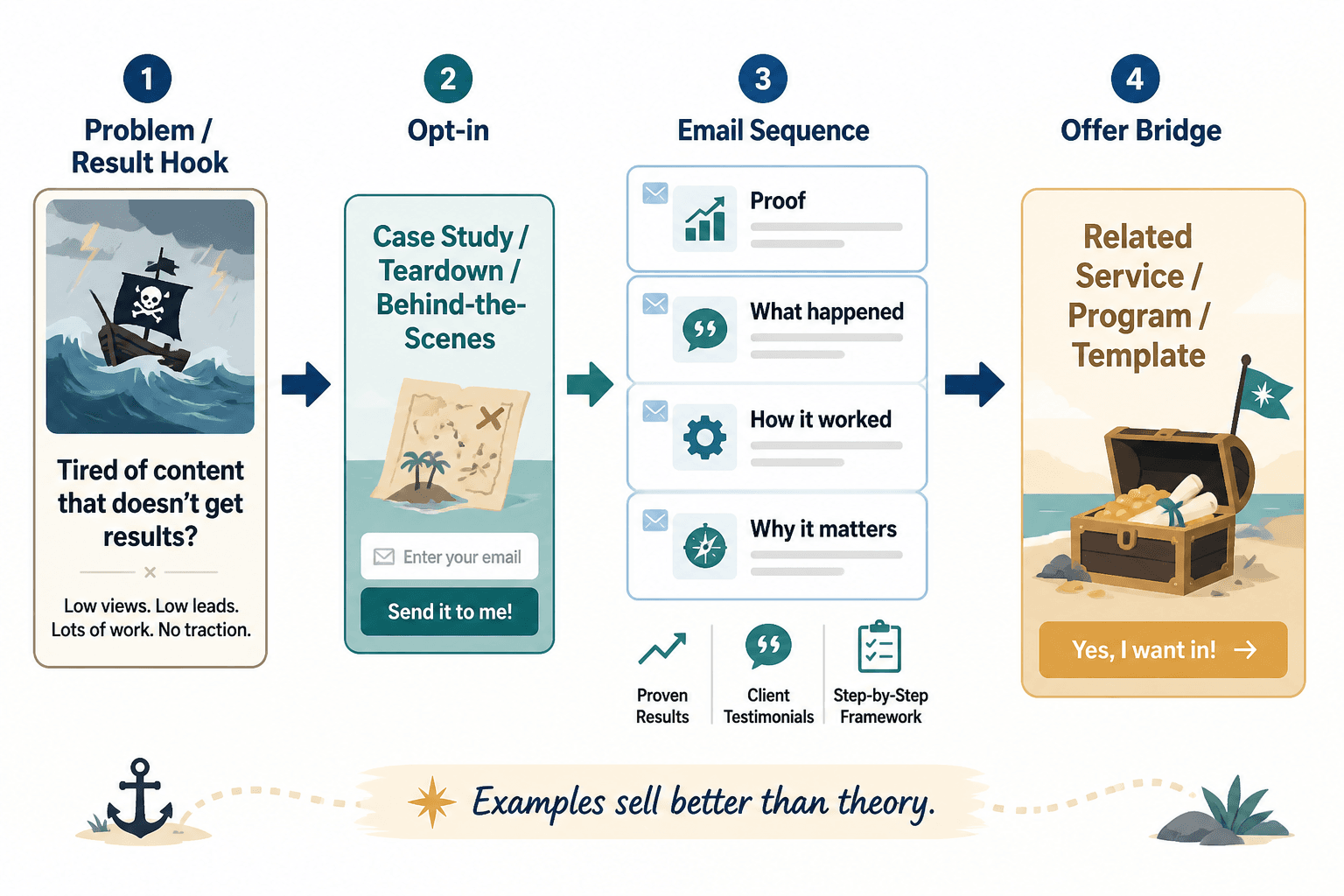
If your audience has seen every promise before and trusts none of them, lead with proof. A case study funnel uses examples, breakdowns, before-and-after transformations, and real process details to move people toward action.
Simple flow:
- Content about a common problem or result
- Opt-in for case study, teardown, or behind-the-scenes breakdown
- Email sequence unpacking the result and method
- CTA to the related offer
Best for:
- Conversion copywriters
- Growth consultants
- Designers and strategists
- Any creator whose work is easier to sell through examples than theory
This funnel tends to attract more serious buyers because it filters for people who care about outcomes, not just free stuff.
It also gives you a stronger bridge to the offer. If somebody just read a detailed breakdown of how you solved a problem like theirs, the next step does not feel random.
6. Webinar or live training funnel to sales sequence
Yes, webinars still work. No, they do not have to be cringe. A live or recorded training funnel can be excellent when the offer needs context, objection handling, and demonstration.
Simple flow:
- Invite to live training or workshop
- Reminder emails
- Training delivery
- Follow-up sequence with recap, proof, FAQ, and offer
Best for:
- Courses
- Group programs
- Higher-ticket coaching
- Offers that benefit from teaching before selling
The mistake here is making the training one long infomercial with slides that look like they were assembled during a hostage situation. Teach something useful. Make a real point. Let the sales sequence continue the conversation instead of trying to force the close in the room.
7. Quiz or self-assessment funnel to segmented email paths
This funnel is underrated when your audience has different needs, stages, or goals. A quiz or assessment helps segment subscribers, and the email sequence changes based on what they selected.
Simple flow:
- Quiz or assessment opt-in
- Segment based on answers
- Tailored sequence per segment
- Relevant offer or recommendation
Best for:
- Business coaches
- Health and performance creators
- Brand strategists
- Creators serving multiple audience types
When it works, it feels highly personal and useful. When it fails, it feels like a BuzzFeed relic in a blazer. So do not build a quiz just because quizzes feel clever. Build one because segmentation changes what people actually need to hear next.
8. Product sampler funnel to low-ticket offer to ascension path
If you sell digital products, templates, swipe files, or small paid resources, a product sampler funnel can be a strong fit. The email sequence warms people up, then nudges them toward a low-friction purchase that can later lead to larger offers.
Simple flow:
- Content
- Free sample, preview, or lite version
- Email sequence
- Low-ticket product
- Upsell to bundle, membership, or service
Best for:
- Template sellers
- Writers with digital products
- Creators with libraries or memberships
- Educators building a product ladder
This can work well because it lets subscribers buy before they are ready for a bigger commitment. A small purchase often creates more trust than another month of “valuable content” floating in the inbox.
9. Newsletter to evergreen article hub to offer funnel
This one is simple and surprisingly effective for creators with a decent content library. The email sequence introduces your best evergreen articles, frameworks, and resources, then uses those assets to build authority before making an offer.
Simple flow:
- Newsletter signup
- Welcome sequence
- Curated links to your strongest articles
- Offer tied to those topics
Best for:
- Writers
- Consultants with educational content
- Niche experts
- Personal brands building authority over time
The beauty of this setup is leverage. Instead of trying to cram all your trust-building into five emails, you use your existing content as proof. If you are building this kind of system, it also helps to think in terms of a larger content structure, not isolated emails. These broader resources on email newsletter writing and creator email systems can help connect those dots, weird URL and all.
10. Reply-driven funnel for relationship-first selling
Sometimes the best conversion move is not a link. It is a reply.
This funnel uses the email sequence to start conversations. Instead of pushing straight to a sales page, one or more emails invite the subscriber to reply with a problem, goal, or question. Those replies then create a natural path into DMs, consultations, or offers.
Best for:
- Consultants
- Ghostwriters
- High-ticket service providers
- Creators who sell through conversations
Simple flow:
- Content or opt-in
- Short trust-building email sequence
- Reply prompt
- Manual follow-up
- Soft offer if relevant
The key word there is relevant. If every reply gets shoved into the same scripted pitch, people can smell it. This funnel works because it feels human. Do not immediately ruin that by acting like an autoresponder wearing cologne.
How to choose the right funnel for your creator business
You do not need ten funnels. You need one that fits your business model, sales cycle, and audience awareness level.
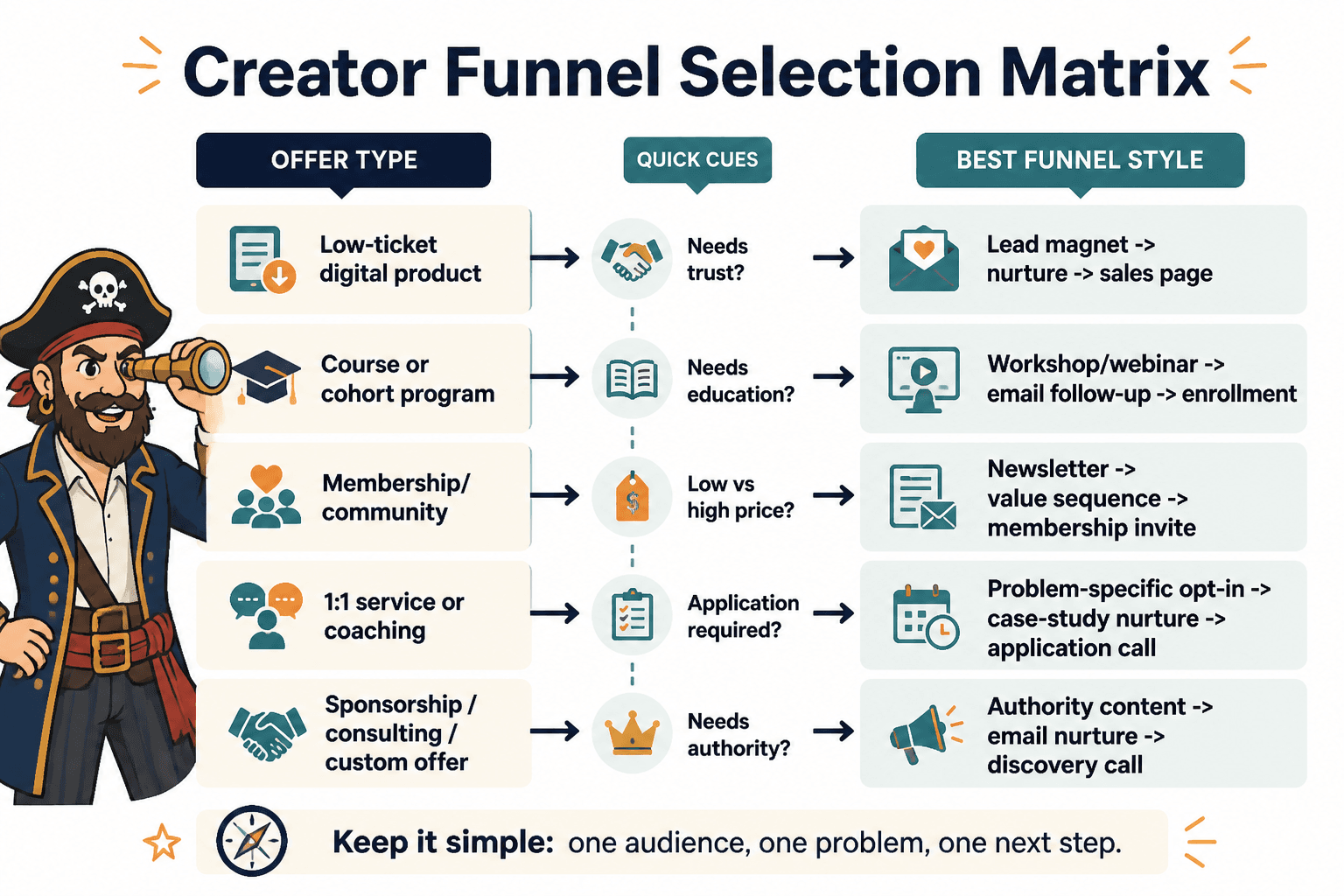
| If you sell… | Best funnel fit | Why it works |
|---|---|---|
| High-ticket service | Free resource to educational sequence to consultation | Builds trust before the call |
| Course or group program | Mini-course or webinar funnel | Explains the method before the pitch |
| Digital products | Lead magnet to welcome sequence to low-ticket product | Low friction first purchase |
| Membership or paid newsletter | Newsletter to nurture to curated content and offer | Lets your thinking sell the subscription |
| Custom consulting | Case study or reply-driven funnel | Proof and conversation drive conversion |
You should also factor in audience size. If your audience is still small, complicated multi-branch automations are often overkill. You usually need better targeting and clearer messaging before you need more software gymnastics. If that is your situation, read creator email sequences for creators with small audiences before building some majestic funnel castle nobody walks into.
The simplest funnel stacks tend to win
There is a reason so many good creator funnels look boring on paper. They are not trying to impress other marketers. They are trying to move a real person from interest to trust to action.
A simple funnel with a strong entry point and a clear sequence usually beats an elaborate one with seven branches, twelve tags, and no real point of view.
In practice, that means:
- One audience
- One main problem
- One relevant opt-in
- One clear nurture sequence
- One logical next step
That setup is easier to write, easier to measure, easier to improve, and much harder to accidentally turn into nonsense.
Common funnel mistakes that wreck creator email sequences
You can pick a good funnel model and still mess it up with bad execution. Here are the usual offenders.
Mismatch between opt-in and offer
If someone opts in for “50 content hooks” and gets pitched leadership coaching three emails later, something has gone wrong. The offer should feel connected to why they joined.
Too much too soon
Not every new subscriber is ready for your premium offer on day one. Some are. Most are not. Your funnel needs enough education and proof to earn the ask.
No clear next step
The bigger point is simple: clearer structure and clearer writing make the piece more useful. That is usually what makes the ending land better too.
Email sequences work better when each message has one clear role and the progression feels natural. Better sequencing usually beats more aggressive copy.