Most welcome emails are not too short or too long. They are too vague, too self-important, or too busy trying to “nurture” before they have earned a second click.
That is why asking How Long Should Welcome Emails Be in 2026? is useful, but only if you ask the right follow-up question: long enough for what?
A welcome email has a job. Sometimes that job is simple: confirm the signup, deliver the free thing, set expectations, and point people to one next step. Sometimes it needs a bit more room: explain your angle, build trust, and move the reader into a short sequence that does not feel like a hostage situation.
So no, there is not one magic word count. Annoying answer, yes. Still the right one.
Here is the practical version: most welcome emails in 2026 work best somewhere between 75 and 300 words if they have one clear goal, and between 300 and 700 words if they need to do a bit more trust-building, context, or onboarding. Past that, you usually need a very good reason. Not a “my brand story matters” reason. A reader reason.
This article will help you decide how long your welcome email should be, what changes that length, when short beats long, and how to write one that actually gets read instead of politely ignored.
If you want the bigger picture, start with the parent guide.
How long should welcome emails be in 2026? The short answer
If you want the cleanest rule of thumb, use this:
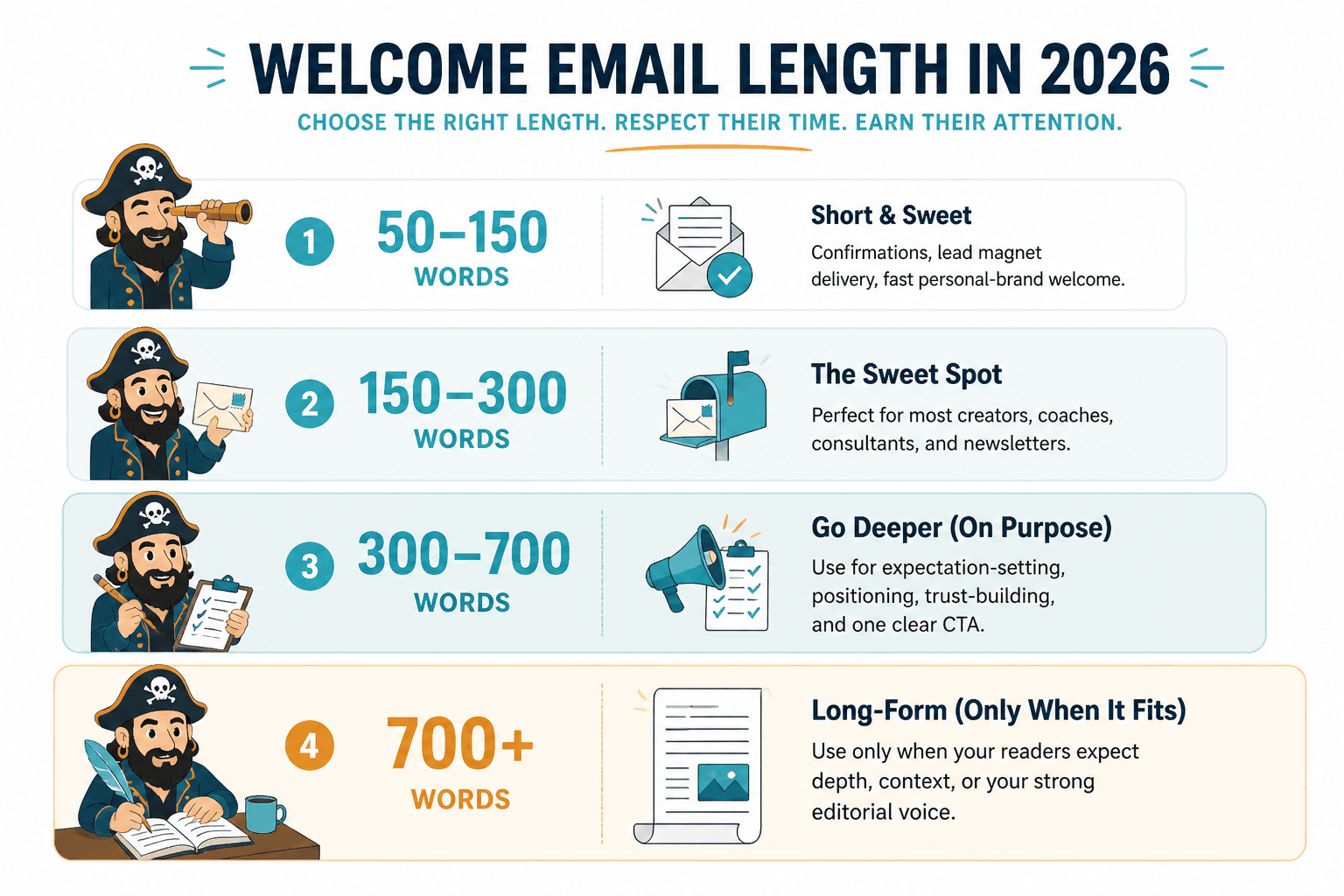
- 75 to 150 words: best for simple confirmations, lead magnet delivery, or fast personal-brand welcomes
- 150 to 300 words: best for most creator, coach, consultant, and newsletter welcome emails
- 300 to 700 words: best when you need expectation-setting, positioning, trust-building, and one clear CTA
- 700+ words: only worth it when the reader expects depth, context, or a strong editorial voice
If your welcome email is pushing past 700 words, it had better be genuinely interesting, sharply written, and easy to skim. Otherwise you are not building trust. You are assigning homework.
And in most cases, your first email should not try to do the entire relationship in one go. That is what the rest of your welcome sequence is for.
What actually determines welcome email length
The right length depends less on trends and more on function. A lot of people write as if length is a branding choice. It is not. It is a job-fit choice.
1. The goal of the email
Start here. What is the one thing this email needs to do?
- Deliver a freebie
- Confirm the signup
- Introduce your newsletter
- Set expectations
- Send people to a key page
- Start a welcome sequence
- Build trust before a later offer
The more jobs you give the email, the more length it may need. But that does not mean piling everything into one bloated message. It means being honest about what belongs here and what belongs in email two or three.
2. Reader intent
Why did they sign up?
If someone joined to get a checklist, template, discount code, or resource, they usually want speed first. Deliver the thing. Add a little context. Do not trap the link under six paragraphs about your mission.
If they signed up for a thoughtful newsletter, paid workshop waitlist, or high-trust consulting funnel, they may be more open to a longer note that explains your angle and what they can expect next.
3. Relationship temperature
Cold subscribers need clarity more than charm.
If they barely know you, shorter often works better because it reduces friction. Give them one useful next step and let future emails do more of the heavy lifting. If they signed up after reading your content for months, you can usually get away with more personality, context, and depth.
4. Complexity of your offer or ecosystem
A solo newsletter with one topic and one promise does not need a mini onboarding manual. A business with multiple resources, a podcast, a paid offer, a community, and a booking flow may need a bit more explanation.
Still, the fix is not “write a longer blob.” The fix is structure. Short paragraphs. One idea at a time. One real CTA.
5. Your writing quality
This part gets ignored because it is less flattering.
A 500-word welcome email can work beautifully if it is crisp, relevant, and easy to scan. A 120-word welcome email can flop if it sounds like generated mush wearing a smile. Length does not save weak writing. It just gives it more room to be weak.
When short welcome emails work best
Short welcome emails are usually the safer default, especially for creators and service businesses. They respect attention. They deliver quickly. They make the next step obvious.
Short is best when:
- the subscriber mainly wants a resource or lead magnet
- you have one obvious next action
- your audience is cold
- your offer is simple
- your brand voice is direct and minimal
- you are sending a follow-up sequence anyway
There is a reason short welcome emails often outperform longer ones: they are easier to finish. And completion matters. A half-read masterpiece still does less than a fully read, well-aimed note.
If you want a deeper breakdown on that, this article on when short welcome emails beat long ones is worth your time.
A good short welcome email feels deliberate. A bad short welcome email feels underwritten. There is a difference.
A short welcome email template
Here is a simple structure that works well in the 100 to 180 word range:
- Quick welcome
- Deliver the promised thing
- Set one expectation
- Give one next step
Example:
Hey, glad you joined.
Here is your welcome email checklist: [resource link]
Over the next few emails, I will show you how to write welcome emails that sound like a smart human and actually move people somewhere useful.
If you want a fast win now, start with this: cut any sentence in your first email that exists only to “sound professional.” It is probably slowing the whole thing down.
And if you want the deeper version, read how to write better welcome emails.
When longer welcome emails make sense
Longer welcome emails are not wrong. They are just easier to mess up.
A longer welcome email can work if the extra length earns its keep. That usually means it is doing one or more of these things:
- explaining a distinctive point of view
- setting expectations for a newsletter with a strong editorial angle
- onboarding readers into a more complex ecosystem
- building trust for higher-ticket services
- sharing selective proof or credibility without turning into a chest-thumping bio dump
The key phrase there is earns its keep. If a paragraph does not help the reader understand, trust, or act, it is decorative. Decorative copy is how welcome emails become sleepy little museums.
What longer emails need in order to work
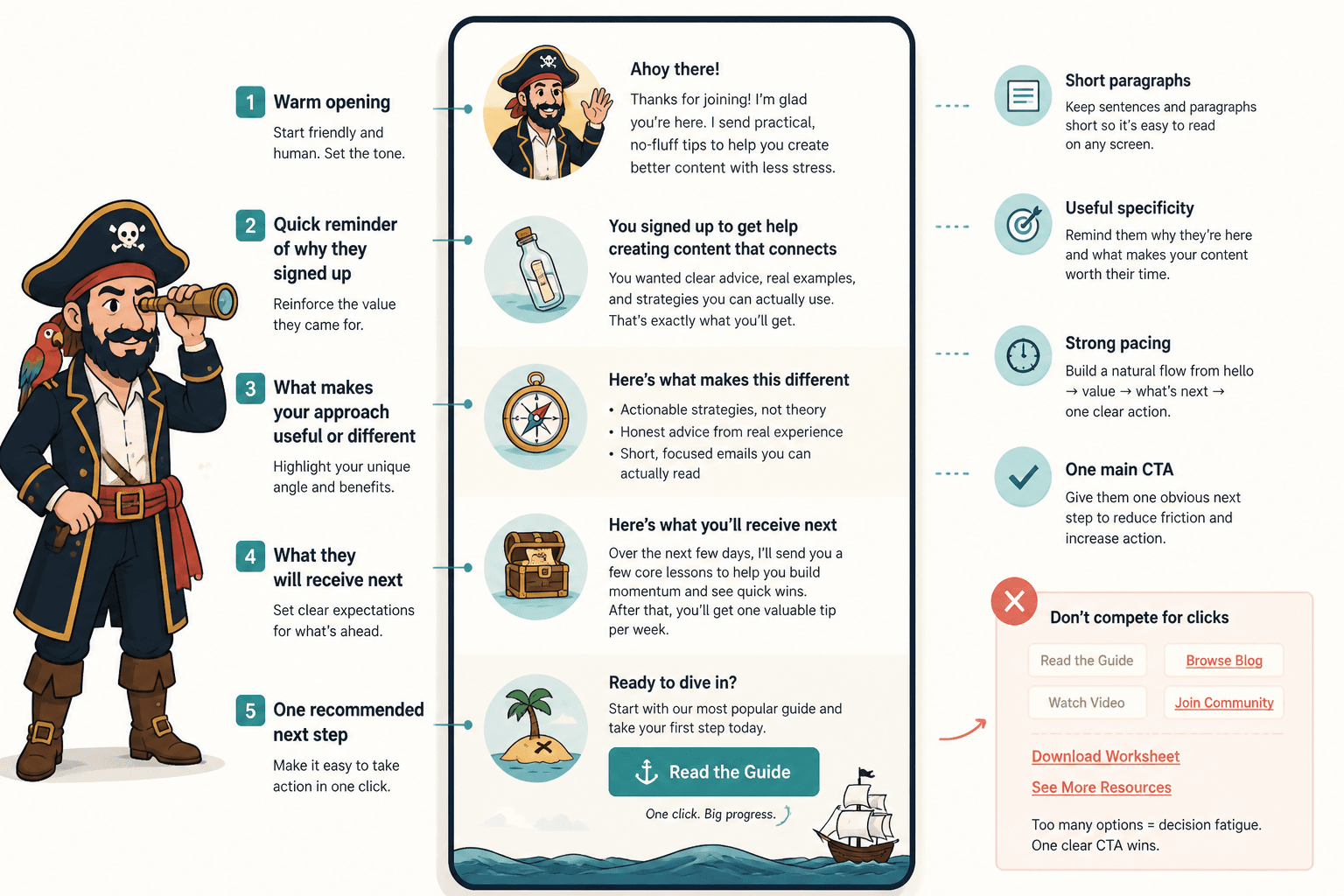
- A clear reason for existing
- Strong pacing
- Short paragraphs
- Useful specificity
- One main CTA, not five
- Real voice, not polished corporate fog
If your email is long because you are trying to compensate for weak positioning, that is not strategy. That is nervous typing.
A longer welcome email structure that still feels readable
- Warm opening
- Quick reminder of why they signed up
- What makes your approach useful or different
- What they will receive next
- One recommended next step
That is enough. You do not need your life story, your full offer ladder, and three links to everything you have ever made.
The best length by welcome email type
| Welcome email type | Typical length | What matters most |
|---|---|---|
| Lead magnet delivery | 75–200 words | Speed, clarity, obvious link |
| Newsletter welcome | 150–350 words | Expectations, tone, next step |
| Personal brand intro | 150–400 words | Positioning, relevance, trust |
| Course or community onboarding | 300–700 words | Orientation, setup, priority actions |
| High-ticket service funnel welcome | 250–600 words | Credibility, problem framing, soft CTA |
| Editorial or essay-style welcome | 400–900 words | Strong voice, genuinely good writing |
Notice what is missing: one universal number. Because the right answer depends on the promise you made at signup and what the reader needs next.
What changed by 2026
The basics are still the basics. Clear subject line. Fast relevance. One obvious next step. That part did not magically expire.
What has changed is reader tolerance for fluff. People are getting more emails written in suspiciously polished, generic voices. They can smell it. Maybe not consciously in every case, but enough to disengage.
So in 2026, welcome email length matters a bit less than welcome email density. Readers are asking, often silently:
- Did you get to the point?
- Did you deliver what I came for?
- Do you sound real?
- Do I know what to do next?
A tighter email with actual substance beats a longer one stuffed with performative warmth and suspiciously smooth filler. Every time.
How to decide the right length for your welcome email
If you are stuck, use this quick decision process.
- Name the primary goal. If you cannot do that in one sentence, your email is probably trying to do too much.
- Identify the subscriber’s immediate need. What did they sign up expecting right now?
- Choose one CTA. Download, reply, read, book, browse, whatever. Pick one.
- Write the shortest version that does the job well. Then add only what improves understanding or trust.
- Cut anything that exists for your ego, not their clarity. Harsh, yes. Helpful, also yes.
This approach keeps the email from becoming a messy little hallway full of doors. You want momentum, not choices that make people stall out.
Common mistakes that make welcome emails feel too long
Sometimes the problem is not the actual length. It is the drag.
- Overlong intros: “I’m so excited to welcome you…” is fine once. It is not a paragraph strategy.
- Biography bloat: readers care about who you are mainly as it relates to what they need.
- Too many links: choice overload makes emails feel heavier.
- No hierarchy: giant text blocks make even decent copy feel longer than it is.
- Repeated points: if you have said it, you usually do not need to say it in two more slightly shinier ways.
- Trying to sound “professional”: this is where a lot of life goes to die.
One of the easiest fixes is reading your draft and asking, sentence by sentence, “Would the reader miss this if I removed it?” If the answer is no, cut it. Ruthlessly, but with manners.
Before and after: same message, better length
Too long and soft
The bigger point is simple: clearer structure and clearer writing make the piece more useful. That is usually what makes the ending land better too.
Welcome emails work best when they set expectations clearly and move the relationship forward without overperforming. Clarity and trust do more than extra cleverness.