
Most Substack posts do not sound robotic because the writer lacks personality. They sound robotic because the writer is trying too hard to sound like A Writer. Add a funnel-brain sales instinct on top, and now the post reads like a polite machine asking for trust it has not earned.
That is the real problem behind how to write Substack posts and series without sounding salesy or robotic. It is not about being casual for the sake of it. It is about writing with enough clarity, specificity, and actual perspective that readers feel like a person is talking to them, not performing at them.
If you want your Substack to grow, you need two things at once: useful ideas and a voice people can stand being in for more than thirty seconds. This means better openings, less canned “value,” cleaner structure, and a much more human relationship to promotion. You can sell on Substack. You just cannot sound like your post was assembled by a webinar template and a fear of being ignored.
This article will show you how to write standalone Substack posts and multi-part series that feel sharp, readable, and trustworthy, while still moving readers toward paid subscriptions, offers, replies, or whatever next step actually matters.
For the broader learning path, visit our parent guide.
Why Substack posts start sounding fake so fast
Substack sits in an awkward middle space. It is more personal than a blog, more durable than social posts, and closer to email than most people admit. That makes writers overcorrect in weird ways.
Some get stiff and formal because they think paid writing must sound serious. Others get weirdly confessional because they think intimacy is the product. Then there is the sales problem: halfway through the post, the tone shifts from thoughtful to “by the way, smash subscribe for more transformative insights.” Grim.
Usually, robotic writing on Substack comes from one of these habits:
- Writing to an imagined audience blob instead of a real type of reader
- Using abstract language instead of concrete observations
- Padding simple ideas to make them feel premium
- Copying LinkedIn thought-leader phrasing into a newsletter format
- Forcing transitions into a pitch
- Writing series with no real narrative thread, so every post feels templated
Substack readers are surprisingly tolerant of imperfect prose. They are much less tolerant of fake tone. You do not need to sound polished. You need to sound like you mean it.
What human Substack writing actually sounds like
A good Substack post usually feels like one smart person making a clear point to another smart person. It has texture. It has shape. It knows why it exists.
That does not mean rambling into the void and calling it voice. “Human” is not a license for messy writing. It means the post has a real point of view, uses natural language, and earns its recommendations instead of dropping them in like preset CTA furniture.
In practice, that often means:
- Specific claims instead of vague truths
- Natural phrasing instead of stiff transitions
- A strong opening that gets to the tension fast
- Examples that sound lived-in, not generic
- A visible through-line from opening to ending
- A CTA that fits the piece instead of interrupting it
If your post could be read aloud without sounding like a customer nurture sequence, you are probably heading in the right direction.
Start with a sharper point, not a warmer tone
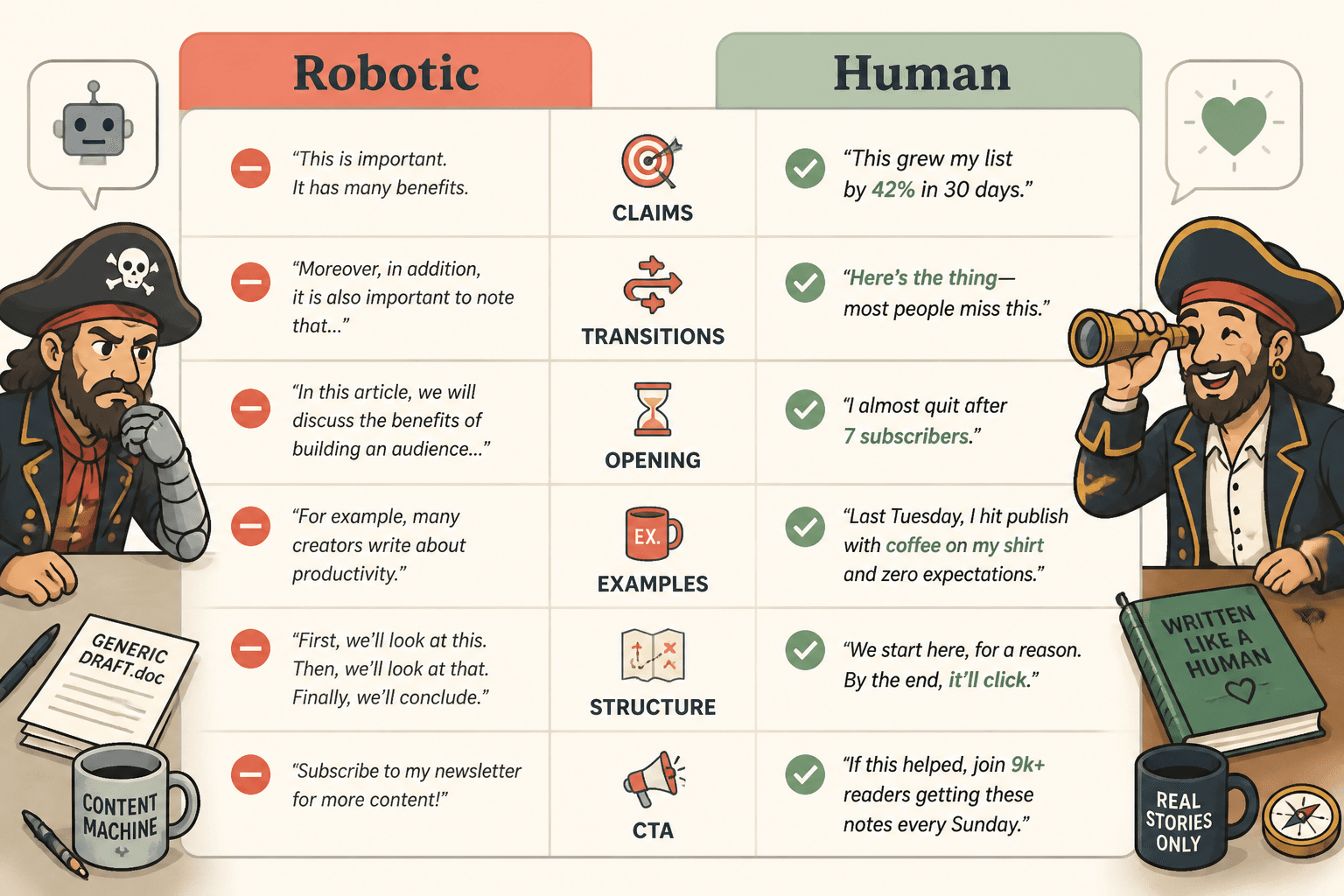
A lot of writers try to fix robotic writing by sprinkling in casual phrases. A “here’s the thing” here, a “to be honest” there, maybe a rhetorical question if we are really trying to cosplay authenticity. That is not the fix.
The fix is a sharper point.
When you know exactly what you are trying to say, your writing naturally gets more direct. You stop stuffing the piece with generic context and throat-clearing. You stop sounding like you are preparing to write and start actually writing.
Weak point vs strong point
Weak: “Consistency matters a lot when building a newsletter.”
Stronger: “Most Substack newsletters do not stall because the writer lacks ideas. They stall because each post resets the relationship from scratch.”
The second one gives you something to build around. It has tension. It makes a claim. It also creates momentum for a series, because now you can talk about continuity, expectations, themes, and reader trust.
If you struggle with openings, this gets even more important. A bland first paragraph makes the whole post feel mass-produced. If you want help there, read how to improve Substack posts and series post openings without sounding generic and how to start Substack posts and series without a weak opening.
Write like a person with taste, not a content dispenser
Substack rewards distinctiveness more than most platforms. Not because of magic platform mechanics, but because people subscribe when they want more of you, not just more information.
That means your posts need taste. Not fancy taste. Editorial taste. Selection. Judgment. The sense that you know what matters, what does not, and why this specific reader should care.
A salesy tone often creeps in when the post is too eager to prove usefulness. Every paragraph starts trying to justify itself. Every section has to deliver a takeaway. The result is exhausting and weirdly impersonal.
Sometimes it is better to slow down and explain one thing properly. Give the idea room. Add an observation. Show a contrast. Let the writing breathe a bit. Readers can feel the difference between “I am guiding you through an idea” and “I am aggressively optimizing your attention.”
How to sound more human without getting sloppy
- Use contractions naturally most of the time
- Prefer concrete nouns over abstract language
- Say “clients stopped replying” instead of “engagement decreased”
- Cut generic setup unless the reader truly needs it
- Keep your transitions simple and invisible
- Leave in a little rhythm and personality instead of sanding every sentence flat
You are not trying to sound casual. You are trying to sound unforced.
How to write Substack posts and series without sounding salesy or robotic
The simplest way to do this is to separate the roles in your writing. Not every paragraph needs to teach. Not every sentence needs to persuade. Not every post needs to pitch.
When writers blend everything together, the post starts doing too much at once. It is trying to be useful, intimate, premium, insightful, and conversion-focused in every line. That is how you end up with a newsletter that sounds like a founder writing through clenched teeth.
A cleaner structure for standalone posts
- Open with the actual tension. What is going wrong, misunderstood, overrated, or quietly killing results?
- Make one clear argument. Not five adjacent thoughts in a trench coat.
- Support it with examples, contrast, or a small framework.
- Land the post with a fitting next step. Reply, subscribe, read another piece, check out a paid tier, book something if truly appropriate.
That structure leaves room for voice because it reduces strain. You are not trying to perform authority every second. You are guiding the reader somewhere.
A cleaner structure for series
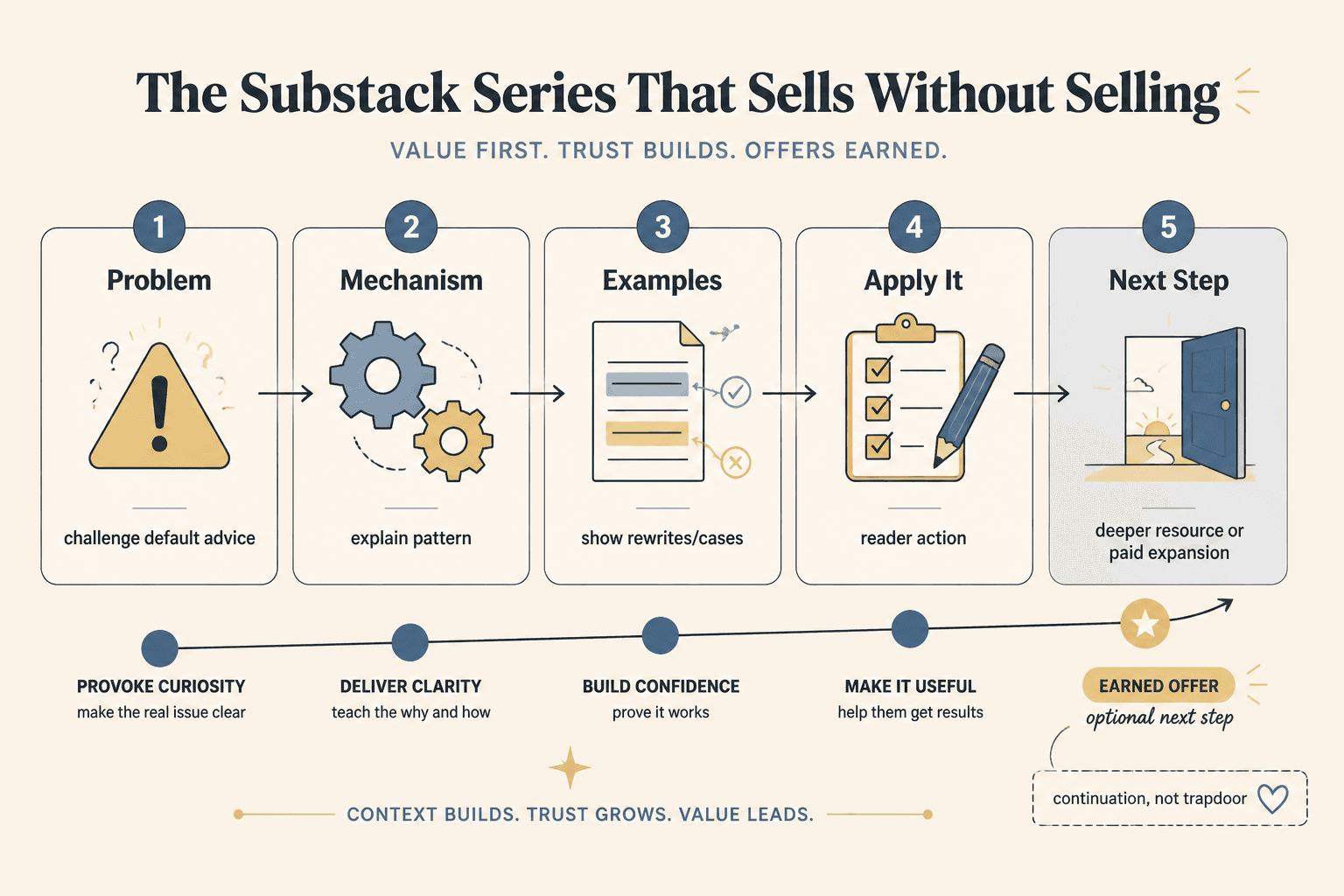
Series get robotic when every installment uses the same packaging and none of them deepen the relationship. The fix is to make the series feel cumulative, not repetitive.
- Part 1: Name the problem and challenge the default advice
- Part 2: Break down the mechanism or pattern behind it
- Part 3: Show examples, rewrites, or case-style applications
- Part 4: Help the reader apply it to their own work
- Part 5: Offer a deeper next step, resource, or paid expansion if relevant
Now the pitch, if there is one, feels earned. The series has built context first. Readers understand why the offer exists. It is a continuation, not a trapdoor.
For more on building stronger posts overall, how to write better Substack posts and series is a useful next read.
Stop using canned “value” language
Nothing dries out a Substack post faster than vague advice pretending to be insight.
Phrases like these usually signal trouble:
- “I wanted to share some thoughts on…”
- “Here are a few things I have learned on my journey…”
- “This can be applied to business and life”
- “If this resonates, consider subscribing”
- “I hope this provides value”
These are not evil. They are just incredibly flattening. They remove tension, blur the point, and make your writing sound pre-approved by a committee that fears specificity.
Better replacements
| Flat version | Stronger version |
|---|---|
| I wanted to share some thoughts on consistency. | Most writers do not have a consistency problem. They have a repeatability problem. |
| Here are a few things I have learned. | Three patterns keep showing up when newsletters lose momentum. |
| If this resonates, consider subscribing. | If you want more posts like this, subscribe. That is what this newsletter is for. |
| I hope this provides value. | Try this in your next post and you will feel the difference fast. |
Notice the shift. More direct. Less ceremonial. More confidence without the puffed-up guru act.
Use promotion like seasoning, not grout
Salesy writing is often not about selling too much. It is about selling too awkwardly.
Writers panic and start wedging promotion into every available crack. A paid mention here, a reminder there, a “work with me” button floating around like a desperate balloon. It makes the reader feel managed.
Promotion works better on Substack when it feels proportional to the post and connected to the reader’s likely next need.
Good moments to promote
- After a useful breakdown, offer a deeper paid version or related resource
- At the end of a series, invite readers into the next layer
- After a strong example, mention that paid subscribers get more of that kind of analysis
- When readers are already replying with questions, direct them toward the relevant offer
Bad moments to promote
- Before you have made a real point
- In the middle of a paragraph that was working perfectly well without it
- With inflated urgency that does not match the product
- Every single week in exactly the same script
A simple rule helps: your CTA should feel like a natural extension of the post, not a hostage note taped to the bottom.
Examples of non-salesy CTAs
- “If this helped, the paid archive has more breakdowns like this.”
- “Next week I’m sending part two, where I show the rewrite process.”
- “If you are trying to fix this in your own newsletter, start here.”
- “Paid subscribers get the templates version because that one is easier to keep out of the free feed.”
Direct is fine. Robotic is not. You do not need a velvet curtain around every ask.
Make your series feel connected, not mass-produced
A series should create anticipation. Too many create déjà vu.
If every installment opens the same way, follows the same rhythm, and ends with the same half-polished pitch, readers start skimming. Not because they hate structure, but because nothing new is happening at the sentence level or idea level.
To fix that, keep the series consistent in purpose but varied in execution. One part can be more argument-driven. Another can use examples. Another can be a breakdown. Another can answer objections. Same lane, different energy.
What to repeat across a series
- The central problem or theme
- The promise of what the reader will understand by the end
- The level of depth and tone
- A light callback to previous parts when useful
What not to repeat mechanically
The bigger point is simple: clearer structure and clearer writing make the piece more useful. That is usually what makes the ending land better too.
Stronger Substack posts usually come from a clearer point, tighter structure, and a more deliberate series flow. Better pacing often matters more than more volume.