
Most weak Substack openings are not failing because the writer lacks ideas. They fail because the first few lines sound like they were assembled from leftover newsletter dust: polite, vague, competent, forgettable.
You’ve seen the type. “I’ve been thinking a lot about…” “Today I want to talk about…” “There’s something important we need to discuss…” Nothing is technically wrong with those lines. They’re just doing absolutely nothing heavy enough to earn attention.
If you want to know how to improve Substack post openings without sounding generic, the fix is not to become louder, weirder, or more dramatic. It’s to become more specific, more immediate, and more intentional about what the opening is actually trying to do.
This matters even more for a series. A one-off post can survive on novelty. A recurring Substack series needs an opening style that creates recognition, momentum, and trust without sounding like you copied your own homework 14 weeks in a row.
Here’s how to make your openings sharper, more distinct, and much more worth reading.
If you want the bigger picture, start with the parent guide.
What generic Substack openings usually get wrong
Generic openings usually have one of three problems:
- They warm up too slowly
- They hide the real point
- They sound like filler instead of a deliberate start
Writers often confuse “natural” with “casual throat-clearing.” So the post starts with context, apologies, scene-setting, vague reflections, or some soft little runway before the actual idea arrives. The issue is not warmth. Warmth is good. The issue is delay.
Substack readers are usually more generous than social media scrollers. They’ll give you a bit more room. That doesn’t mean you should spend the first four paragraphs wandering around the topic like you’re trying not to wake it up.
A good opening does not just begin the post. It creates a reason to keep going.
What a strong opening actually needs to do
A strong Substack opening usually does at least two of these things within the first few lines:
- Names a specific tension, problem, or question
- Makes a clear promise about where the piece is going
- Creates curiosity without using cheap cliffhanger tricks
- Signals a point of view
- Establishes relevance fast
- Sounds like an actual person with taste wrote it
That last one matters more than people think. A lot of newsletter openings are not bad because they lack structure. They’re bad because they have no voice pressure in them at all. They read like someone is trying not to be wrong instead of trying to be interesting.
Your opening does not need fireworks. It needs intent.
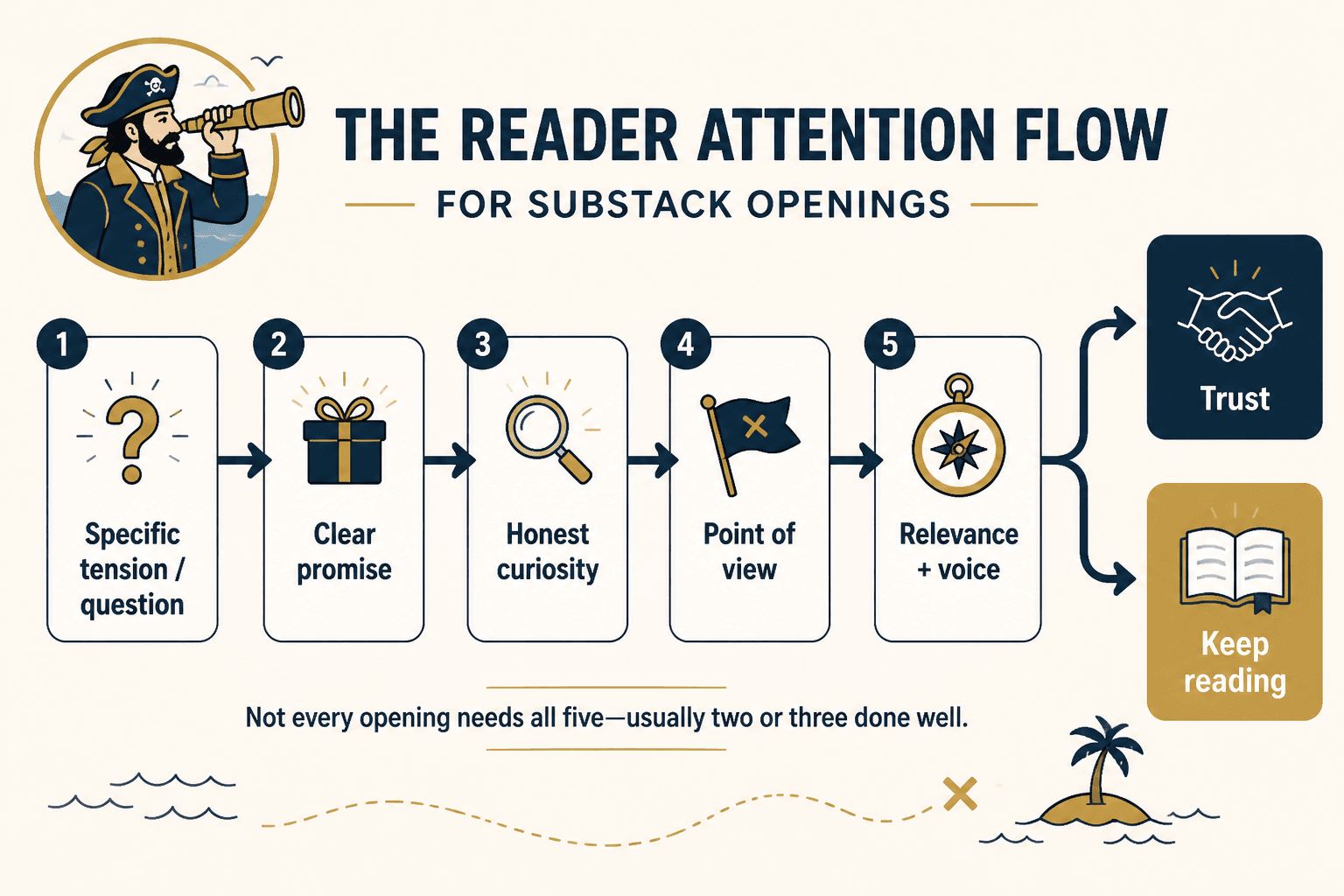
How to improve Substack post openings without sounding generic
Let’s get practical. These are the moves that consistently make openings better.
1. Start with the sharpest version of the real point
Many writers know the point of the post, but they do not start there. They start near it. Around it. In the general emotional neighborhood of it.
Before you write the opening, ask: What is the cleanest, most specific thing this piece is actually saying?
Then test whether you can put some version of that truth in the first paragraph.
Weak: “I’ve been thinking a lot lately about how creators approach consistency and what that means for long-term writing.”
Stronger: “A lot of creators say they want to be consistent, but what they really want is to publish only when the post already feels finished in their head.”
The second one has tension. It has a point. It gives the reader something to react to.
2. Cut throat-clearing harder than feels polite
Most openings can lose the first one to three sentences and improve immediately.
Common throat-clearing lines include:
- “Today I want to talk about…”
- “I’ve been reflecting on…”
- “This week, I thought it might be useful to share…”
- “There’s something I’ve noticed lately…”
- “Before we get into it…”
These lines are not evil. They’re just usually unnecessary. They tell the reader a post is beginning instead of beginning the post.
If you want a cleaner test, delete the first paragraph entirely and read the second one first. Quite often, that’s the real opening.
3. Use specificity instead of mood
Generic openings often try to create a feeling before they create a point. That usually leads to airy language and soft abstractions.
Generic: “The modern internet has changed how we think about attention, value, and the way we communicate with our audiences.”
Better: “A lot of newsletter writers are losing readers for a boring reason: their posts promise a useful idea, then spend 400 words circling it.”
Specificity gives the reader something to grab. Mood alone usually gives them fog.
4. Build openings around tension
Tension is one of the easiest ways to make an opening feel alive. Not fake drama. Actual tension.
Useful types of tension include:
- What people believe vs what actually happens
- What sounds smart vs what works
- What readers want vs what they avoid doing
- What makes sense in theory vs what breaks in practice
- What seems minor vs what causes the real damage
Example:
Flat: “Writing a great newsletter introduction is important if you want to keep readers engaged.”
With tension: “Most newsletter intros don’t lose readers because they’re too long. They lose them because the reader still can’t tell why this piece exists.”
That’s sharper because it challenges a lazy assumption and introduces the real problem at the same time.
5. Let the opening sound like your angle, not the topic label
One reason openings sound generic is that writers open with the category of the piece instead of their actual angle on it.
For example, a post about creator burnout could open in dozens of uselessly familiar ways. But if your real angle is that burnout often comes from content systems built around guilt, start there.
Topic label opening: “Burnout is something many creators deal with in today’s fast-paced online world.”
Angle-led opening: “A lot of creator burnout is not caused by volume. It’s caused by building a content routine that only works when you are already feeling heroic.”
The second one sounds more original because it is. It comes from a point of view, not a content category.
6. Don’t confuse “smart” with abstract
Substack can tempt people into writing like they’re composing a thoughtful essay for an imaginary panel of elegant strangers. Which is lovely, until the opening becomes all concept and no traction.
If your opening uses broad words like change, culture, systems, meaning, identity, creativity, value and barely any concrete examples, problem language, or grounded claims, it may sound thoughtful while saying very little.
Try translating the idea into plainer English. Usually the stronger version is less decorated and more direct.
Opening formulas that work without sounding canned
Formulas are useful when they give structure, not when they flatten your voice into template paste. These are flexible enough to help without making every issue sound identical.
The “common mistake” opening
Structure: Name the thing people keep doing wrong, then explain the real issue.
Example: “A lot of Substack writers think their intro needs more personality. Usually it needs less wandering and a clearer point.”
The “contrarian clarity” opening
Structure: Push against a common belief, then replace it with a more useful one.
Example: “The problem with most newsletter openings is not that they’re boring. It’s that they’re shy.”
The “specific pain” opening
Structure: Name the annoying thing the reader experiences, then frame the piece as the fix.
Example: “If your Substack posts keep starting with three paragraphs of decent-sounding setup before the real idea shows up, your opening is doing too much and saying too little.”
The “observation” opening
Structure: Make a sharp observation about how people behave, write, buy, avoid, or misunderstand something.
Example: “Writers often spend more time polishing the fourth paragraph than deciding whether the first one gives anyone a reason to stay.”
The “stakes” opening
Structure: Show why the problem matters beyond the obvious surface issue.
Example: “A weak opening doesn’t just hurt open-to-read conversion. It teaches readers that your newsletter takes a while to get useful.”
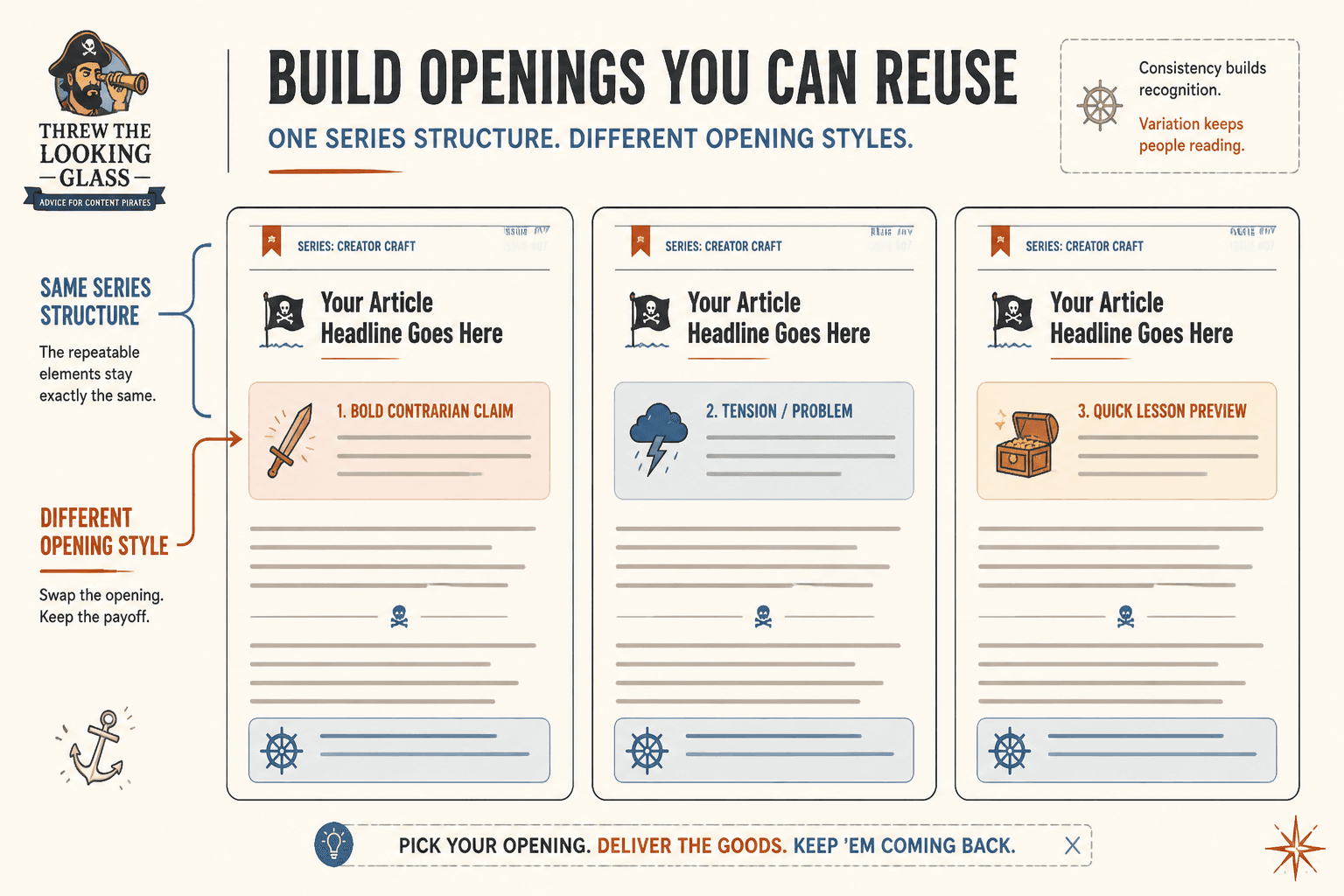
These can work beautifully for recurring newsletter formats too. You just need enough variation that the series feels coherent rather than repetitive.
How to open a Substack series without repeating yourself
Series intros are tricky because they need two things that push against each other:
- Consistency, so readers recognize the format
- Freshness, so each installment doesn’t sound copy-pasted
A lot of writers solve this badly by using the exact same intro structure every time. That creates familiarity, sure, but also a creeping sense that the reader can skip the beginning because they have seen this little dance before.
A better approach is to keep the opening function consistent, not the exact wording.
For example, if your weekly series breaks down one creator strategy, each opening might do the same three jobs:
- Name the strategy or trend
- Surface the tension or mistake
- Preview the useful takeaway
But the language, shape, and rhythm can change.
| Weak repeated series intro | Better varied series intro |
|---|---|
| “In this week’s edition, we’re looking at…” | “This week’s tactic sounds smart until you look at what it trains readers to expect.” |
| “Today I want to break down…” | “This is one of those newsletter habits that feels productive and quietly hurts the post.” |
| “For this issue, let’s explore…” | “On paper, this opening works. In practice, it delays the point for half the page.” |
That’s the move. Keep the editorial identity. Ditch the robotic repetition.
Before-and-after rewrites for generic Substack openings
Sometimes the fastest way to fix this is to see what changed.
Example 1: The vague reflective intro
Before: “I’ve been thinking a lot recently about the role consistency plays in building a writing habit, and I wanted to share a few thoughts that may be helpful.”
After: “Consistency gets talked about like a discipline problem. A lot of the time, it’s actually a design problem.”
Why it works: It cuts the self-referential setup and replaces it with a claim worth reading.
Example 2: The broad industry opener
Before: “In the creator economy, standing out has become more important than ever before.”
After: “A lot of creators do not have an originality problem. They have a packaging problem that makes every good idea arrive looking pre-skipped.”
The bigger point is simple: clearer structure and clearer writing make the piece more useful. That is usually what makes the ending land better too.