
Most weak newsletter subject lines are not weak because you are bad at email. They are weak because you are trying to invent something new five minutes before sending.
For the broader learning path, visit our parent guide.
That is usually the mistake. You already have better raw material sitting in old posts, old emails, old threads, old client notes, old sales calls, and old content that actually got a reaction. But instead of mining that, people write subject lines like “This week’s newsletter” and then act surprised when the open rate dies quietly in a corner.
If you want to know how to turn old content into better newsletter subject lines, the job is not to recycle headlines word for word. It is to extract what made the old content interesting in the first place: the tension, specificity, promise, question, mistake, or contrarian angle. Then you rebuild that into a subject line that earns the click without sounding like a clearance-bin marketer.
Here’s how to do that in a way that is fast, practical, and much better than staring at a blank subject line field like it insulted your family.
Why old content is usually better source material than fresh brainstorming
Fresh brainstorming sounds creative. In practice, it often produces vague mush.
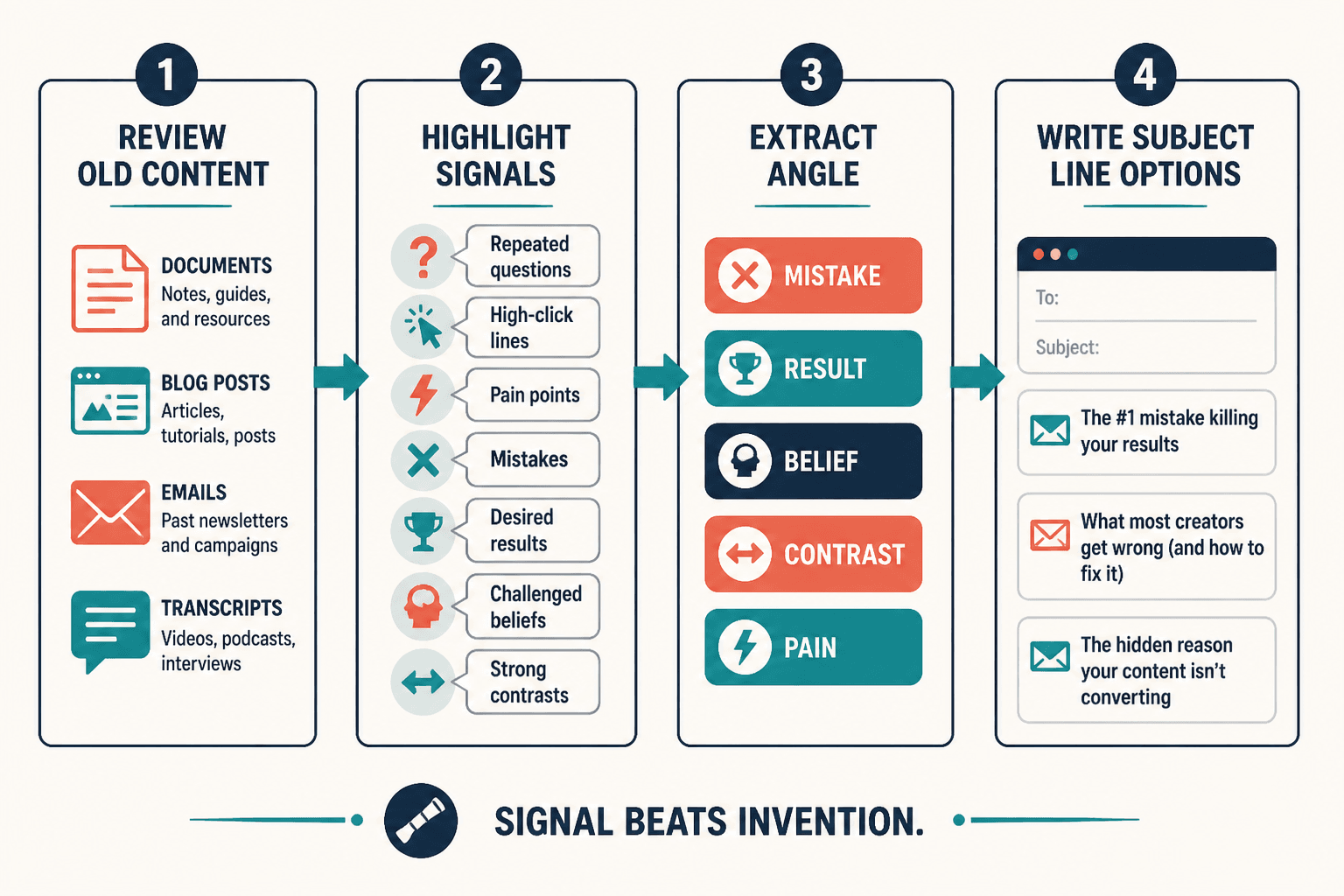
Old content has one big advantage: it has already revealed what your audience cared about. Maybe a post got replies. Maybe a thread got saves. Maybe a section in a past newsletter led to clicks. Maybe clients keep repeating the same question on calls. That is signal. Signal beats invention.
A lot of creators think reusing old ideas will make them sound repetitive. Usually the opposite happens. Reusing strong ideas makes you sound consistent. Repeating the same bland subject line format every week is what makes you forgettable.
Old content gives you tested angles like:
- a mistake people keep making
- a result people want
- a belief worth challenging
- a useful contrast
- a specific pain point
- a line that made people stop scrolling
That is the material. Your subject line just needs to package it better.
What to look for inside old content
Do not just skim for titles. Titles can help, but they are not the whole game. Often the best subject line is hiding in the middle of the content, not at the top.
When you review old content, look for these five things.
1. The sharpest line
Find the sentence that makes the point most clearly. Usually it is the line with the strongest tension or contrast.
Example from old content:
Your content is not underperforming because you need more consistency. It is underperforming because it says the same thing as everyone else.
Possible subject lines:
- Your content does not need more consistency
- The real reason your content blends in
- Why “posting consistently” is not fixing it
2. The strongest pain point
If people reacted because you named a frustrating problem accurately, use that.
Example from old content:
Lots of smart creators write newsletters that sound fine, read fine, and get ignored anyway.
Possible subject lines:
- Why “fine” newsletters get ignored
- Your newsletter may have a “fine” problem
- The problem with sounding perfectly fine
3. The useful promise
If the content helped people do something concrete, turn that outcome into the angle.
Example from old content:
Three small edits can make your CTA feel clearer, less needy, and more clickable.
Possible subject lines:
- 3 edits that make your CTA more clickable
- A less needy CTA in 3 moves
- Small CTA fixes that actually help
4. The opinion people pushed back on
If a post got comments because people agreed, disagreed, or argued in the replies like tiny unpaid panelists, that often means the angle has energy.
Example from old content:
Most creators do not need more content ideas. They need better packaging.
Possible subject lines:
- You probably do not need more content ideas
- The packaging problem nobody wants to admit
- More ideas will not fix this
5. The exact phrase your audience uses
This one matters more than people think. Subject lines often improve when they sound like the reader’s internal monologue, not your polished brand strategy deck.
If clients say things like “I’m posting and getting polite silence,” that phrase is gold. It is alive. It sounds like a real person. It does not sound workshop-tested by a committee.
Possible subject lines:
- Getting polite silence from your content?
- Posting useful stuff and hearing crickets?
- Why your audience nods and does nothing
A simple process for turning old content into better newsletter subject lines
You do not need a massive system here. You need one repeatable process that does not collapse the minute you are busy.
- Pick one old piece of content that performed well or made a strong point.
- Highlight 3 to 5 lines with tension, specificity, or a clear promise.
- Identify the core angle behind those lines.
- Choose one subject line style that fits the angle.
- Write 5 to 10 versions.
- Cut the weakest, soften the most gimmicky, keep the sharpest.
That is it. No elaborate spreadsheet ritual required, unless spreadsheets are your thing and you enjoy that sort of structured suffering.
Step 1: Start with content that already proved something
Good candidates include:
- top-performing social posts
- past newsletters with strong opens or clicks
- blog posts with clear subheads
- sales emails that got replies
- call notes from client conversations
- frequently asked questions
- voice notes where you explained something well
If you want stronger fundamentals before doing this, read How to Write Better Newsletter Subject Lines and the broader newsletter subject lines guide for creators who want better results.
Step 2: Find the angle, not just the topic
Topic is what the content is about. Angle is why anyone should care.
Example:
- Topic: newsletter CTAs
- Angle: your CTA sounds too vague to act on
Another example:
- Topic: repurposing content
- Angle: you are sitting on useful ideas and still acting like you need fresh inspiration
Bad subject lines usually stop at topic. Better ones express angle.
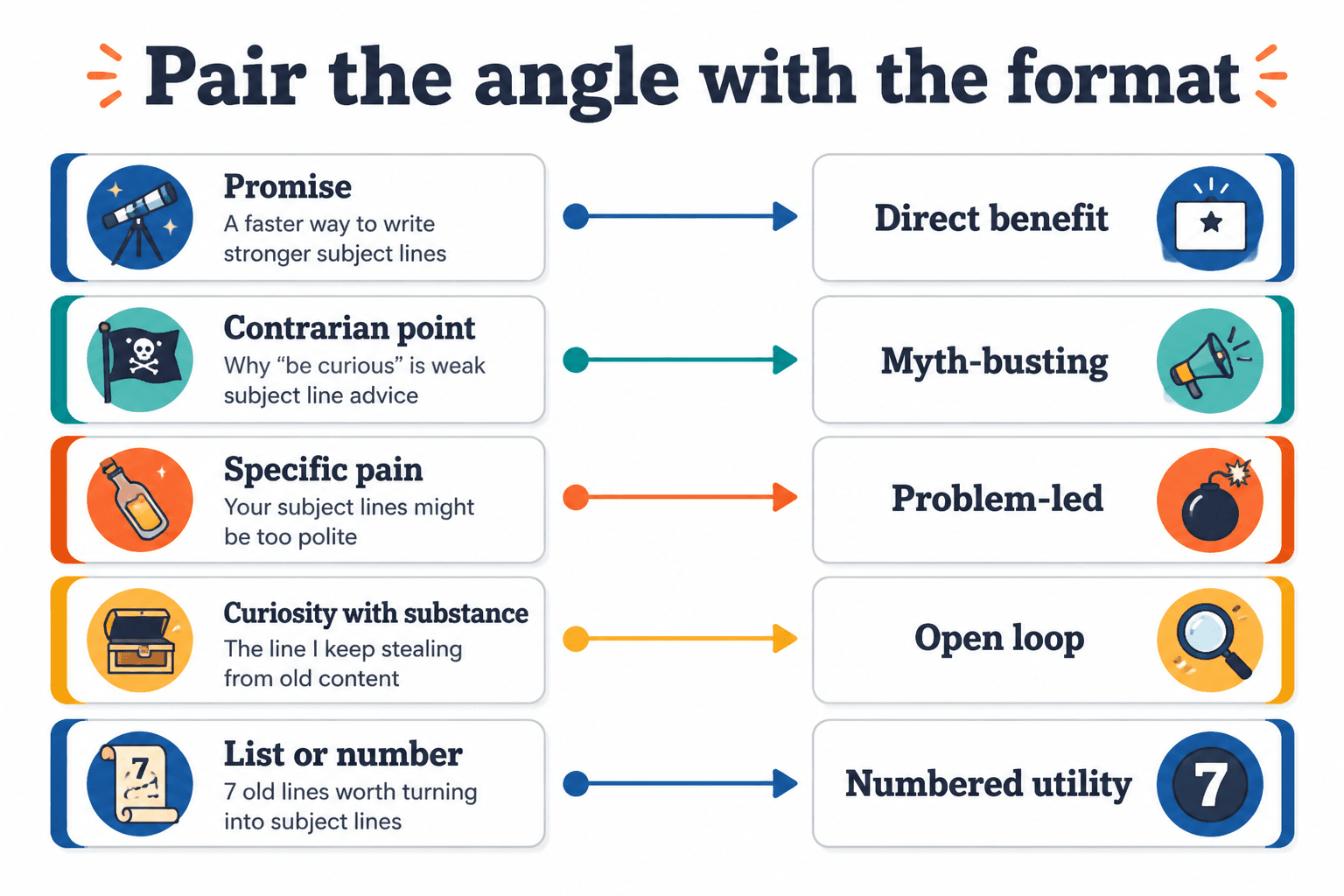
Step 3: Match the angle to a subject line type
Different angles want different packaging. Here are a few reliable subject line types.
| Angle type | Useful subject line style | Example |
|---|---|---|
| Mistake | Call out the error | The mistake making your emails easier to ignore |
| Promise | Show the practical outcome | A faster way to write stronger subject lines |
| Contrarian point | Challenge the default advice | Why “be curious” is weak subject line advice |
| Specific pain | Name the frustration | Your subject lines might be too polite |
| Curiosity with substance | Open a loop without going full circus | The line I keep stealing from old content |
| List or number | Signal quick utility | 7 old lines worth turning into subject lines |
This is where a lot of people overcomplicate things. You are not trying to invent a dazzling original structure every week. You are pairing the right angle with the right format.
Step 4: Write more options than you think you need
Your first subject line is usually not your best one. It is often your most obvious one.
Write at least five versions:
- one direct
- one curiosity-based
- one with a clear benefit
- one with a mistake or warning
- one that sounds more conversational
Then compare them. Which one says something real fastest? Which one feels specific? Which one sounds like you, not like a borrowed webinar template from 2018?
Before-and-after examples: turning old content into better subject lines
Examples make this much easier, so here are a few.
Example 1: From old LinkedIn post
If your post needs three lines of setup before the point appears, the hook is probably not the hook.
Weak recycled subject line:
- How to improve your hooks
Better subject lines:
- Your hook probably starts too late
- The setup is killing your hook
- If the point shows up on line 4, you have a problem
Example 2: From old newsletter section
Creators keep trying to sound impressive when what their audience actually wants is clarity.
Weak recycled subject line:
- Why clarity matters in content
Better subject lines:
- Trying to sound impressive is costing you
- Your audience does not need more impressive
- Clarity beats impressive, again
Example 3: From client FAQ
How do I make my newsletter less educational and more wanted?
Weak recycled subject line:
- Making your newsletter more engaging
Better subject lines:
- Useful is not always wanted
- When your newsletter feels too educational
- How to make your newsletter more wanted
Example 4: From old sales email
You do not need more subscribers if your current readers still do not know what you help with.
Weak recycled subject line:
- Growing your newsletter audience
Better subject lines:
- You may not need more subscribers yet
- The audience problem that is not about audience size
- Before you grow, fix this
How to avoid making recycled subject lines feel stale
Reusing old content is smart. Copy-pasting old phrasing without adjusting it is lazy.
The point is not to create a museum of your past best lines. The point is to turn proven ideas into fresh packaging. To do that, change at least one of these:
- the framing
- the level of specificity
- the emotional tone
- the reader benefit
- the time angle
- the contrast or tension
That is usually enough to make an old idea feel current again. You are not starting from zero. You are taking something that already proved it mattered and giving it a fresher, more useful angle.