Most newsletter subject lines do not fail because they are too short, too long, or missing an emoji. They fail because they sound like they were assembled by a panicked marketer and a spreadsheet.
You have seen the type. “Don’t miss this exclusive opportunity.” “Quick question…” “A special gift just for you.” Technically, these are words. Functionally, they scream I want something from you.
If you want to learn how to write newsletter subject lines without sounding salesy or robotic, the fix is not “be more clever.” It is to sound more specific, more human, and more honest about what is actually inside the email. That is what gets opens from people who trust you, instead of eye-rolls from people who have developed banner blindness in their inbox.
This article will help you write subject lines that feel natural, get attention without cheap tricks, and fit the actual tone of your newsletter. We will cover what makes subject lines feel stiff or salesy, what to do instead, and plenty of examples you can steal and adapt without sounding like everybody else’s email template had a baby.
Why so many newsletter subject lines sound fake
Bad subject lines usually come from one of three mistakes:
- They try too hard to sound important
- They hide the real topic behind vague teaser language
- They use “marketing voice” instead of a human voice
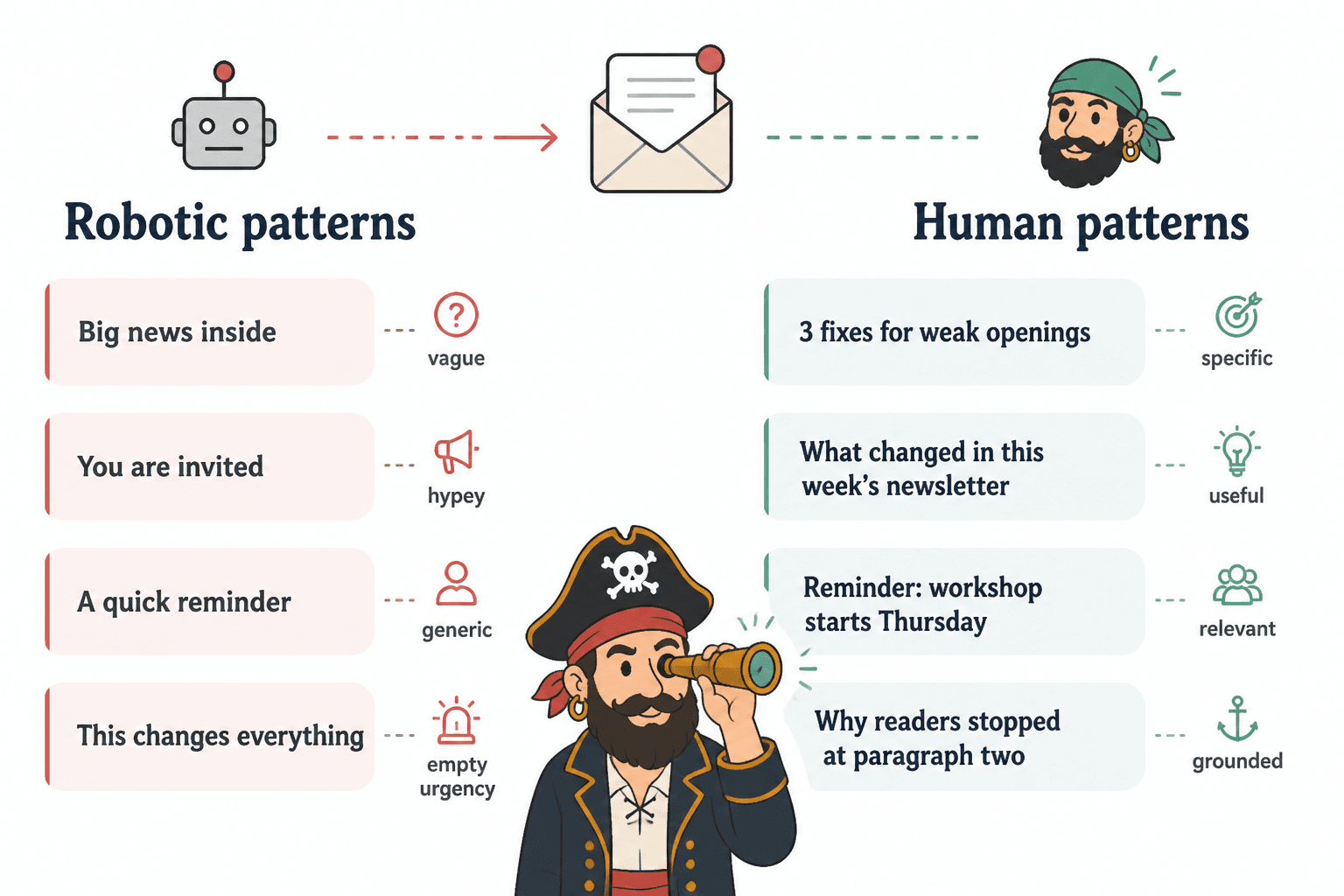
That is how you end up with subject lines like:
- Big news inside
- You are invited
- A quick reminder
- This changes everything
- Last chance to act now
None of these tell the reader anything useful. They are trying to create urgency, curiosity, or exclusivity without earning it. And people can smell that from three inbox tabs away.
A good subject line does not need hype. It needs a clear reason to open. Sometimes that reason is usefulness. Sometimes it is relevance. Sometimes it is curiosity. But it should still feel grounded in an actual message written by an actual person.
What a strong subject line actually needs
You do not need magic formulas. You need a few durable ingredients.
1. Clarity
If the reader cannot tell what the email is roughly about, you are making them work too hard. Curiosity is fine. Confusion is not.
2. Specificity
“A better way to write” is weaker than “Why most intros lose the reader by line two.” Specific words carry more weight than broad claims.
3. A human tone
The best subject lines often sound like something a smart person would naturally write to another smart person. Not like a funnel template trying to mimic concern.
4. Alignment with the email itself
If the subject line promises one thing and the email delivers another, trust starts leaking. Fast.
5. Enough intrigue, not theater
You are allowed to leave a little unsaid. You just do not need to write like a TV trailer voiceover.
How to write newsletter subject lines without sounding salesy or robotic
Here is the practical part. If your subject lines tend to come out stiff, vague, or weirdly pitchy, use this process.
Start with the real point of the email
Before you write the subject line, answer one question:
Why should this email be opened by this person today?
Not in theory. Not in “brand awareness” language. What is the actual reason?
- It solves a problem
- It shares a useful insight
- It tells a story with a clear takeaway
- It announces something relevant
- It offers a sharp opinion worth considering
If you cannot answer that cleanly, the subject line is not the problem. The email probably is.
Write like you are naming the email, not advertising it
This shift helps a lot. Instead of asking, “How do I make this irresistible?” ask, “What is the clearest, sharpest way to name what is in here?”
That one change tends to remove a lot of nonsense.
| Salesy or robotic | Stronger and more human |
|---|---|
| Unlock your writing potential | Why your writing sounds smart but not clear |
| Exclusive strategy inside | The simple structure I use for tighter newsletters |
| Don’t miss this | 3 subject line fixes that usually improve open rates |
| A special offer for you | If you want help writing this stuff faster |
| Quick reminder | Registration closes tomorrow at 5 |
Use natural language people actually use
A lot of robotic subject lines are not aggressive. They are just weirdly formal. They use phrases nobody says in normal life.
Stuff like:
- We are pleased to announce
- This serves as a reminder
- Valuable insights enclosed
- Take advantage of this opportunity
You are not writing a legal notice. You are writing an email.
More natural alternatives:
- I have got something new for you
- Before you forget
- A few useful notes on this
- If this has been on your list, now is a good time
This does not mean every subject line should sound casual to the point of sloppy. It means the language should resemble a person with taste, not a neglected autoresponder sequence.
Earn curiosity with contrast or tension
Curiosity works best when it comes from a real gap, not cheap mystery.
Weak curiosity:
- You will not believe this
- This changed everything
- Nobody talks about this
Better curiosity:
- Why helpful emails still get ignored
- The subject line mistake that makes good newsletters look generic
- What readers assume when your subject line sounds too polished
The difference is simple. The second group contains an actual idea.
Keep the promise modest and believable
One of the fastest ways to sound salesy is to overpromise in tiny space. Subject lines are especially vulnerable to this because people try to cram drama into them.
Instead of:
- The ultimate guide to instant growth
- The secret that transforms your content overnight
Try:
- A cleaner way to write subject lines people actually open
- One small tweak that makes newsletter intros feel less flat
Believable beats breathless. Almost always.
Match the tone to the type of email
Not every subject line should sound the same. A teaching email, a story email, a launch email, and a plain update email need different energy.
- Teaching email: Be clear and useful
- Story email: Hint at the tension or lesson
- Offer email: Be direct without sounding like a clearance banner
- Announcement email: State what changed and why it matters
If you use the exact same “intrigue plus urgency” formula on every email, people stop trusting the wrapper. And once they stop trusting the wrapper, the inside has a harder job.
For more detailed subject line strategy, it also helps to study broader guidance on newsletter subject lines and compare how different approaches fit different email goals.
What to avoid if you do not want to sound salesy
Some patterns almost always make a subject line feel pushy, stale, or fake. A few are still common because they used to work often enough to become internet wallpaper.
Vague urgency
- Last chance
- Final call
- Don’t miss out
If there is a real deadline, say what it is. If there is not, stop cosplaying one.
Fake intimacy
- Just for you
- I made this personally for you
- A quick favor
This can work if the relationship is genuinely close. For most newsletters, it just feels like emotional clickbait wearing a cardigan.
Corporate stiffness
- Important update regarding your account
- Please review the following information
- Enhance your productivity today
Unless you actually are sending an account notice, loosen up.
Overused clickbait framing
- You won’t believe
- This changes everything
- The secret to
These lines are not banned because they are dramatic. They are bad because readers have seen them too many times from people who had absolutely nothing interesting to say.
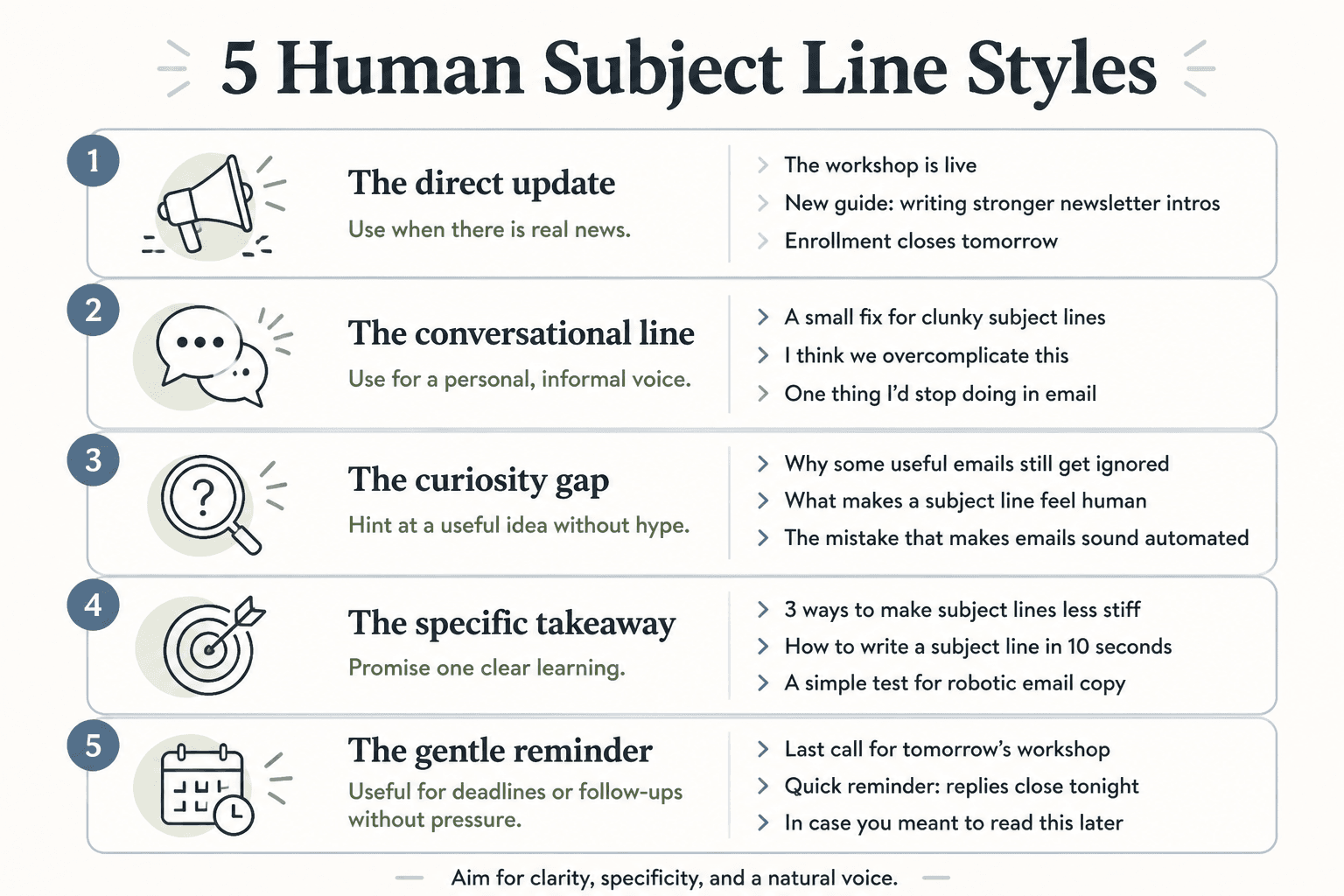
Simple subject line styles that sound more human
You do not need dozens of formulas. A few reliable styles cover most newsletters well.
The clear benefit line
Use this when the email teaches something practical.
- How to make your emails sound less generic
- A better way to open your newsletter
- 3 edits that make subject lines stronger
The sharp observation
Use this when you have a useful opinion or insight.
- Why polished emails often feel less trustworthy
- The problem with “quick question” subject lines
- Why your newsletter sounds like everyone else’s
The tension-based line
Use this when the email addresses a common mistake or contradiction.
- Helpful content, weak opens
- Good email, bad subject line
- More effort, fewer opens
The direct update
Use this when there is actual news.
- The workshop is live
- New guide: writing stronger newsletter intros
- Enrollment closes tomorrow
The conversational line
Use this if your newsletter voice is more personal and informal.
- A small fix for clunky subject lines
- I think we overcomplicate this
- One thing I’d stop doing in email
These work because they sound like a person talking, not a promo engine trying to trigger a reflex.
Before-and-after rewrites
Sometimes the easiest way to get this right is to see the rewrite logic in action.
Example 1
Before: Unlock the secret to better email engagement
After: Why some useful emails still get ignored
The rewrite drops the hype and replaces it with a real tension the reader recognizes.
Example 2
Before: A quick reminder about this exciting opportunity
After: Why this offer still gets ignored even when people say they want it
This version sounds more grounded because it points to a recognizable problem instead of leaning on fake excitement. That is usually the trade you want.