
Most creators do not have a content problem. They have a packaging problem.
For the broader learning path, visit our parent guide.
You can write something genuinely useful, thoughtful, and well-argued, then kill its chances with a title that sounds vague, generic, or weirdly proud of itself. That is how solid articles end up collecting dust while thinner pieces with better headlines get the clicks.
A good title does not save a bad article forever. But a bad title absolutely can bury a good one.
This blog titles and headlines guide for creators who want better results will help you write titles that earn attention without sounding like a clickbait goblin or a beige content machine. We are going to cover what makes a title work, which headline styles fit which goals, where most creators go wrong, and how to write stronger options fast.
If your current title process is “finish article, panic, type eight boring words, publish,” this should help.
Why blog titles matter more than most creators want to admit
People do not read your article first. They read your title first.
That title has to do a few jobs quickly:
- Get the right person to care
- Set a clear expectation
- Signal relevance
- Show enough specificity to earn trust
- Make the reader feel like clicking is worth their time
That is true on search, social, email, internal site pages, and even your own blog archive. Titles are not decorative. They are decision points.
And no, “if the content is good enough, people will find it” is not a strategy. That is a coping mechanism.
What a strong headline actually does
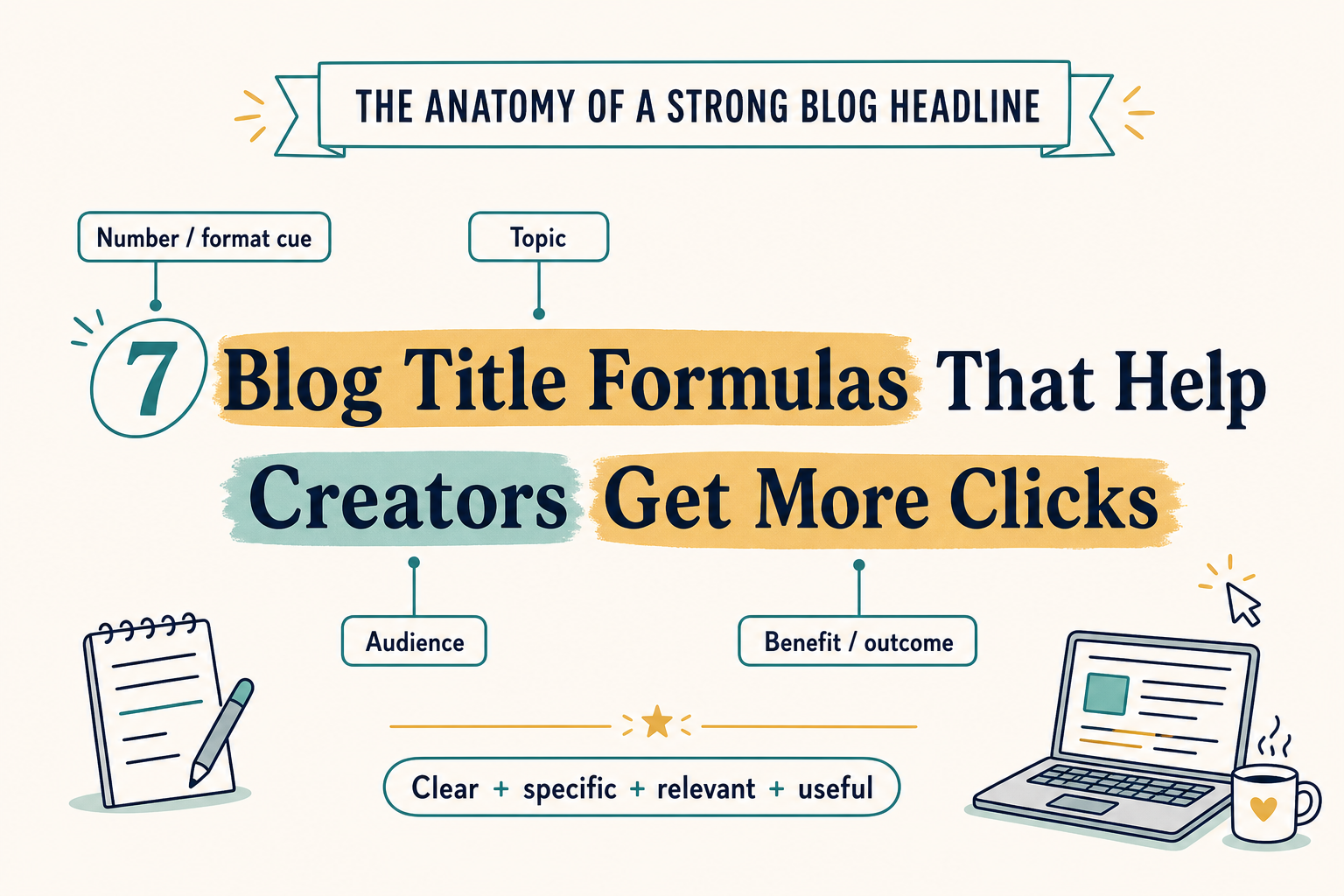
The best blog titles usually combine four things:
- Clarity: the reader quickly understands the topic
- Specificity: it does not feel interchangeable with 900 other posts
- Relevance: it matches what the target reader wants
- Promise: it hints at the benefit or payoff
That does not mean every title needs a number, a bracket, a power word, and a mild identity crisis. It means the title should help the right reader say, “Yes, that is for me.”
Here is a simple test:
If someone saw only your title with no context, would they know what they are getting and why it might help them?
If not, the title probably needs work.
The most common reasons blog titles fall flat
Most weak titles are not failing because they are too short or too long. They fail because they say almost nothing.
Here are the usual culprits.
1. They are too broad
Weak: Content Marketing Tips
Better: 10 Content Marketing Tips That Actually Help Small Creators Get Leads
Broad titles feel lazy because they force the reader to guess what kind of advice is inside.
2. They sound like everybody else
Weak: How to Build Your Personal Brand
Better: How to Build a Personal Brand That Does Not Sound Like Corporate Wallpaper
If the title could sit on a hundred other blogs without anyone noticing, it probably is not pulling its weight.
3. They lead with cleverness instead of clarity
Weak: Whispering Louder in a Noisy World
Better: How to Write Distinctive Content When Your Niche Feels Overcrowded
Poetic titles can work for essays. They usually work terribly for practical content.
4. They promise nothing useful
Weak: Thoughts on Blogging
Better: What Most Creators Get Wrong About Blogging for Leads
“Thoughts” is not a compelling outcome. Readers want help, not a vague cloud of reflection.
5. They use empty hype words
Weak: The Ultimate Guide to Explosive Headline Success
Better: A Practical Guide to Writing Blog Headlines People Actually Click
“Ultimate,” “explosive,” and their dramatic little cousins often make titles feel less trustworthy, not more.
Start with the reader, not the article
One of the easiest ways to write better titles is to stop summarizing what you wrote and start framing what the reader gets.
Creators often write titles from the inside out:
- What did I write about?
- What category does this fit into?
- What keywords are in here somewhere?
That approach usually produces titles that are accurate but dull.
A stronger approach is to ask:
- Who is this for?
- What problem does it solve?
- What result does it help with?
- What tension, mistake, or curiosity makes this worth clicking?
That is how you get titles with energy and direction.
A fast title planning framework
Before you write title options, fill in these blanks:
- Audience: Who is this helping?
- Topic: What is the article actually about?
- Angle: What is the specific approach, opinion, or distinction?
- Outcome: What gets better for the reader?
Example:
- Audience: creators
- Topic: blog titles and headlines
- Angle: practical, non-generic, performance-focused
- Outcome: better clicks and better-fit readers
That naturally leads to stronger options like:
- How to Write Blog Titles That Attract the Right Readers
- Blog Headlines for Creators: What Gets Clicked and What Gets Ignored
- A Creator’s Guide to Blog Titles That Earn Better Results
Blog title types that actually work
You do not need one magic formula. You need a few reliable title types and the judgment to use the right one.
How-to titles
These work well when search intent is practical and clear.
- How to Write Better Blog Titles Without Sounding Generic
- How to Improve Blog Headlines for More Clicks and Better Readers
Best for: tutorials, actionable content, search-friendly articles
Watch out for: bland phrasing and overused wording that says very little
List titles
These work when the reader wants examples, options, or quick inspiration.
- 21 Blog Title Ideas Creators Can Adapt Fast
- 15 Headline Mistakes That Make Good Articles Easy to Ignore
Best for: examples, swipe files, resource posts
Watch out for: random numbers with thin content underneath
Problem-solution titles
These are great when your reader is frustrated and wants a fix.
- Why Your Blog Titles Are Getting Ignored and How to Fix Them
- Blog Headlines That Sound Smart but Get No Clicks
Best for: diagnostic articles, contrarian pieces, optimization advice
Watch out for: overdramatizing the problem to manufacture urgency
Guide titles
These work when the topic needs a fuller, more structured explanation.
- Blog Titles and Headlines Guide for Creators Who Want Better Results
- A Practical Guide to Writing Stronger Blog Headlines
Best for: pillar posts, evergreen resources, foundational topics
Watch out for: calling something a guide when it is basically a long shrug
Examples and formula titles
These are useful when readers want a shortcut they can apply quickly.
- Headline Formulas Creators Can Adapt Fast
- Blog Title Examples That Feel Specific Instead of Generic
Best for: templates, examples, swipe-based content
Watch out for: formulas that create robotic sameness
How to write better blog titles in 5 steps
If you want a repeatable process, use this one.
1. Find the real point of the article
Not the topic. The point.
“This article is about headlines” is not enough. Try:
- This article helps creators write headlines that get more relevant clicks
- This article shows why vague titles underperform
- This article gives formulas and examples readers can use today
Your title should reflect that sharper point.
2. Identify the most useful angle
Same topic, different angles:
- Beginner-friendly
- SEO-focused
- Conversion-focused
- Examples-heavy
- Contrarian
- Fast and practical
Pick one. Titles get muddy when they try to be all things at once.
3. Add specificity
This is where titles stop sounding generic.
You can add specificity through:
- Audience: for creators, for coaches, for consultants
- Outcome: better clicks, better leads, stronger SEO
- Format: examples, formulas, templates, guide
- Problem: ignored posts, weak traffic, low CTR
- Constraint: without sounding clickbaity, without being generic
Example progression:
- Blog Titles
- How to Write Blog Titles
- How to Write Better Blog Titles
- How to Write Better Blog Titles Without Sounding Generic
- How to Write Better Blog Titles That Attract the Right Readers Without Sounding Generic
You do not always need the longest version. You do need enough specificity to make the title matter.
4. Write 10 options before choosing one
Most creators pick the first decent title and move on. That is usually how you end up with the article equivalent of “meeting notes final final 3.”
Write at least 10 options across different styles:
- How-to
- Guide
- Problem-solution
- Examples
- List
- Contrarian angle
Then compare them on clarity, specificity, usefulness, and audience fit.
5. Cut fluff and throat-clearing
Titles often improve when you remove the part trying too hard.
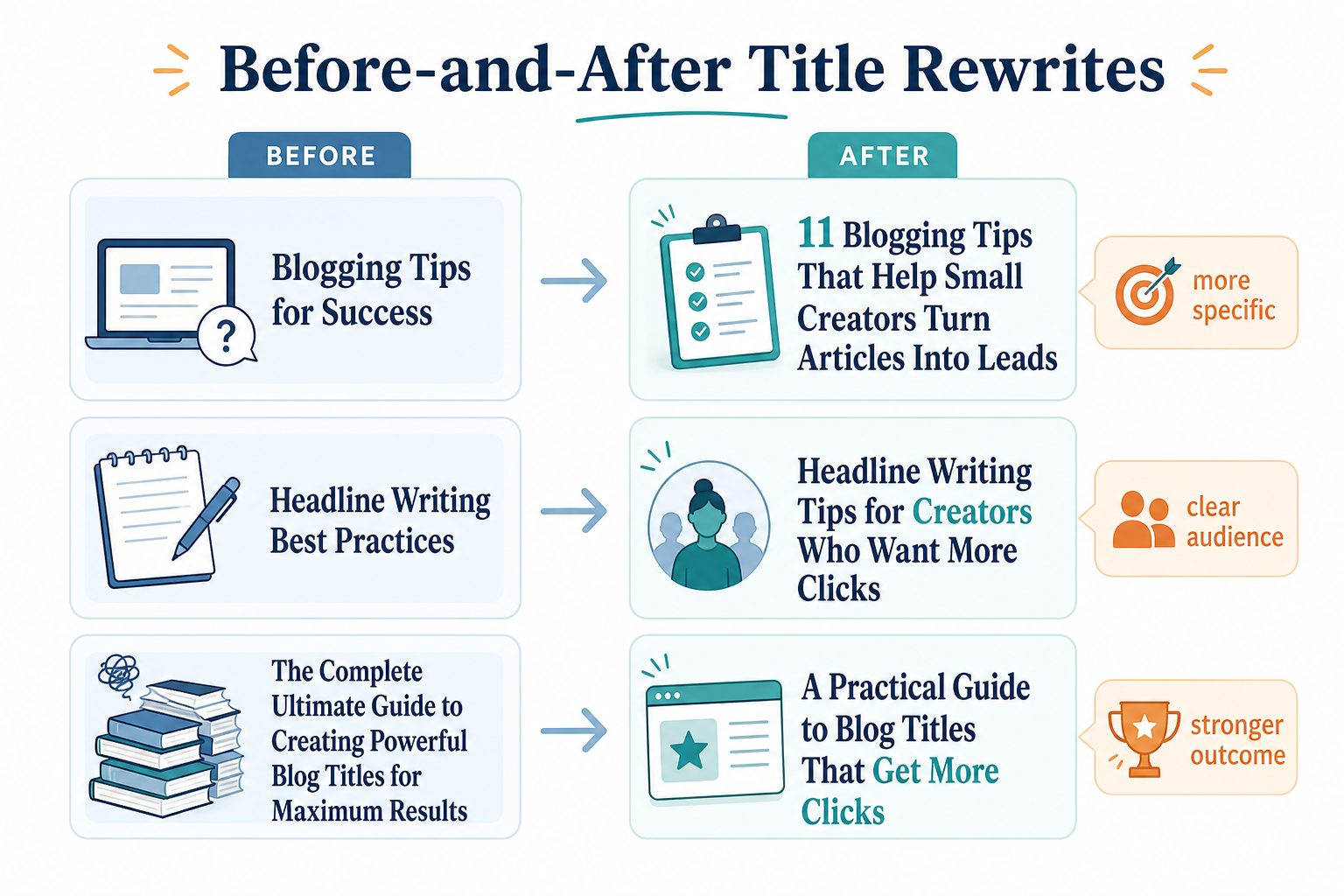
Before: The Complete Ultimate Guide to Creating Powerful Blog Titles for Maximum Results
After: A Practical Guide to Blog Titles That Get More Clicks
Cleaner usually wins.
Before-and-after title rewrites
Here is where this gets more useful. Let’s take some weak titles and fix them.
Example 1: Too broad
Before: Blogging Tips for Success
After: 11 Blogging Tips That Help Small Creators Turn Articles Into Leads
Why it works better: It says who it helps, what kind of advice to expect, and what result matters.
Example 2: Too generic
Before: Headline Writing Best Practices
After: Headline Writing Best Practices for Creators Who Want More Than Empty Traffic
Why it works better: It adds audience fit and a sharper benefit.
Example 3: Clever but unclear
Before: The First Door They Open
After: Why Your Blog Title Decides Whether Anyone Reads the Article
Why it works better: The meaning is obvious immediately.
Example 4: Empty hype
Before: The Ultimate Secret to Magnetic Headlines
After: How to Write Blog Headlines That Sound Specific, Useful, and Worth Clicking
Why it works better: It sounds credible instead of trying to seduce the reader with nonsense glitter.
Example 5: Topic without a payoff
Before: Understanding Blog Headlines
After: A Creator’s Guide to Blog Headlines That Pull in Better-Fit Readers
Why it works better: It gives a reason to care.
How long should a blog title be?
There is no magic number that works every time, which is annoying if you were hoping for one clean rule.
Still, some practical guidance helps.
- Too short: often vague, low-context, forgettable
- Too long: can feel bloated, repetitive, or hard to scan
- Good range: long enough to be clear and specific, short enough to stay readable
For most creator blogs, titles in the rough range of 50 to 70 characters can work well for search display, but that is not a law. A slightly longer title can still be the better choice if it makes the benefit much clearer.
The better question is not “How long should it be?” It is “Does this title earn the click without wasting words?”
Balancing SEO and human readability
Yes, your title should help search engines understand the topic. No, that does not mean stuffing the exact phrase in like you are forcing socks into an overfilled drawer.
Good SEO-aware titles usually do three things:
- Use the main phrase naturally
- Signal search intent clearly
- Still sound like a human wrote them on purpose
For example:
Awkward: Blog Titles and Headlines Guide for Creators Better Results Blog Headlines Tips
Better: Blog Titles and Headlines Guide for Creators Who Want Better Results
If you are trying to improve this skill across your content system, it is worth reading how to write better blog titles and headlines alongside this guide.
Headline formulas worth using, without sounding templated
Formulas are useful as scaffolding. They are not the finished building.
Here are a few that work well for creators.
Formula 1: How to get result without annoying downside
- How to Write Better Blog Titles Without Sounding Like Clickbait
- How to Improve Your Headlines Without Turning Them Into SEO Mush
Formula 2: Number + specific thing + specific audience
- 17 Blog Title Ideas for Creators Who Need More Than Random Traffic
- 9 Headline Fixes for Consultants Publishing Thought Leadership Articles