
Most newsletter subject lines fail at monetization for one very stupid reason: they act like tiny banner ads instead of trust-building promises.
You can feel the shift when it happens. A creator starts with useful, honest emails. Then they decide they should “sell more,” and suddenly every subject line sounds like it was assembled by a nervous funnel bro with a discount code addiction. Open rates wobble. Trust gets thinner. Readers start treating the inbox like a minefield.
The problem is not monetizing your newsletter subject lines. The problem is monetizing them badly.
If you want to learn newsletter subject lines that can drive clicks, leads, and sales without making readers feel tricked, this is the part people usually skip: the subject line is not just a lever for opens. It is a trust signal. It tells readers what kind of relationship you are offering.
Here’s how to monetize newsletter subject lines without wrecking trust, sounding salesy, or training your audience to ignore you the second they smell an offer.
What “monetizing” a subject line actually means
Let’s fix the framing first.
Monetizing a subject line does not mean cramming money language into every send. It does not mean adding “last chance,” “special offer,” or “don’t miss out” until your list develops email allergies.
It means writing subject lines that help revenue-producing emails get opened by the right people without using cheap tricks that hurt long-term trust.
That includes subject lines for:
- sales emails
- launch emails
- offer nurture emails
- lead magnet delivery emails
- case study emails
- emails that warm people toward a booking, product, service, or paid resource
Good monetized subject lines do one or more of these things:
- signal a useful outcome
- frame a commercial email honestly
- create relevant curiosity
- attract buyers without alienating non-buyers
- set the right expectation for what is inside
In other words, the job is not “get the open at all costs.” The job is “earn the open in a way that supports the business and the relationship.” Very different energy.
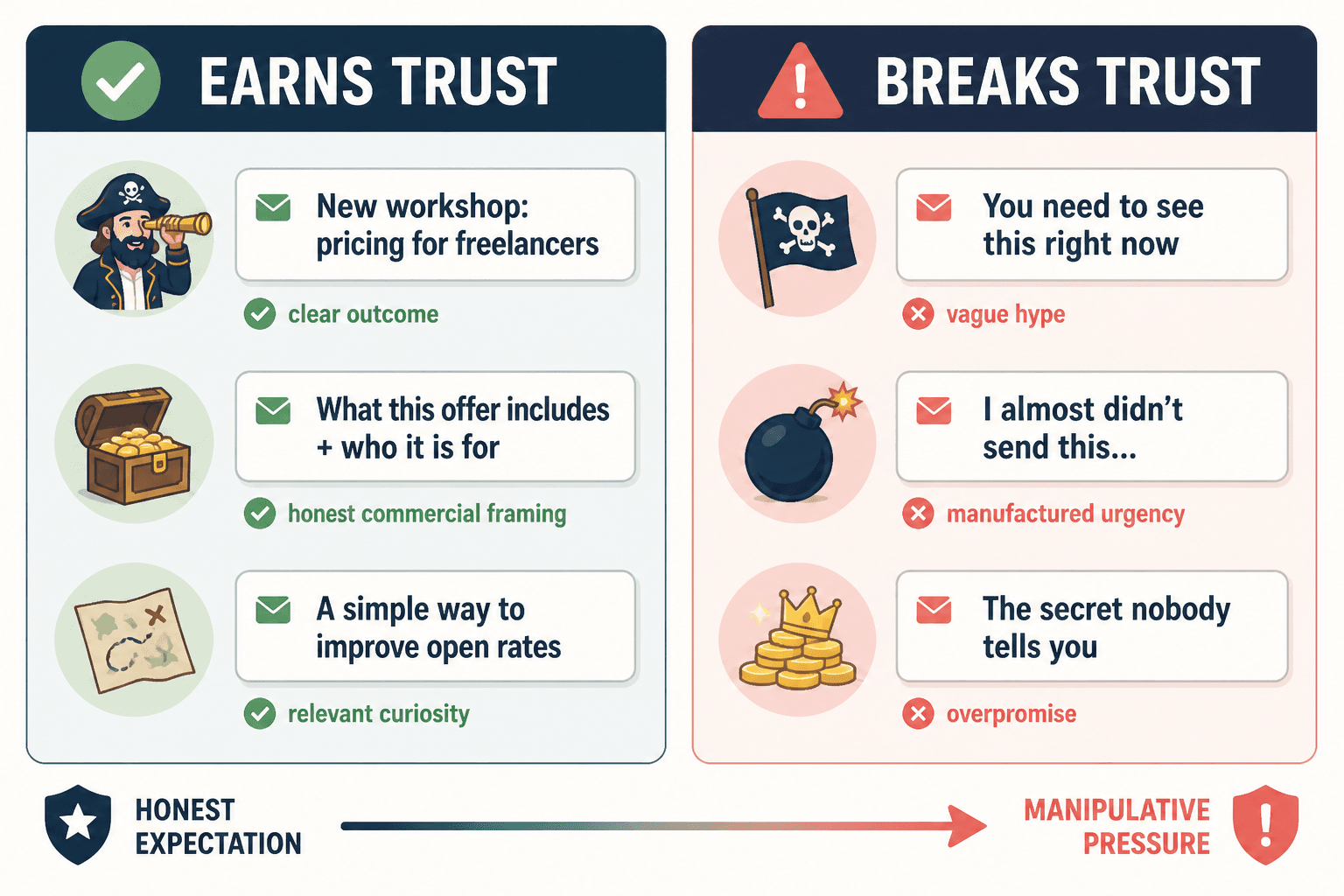
Why trust breaks so fast in newsletter subject lines
Email is intimate. That is why it converts. It is also why readers get irritated fast when they feel managed, squeezed, or toyed with.
Trust usually breaks in one of four ways.
1. The subject line overpromises
If the subject line promises a revelation and the email delivers a soft pitch with one recycled tip, people remember. Not in a good way.
Example:
- Weak: The one thing nobody tells you about growing a newsletter
- Reality inside: “By the way, my course is open”
2. The subject line hides commercial intent
You do not need to slap “SALE” on everything. But if a subject line pretends to be purely educational and the email is mostly a pitch, readers feel the bait-and-switch.
3. The subject line uses fake urgency too often
Urgency works when it is real and used sparingly. It becomes wallpaper when every week is somehow the final, last, extended, bonus, urgent reminder of the century.
4. The subject line sounds like everybody else’s launch email
Readers are not stupid. They have seen “quick question,” “you’re invited,” “last call,” “big announcement,” and “something special for you” enough times to build emotional scar tissue.
If your email sounds mass-produced, trust drops before the message even opens.
How to monetize newsletter subject lines without wrecking trust
The safest approach is not softer selling. It is cleaner alignment between promise, content, and offer.
Here are the principles that actually hold up.
Lead with relevance, not hype
A revenue-focused subject line should still answer the reader’s private question: “Why should I care?”
That does not require drama. It requires relevance. Tie the email to a pain point, desired outcome, mistake, decision, or opportunity your audience already thinks about.
For example, compare these:
- Hypey: Something exciting is here
- Relevant: If your emails get opens but not clicks, read this
The second one may sound less “launchy,” but it earns more trust because it tells the truth about the value inside.
Be honest about the email’s job
If the email sells, the subject line can acknowledge that without sounding like a clearance aisle. Readers do not mind offers nearly as much as marketers think. They mind feeling tricked into offers.
That means subject lines like these can work well:
- The template I use to write faster is finally ready
- A simpler way to plan your weekly newsletter
- Enrollment is open: subject lines that actually get opened
- If you want help fixing your newsletter, this is for you
Clear beats coy. Usually by a lot.
Use curiosity carefully, like salt
Curiosity is useful. Manufactured mystery is annoying.
A good monetized subject line can create a curiosity gap, but it should still anchor that curiosity in something concrete. The reader should know the general territory, even if they do not know the exact point yet.
Better curiosity looks like:
- The subject line tweak that raised clicks, not just opens
- Why this sales email worked better after I made it less clever
- The mistake making your launch emails easier to ignore
Bad curiosity looks like:
- You won’t believe this
- I need to tell you something
- This changed everything
Those lines are not intriguing. They are vague. There is a difference.
Sell the outcome, not just the product
Readers care less about your thing than the problem your thing solves. Harsh, but useful.
If the subject line only names the product, it often underperforms unless your audience already knows and wants it. If it ties the offer to a result, use case, or friction point, it becomes easier to justify opening.
Compare:
- Product-first: My new email template pack is live
- Outcome-first: For the days when writing your newsletter feels like pulling teeth
The second line does more work. It names a felt problem. That is usually what gets attention from the right readers.
Match the intensity to the relationship
A warm list that knows your offers can handle more direct promotional language than a newer or colder list. This sounds obvious, yet people keep writing every subject line as if the audience has been waiting all week for a cart-open email from someone they barely know.
If trust is still developing, use subject lines that bridge value and offer. Teach, diagnose, clarify, then invite. Do not jump straight to “buy this now” unless your list expects that style from you.
This is also why turning newsletter subject lines into more leads or sales works better when the email ecosystem makes sense. The subject line is not a solo act. It is part of a sequence, a relationship, and a positioning pattern.
Make the inside of the email earn the outside promise
This is where a lot of monetization advice falls apart. It obsesses over open rates and ignores what happens after the open.
If the subject line is sharp but the email body is thin, manipulative, or padded with fake story tension before a limp pitch, trust still takes the hit. The subject line gets blamed, but the mismatch is the actual problem.
So before you chase “better monetized subject lines,” check whether the email itself deserves the open. A fair amount of low trust comes from disappointing payloads, not weak headlines.
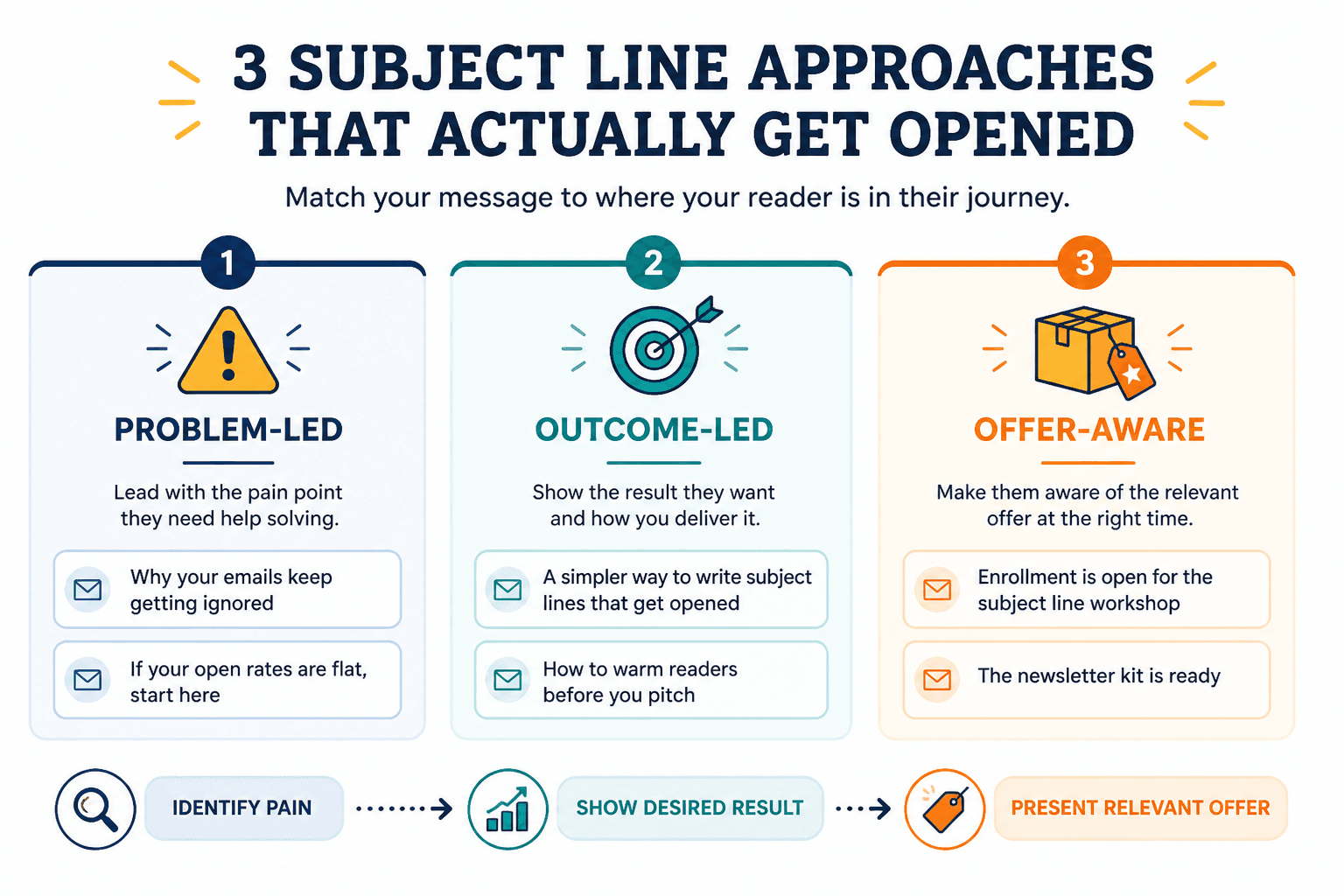
Three subject line lanes that monetize well without sounding gross
You do not need infinite creativity. You need a few reliable lanes you can use with taste.
1. Problem-led subject lines
These work well when your offer solves a specific pain point and your audience already feels that pain.
- Your emails are getting opened but not acted on
- If selling in emails always feels awkward
- The reason your subject lines attract clicks but not buyers
- When “valuable content” still does not convert
Why they work: they attract people already in the problem. No circus tricks required.
2. Outcome-led subject lines
These frame the commercial email around the result, not just the product or promotion.
- A cleaner way to sell in your newsletter without sounding weird
- How to make your next promo email feel more like trust, less like pressure
- A faster system for writing subject lines that pull their weight
- The easier way to warm readers before you pitch
Why they work: they connect your offer to what the reader actually wants.
3. Offer-aware subject lines
These are direct, but not obnoxious. Best used when the list already knows you and the offer is not coming out of nowhere like a jump scare.
- Enrollment is open for the subject line workshop
- The newsletter kit is ready
- I made something for people tired of writing promo emails
- Need help fixing your email strategy? Here it is
Why they work: they are straightforward and easy to trust.
Before-and-after rewrites: monetized subject lines that stop sounding desperate
Sometimes the easiest way to improve this stuff is to see the bad version next to the better one.
| Weak subject line | Better rewrite | Why it works better |
|---|---|---|
| Last chance!!! | Closes tonight: the email copy kit | Still urgent, but specific and believable |
| Something special for you | A simpler way to write sales emails that don’t sound pushy | Gives a real reason to open |
| Big announcement | I turned my subject line process into a template pack | Tells the reader what changed |
| You need this | If subject lines are costing you opens, this will help | Less bossy, more relevant |
| Don’t miss out | Open if your newsletter gets polite opens and weak clicks | Targets the actual problem |
| Quick question | Do your promo emails feel useful or just noisy? | Specific question with strategic tension |
The pattern is simple. The better version usually does at least one of these:
- adds specificity
- signals the problem
- names the offer honestly
- sounds like a human, not a launch template
- reduces manipulative vagueness
A practical framework for writing revenue-friendly subject lines
If you want a repeatable process, use this five-part check before sending.
1. What is the real goal of this email?
Not the emotional goal. The actual one.
- get direct sales
- warm readers toward an offer
- drive clicks to a landing page
- book calls
- deliver a lead magnet that starts a funnel
The subject line should support that exact job.
2. What is the reader-level hook?
Why would they open it? What tension, desire, pain, or curiosity is in play?
If you cannot answer that quickly, the subject line will probably default to generic promo mush.
3. How honest can you be about the commercial intent?
Usually more honest than you think.
You may not need to hide the fact that there is an offer. Often, soft transparency performs better than forced stealth.
4. Is the promise specific enough?
Specific does not always mean long. It means concrete.
“Fix your sales emails” is broad. “If your newsletter sells but feels awkward” is more precise. One sounds like a category. The other sounds like your reader’s actual Tuesday.
5. Does the email body pay it off?
If not, rewrite the email or tone down the subject line. Trust is usually lost in the gap between the two.
This framework also plays nicely with funnel ideas to pair with newsletter subject lines because a strong subject line should fit the sequence it lives inside, not just win a one-off open.
What to avoid if you want long-term trust and revenue
Some subject line habits can boost short-term opens while quietly making your list worse over time.
- Chronic vagueness: If readers constantly have to guess what the email is about, they stop bothering.
- Fake intimacy: “Can I be honest?” is not a strategy. Neither is acting like every promo is a heart-to-heart confession.
- Overusing urgency: Real deadlines are fine. Permanent alarm bells are not.
- Curiosity with no payload: If the open reveals a mediocre pitch and a shrug, people remember.
- Subject lines disconnected from your positioning: If your brand voice is thoughtful and sharp, a random “Hurry!!!” line feels cheap.
- Every email sounding monetized: If every send smells like extraction, trust drops even before unsubscribes do.
This last one matters a lot. Your subject lines do not need to monetize every single email directly. Sometimes the revenue move is sending a genuinely useful subject line and email that strengthens the habit of opening you in the first place.
That part is less flashy. It is also how adults build businesses.
Balancing trust emails and sales emails
If you only show up when you want something, your subject lines get treated like incoming nuisance. If you never sell, your newsletter becomes a charming hobby with server costs.
The better balance is this: make most of your emails genuinely worth opening, and make your promotional emails feel like a natural extension of that value rather than a personality transplant.
Practically, that can look like:
- teaching a concept, then offering the tool
- showing a mistake, then offering the fix
- sharing a case-study lesson, then inviting readers to work with you
- giving away a useful framework, then selling the template, system, or service behind it
This is why it helps to study how to write newsletter subject lines without sounding salesy or robotic. The point is not to hide sales. It is to make the writing sound human enough that a commercial email still feels credible.
And yes, sometimes a direct subject line is the right move. If your audience knows you, wants your help, and expects offers from you, stop overcomplicating it. Clean, direct promotion often outperforms tortured cleverness.
Subject line templates you can adapt
Use these as starting points, not copy-paste wallpaper.
Problem-led templates
- If [problem] is slowing your [goal]
- Why your [asset] gets [result] but not [desired result]
- The mistake making your [thing] harder to [desired outcome]
- When [common effort] still does not lead to [result]
Example: If your newsletter gets opens but not replies
Outcome-led templates
- A cleaner way to [desired outcome]
- How to [desired outcome] without [annoying downside]
- A simpler system for [ongoing task]
- The easier way to [goal] before you [next step]
Example: How to sell in email without sounding like a launch robot
Offer-aware templates
- [[Offer type] for [audience] who want [result]
- A better way to [result] without [pain point]
- The [resource or offer] that helps [audience] do [task] faster
The point of these is not to sneak a pitch into the inbox. It is to make the subject line line up honestly with the value waiting inside the email or offer.
If the promise is clean and the follow-through is real, monetizing subject lines feels less like manipulation and more like good positioning.